The first batch of Party B users who started using WorkBuddy have already got off work ahead of schedule.
Written by | Shen Hai
Cover Source | Screenshot from *Fake It Till You Make It*
Second-party service providers are arguably the most "time-poor" group in the workplace.
Client demands are like blind boxes: before you open the dialog box, you never know if the request is "just a simple tweak" or "let's try a completely different direction". The lights in advertising agency buildings always stay on deep into the night, because the feedback from the client side has to go through layers of approval and will not be delivered to the service provider's inbox until the very last moment.
Time is always extremely tight for second-party teams. But the endless to-do list is never caused by lack of inspiration. On the contrary, in most cases, the client asks for too much, and every creative idea has to be packaged independently into a complete set of materials that can be presented for reporting and delivered. Even the most brilliant creative ideas have to go through a whole set of formal adjustments, to be translated into logic that clients can understand, highlights that supervisors can notice, and executable solutions for colleagues in design, copywriting and channel teams.
So the second-party teams that seem to work in the content industry are essentially just brick movers on the assembly line.
Fortunately, office workers have become smarter, and know how to "call for backup" for their work: they connect to AI colleagues, hand over the most time-consuming execution work, and finally get the chance to leave work on time earlier.
This new colleague is exactly WorkBuddy.
AI colleagues, extend the vitality of creativity for office workers
The work of second-party teams is like a relay race. Coming up with a good idea is only the first lap of the race, followed by data sorting, solution structuring, copywriting polishing, visual presentation that are closely linked waiting for you, as well as the nerve-wracking request of "tweak another version for us to see".
Who can relate to the exhaustion of finishing all these links alone? But after connecting to a reliable AI colleague, office workers are like having a dedicated outsourced supplier, and no longer fight alone.
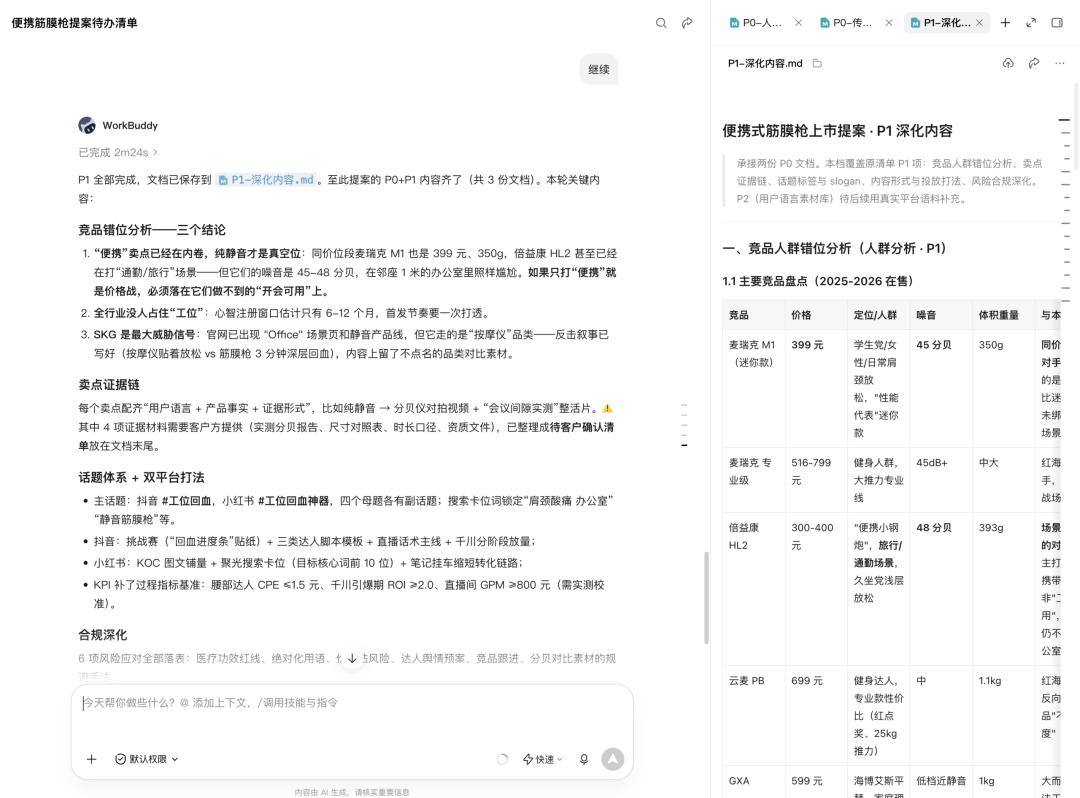
Zhang Liuyi, an employee of a large internet company, will fall into full anxiety mode 48 hours before every proposal. The project team often suddenly receives a new urgent task that needs promotion, and then asks the planning colleagues to quickly cooperate to package their "half-finished product" into a new product that is worth presenting. This kind of forced "build something out of nothing" demand has happened many times. Every time, she has to prepare several directions at the same time, ask colleagues to review, and pick the most passable one to continue modifying.
In the past, she often had to deal with sudden demands until 1 a.m. before taking a taxi home. But after becoming a seasoned veteran in the workplace, she summed up a new set of coping strategies: she will list several core concepts in her notepad, write down the catchphrases she packaged based on past experience, and the fleeting embryonic ideas that seem to be expandable but are not ready to show to others for the time being.
Then, she packs all these key messages and sends them to WorkBuddy, asking it to disassemble the concepts and generate three complete sets of communication solutions.
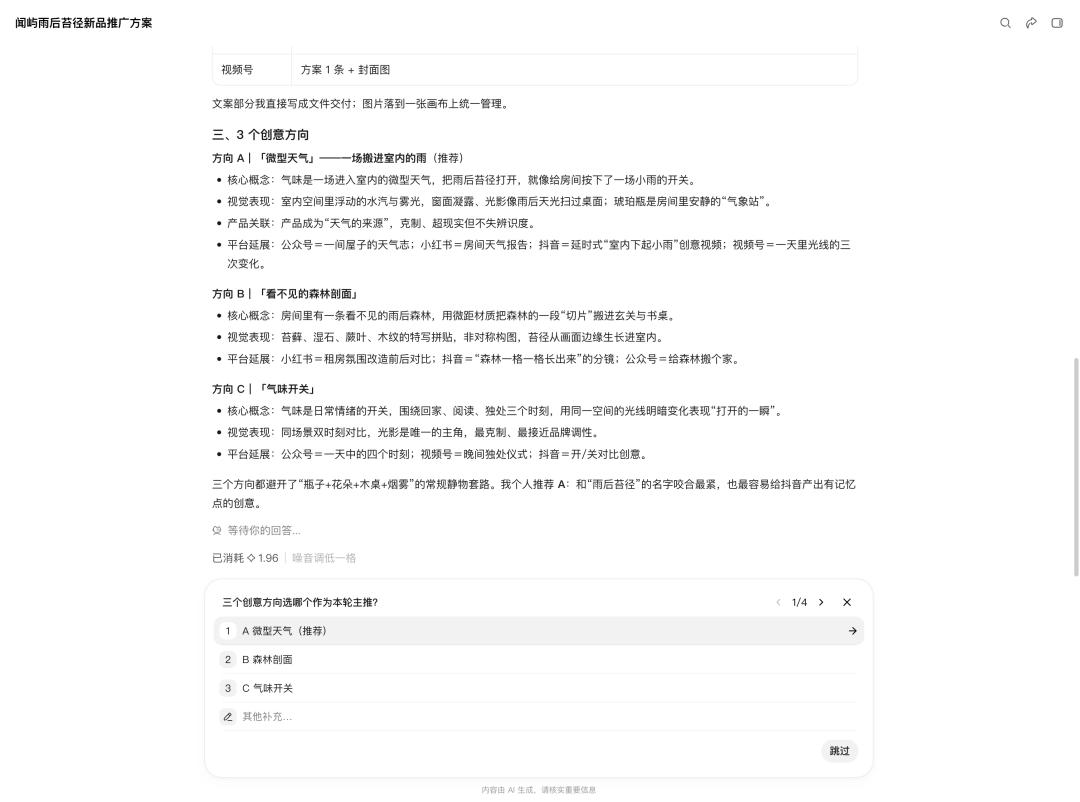
Right after that, the AI colleague will help her generate a to-do list: how to analyze the target audience, how to extract highlights, how to set the communication theme, and how to plan the channels. The AI colleague has already pre-simulated how difficult colleagues will challenge her, and listed all the unclear parts that are missing in the draft.
After the direction becomes clear, WorkBuddy can continue to assist in sorting out topics, polishing copywriting, and providing alternative Slogans. After Liuyi confirms the final direction, it will organize the solution into a complete PPT.
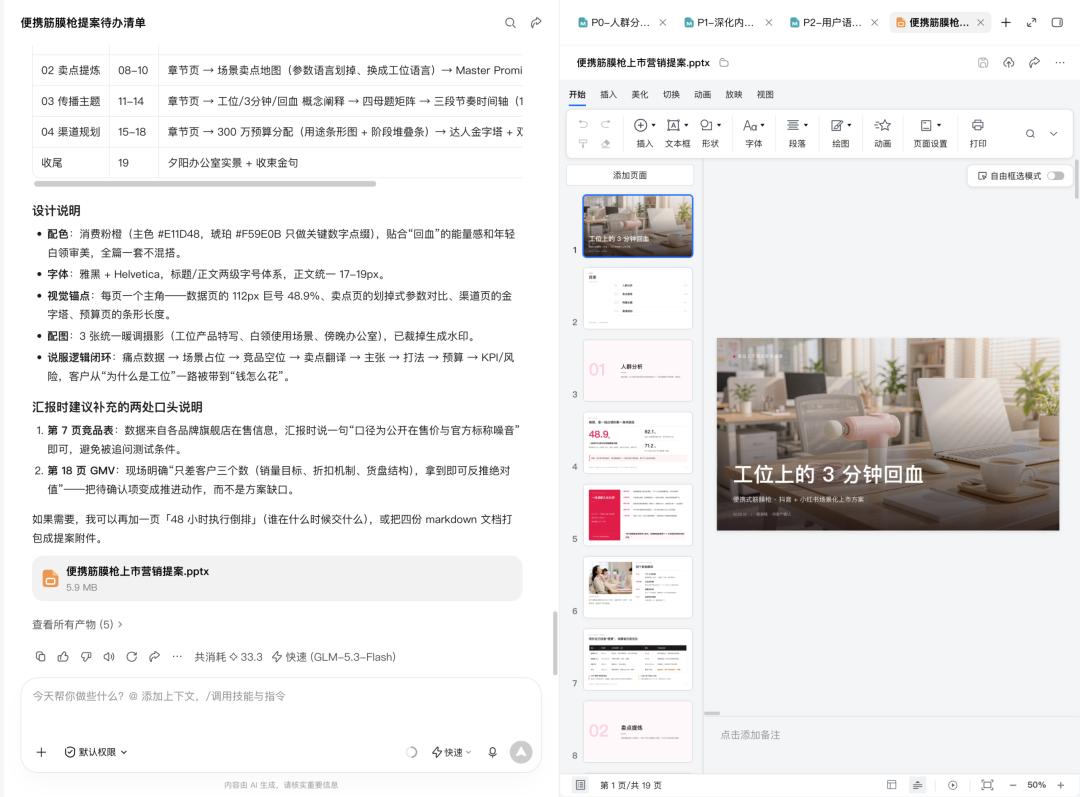
Based on Liuyi's experience, although large AI models cannot provide much help for core creativity, they perform extremely well in completing these trivial execution tasks. This is the most efficient team mode of human brain and AI collaboration, which she calls letting AI colleagues "extend the vitality" of creativity.
This working mode is especially suitable for picky "feeling-oriented" clients. If the client says after reviewing "the content is fine, but the overall vibe is not quite right", or "the cases are acceptable, but the writing style/format is not interesting enough", she does not need to modify the content word by word. She can just input a few abstract adjectives, and the whole solution will be updated uniformly. In this way, Zhang Liuyi finally gets rid of the identity of "PPT worker", and returns to the role of a real planner who is responsible for judging the general direction.
Of course, passing the review of the solution is only the beginning. When the creativity enters the implementation stage, the trivial work at the execution level really begins.
Among countless tedious tasks, the most troublesome thing for Liuyi is sorting out the list of event guests and media placement resources. She often needs to sort out the information of each talent, including their quotation, available schedule and the differentiation of their published content from a long list of influencers. Sorting out so many placement resources manually is extremely tiring for the eyes, and very unfriendly for people with ADHD. She is often attracted by the information of another guest halfway, and forgets what she was doing just now.
For this reason, she thinks she is the biggest beneficiary after the AI workstation comes out. Now she directly copies all these sudden updates to WorkBuddy, and asks it to organize them into a well-structured schedule sheet and budget sheet.
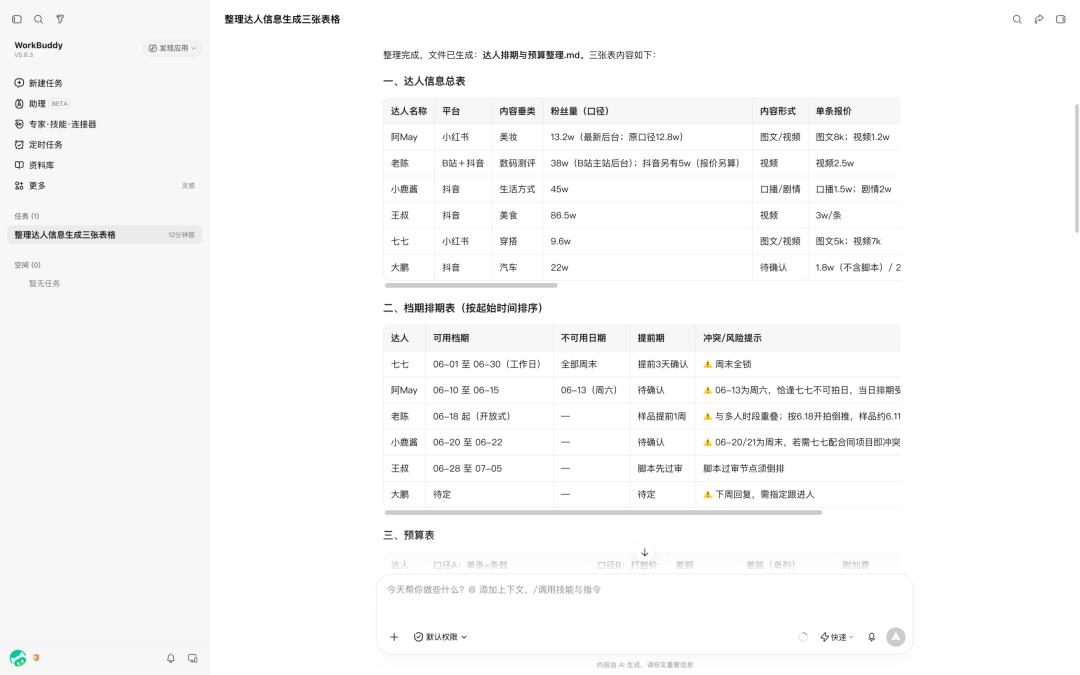
Some time ago, she watched the hit drama *Sunshine in Early Spring*, in which there is an outdated plot that was wildly complained by advertisers: the heroine was praised by colleagues because she could remember Excel shortcuts, and successfully solved an urgent problem at work. Excel lists used to give Liuyi a big headache, but now she can just describe her needs verbally, and ask WorkBuddy to help modify the table information, which greatly improves the work efficiency.
With the participation of AI colleagues, human beings can put more energy into creativity itself and give full play to their initiative.
Office workers who secretly use AI colleagues are equivalent to having a full advertising team
In fact, people working in the content industry have more or less experienced this moment: when your mind is empty and relaxed, ideas keep pouring out, but as soon as you sit in front of the computer, you draw a complete blank.
People in the content industry all recognize a truth: creativity needs to be nurtured, otherwise it will slip through the cerebral cortex like water, leaving only a thought of "I just seemed to have a really good idea". With an AI colleague, you are essentially accompanied by a 24/7 execution team that is dedicated to expanding fleeting ideas into mature content.
Li Feifei, who works as a channel operation specialist in a small and medium-sized company, has a deep understanding of this. To put it bluntly, her main job is to adapt the same set of promotional materials to different platforms to fit the local usage habits. For WeChat Channels, WeChat Official Accounts, Xiaohongshu, Weibo and Douyin, the hot topics need to be targeted, the cover should match the platform tone, and the tone of copywriting, output angle and overall style should be adjusted accordingly, instead of copying the same content directly.
It seems that Feifei is doing the same thing, but it is like completing five projects at the same time. Now she outsources all these "five projects" to her AI colleague: she sends a set of standardized materials to WorkBuddy, and asks it to generate the required size, style and copywriting for different platforms.
Feifei no longer needs to spend her off-hours on mechanical adjustment work. There is already an execution specialist in her "one-person team" that is dedicated to channel adaptation. It is worth mentioning that WorkBuddy comes with built-in Skillhub, which has accessed the operation skills of Xiaohongshu, WeChat Official Accounts, Douyin and WeChat Channels, and even the expression habits of different channels are pre-stored.
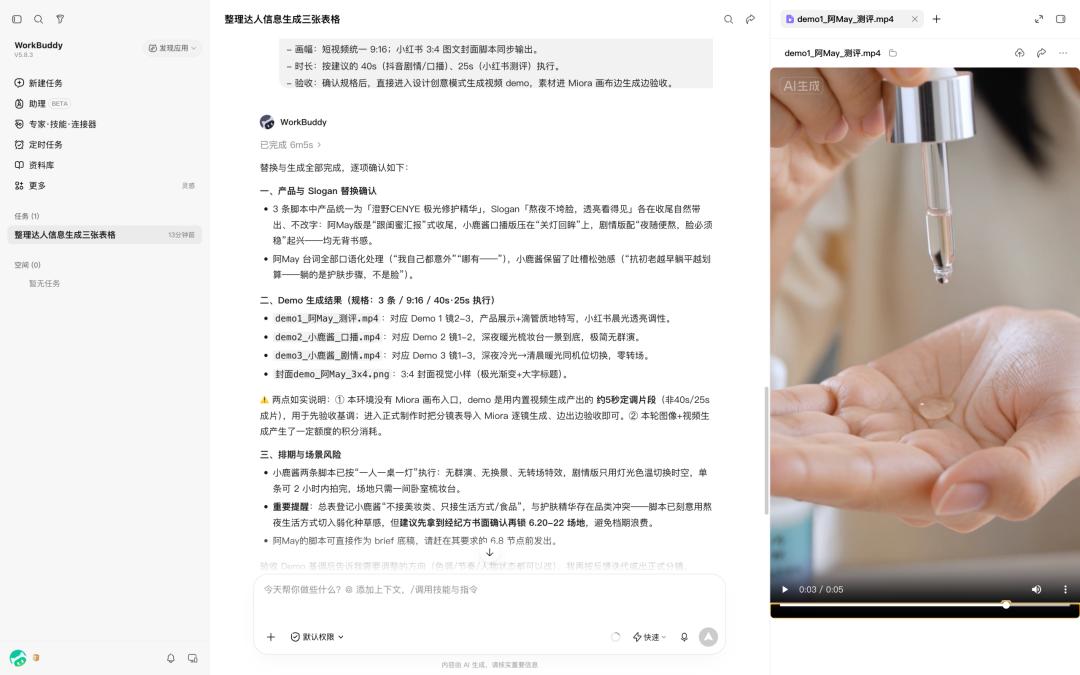
Finding pictures and making videos is another huge time sink. Especially when producing content such as Vlogs and behind-the-scenes clips, you often receive tiny demands from different collaborators: maybe you need to add a mosaic to a certain frame of a certain picture; a certain picture is too plain, so you need to add some post-production text effects; the face in this frame is too dark, can you adjust the color to brighten it up.
Every time you rework these tiny demands, you have to generate and modify the content from beginning to end. Especially when the styles of AI-generated materials are not unified, it will easily cause a sense of fragmentation in the picture. When multiple demands come in at the same time, it will lead to greater waste of time.
Feifei's current approach is to use the design and creative mode of WorkBuddy to confirm a satisfactory sample picture first, and then let the whole set of materials be generated along this direction. WorkBuddy has accessed Tencent Miora, which can maintain a unified style as much as possible when generating multi-modal visual assets such as graphics and videos. The creative design zone on the homepage of WorkBuddy also covers different creative directions including graphics, videos, web pages and branding.
Moreover, in WorkBuddy, she can execute tasks in multiple windows: on one side, she edits the short video script synchronously, on the other side, she waits for Miora to output the results. If something is not appropriate, she can directly enter the Miora canvas to adjust on the spot, instead of waiting for the whole set of content to be finished, only to find that there is a sense of fragmentation, and then go back to rework.
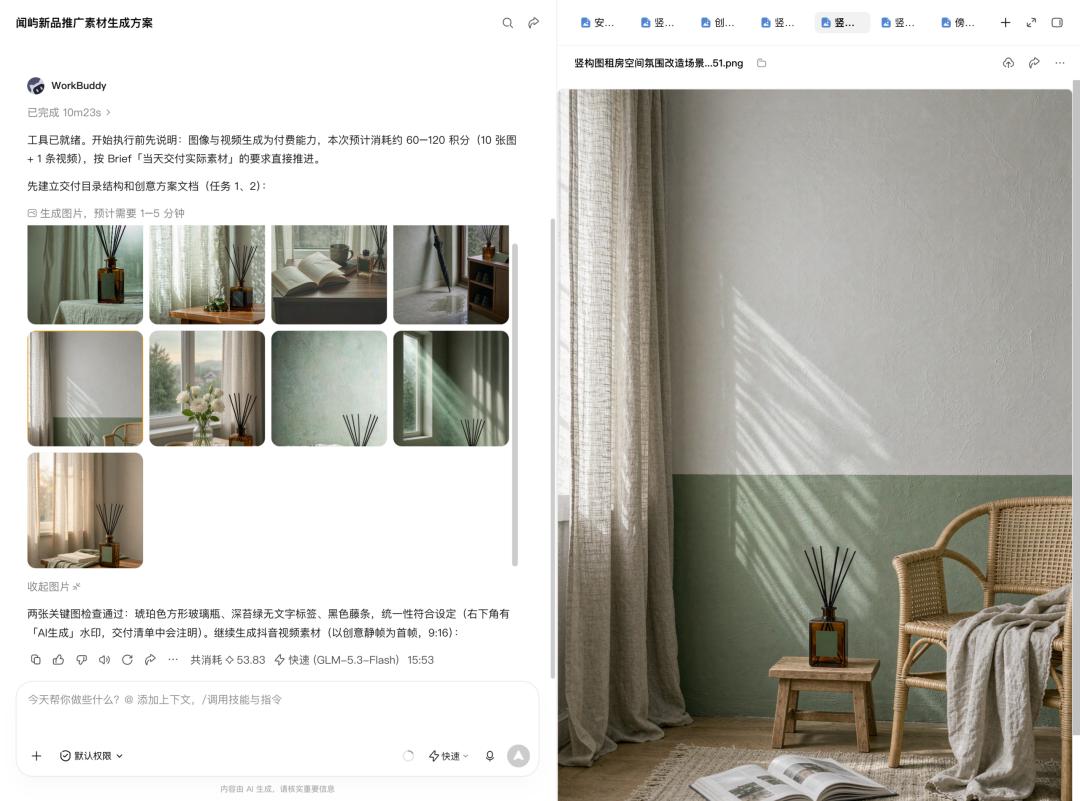
Now Feifei only needs one WorkBuddy, and no longer needs to switch back and forth between multiple software windows. She remembers that when she first started working, she even tried to apply for an extra monitor from the company to support multi-window collaboration, but the company rejected her request on the grounds that "monitors are only provided for the technology department". She could only envy the monitors of programmers sitting next to her every day.
Fortunately, this problem is no longer a concern now. Feifei can put the whole process from describing ideas to getting the final materials into the same task in WorkBuddy. Second-party teams usually call the downstream execution side the "third party". Now, second-party office workers can also summon their own "AI third party".
The efficiency gap of second-party teams starts to widen with the help of AI colleagues
More and more office workers find that summoning an AI colleague is a huge relief for workplace burden.
The key point is not that AI can help you finish things faster, but that some tasks can be handed over, and you no longer need to do them yourself — when part of the work in content planning, copywriting creation and visual production can be promoted with the help of AI, the work focus of second-party teams will also change accordingly.
In the past, a person's energy was often cut into many small pieces: when you just entered the state of creative thinking, you had to jump out to deal with formatting problems; when you were about to study user portraits, you were pulled away to fine-tune the materials. When you come back to continue your previous work, you have to readjust your state from the beginning. You seem to be very busy all day, but there is not much time left for judgment and insight.
When AI colleagues take over part of the repetitive work, creators have the opportunity to put more energy back on judging creative directions, understanding client demands and polishing content details. At the same time, a person's content production capacity also has the possibility to expand. Tasks of multiple platforms and multiple specifications can be solved in a quarter of an hour, and the lengthy process is shortened to a simple task window. One person can also grow into a versatile talent who can coordinate the whole content implementation process with the help of AI colleagues.
This change may not make everyone get a promotion and raise immediately and reach the peak of their life, but at least it makes time controllable again. The saved energy can be used to continue researching content, or to enjoy life.
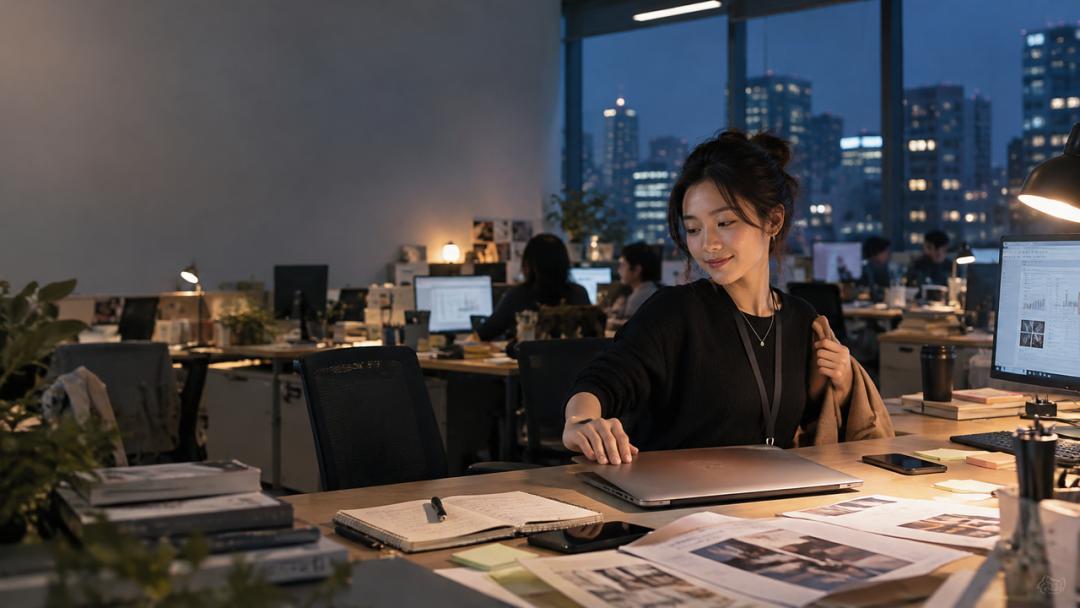
Picture generated by AI
Maybe you will find that some of your colleagues are in a much better mental state recently, and leave the office building earlier and earlier — that may be because their AI colleagues have quietly taken up their posts.
The next round of competition for second-party teams is not about competing for longer working hours. When everyone's AI tools are on the right track, the real gap will turn to who can organize the workflow stably, who can disassemble demands faster and more clearly, and who can make humans and AI do what they are good at respectively.
Starting this workplace upgrade with WorkBuddy will be a great choice. It is not an opponent that comes to take your job, but more like a good helper who has finally reported for duty. You can try to hand over the most annoying small task in your hand first, such as sorting out scattered briefs into a clear demand list, adding several discussable directions for the stuck Slogan, organizing the confirmed creative concept into a proposal that clients can understand, generating several sets of visuals adapted to different platforms to give your supervisor an intuitive impression...
You have to know that what office workers in the creative industry save is not just a few operation steps, but the attention that is repeatedly broken. Less unnecessary consumption in trivial execution will leave more time for insight extraction, aesthetic accumulation and life experience. Hope every office worker who introduces an AI colleague can leave work on time every day.