One report, two first places: What are Alibaba Cloud and Volcano Engine competing for?
On the afternoon of October 29, Volcano Engine and Alibaba Cloud successively released statements, announcing that they had claimed the "first place".
Volcano Engine stated that the scale of China's MaaS (Model as a Service) market reached 106.3 billion yuan in the first half of 2026, and it ranked first with a 45.1% market share. Shortly afterwards, Alibaba Cloud also released its ranking, taking the first place in China's large language model MaaS market with a 46.6% share, while Zhipu AI and Volcano Engine ranked second and third with 10.6% and 10.2% respectively.
Interestingly, the data of both parties comes from the latest *China AI Software Semi-Annual Tracker, 26H1* released by IDC. From the same report, each side selected the statistical caliber that is most favorable to itself.
This is not the first time the two companies have competed for the "first place".
In September last year, their competition for the "first place" even appeared on airport billboards in Beijing, Shanghai and other regions. Alibaba Cloud cited Omdia's *China AI Cloud Market, 1H25* report, emphasizing that it ranked first in China's AI cloud market with a 35.8% share. Volcano Engine, on the other hand, cited IDC's *China Large Model Public Cloud Service Market Analysis 2025H1*, emphasizing that it ranked first in the large model public cloud service market.
A year has passed, and the two sides are competing for the top spot again. This time, they don't even need to look for different research institutions, and they can each pick out favorable results from the same report.
Behind the rankings that the two companies attach so much importance to is a rapidly expanding market. In the first half of 2026, the revenue of China's MaaS market increased by nearly 9 times year-on-year, and its scale exceeded 100 billion yuan for the first time.
What do the two "first places" in the same report indicate respectively? Why do manufacturers value the rankings so much? Whose first place is more solid?
01 One Report, Two First Places
Let's first look at the market behind these two "first places".
IDC data shows that in the first half of 2026, the scale of China's MaaS market reached 106.3 billion yuan, a year-on-year increase of 889.4%, exceeding 100 billion yuan for the first time. In the same period, the total Token consumption of the entire market reached 2857.9 trillion, a year-on-year increase of 432.5%.
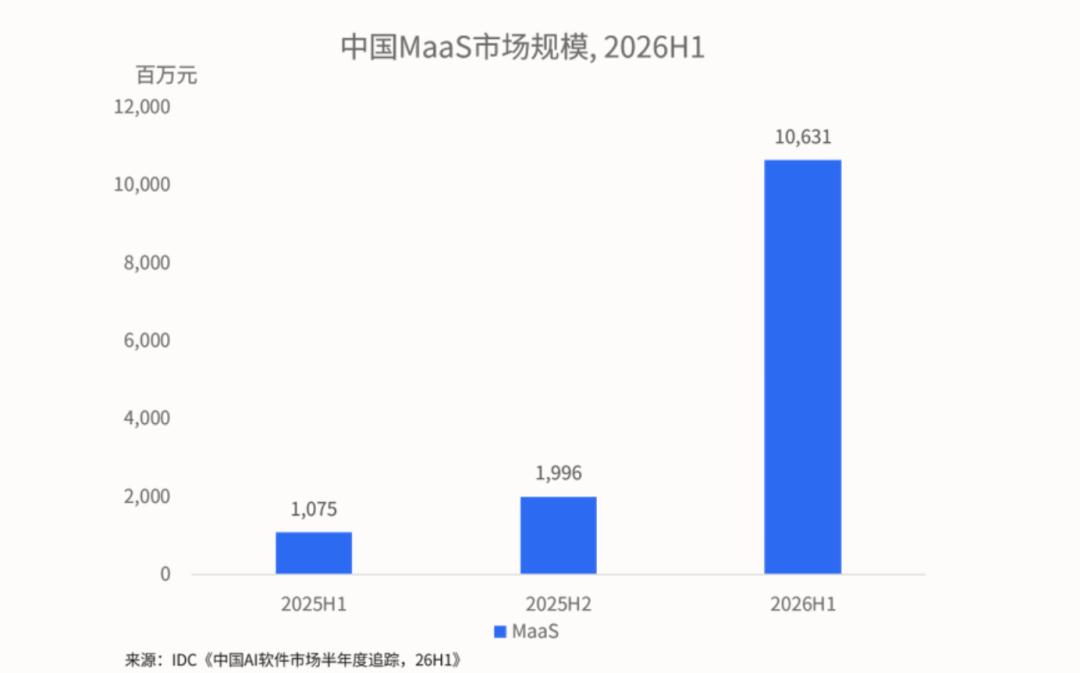
Two factors drive this round of growth: first, the improvement of model capabilities and the decline of reasoning costs. Tasks that previously required flagship models to complete can now be handled by some lightweight models; second, application scenarios continue to expand, and model services have entered more traditional industries.
Wang Man, a MaaS salesperson at a cloud vendor, has the same personal experience. She told *AIX Finance* that back in April this year, most of the consulting customers were AI startup teams, but now the proportion of customers from traditional industries such as manufacturing, retail and finance has increased significantly.
Next, let's look at the revenue structure of the MaaS market.
IDC divides the market revenue into three parts according to modalities: large language models contribute 47.0%, video generation models account for 32.7%, and other modality models account for 20.2%. Estimated based on the total scale, video generation models contributed about 34.8 billion yuan in revenue in half a year, close to one-third of the entire market.
Video generation has become the second largest revenue source after large language models. IDC mentioned that the new generation of video models represented by Seedance 2.0 has improved the availability rate of generated content, and industries such as advertising, short drama and e-commerce have begun to use them in batches. Compared with text generation, video generation usually consumes more computing power, and the cost of a single task is also higher. Once the demand rises sharply, it can bring considerable revenue.
The reason why the two sides can each take a first place lies in the fact that their revenue comes from different modalities: Volcano Engine mainly relies on non-language models such as video, while Alibaba Cloud mainly relies on language models.
First, take a look at Volcano Engine. In the overall MaaS revenue market, Volcano Engine ranks first with a 45.1% share, and Alibaba Cloud ranks second with 25.2%. Estimated based on the market size, the MaaS revenue of the two companies in the first half of the year was about 47.9 billion yuan and 26.8 billion yuan respectively, and Volcano Engine led by more than 21 billion yuan.
Compared with the first half of 2025, Volcano Engine's share rose from 37.5% to 45.1%, and Alibaba Cloud's share rose from 21.0% to 25.2%. The shares of both companies are increasing, but Volcano Engine has a larger increase.
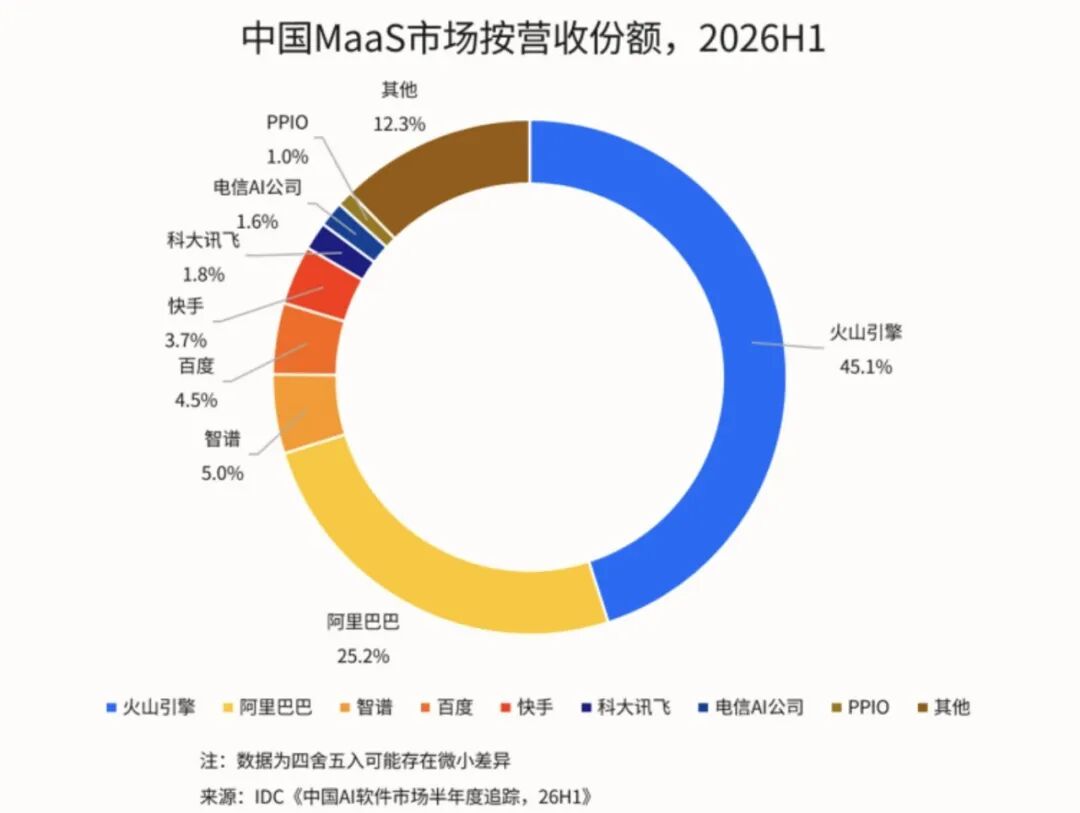
However, in the large language model segmented market, Volcano Engine's share is only 10.2%. Estimated based on the fact that large language models account for 47.0% of the overall MaaS revenue, its language model revenue is about 5.1 billion yuan, and the remaining about 42.8 billion yuan comes from non-language model businesses, accounting for nearly 90% of its own MaaS revenue.
Volcano Engine has both the Doubao language model and the Seedance series of video generation models. Although IDC did not disclose the specific revenue of Volcano Engine's video business, it is certain that what supports its overall first place is mainly the non-language model business.
The situation of Alibaba Cloud is just the opposite. In the large language model MaaS market, Alibaba Cloud leads with a 46.6% share, which is more than 4 times that of Zhipu AI and Volcano Engine. Estimated in the same way, Alibaba Cloud's language model MaaS revenue in the first half of the year was about 23.3 billion yuan, accounting for about 87% of its overall MaaS revenue. That is to say, Alibaba Cloud's MaaS revenue almost all comes from language models.
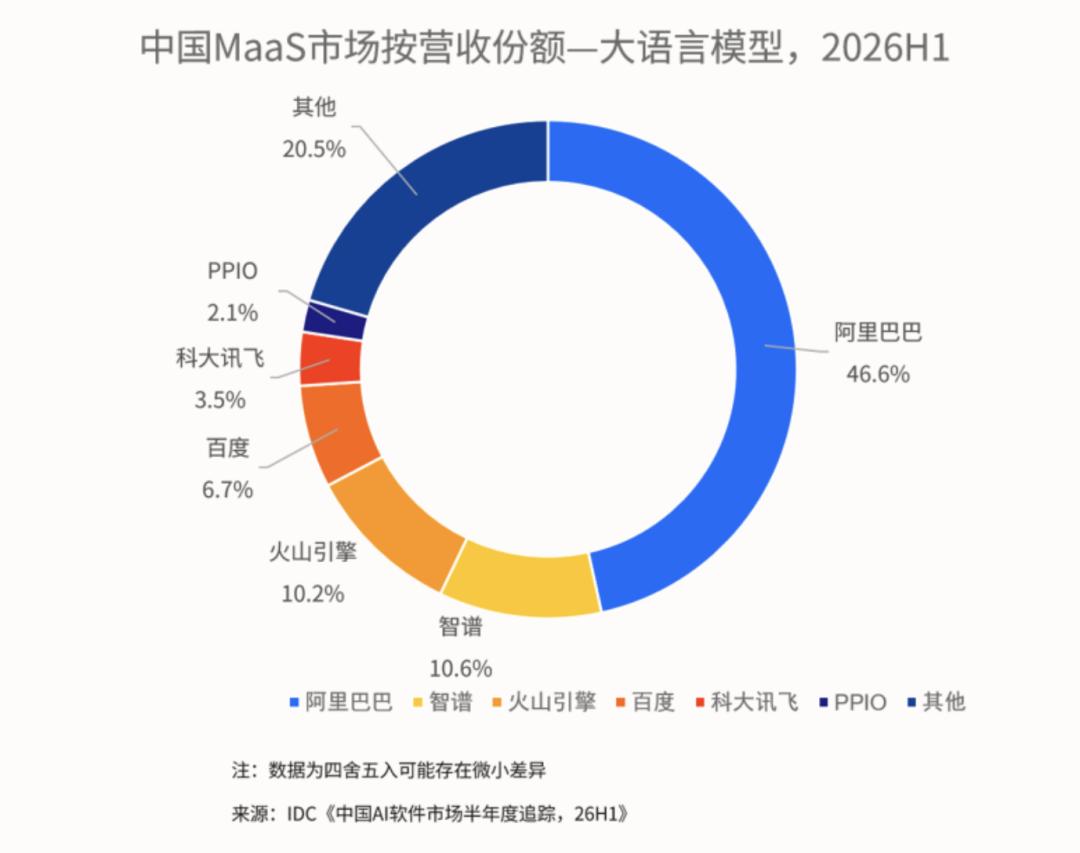
Why does Alibaba Cloud emphasize this first place? IDC pointed out that most of the current enterprise-side demands such as knowledge Q&A, code generation and Agent orchestration are text-centered. Compared with video generation, language model technology is more mature, and the reasoning cost drops faster, which has entered the daily workflow of more enterprises. What Alibaba Cloud wants to emphasize is actually its position in the core base of enterprise production scenarios.
This advantage comes from the combination of the Tongyi series models and the Bailian platform, superimposed on the original computing power, database and enterprise service system. Enterprises that have already used Alibaba Cloud can directly access model services on the existing cloud platform without building supporting facilities from scratch.
Jiang Qingyun, an Agent development engineer, told *AIX Finance* that the Tongyi series models have a good open source ecosystem and developer base, and developers have more choices in scenarios such as text, code and knowledge Q&A.
In short, the "first places" emphasized by Volcano Engine and Alibaba Cloud respectively correspond to different business advantages. Volcano Engine has expanded its overall revenue relying on multi-modal business, and video generation is a new growth point. Alibaba Cloud has established advantages in the language model market, and enterprise demands such as knowledge Q&A, Coding and Agent are its long-term core base.
Apart from the two first places, this report also reveals two changes in the market pattern.
First, the market is still concentrating on leading players. In the first half of 2025, Volcano Engine and Alibaba Cloud together accounted for 58.5% of the overall MaaS revenue share. By the first half of 2026, this figure has reached 70.3%. The market is growing at a high speed, but the share of the two leading vendors is still expanding, and Volcano Engine has increased more significantly.
Second, the rankings outside the top players are still changing. For the whole year of 2025, the top four in overall MaaS revenue were Volcano Engine, Alibaba Cloud, Baidu and Zhipu AI in sequence. By the first half of 2026, the top two remained unchanged, and Zhipu AI surpassed Baidu to rise to the third place.
The rise of Zhipu AI is related to the growth of Coding demand. Wang Man mentioned that with the popularity of products such as OpenClaw, enterprises' demand for programming models has increased significantly. Many domestic customers regard Zhipu AI's GLM model as a cost-effective alternative to Anthropic's Claude model, and Zhipu AI once became the first choice for many domestic Coding customers.
This also shows that although the market share of leading cloud vendors is expanding, new models and new scenarios may still change customers' choices, and the ranking is far from being solidified.
02 Why They Must Compete for the First Place
Why do Alibaba Cloud and Volcano Engine attach so much importance to the first place in the MaaS market?
Because this business is playing an increasingly important role in cloud computing. IDC data shows that in the second half of 2025, the proportion of MaaS revenue in China's public cloud PaaS market was only 5.2%, and by the first half of 2026, it has risen to 21.0%. In just half a year, model services have changed from a small part of cloud business to an important source of revenue.
For cloud vendors, the value of MaaS is not limited to selling APIs. An enterprise may initially only purchase model interfaces to develop customer service Agents or automatically generate reports. As the application enters the production environment, supporting services such as computing power, database, storage and development tools are also required. Selling model services also brings opportunities to drive the sales of other cloud products.
From the perspective of a larger market, the patterns of the two companies are different.
IDC data shows that in the second half of 2025, the overall scale of China's public cloud market exceeded 2000 billion yuan for the first time. Alibaba Cloud is a leading vendor in the traditional cloud computing market and has long been leading in this large market. Omdia data shows that in the third quarter of 2025, Alibaba Cloud ranked first in China's cloud infrastructure service market with a 36% share, exceeding the sum of Huawei Cloud and Tencent Cloud.
In contrast, Volcano Engine entered the cloud computing market relatively late. It did not follow the path of traditional cloud vendors to catch up, but took AI as an important breakthrough direction. Tan Dai, President of Volcano Engine, previously said in an interview that the company's goal has always been to become a leading AI cloud vendor.
The latest report from Sullivan shows that in the first half of 2026, the scale of China's full-stack AI cloud service market reached 581.3 billion yuan, Alibaba Cloud ranked first with a 42% share, and Volcano Engine ranked second. In the MaaS market counted by IDC, the positions of the two companies are exactly the opposite.
This also makes the competition for the first place in MaaS have different meanings for the two sides. For Volcano Engine, MaaS is an important breakthrough to catch up with Alibaba Cloud and expand its cloud business; for Alibaba Cloud, it needs to extend its original cloud computing advantages to the model service market to hold the new round of growth opportunities brought by AI.
Therefore, at this stage, the number one market share is a useful sign. It can not only help the sales team win customers, but also prove to the outside world that AI investment is generating returns. Especially when the market is growing rapidly, the earlier you accumulate customers, the more opportunities you have to compete for subsequent cloud service expenditures.
However, getting the first place does not mean keeping the first place steadily. From the perspective of revenue structure, both companies still have shortcomings to make up for.
The video generation revenue where Volcano Engine takes the lead is mainly concentrated in a few industries such as advertising, short drama and e-commerce. Once the video models of other vendors catch up in availability rate and generation duration, Volcano Engine's price and share may face pressure. Therefore, Volcano Engine not only needs to maintain its leading position in video models, but also needs to make up for its shortcomings in language models.
Alibaba Cloud also needs to speed up its catch-up in the multi-modal business. The growth of its dominant core base of language models is slowing down. IDC mentioned that the penetration of early scenarios such as Coding is close to saturation, and the marginal revenue is decreasing, while in the Coding scenarios that still have premium, there are more and more competitors.

Source / Alibaba Cloud Official Website
Apart from their respective shortcomings, the two companies also have to face the competition from independent model companies together.
Take Zhipu AI as an example. Its 2026 semi-annual report shows that the revenue of its open platform and API in the first half of the year reached 825 million yuan, a year-on-year increase of about 27 times, accounting for 86.5% of the total revenue. Zhipu AI has been able to obtain considerable revenue directly through model calls. Independent model companies are not only model suppliers on cloud vendor platforms, but also directly compete for developers and enterprise customers through their own platforms.
Moreover, platforms such as Alibaba Cloud and Volcano Engine are all providing third-party models such as Zhipu AI, DeepSeek and Kimi. The same model can be called through different platforms. For customers who mainly purchase standard APIs, price, reasoning efficiency and service stability will also affect the final choice.
Wang Man mentioned that in general scenarios, the price war in the MaaS market is still very fierce. Customers usually give priority to models with sufficient capabilities and lower prices, and are only willing to use high-cost flagship models for core tasks. Many customers will purchase multiple models at the same time, and adjust the calling scheme according to the effect and price.
This also means that neither cloud vendors nor independent model companies can lock customers for a long time only by relying on a popular model. With the continuous iteration of model capabilities and continuous price competition, today's share advantage may not be able to continue to the next round of competition.
So, what will they compete for next?
In addition to consolidating existing customers, vendors also need to find new sources of growth.
IDC believes that the future growth of the MaaS market comes from scenarios such as video generation, general Agent and daily office work on the one hand, and in-depth applications in industries such as finance, medical care and government affairs, as well as overseas markets on the other hand.
These incremental parts correspond to the different chips of the two companies respectively. If video generation continues to grow, the most direct beneficiary will be Volcano Engine; large customers in industries such