AI chips are in short supply, yet Intel's stock price has plummeted by 20%
On October 29 local time in the United States, Intel released its financial report for the third quarter of 2026. The financial report shows that Intel's revenue in the quarter reached 16.51 billion US dollars, a year-on-year increase of 21%; net profit was 3.32 billion US dollars, a year-on-year decrease of 18%; diluted earnings per share was 0.60 US dollars, a year-on-year decrease of 33%.
After excluding items such as equity investment gains, restructuring expenses, and equity-based compensation, under the Non-GAAP caliber, Intel's net profit in the third quarter was 2.756 billion US dollars, a year-on-year increase of 169%; diluted earnings per share was 0.52 US dollars, a year-on-year increase of 126%, which was higher than the market's previous expectation of 0.40 US dollars.
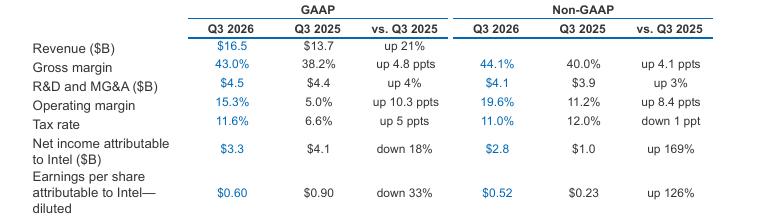
Meanwhile, Intel's gross margin reached 43% in the quarter, and 44.1% under the Non-GAAP caliber, up 4.8 percentage points and 4.1 percentage points year-on-year respectively.
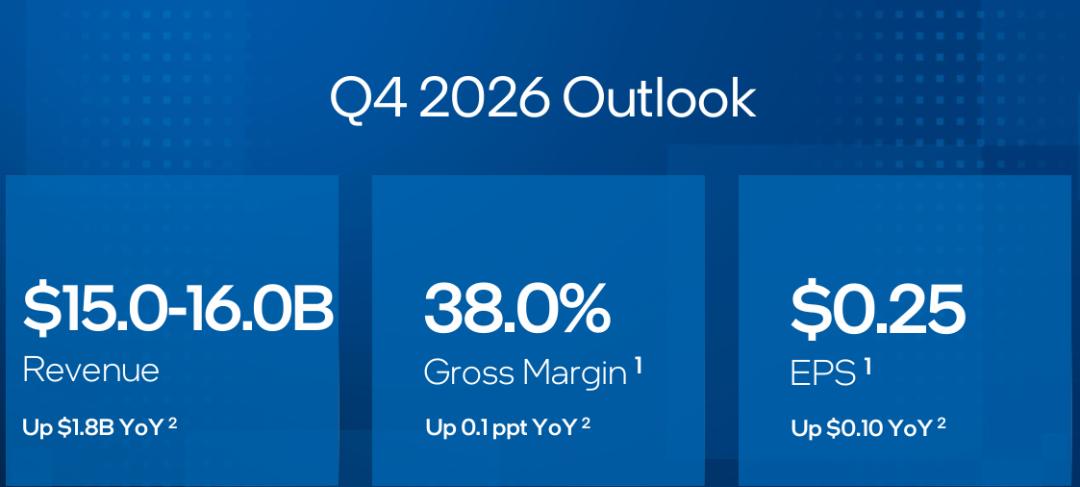
However, revenue growth has not brought a continuous upward revision of market expectations. The company expects fourth-quarter revenue to be between 15 billion and 16 billion US dollars, and Non-GAAP earnings per share will only be 0.25 US dollars, significantly lower than Wall Street's expected revenue of about 17.07 billion US dollars and earnings per share of 0.43 US dollars.
Prior to the release of the financial report, Intel's stock price had fallen 3.6% in regular trading on October 29, closing at $92.07. After the release of the performance and guidance, the after-hours stock price once fell by more than 20%.
The direct cause of the sharp drop in stock price is that the fourth-quarter revenue and profit guidance are significantly lower than market expectations. Despite strong demand for AI servers, weak PC business, limited CPU supply, and production capacity losses caused by the accident at the Israeli plant have made investors worry whether Intel can continuously convert AI demand into revenue and profits.
01 Xeon chips are selling hot, while the PC business is falling behind
The Data Center and Artificial Intelligence (DCAI) division is Intel's fastest-growing business this quarter.
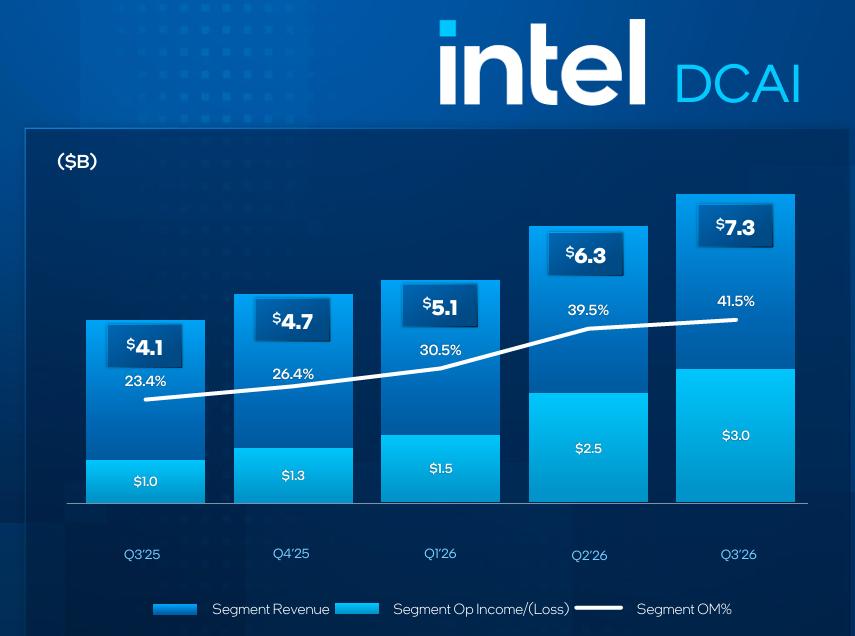
In the third quarter, the division's revenue reached 7.318 billion US dollars, a year-on-year increase of 78%; operating profit was 3.039 billion US dollars, more than tripled compared with 964 million US dollars in the same period last year, and the operating profit margin reached 41.5%.
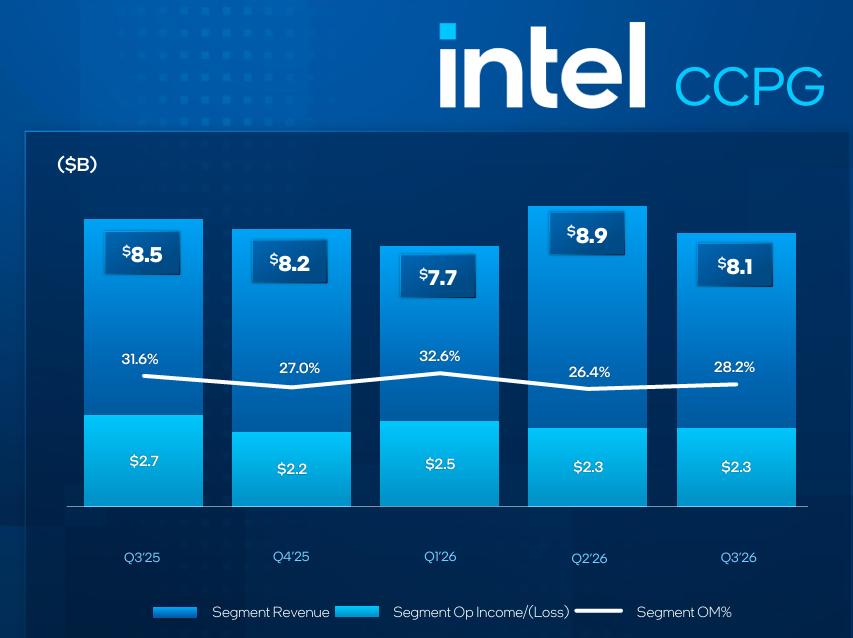
The revenue of the Client Computing and Physical AI (CCPG) division was 8.097 billion US dollars, a year-on-year decrease of 5%; operating profit was 2.285 billion US dollars, lower than 2.694 billion US dollars in the same period last year, and the operating profit margin was 28.2%.
The growth of data center demand is related to the boom in AI infrastructure construction. With the increase of AI model inference and agent applications, servers need to undertake task scheduling, data processing, memory management and other general-purpose computing work, and the configuration demand for CPUs in AI server systems has increased accordingly.
Intel CEO Lip-Bu Tan said in the financial report that despite the short-term pressure facing the PC industry, the company's CPU demand remains strong. The company's top priority now is to increase supply to meet the demand for Xeon processors, while strengthening the product portfolio and roadmap.
Intel's Chief Financial Officer David Zinsner also said that the data center business achieved the company's strongest revenue growth in 15 years in the third quarter, with revenue, gross margin and earnings per share all exceeding previous guidance.
Supply remains an important factor limiting growth. Intel has previously stated that the growth rate of server CPU demand exceeds the supply expansion rate of some products. The company is increasing factory output, improving yield and shortening production cycles to increase the supply of Xeon processors.
In terms of products, Intel is advancing the next-generation Xeon processor Diamond Rapids, targeting high-performance computing, AI inference and enterprise-level workloads. Intel also showcased the rack-level design based on Xeon processors and the discrete GPU product Series D for AI inference at the OCP Global Summit.
In the client market, the situation is different. Intel's PC chip revenue in the third quarter was 8.1 billion US dollars, a year-on-year decrease of 5%, which was lower than the market's previous expectation of about 8.98 billion US dollars.
Zinsner expects that the slowdown in the PC market will last at least until the first half of 2027. The rise in memory chip prices has also put pressure on the whole PC machine market. The increase in memory and storage costs may push up the selling price of terminal devices, which in turn affects consumers' willingness to purchase.
02 Foundry revenue increased by 58%, with a single-quarter loss of 1.85 billion US dollars
Intel's foundry business revenue in the third quarter was 6.697 billion US dollars, a year-on-year increase of 58%. But this figure includes internal manufacturing transactions and cannot be directly regarded as the foundry revenue contributed by external customers.
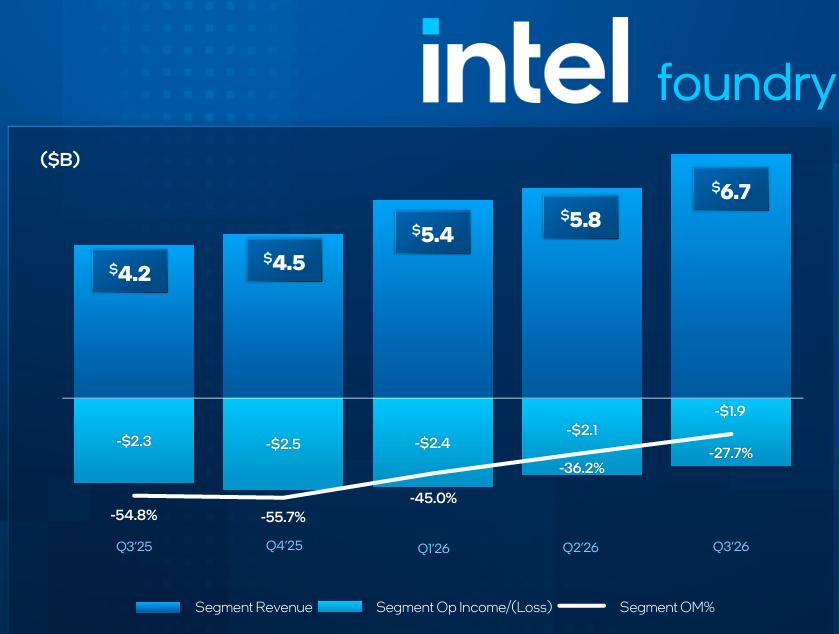
The internal manufacturing fees paid by Intel's product division to the foundry division are also counted in the foundry revenue. In the third quarter, the offset amount of internal transactions between the product division and the foundry division was 6.291 billion US dollars. After deducting internal transactions, the revenue in the consolidated statements is the total revenue actually confirmed externally by the company.
In terms of profitability, the foundry business is still under great pressure. In the third quarter, the division recorded an operating loss of 1.853 billion US dollars, which narrowed compared with the operating loss of 2.321 billion US dollars in the same period last year, with an operating loss rate of about 27.7%.
In terms of advanced process, Intel 18A has entered mass production stage. Intel previously announced that the third-generation Core Ultra processor (Panther Lake) using 18A process has entered high-volume manufacturing. This product uses ASML's High-NA EUV (Extreme Ultraviolet Lithography) technology.
In the second quarter of this year, Intel also launched the Xeon 6+ processor, which became the first server-level product using the 18A process.
After 18A, Intel is advancing two generations of processes: 18A-P and 14A. The company previously disclosed that 18A-P has entered the risk production stage to further optimize performance, power consumption and thermal characteristics. In the third quarter, Intel released the 0.9 version Process Design Kit (PDK) for the 14A process for potential customers to carry out chip design and verification work.
14A is the key to Intel's advanced process competition in the next stage. Compared with 18A, 14A needs to further improve manufacturing capabilities and attract external customers to adopt it. Intel previously expected that customers will make 14A process selection one after another from the second half of 2026 to the first half of 2027.
Advanced packaging is another business path. Intel is promoting packaging technologies such as EMIB-T, and is cooperating with Chinese enterprise Lens Technology to explore the combination of glass processing technology and advanced semiconductor packaging.
Joshua Buchalter, an analyst at TD Cowen, believes that Intel's EMIB-T advanced packaging technology is forming valuable external market opportunities, and the company plans to expand related customer business next year. However, he also pointed out that the key factor that really affects the valuation of Intel's foundry business is still whether it can obtain large-scale front-end wafer manufacturing customers.
03 Capital expenditure rises to 20 billion US dollars, and will continue to increase in 2027
Intel is expanding its manufacturing investment again.
In the third quarter, the company's capital expenditure reached 4.219 billion US dollars, higher than 2.956 billion US dollars in the same period last year. In the same period, cash flow generated from operating activities was 5.082 billion US dollars, and adjusted free cash flow was 1.639 billion US dollars.
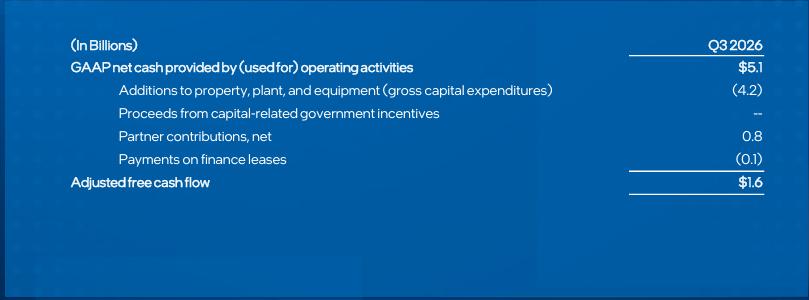
Intel raised its full-year 2026 capital expenditure expectation from the previous 18 billion US dollars to 20 billion US dollars. Zinsner said that in order to meet the future growth demand of products and foundry business, Intel will also significantly increase capital investment in 2027.
The investment focus includes manufacturing equipment, clean room space and substrate production capacity. Intel needs to expand the production capacity of advanced processes, while improving the utilization rate of existing factories to meet the demand for Xeon processors and other products.
However, the capital demand for manufacturing investment is increasing. Intel completed a public stock offering of about 23 billion US dollars in August to support future growth and maintain its balance sheet. According to the third-quarter financial report, the public stock offering brought the company about 22.617 billion US dollars in net cash income.
This also raises a problem: Intel needs to strike a balance between increasing production capacity and controlling capital consumption.
Different from asset-light chip design enterprises such as Arm, Intel needs to bear long-term expenditures such as factory construction, equipment procurement, process R&D and production capacity ramp-up. It takes links such as equipment installation, process verification, customer certification and mass production ramp-up for newly built production capacity to form stable revenue from investment.
If the demand for server CPUs remains strong, the new production capacity is expected to be converted into revenue; if PC demand continues to be weak, or the fulfillment speed of external foundry customer orders is lower than expected, fixed asset investment may further reduce profit margins and cash returns.
The change in gross margin also reflects this pressure. Intel's Non-GAAP gross margin in the third quarter reached 44.1%, up 4.1 percentage points year-on-year. However, the company's guidance for Non-GAAP gross margin in the fourth quarter is only 38%, down 6.1 percentage points.
While capital expenditure continues to increase, whether the gross margin can be maintained at a relatively high level will directly affect the financial sustainability of Intel's expansion plan.
04 Google, Oracle, Meta join the cooperation list
Intel is expanding cooperation with cloud computing vendors, AI enterprises and equipment suppliers, trying to obtain more business opportunities through processors, custom chips and advanced packaging.
In the third quarter, Intel announced a multi-year cooperation with Oracle to expand the application of Xeon processors in Oracle Cloud Infrastructure (OCI). The cooperation covers current and future Xeon platforms, including the OCI X14 product which is planned to use the next-generation server processor Diamond Rapids.
Intel also disclosed that Meta's Muse Spark Open has completed testing and operation on the upcoming GPU Series D and Xeon platforms. The GPU Series D, whose previous R&D codename was Crescent Island, is mainly targeted at AI inference workloads.
In the client field, Intel cooperated with Google to launch the first batch of Googlebook devices, which adopt the third-generation Core Ultra processor, and related products are participated by manufacturers such as Acer, ASUS and Lenovo.
In addition, Intel also cooperated with AMD to integrate x86 CPU optimizations for PyTorch into the oneDNN software library, so as to improve the development and deployment experience of AI applications on the CPU platforms of the two companies.
Intel also announced cooperation with SAP to connect enterprise IT systems with operational technologies that control physical equipment and production processes, so as to expand the application of Physical AI in industrial scenarios.
These cooperations involve cloud computing, AI inference, PC and industrial applications, covering several directions where Intel currently hopes to expand its market share.
However, cooperative relationships, product testing and actual procurement orders need to be distinguished. Intel has not disclosed the specific procurement amount, long-term order scale or revenue contribution corresponding to the above cooperations in this financial report, and cooperation announcements cannot be directly counted as realized new revenue.
The expansion of external customers for the foundry business also faces similar problems. The market previously paid attention to the news that Google's custom TPU chips may be manufactured by Intel, as well as the potential cooperation between NVIDIA and Intel in the manufacturing business. But as of the disclosure of this financial report, the relevant order scale and formal manufacturing agreement are still not officially confirmed by Intel.
In terms of competition, Intel needs to face TSMC's advantages in advanced processes and customer relationships, as well as competition from enterprises such as AMD and NVIDIA in different computing markets. Large technology companies such as Microsoft, Google, Amazon and Meta are also developing self-developed chips to reduce their dependence on a single supplier.
05 Accident at Israeli plant drags down guidance
The fourth-quarter performance guidance lower than market expectations is the direct reason for the drop in Intel's stock price after this financial report, and the accident at the Israeli plant has further increased the short-term supply and profit pressure.
Intel's factory in Kiryat Gat, Israel, exploded in October, leading to the plant's shutdown for about two weeks. This plant mainly uses Intel's 10 process technology to produce some data center chips.
Zinsner said that the accident is expected to reduce fourth-quarter revenue by about 300 million US dollars and reduce gross margin by about 200 basis points. The plant is planned to gradually resume production around the end of October, but the company is still inspecting the damaged wafers to confirm which products can continue to be used.
Intel expects that the accident may also have a similar scale of impact on revenue in the first quarter of 2027. If the damaged wafers cannot be restored for use, the impact may last longer.
This further complicates the supply constraints that Intel is already facing. On the one hand, the company needs to increase the output of Xeon processors, and on the other hand, it has to deal with the production losses caused by the factory accident.
For Intel under the leadership of Lip-Bu Tan, the next step is to solve three problems: increasing the supply of Xeon processors, controlling the cost pressure brought by factory expansion, and converting the technological progress of 18A and 14A into external customer orders.
The fourth-quarter revenue guidance of 15 billion to 1