Finally, Amazon has also burned through its free cash flow.
On October 29 local time in the United States, Amazon released its financial report for the third quarter of 2026.
The financial report shows that Amazon's revenue in this quarter reached 201.944 billion US dollars, a year-on-year increase of 12%; operating profit was 28.076 billion US dollars, a year-on-year increase of 61%; net profit was 20.685 billion US dollars, a year-on-year decrease of 2%; diluted earnings per share was 1.89 US dollars, lower than 1.95 US dollars in the same period of the previous year. Neither revenue nor earnings per share met market expectations.
The decline in net profit was mainly affected by the high base formed by the Anthropic investment income in the same period of the previous year. In the third quarter of 2025, Amazon recorded a pre-tax gain of 9.5 billion US dollars related to this investment, raising the comparison base.
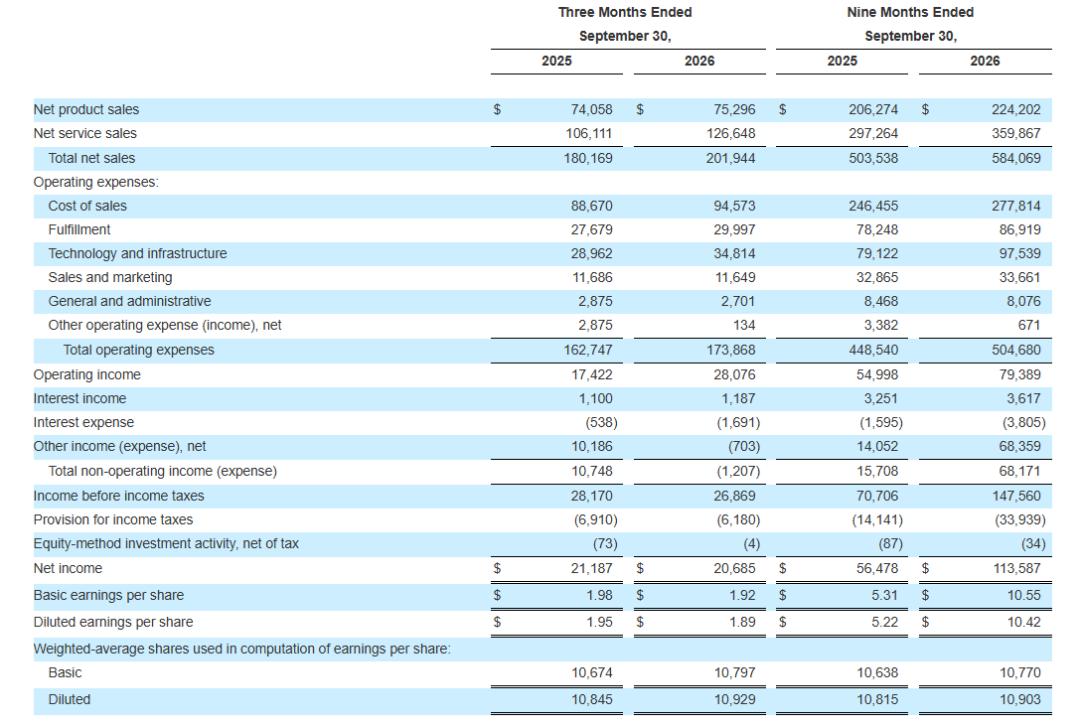
Amazon's operating margin in the third quarter reached 13.9%, a record high. However, its free cash flow in the past 12 months was negative 42.357 billion US dollars, compared with 14.788 billion US dollars in the same period a year ago. That means investments in AI infrastructure are driving up cloud business revenue while rapidly increasing capital requirements.
Amazon expects its fourth-quarter revenue to be between 240 billion and 247 billion US dollars, lower than the average expectation of analysts. At the same time, Amazon maintains its 2026 capital expenditure plan of about 220 billion US dollars.
After the financial report was released, the stock price once fell by more than 7% in after-hours trading. Behind the stock price reaction, investors are no longer only concerned about the quarterly performance, but the operating rhythm of Amazon in the next few quarters.
This also makes the core issues of Amazon this quarter more specific: whether AWS can continuously absorb new computing power, whether AI revenue can cover infrastructure investment, and whether the retail business can generate sufficient cash flow during the year-end shopping season.
01 AWS Backlog Reaches 5.78 Trillion US Dollars
AWS remains the most important growth engine for Amazon this quarter.
Its third-quarter revenue reached 45.984 billion US dollars, a year-on-year increase of 39.3%, higher than the 36.7% in the second quarter, hitting the fastest growth rate in nearly five years. Calculated based on this scale, the annualized revenue run rate of AWS is about 184 billion US dollars.
AWS operating profit reached 17.773 billion US dollars, a year-on-year increase of about 55%; operating margin was 38.7%, lower than the 39.4% in the second quarter but higher than the 34.6% in the same period of last year. Both revenue and profit achieved rapid growth, while the margin saw a slight sequential decline.
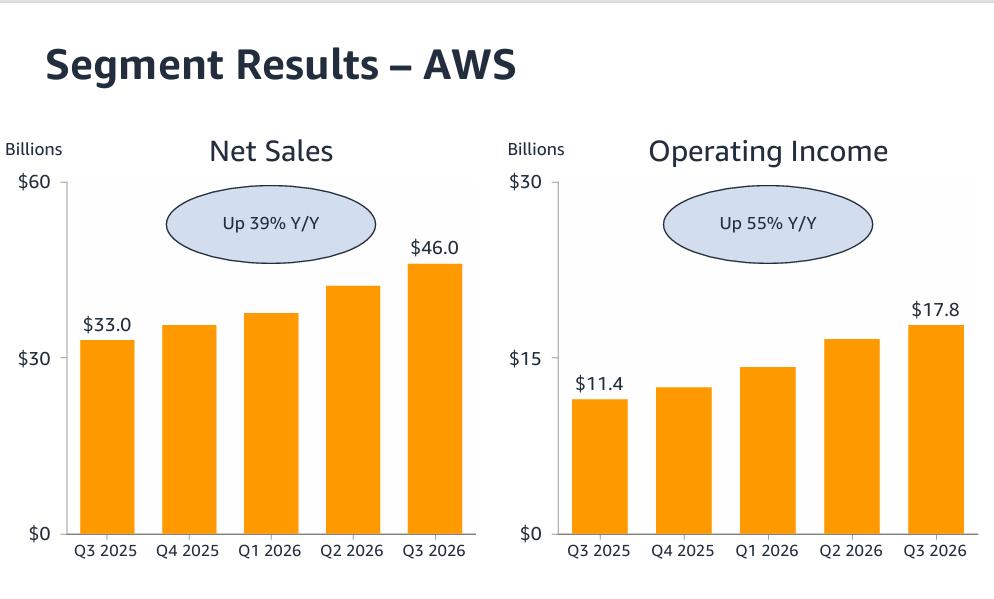
The growth of backlog is an important basis for AWS's revenue in the next stage.
Andy Jassy, CEO of Amazon, disclosed on the earnings call that AWS's backlog reached 5.78 trillion US dollars, continuing to grow from 4.96 trillion US dollars at the end of the second quarter. The backlog reflects the value of signed contracts that have not yet been recognized as revenue, and the actual revenue still depends on resource delivery and customer usage.
Jassy said that the company currently installs one AI accelerator every 14 seconds on average, and customer demand for new computing power remains strong. He expects AWS's revenue growth rate to exceed 40% in both 2027 and 2028.
The growth of the retail business is relatively moderate. In the third quarter, Amazon's North America business revenue was 112.852 billion US dollars, a year-on-year increase of 6%; the international business revenue was 43.108 billion US dollars, a year-on-year increase of 5%, and 8% after excluding the impact of exchange rates.
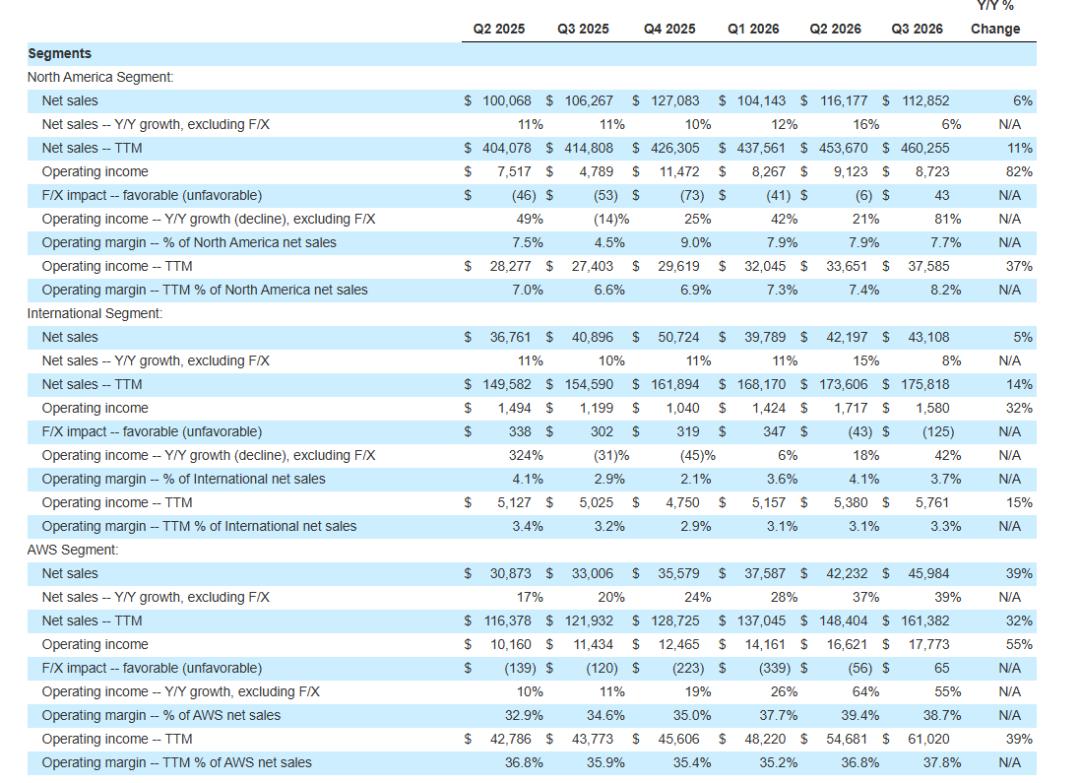
The timing adjustment of Prime Day affected the year-on-year performance of the quarter. In 2026, the Prime Day events in most major markets were moved forward to the second quarter, while all of them were counted in the third quarter last year. Amazon said that if this timing difference is excluded, its third-quarter revenue growth rate would be about 4 percentage points higher.
The advertising business grew by 12% in the third quarter after excluding the impact of exchange rates, and Amazon expects the growth rate in the fourth quarter to return to the high teens. Amazon did not separately disclose the specific revenue amount of the advertising business in this financial report.
02 Model and Agent Business Continue to Expand
Amazon is expanding its AI business from underlying computing power to model services and agent development.
In the third quarter, the spending of Fortune 500 companies on Amazon Bedrock increased nearly 7 times year-on-year, and the total number of Token calls on the platform increased nearly 17 times.
Bedrock is a model service platform provided by AWS for enterprises, where customers can call models from different vendors and deploy AI applications on AWS infrastructure.
In this quarter, Bedrock added models from companies including OpenAI, Anthropic, Moonshot AI, xAI and Zhipu AI, further expanding the selection range for enterprise customers. Amazon also added a built-in web search function for OpenAI models, allowing enterprises to retrieve real-time information when calling the models.
In terms of agents, Amazon launched the public preview version of Bedrock Managed Agents to help enterprises build and deploy AI agents in production environments. Developers can also use Strands Harness to build agents. Amazon claims that with the same cutting-edge models, this tool can improve Token usage efficiency, reduce task costs by 32%, while maintaining equivalent or higher accuracy.
These products cover the whole process of model calling, agent development and deployment. However, Amazon has not separately disclosed the revenue of Bedrock and the agent business, and the growth of platform call volume cannot be directly equated to revenue growth.
03 Demand for Trainium and Graviton Grows 20 Times
Self-developed chips are an important part of Amazon's efforts to reduce computing power costs and expand AWS product differentiation.
Jassy said on the earnings call that the revenue commitments for Trainium and Graviton increased by more than 20 times year-on-year, and the overall chip business maintained triple-digit growth. Trainium is mainly used for AI model training and inference, while Graviton is oriented to general-purpose cloud computing.
In the third quarter, Amazon also disclosed that it had signed new AWS agreements with enterprises including Meta, NVIDIA, OpenAI, Salesforce, Oracle, Qualcomm, Verizon and Stripe. However, the company did not announce the corresponding chip models, computing power scale and purchase amount of these agreements one by one.
However, the procurement or computing power agreements signed by customers need to be gradually converted into revenue along with chip delivery and actual usage.
Amazon previously disclosed that the annualized revenue run rate of its self-developed chip business has exceeded 25 billion US dollars.
Amazon revealed that it is expanding the deployment of new-generation chips and plans to expand the usage scope of Trainium outside AWS in the second half of 2027.
Previously, Anthropic has used Trainium 2 to build the Project Rainier computing cluster, with a deployment scale of more than 500,000 chips.
Expanding the scope of external usage will add new sales channels for Trainium, but it also requires Amazon to further improve its software ecosystem, supply chain and customer support.
Graviton mainly serves EC2 cloud computing instances. Amazon hopes to improve server performance and energy efficiency through self-developed CPUs, while reducing dependence on external processor suppliers.
04 Full-year Capital Expenditure Maintained at 220 Billion US Dollars
Investments in AI infrastructure continue to drive up Amazon's cash expenditures.
In the third quarter, Amazon's cash expenditure on the purchase of related property and equipment reached 77.259 billion US dollars, compared with 35.095 billion US dollars in the same period of last year; after deducting proceeds from asset sales and related incentives, the net expenditure was 75.878 billion US dollars. The cumulative cash expenditure on the purchase of property and equipment in the first three quarters reached 175.67 billion US dollars.
Amazon maintains its full-year expectation of about 220 billion US dollars in cash capital expenditure, and has not further raised it in this financial report. The company has previously raised its full-year investment plan to this level, which is mainly used for the construction of data centers, servers, network equipment and AI infrastructure.
The growth of capital expenditure has also begun to affect cash flow. In the 12 months ended September 30, Amazon's operating cash flow reached 168.3 billion US dollars, a year-on-year increase of 29%. Free cash flow was negative 42.4 billion US dollars, compared with positive 14.8 billion US dollars in the same period of last year.
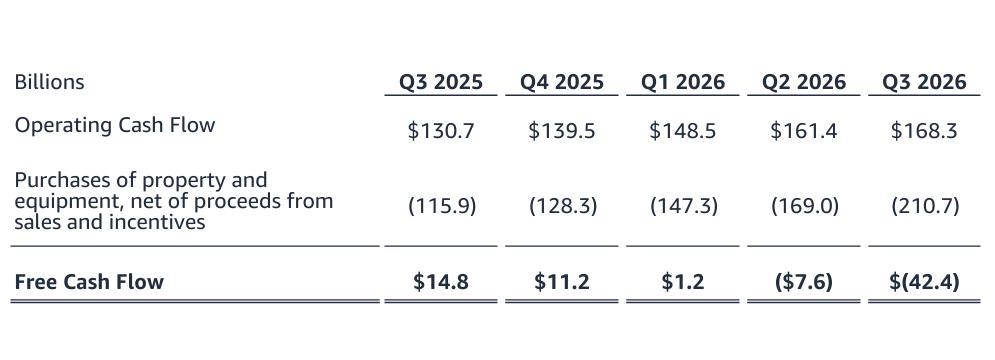
In the past 12 months, the company's operating cash flow increased by 37.6 billion US dollars, but net capital expenditure increased by 94.8 billion US dollars, exceeding the increment of operating cash flow. This is also the main reason for the turn of free cash flow to negative.
05 The Market Begins to Focus on Return on Investment
Amazon expects its fourth-quarter revenue to be between 240 billion and 247 billion US dollars, a year-on-year increase of 12% to 16%; operating profit will be between 28.5 billion and 33.5 billion US dollars, higher than 25 billion US dollars in the same period of last year.
The market previously expected Amazon's fourth-quarter revenue to be about 244.5 billion US dollars, and the midpoint of the company's guidance is 243.5 billion US dollars, slightly lower than analysts' expectations. After the financial report was released, both Reuters and The Wall Street Journal linked the stock price decline to revenue outlook, capital expenditure and free cash flow pressure.
The fourth quarter is Amazon's most important retail sales peak of the whole year. The company expects the growth rate of its advertising business to return to double digits, and plans to recruit about 300,000 seasonal employees in the United States to meet the order demand during the holiday shopping season.
Before the release of this financial report, the market expected Amazon's third-quarter revenue to be about 202.2 billion US dollars, adjusted earnings per share to be about 1.97 US dollars, and AWS growth rate to be about 37% to 38%. The actual performance of AWS exceeded expectations, but revenue, earnings per share and fourth-quarter revenue guidance all failed to meet market requirements.
Investors' focus is on two aspects: first, whether AWS can maintain its current growth rate, and second, when the huge capital expenditure can be converted into revenue and cash flow.
The accelerated growth of AWS indicates that enterprise cloud computing and AI computing power demand is still expanding. However, Amazon's infrastructure investment is also increasing rapidly, and its free cash flow has turned negative in the past 12 months. The fourth-quarter revenue guidance is lower than market expectations, which means investors need to see more evidence to confirm that new computing power can be continuously converted into business revenue and profits.
This article is from the WeChat Official Account "Tencent Tech", written by notable contributors, and published by 36Kr with authorization.