The logic behind Google's sharp plunge: AI has burned through its cash flow, wiped out its share repurchase funds, and even set its search business ablaze.
Google suffered its worst single-day plunge in history on Thursday, with its share price plummeting by more than 11% and its market value evaporating by about $500 billion. A "death cross" appeared during the trading session — meaning the 50-day moving average fell below the 200-day moving average, which also affected the broader tech stock sector, dragging the Nasdaq lower under pressure.
Alphabet's latest earnings report struck the most sensitive nerve of the market: AI investment continues to devour cash flow, share buybacks have dropped to zero, and the pricing power of its core search business has also started to come under pressure. According to the Bloomberg consensus expectation, Google Search, YouTube, subscriptions and Google Services all underperformed expectations. The group's operating profit reached $40.6 billion, lower than the market expectation of $43.2 billion and also below the roughly $45 billion threshold expected by the buy-side.
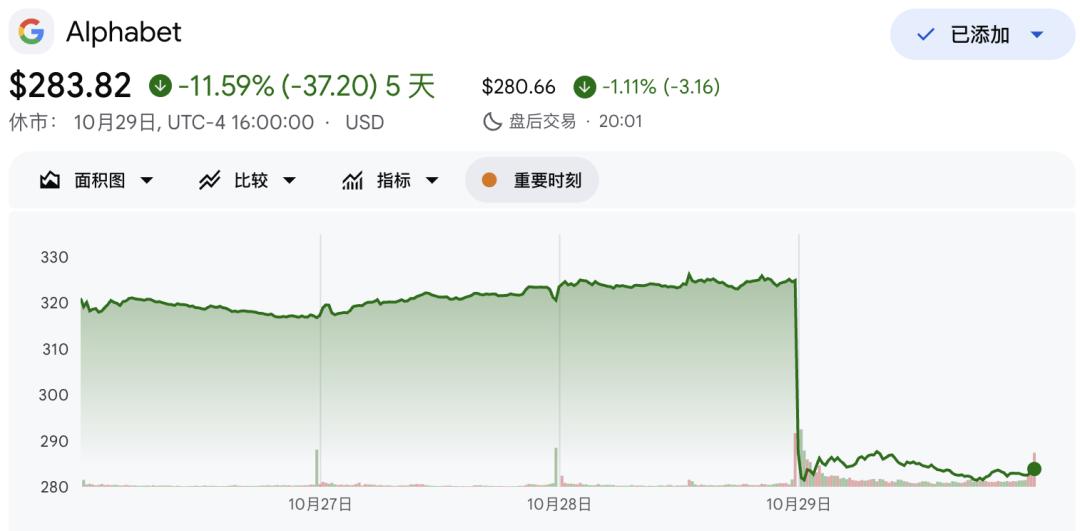
This is not just a setback at the earnings level, but more like a re-pricing of the AI trading logic.
Comments from JPMorgan Chase, Goldman Sachs and Morgan Stanley all point to the same conclusion: this earnings report has put renewed pressure on the risk appetite of the AI sector, which had just recently rebounded, amplifying the market's anxiety about the return on AI capital expenditure of large technology companies. JPMorgan Chase stated bluntly that this is "a setback for the re-ignition of the AI/tech trade".
Thales Arruda, a trader at Goldman Sachs, mentioned that the market is shifting from "rewarding capital expenditure growth" to "demanding evidence of returns".
The results delivered by Alphabet are exactly the opposite. The company's free cash flow consumption far exceeded expectations, buybacks fell to zero in the first nine months of 2026, and it raised funds by selling stocks and issuing bonds at the same time.
Meanwhile, Sundar Pichai emphasized that the year-on-year growth rate of search queries has reached the highest level in five years, but the growth rate of search revenue has slowed down, and the lower monetization rate of AI Mode has become the most worrying signal for the market.
Query Volume Hits 5-Year High, But Search Revenue Records Slowest Growth Rate This Year
The contradiction that most unsettled the bulls in this earnings report is hidden in the comparison of a set of figures.
Sundar Pichai, CEO of Alphabet, stated in the earnings report that the year-on-year growth rate of Google Search queries is "the highest in the past five years". However, revenue from search and other businesses only increased by 12% to $63.35 billion, a sharp drop from 16.8% in the second quarter and 19.1% in the first quarter, and also significantly lower than the buy-side's expected threshold of around 14%.
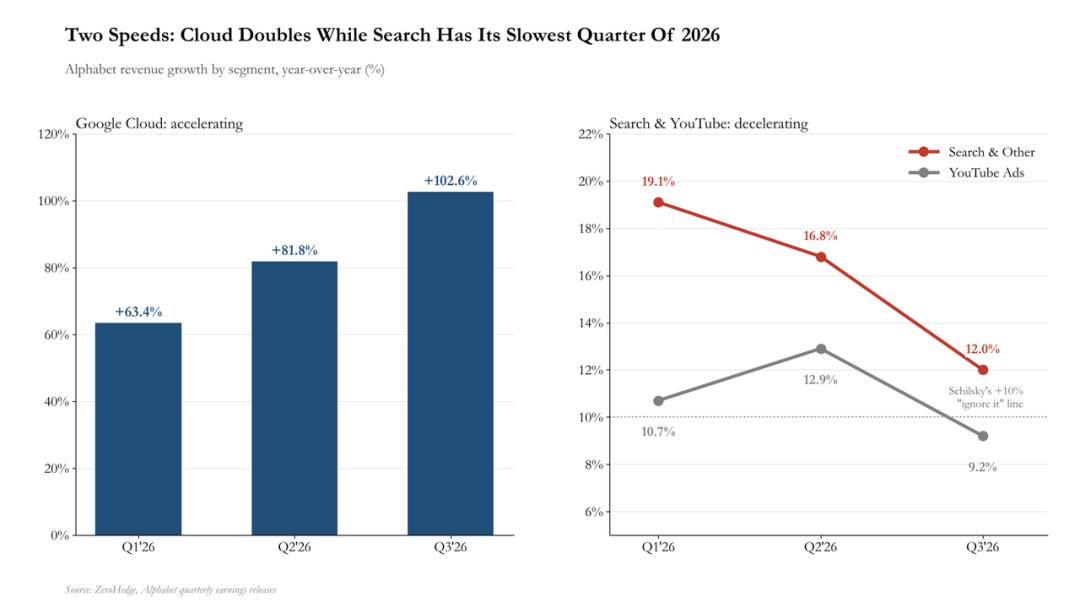
In the words of Mark Schilsky from JPMorgan Chase's trading desk, this means that "Google is answering more questions than ever before, but getting paid less and less for each question".
The management gave multiple explanations. Philipp Schindler, Chief Business Officer, listed exchange rates as "the largest single drag on the search business relative to the second quarter", while Goldman Sachs' TMT team added two vertical industry factors: the EU's cancellation of the minimum threshold exemption policy has impacted the advertising investment of retailers in the Asia-Pacific region, and the advertising expenditure in the media and entertainment sector has normalized and declined after the end of the FIFA World Cup.
But what the market is really worried about is the erosion of search monetization by AI Mode. Schindler admitted that AI Mode has a "lower monetization level", while insisting that "most queries in AI Mode are incremental and will create more monetization opportunities over time".
Ross Sandler, an analyst at Barclays, pointed out that the management "prioritizes user experience over monetization", the growth rate of blue link queries is slower than the growth rate of total queries, and a more aggressive agent-based search process next year may further widen this gap. He characterized this as a "yellow warning" for investors.
Morgan Stanley pointed out that the gap between Alphabet's search growth rate and Meta's advertising growth rate has widened to a recent peak of about 13 percentage points, which reinforces the market's concerns about advertising share migration and AI diversion.
YouTube also failed to provide a buffer, with its revenue growing by 9.2%, falling below the 10% observation line previously mentioned by Mark Schilsky of JPMorgan Chase.
Looking ahead to the fourth quarter, CFO Anat Ashkenazi warned that the exchange rate headwinds will further expand, and the search business will also face high base pressure brought by the accelerated growth in the third quarter of 2025.
Cloud Business Delivers Strong Performance, But Profits Are Eaten Up By The AI R&D Black Hole
The only highlight in the earnings report that exceeded expectations came from Google Cloud.
Revenue from the cloud business doubled year-on-year to $30.7 billion, and the segment profit margin jumped from 23.7% to 36.2%, far exceeding the market expectation of about 33%. Nearly 100 customers are already using TPUs. The cloud business backlog reached $5.61 trillion, up 256% year-on-year, and the company said about 55% of it will be converted into revenue in the next 24 months. Nearly 100 customers are using TPUs.
But the problem is that the strong growth of the cloud business has not been fully transmitted to the group's profits.
The shared AI R&D loss at the Alphabet level expanded from $4.5 billion a year ago to $7.7 billion, and Other Bets lost another $2 billion. Roughly estimated, about half of the profit increment of the cloud business has been consumed before reaching the consolidated income statement.
Eric Sheridan, an analyst at Goldman Sachs, summarized this phenomenon in his quarterly earnings review as "the search business is slowing down, and computing power continues to require investment". He pointed out that the management continues to emphasize the leadership position of cutting-edge models, including the release of Genie 4 and Gemini C4 Carbon, while also acknowledging that available computing power is still a limiting factor for the cloud business to further accelerate.
This is also the core concern of the market: demand for the cloud business is strong, and demand for AI capital expenditure is even stronger. Growth appears to be there, but cash returns still need to wait.
Free Cash Flow Is Under Strain, Buybacks Drop To Zero, The Company Turns To Issuing Bonds And Selling Shares
The most impactful information in this earnings report may not come from the income statement, but from the disclosure of financing activities.
The market originally expected Alphabet to consume about $3.5 billion in free cash flow this quarter. The actual figure is nearly three times that expectation. Capital expenditure reached $51.4 billion, lower than the market expectation of $55.8 billion, but operating cash flow fell 13% year-on-year to $42.3 billion, far below the market expectation of $53.9 billion. Capital expenditure doubled within a year, while operating cash flow regressed.
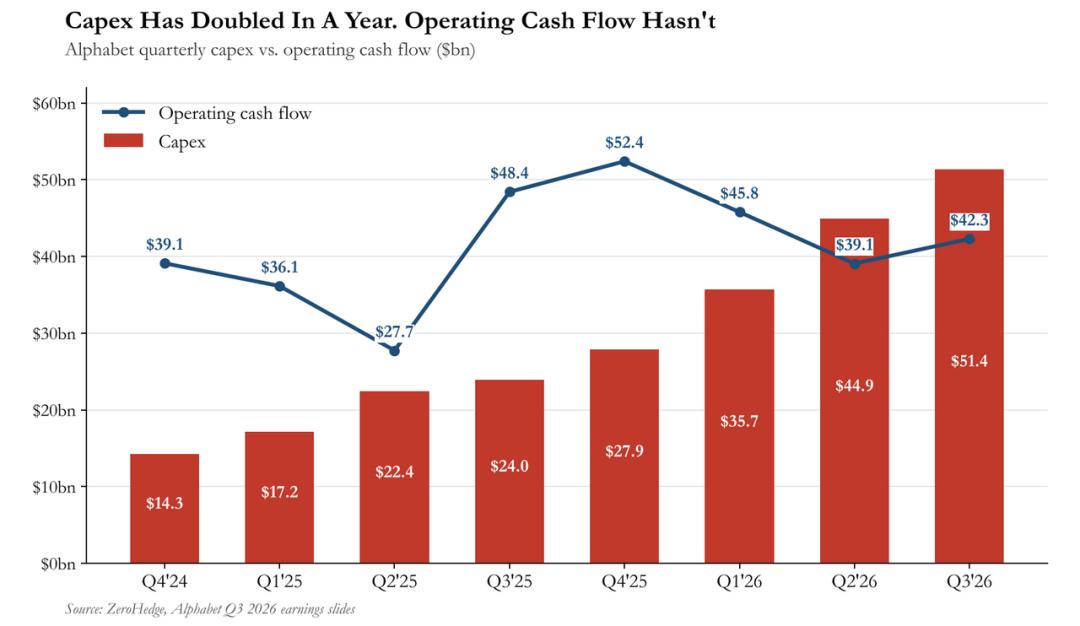
What is more striking is the fundamental shift in the financing structure. In the first three quarters of 2026, Alphabet's share repurchase amount was zero — compared with $39.8 billion in the same period in 2025. At the same time, the company sold 12 million Class A shares (cashing out $4.3 billion) and 24 million Class C shares (cashing out $8.1 billion) through the At-The-Market (ATM) offering plan, raising a total of $12.4 billion through new share issuance, with $27.6 billion remaining under the ATM plan. In addition, the company issued $28.7 billion in senior unsecured bonds, and quarterly interest expenses surged from $143 million a year ago to $967 million.
In comparison, in the first three quarters of 2025, Alphabet returned $44.4 billion to investors through financing activities; while in the first three quarters of 2026, the company raised a net of $115.8 billion, including $42.9 billion in common stock (of which $10 billion came from Berkshire Hathaway), $19.1 billion in mandatory convertible preferred stock, and $76.3 billion in net new debt.
The management said the expected return on investment will be "significantly higher than the cost of capital". But the cost of capital itself is rising: the average price at which Alphabet sold its shares was about $358 for Class A shares and $338 for Class C shares, while the pre-market share price was about $290, meaning the company completed financing at a price 15% to 20% higher than the current market price — which may be the most cost-effective transaction it made this quarter.
Market Narrative Shifts, The AI Sector Faces A New Test Of "Proving Returns"
The market impact of this earnings report has gone beyond Alphabet itself, pointing directly to the core of the entire AI investment logic.
Thales Arruda, a trader at Goldman Sachs, pointed out in his morning note that the market is undergoing a shift from "rewarding capital expenditure growth" to "demanding evidence of returns", and described the current "pain trade" as large-scale cloud underperformance relative to the broader market, while de-risked "shovels and picks" type assets are starting to gain momentum. He also noted that the improvement in credit market stability and Oracle's earnings may be more decisive for the highly leveraged infrastructure complex than any individual hyperscaler cloud vendor's earnings report.
The JPMorgan Chase market intelligence team characterized this earnings report as "a setback for the re-ignition of the AI/tech trade", and pointed out that the pre-market price action shows that the broad-based rotation trend will continue.
The bank cited the precedent at the beginning of this year: between January and February 20 this year, the energy sector rose by 22%, the materials sector by 16%, the industrial sector by 14%, while the tech sector fell by 3.5%, and the overall S&P 500 rose by less than 1%. JPMorgan Chase maintains its "tactically bullish" stance, believing that the main risk comes from the escalation of geopolitical conflicts in the Middle East rather than the earnings report itself, and says it will buy on dips.
In terms of analyst target prices, many institutions lowered their target prices while maintaining their ratings: Bernstein cut its target price from $385 to $325, BofA from $430 to $380, JPMorgan Chase from $425 to $375, Morgan Stanley from $400 to $375, Barclays from $425 to $405, and Susquehanna from $460 to $400. Citizens is the only institution that downgraded its rating to "Market Perform". Even after the downgrades, the median analyst target price is still about 30% higher than the pre-market price.
BofA pointed out that at about $291, Alphabet's stock trades at roughly 19 times 2027 earnings and 16 times 2028 earnings, with the core search business valued at only about 10 times. This could be a buy signal, provided the market believes the 2028 earnings forecast is credible and no other competitor has eroded this market first.
While Alphabet is struggling with monetization difficulties, Microsoft Azure delivered stronger-than-expected growth and guided for a fixed-currency growth rate of 49% to 50% in the next quarter. This contrast makes the logic of winner differentiation in AI infrastructure investment increasingly clear.
This article is from the WeChat Official Account "Wall Street CN", written by Zhao Ying, and published by 36Kr with authorization.