The starting point of Physical AI may well lie on this 8.4-kilometer urban road in Xiangcheng, Suzhou.
South of Suzhou North Railway Station, in Xiangcheng District, there is a four-lane dual carriageway called Nantiancheng Road.
Seven years ago, intelligent driving tests began to appear on this 8.4-kilometer road, when there were still large stretches of vacant land on both sides.
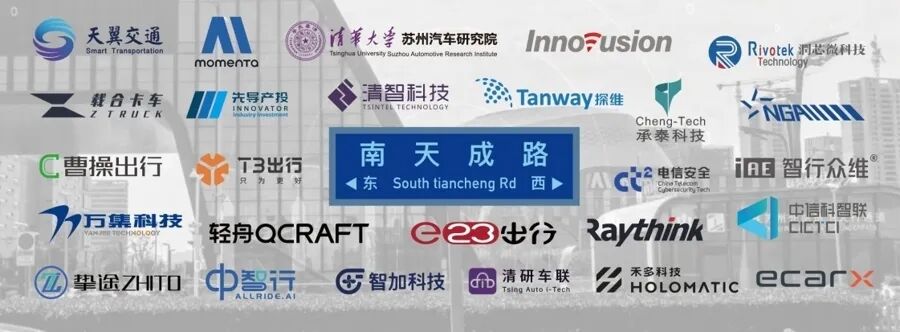
Today, more than 280 companies are clustered on both sides of this same road, and three of them have grown into listed companies on the Hong Kong Stock Exchange.
Every day, various intelligent driving vehicles shuttle back and forth on Nantiancheng Road.
This area has become a national highland for the intelligent driving industry.
A couple of days ago, the 8th Intelligent Driving Conference and the 2026 Huanxiu Lake Physical AI Industry Development Promotion Conference was grandly held here.
At the conference, Xiangcheng District unveiled a three-year action plan: it strives to push the total scale of Physical AI-related industries around Huanxiu Lake to exceed 800 billion yuan.
It is worth noting that the output value of the intelligent connected new energy vehicle industry in this area only reached 360 billion yuan in 2025.
What makes it dare to more than double the scale in three years?
How can an ordinary urban road nurture a "City of Physical AI"?
01 Test Field in the Real World
The story dates back to early 2018.
In the spring of that year, Xiangcheng District of Suzhou held an investment promotion conference in Beijing, with a special focus on intelligent connected vehicles.
Among the audience was a young man named Cao Xudong.
He graduated from Tsinghua University with a major in engineering mechanics, and worked on artificial intelligence for many years at Microsoft Research Asia.
At that time, intelligent driving was still regarded as a "castle in the air" by most people.
After all, the country did not release its first technical roadmap for intelligent connected vehicles until 2016.
Cao Xudong later recalled that meeting and said: "It is foreseeable that Xiangcheng will gather advanced enterprises and high-end talents in related fields to form an agglomeration effect, which is exactly what we need, and that is why we were attracted to settle in Xiangcheng."
The development speed exceeded the imagination of many people.
In April 2018, the China headquarters of Plus.ai was established here.
At the same time, Momenta, the intelligent driving technology enterprise founded by Cao Xudong, officially settled in the Xiangcheng High-speed Railway New Area.
These two companies later became leading players in the industry.
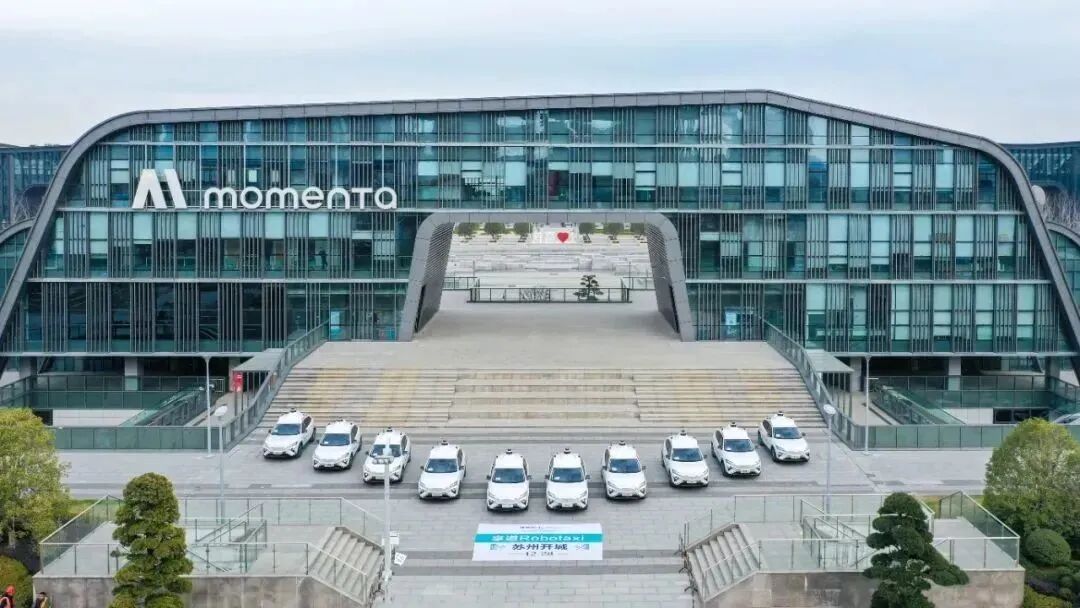
Momenta settled in the Suzhou High-speed Railway New Area
The really interesting part came a year later.
In April 2019, Suzhou issued the first batch of road test licenses for intelligent connected vehicles.
The two license recipients, Momenta and Hedao Technologies, are both located in Xiangcheng District.
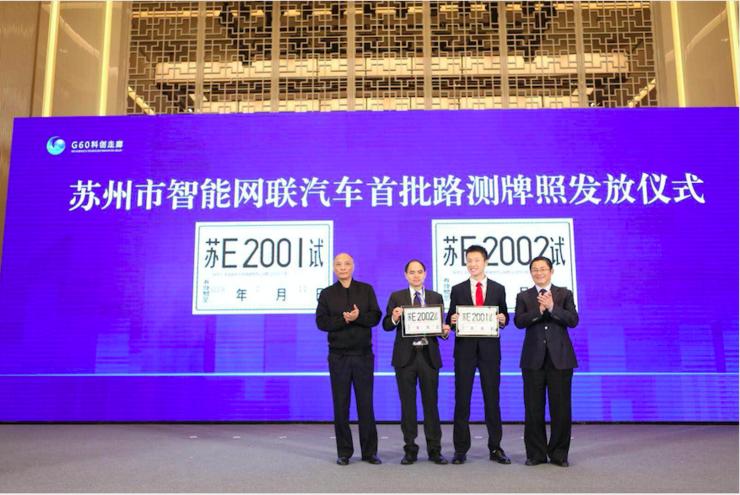
In 2019, Momenta and Hedao Technologies obtained Suzhou intelligent connected road test licenses Su E2001 Test and Su E2002 Test respectively
What does this mean?
It means that self-driving cars were legally allowed to drive on the roads of this city.
Before that, most intelligent driving tests were carried out in closed parks and closed test fields: with fixed routes, no social vehicles, and pre-arranged obstacles.
When vehicles are actually driven on urban roads, variables pour in all at once, and the complexity increases exponentially.
Pedestrians may cross the road abruptly, violating vehicles may drive against the traffic, buses may change lanes suddenly, road markings at intersections may be just covered by construction enclosures, and lighting conditions on rainy, foggy days and at night further increase the difficulty.
More trouble is that once a scratch occurs, there are no ready-made answers in existing social rules for how to determine responsibility, how to compensate through insurance, and who owns the data.
This batch of road test licenses issued by Xiangcheng District of Suzhou is far more than just two certificates. It requires algorithms to start taking responsibility for unexpected situations in the real world.
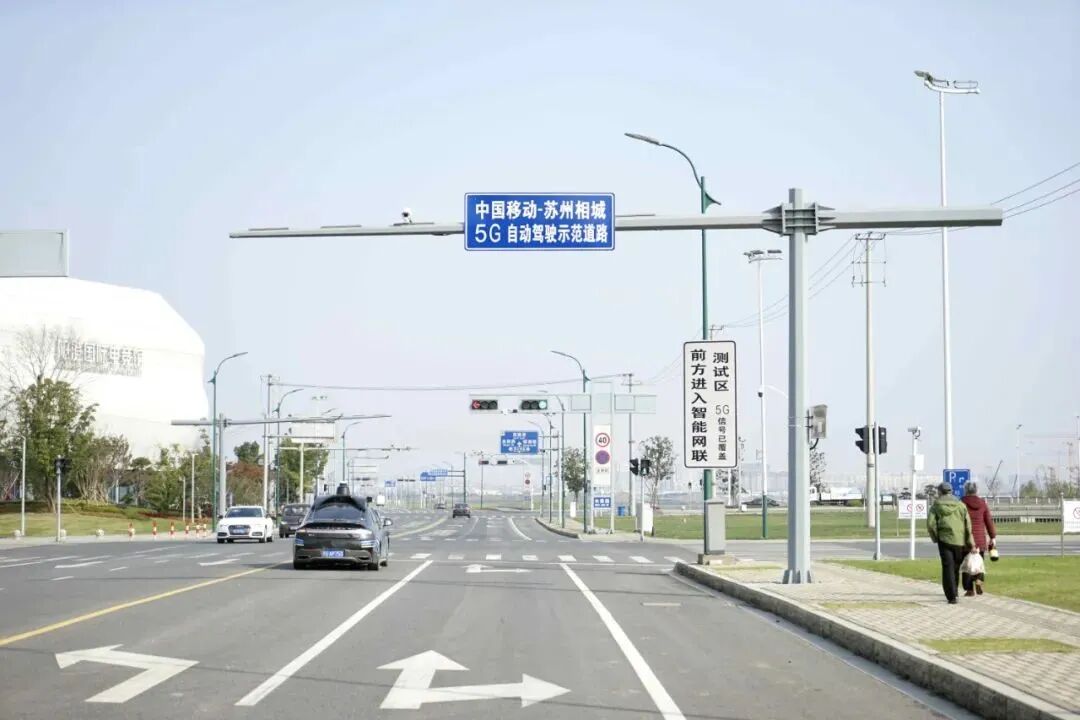
Xiangcheng 5G autonomous driving demonstration road
Xiangcheng is not the earliest place in China to open roads for testing, but it did take a leading position among cities that launched such practices around that time.
Well-known enterprises including Zhituo Technology focusing on trunk logistics, Innovusion and Chengtai Technology in the field of environmental perception, Rinwell and Giga Intelligence in the field of software algorithms, T3 Travel, Cao Cao Mobility and Nissan Mobility in the travel sector, have successively set up their presence in the High-speed Railway New Area of Xiangcheng District.
Every day, various intelligent driving vehicles shuttle back and forth on Nantiancheng Road.
These include the silver Longzhou SPACE minibus integrated with L4-level autonomous driving technology, unmanned delivery vehicles over 1 meter tall, autonomous driving taxis, and unmanned sanitation vehicles for automatic cleaning.
In 2020, the first batch of 5G unmanned buses in China that operated on a regular basis departed from Nantiancheng Road.
Application scenarios for various models such as sightseeing vehicles, inspection vehicles, and road inspection vehicles have also been continuously innovated.
In terms of economic strength, Xiangcheng ranks relatively low in total GDP among all districts in Suzhou, but in recent years it has delivered outstanding performance and made rapid progress in intelligent technology and AI sectors.
What is the source of Xiangcheng's confidence?
02 The First Movers
It has to be said that there is a group of bold pioneers behind Xiangcheng.
Looking back at the 8 years of the Intelligent Driving Conference, its policy concepts have always been forward-looking.
In October 2018, the first Intelligent Driving Conference opened beside Nantiancheng Road, which was one of the earliest intelligent driving brand events held in China.
The Yangtze River Delta Intelligent Driving Industry Demonstration Zone was launched, with special industrial policies released simultaneously to provide support from three dimensions: core elements, industrial empowerment, and enterprise support.
Xiangcheng caught the trend immediately, and Momenta's valuation exceeded 1 billion U.S. dollars that year.
Autonomous driving suddenly became popular across China, with capital chasing projects.
The next year, the conference was upgraded to the Yangtze River Delta G60 Science and Technology Innovation Corridor Intelligent Driving Industry Conference.
More than 1,500 people attended, including R&D teams from China, the United States and Japan.
An international intelligent driving technology innovation competition was held at the same time, where more than 20 teams competed on real roads.
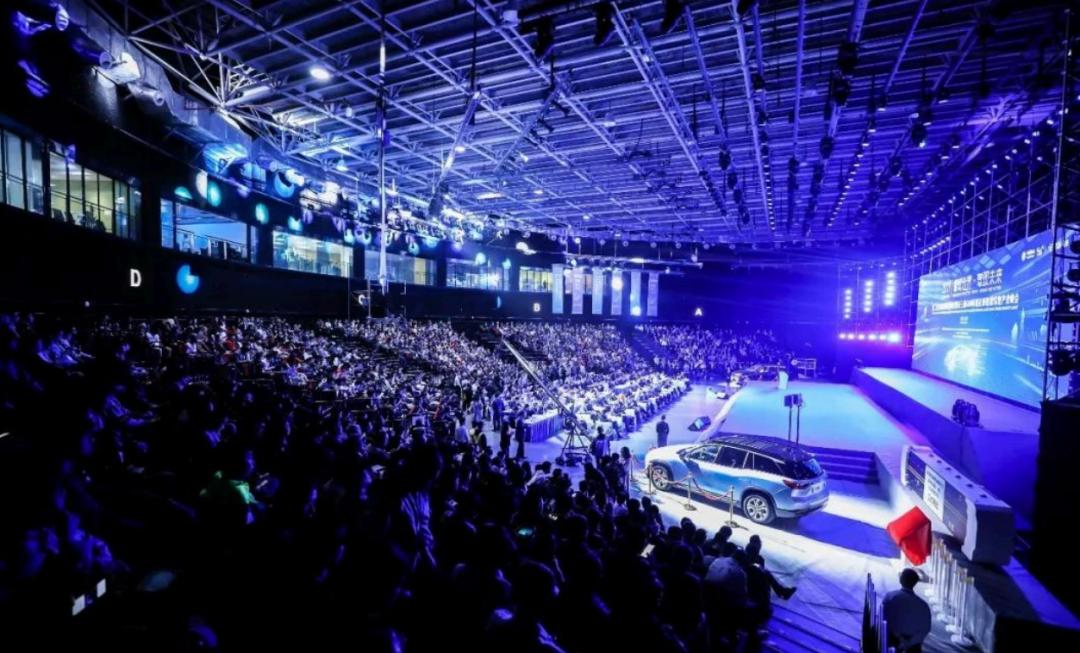
The 2nd Intelligent Driving Conference and the 2019 Yangtze River Delta G60 Science and Technology Innovation Corridor Intelligent Driving Industry Conference
Pioneering policies played a key foundational role for the subsequent development of the industry.
At the 2nd Intelligent Driving Conference, the Jiangsu Provincial Connected Vehicle Pilot Zone was inaugurated as one of the first batch in the province; the first phase of the 8.4-kilometer test road was released.
The "Guiding Opinions on the Demonstration and Application of Intelligent Connected Vehicles in Xiangcheng District (Trial)" was also publicly released, which was a pioneering move across the country.
This guiding opinion covers very detailed issues, so specific that it hardly looks like an industrial policy: whether passengers can be carried, whether fees can be charged, and who is responsible in case of a traffic accident.
As you can see, enterprises are not afraid of accidents during testing, but of unclear responsibility boundaries.
Since then, all intelligent driving test enterprises have felt reassured, and the industry has ushered in its "Cambrian explosion" moment.
In 2020, Xiangcheng was named the first Digital Transportation Demonstration Zone in Jiangsu Province.
The first batch of regularly operated 5G unmanned buses and unmanned taxis in China started their operation from this road.
Statistics in 2022 show that Xiangcheng had opened 10 routes for 5G unmanned buses, with more than 200,000 passenger trips and a total driving mileage of 390,000 kilometers.
390,000 kilometers is nearly 10 times around the Earth.
In the same year, Momenta became the first "unicorn" enterprise in China's intelligent driving industry.
In February 2022, the first mass-produced vehicle equipped with Momenta's solution, the SAIC IM L7, rolled off the production line.
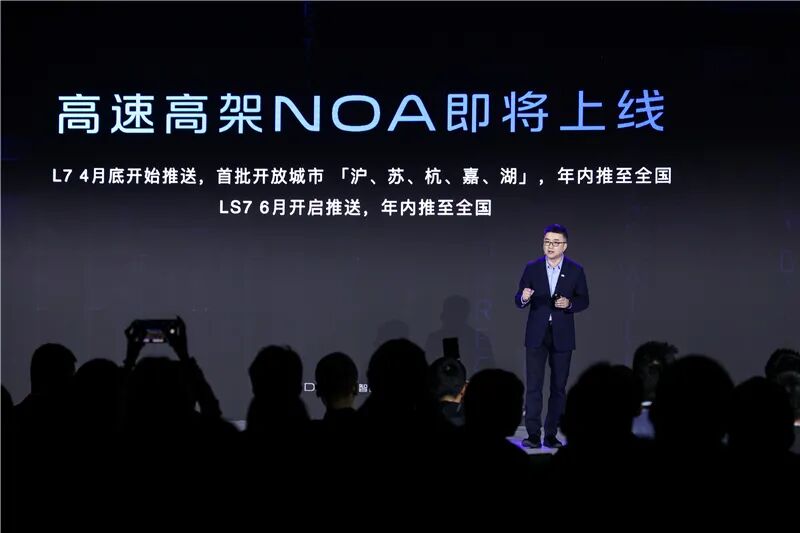
IM Motors announced at the launch event that the high-speed and elevated NOA function was officially launched
The moment the vehicle rolls off the assembly line, its nature changes completely.
All previous road tests, data and algorithms were costs; starting from this mass-produced vehicle, the business officially generates revenue.
An industrial cluster began to take shape.
03 From Test Field to Industrial Cluster
In November 2022, Xiangcheng raised its development ambition to a new level.
It fully opened up its entire 489 square kilometers of administrative area and 1906 kilometers of roads for testing, demonstration application and demonstration operation.
At the same time, it opened up 28.9 square kilometers and 162 kilometers of roads in the High-speed Railway New Area, allowing "no human driver in the main driving seat".
According to the statistical standard at that time, this made Suzhou the city with the longest open road mileage for autonomous driving testing across China.
A year later, at the 5th Intelligent Driving Conference.
The first municipal cloud control platform with a dual cross-city and district system in China was put into use.
Three intelligent connected roads including S17, G524 and G312 were opened at the same time.
Among them, S17 is the first holographic perception smart highway in China that meets the level of vehicle-road cooperative autonomous driving.
With such complete infrastructure, the testing ground has truly nurtured a growing industrial cluster.
First of all, Momenta was listed on the Hong Kong Stock Exchange on July 8 this year.
14 cornerstone investors subscribed for nearly half of the offered shares.
GIC and Fidelity International each invested 100 million U.S. dollars, and Mercedes-Benz and BYD were also on the investor list.
There are several sets of data in the prospectus that are worth careful analysis.
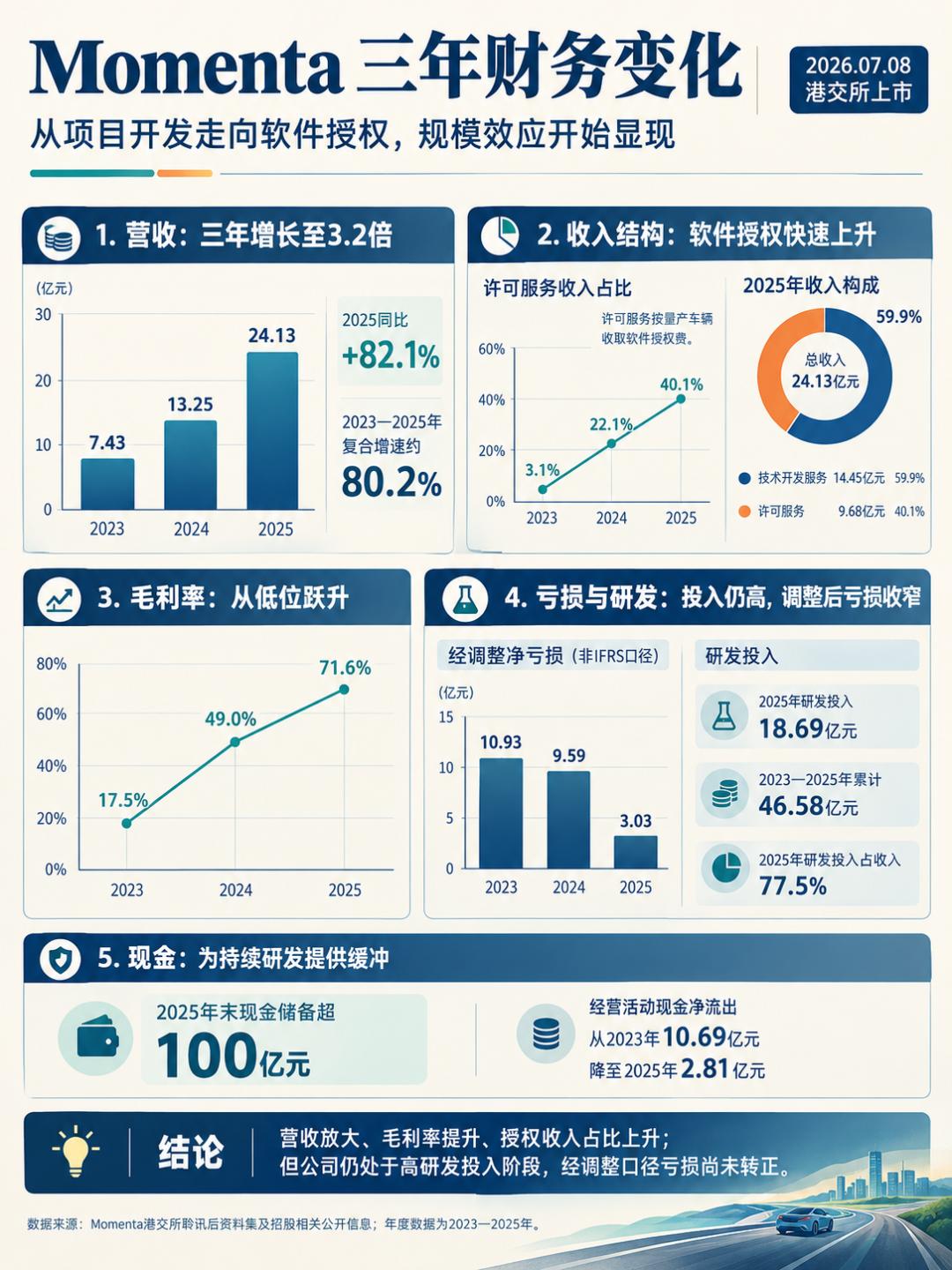
The proportion of licensing revenue was 3.1% in 2023, 22.1% in 2024, and 40.1% in 2025.
The gross profit margin was 17.5%, 49.0% and 71.6% respectively.
What do these figures mean?
The proportion of R&D investment is high, the revenue scale continues to expand, the proportion of software licensing revenue rises, the gross profit margin improves, and the adjusted loss narrows.
To understand this set of data, you need to know a professional term in the industry: project designation.
When an automaker decides to use a certain supplier's intelligent driving solution on a specific vehicle model, this is called a "designation".
After designation comes mass production, and licensing fees are collected only after mass production starts.
In three years, Momenta's cumulative number of designated models rose from 31 to 180, and the number of officially mass-produced models increased from 8 to 68. As of October 29, the cumulative mass production volume has exceeded 1.4 million units, with a cumulative real driving mileage of 200 billion kilometers.
The first 100,000 units took about 24 months; the latest 100,000 units took less than one month.
The more vehicles there are, the more scenario data is fed back, and the faster the model iterates.
The inflection point of the industry never appears at press conferences, but is hidden on the conveyor belt from designation to mass production.
This is only the performance of Momenta alone. In fact, a whole industrial cluster is growing in the Suzhou High-speed Railway New Area.
Cao Cao Mobility moved its national headquarters here in 2021.
Now the second-generation Robotaxi of Cao Cao Mobility is running in 6 cities including Suzhou, Hangzhou, Zhuhai and Xi'an, with a fleet of more than 200 vehicles.
The third-generation original model Eva Cab has no steering wheel and no front passenger seat, and is scheduled to be mass-produced in 2027.
At the intelligent driving conference held a few days ago, Gong Xin, CEO of Cao Cao Mobility, did the math:
The cost per kilometer of Robotaxi is about 40% of that of human-driven vehicles; the long-term gross profit margin of the industry can reach 45%.
