Net profit surged 169%, Intel is reaping huge AI dividends, while its memory business is still dragging its feet.
Reported by Chipsn on October 30, today, Intel released its financial report for the third quarter of 2026. The company achieved revenue of 16.51 billion US dollars (equivalent to about 110.01 billion RMB) in the third quarter, a year-on-year increase of 21%, exceeding the performance guidance for the eighth consecutive quarter. GAAP net profit was 3.32 billion US dollars (equivalent to about 22.12 billion RMB), down 18% year on year; non-GAAP net profit was 2.8 billion US dollars (equivalent to about 18.66 billion RMB), up 169% year on year.
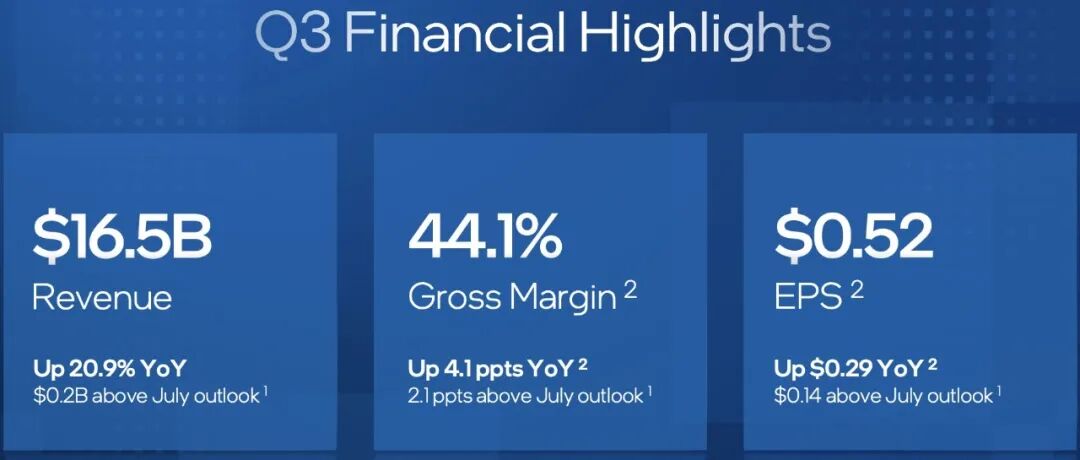
In addition, the company's GAAP operating profit was 2.52 billion US dollars (equivalent to about 16.79 billion RMB), with an operating profit margin of 15.3%; non-GAAP operating profit was 3.2 billion US dollars (equivalent to about 21.32 billion RMB), with an operating profit margin of 19.6%.
Intel CEO Tan Lip-Bu said that the company has achieved improved execution, expanded supply and progress in process technology this quarter; the top priority at present is to unlock production capacity to meet the demand for Xeon server processors. At present, the yield of Intel 18A has achieved double-digit improvement, and 18AP will be launched by the end of the year as scheduled.
He also mentioned that the strong momentum of the Data Center and AI (DCAI) business drove the performance to exceed expectations, and achieved the strongest revenue growth of the segment in 15 years.
Intel's GAAP gross margin in the third quarter was 43.0%, up 4.8 percentage points year on year; non-GAAP gross margin was 44.1%, up 4.1 percentage points year on year. The company's CFO David Zinsner reminded that the non-GAAP gross margin in the fourth quarter will drop to 38.0%, mainly due to the combined impact of the shutdown of the Fab 28 plant in Israel, the inventory adjustment of PC clients and continuous investment in foundry services.
David Zinsner said that the third quarter of this year is a relatively weak quarter for the PC industry in recent years, and inventory destocking will continue at least until the first quarter of 2027. Intel expects the overall PC shipment volume to drop by about 12% in 2026, and continue to fall by about 10% in 2027. Before memory supply and prices return to normal, the market is difficult to achieve sustained recovery.
Tan Lip-Bu said that 2027 will be Intel's "year of investment", capital expenditure will increase significantly, and positive free cash flow cannot be achieved for the whole year.
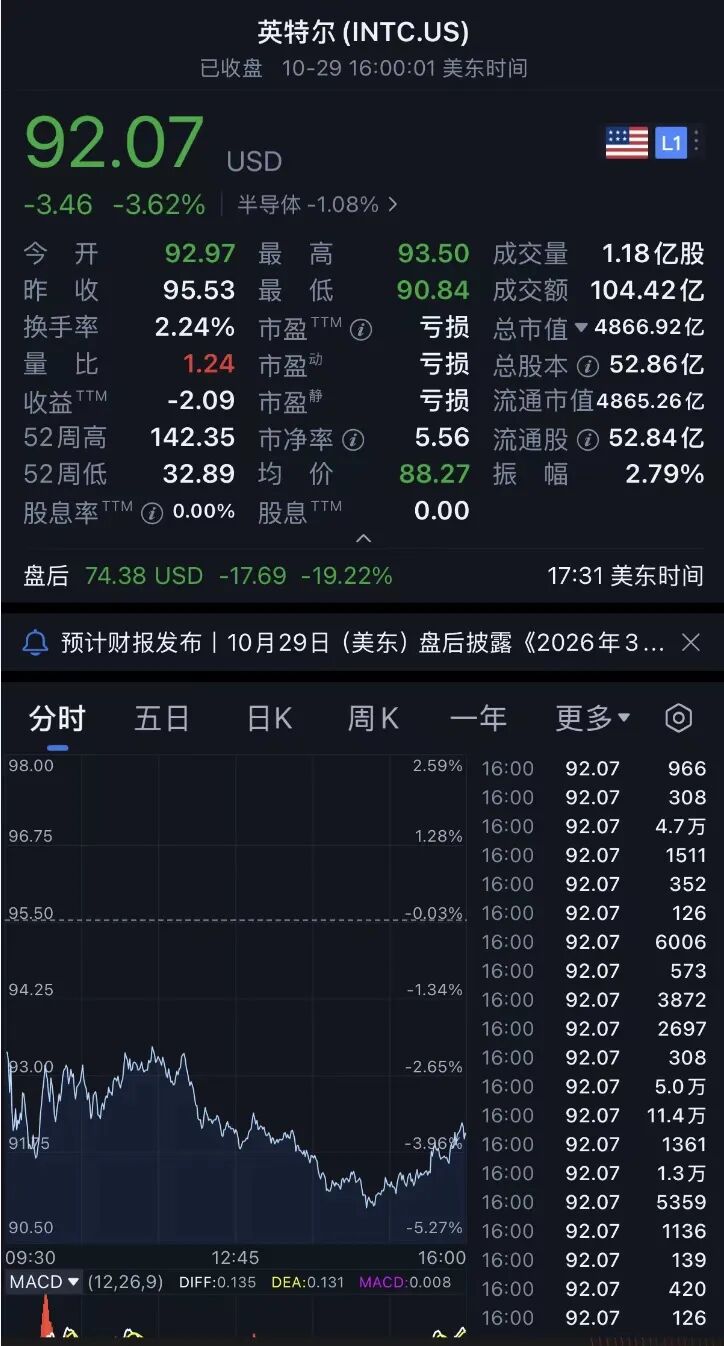
As of 17:31 after the market close on October 29 Eastern Time, Intel fell 19.22% to $74.38 per share (equivalent to about RMB 495.6 per share). Calculated at this after-market price, the total after-market market value is about $393.228 billion (equivalent to about RMB 2.6 trillion). The total market value at the close was 486.692 billion US dollars (equivalent to about 3.2 trillion RMB), and the after-market market value evaporated by about 93.464 billion US dollars (equivalent to about 622.8 billion RMB).
01. Data Center and AI business increased by 78% year on year, PC business dragged down by memory shortage
Intel's core business is divided into two product groups and one foundry segment: Client Computing and Physical AI Business (CCPG), covering PC processors (Core Ultra series), edge and AI PC chips; Data Center and AI Business (DCAI), covering Xeon server CPUs, AI-oriented servers and GPU products; Intel Foundry, which provides wafer manufacturing and advanced packaging services to external customers.
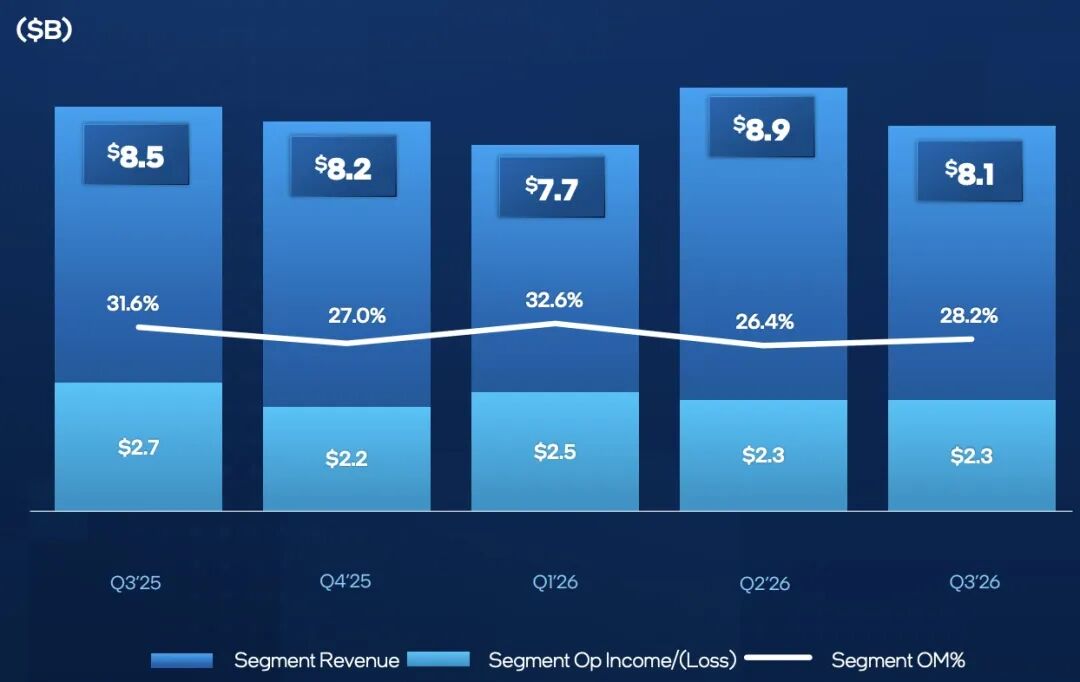
By business segment, the company's revenue from Client Computing and Physical AI business in the third quarter was 8.1 billion US dollars (equivalent to about 53.97 billion RMB), down 9% quarter on quarter and 5% year on year, with an operating profit margin of 28.2%.
The revenue of Data Center and AI business was 7.32 billion US dollars (equivalent to about 48.78 billion RMB), up 78% year on year, with an operating profit margin of 41.5%.
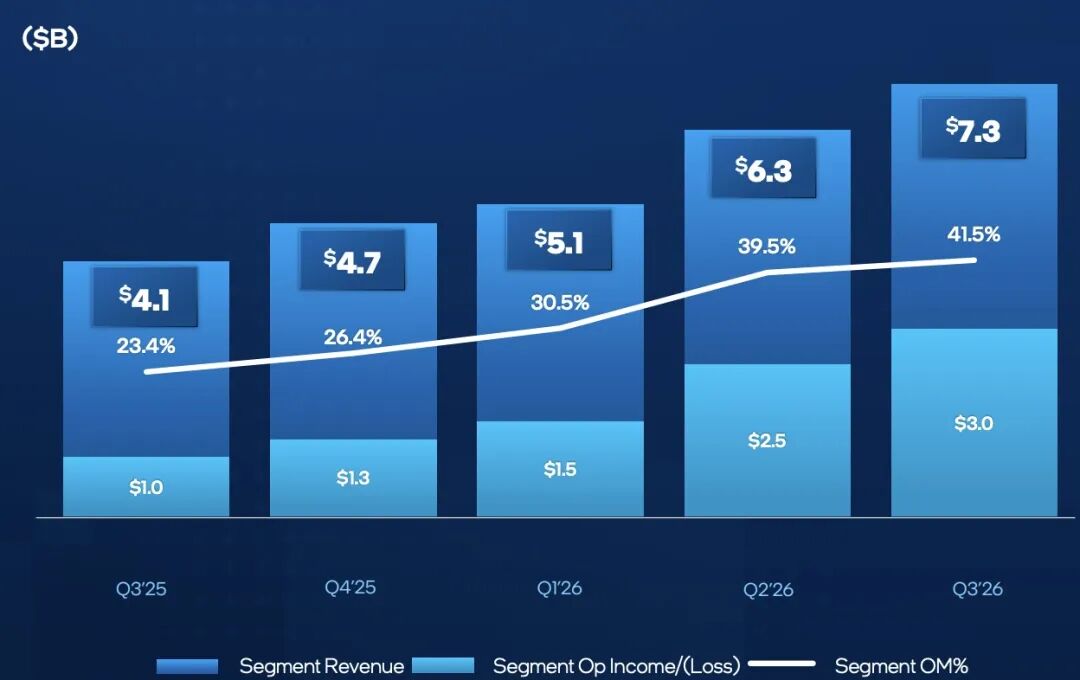
David Zinsner explained that the strong demand for Data Center and AI business comes from hyperscale cloud vendors, enterprises and emerging cloud vendors, and the revenue of Purpose Built Silicon has more than doubled year on year. The decline in revenue of Client Computing and Physical AI business is mainly due to the industry-wide memory shortage that has affected the size of the PC market. In contrast, the demand for AI PCs has increased year on year, the demand for Wildcat Lake chips based on 18A process is strong, shipments increased by 70% quarter on quarter, and they have all been sold out at present.
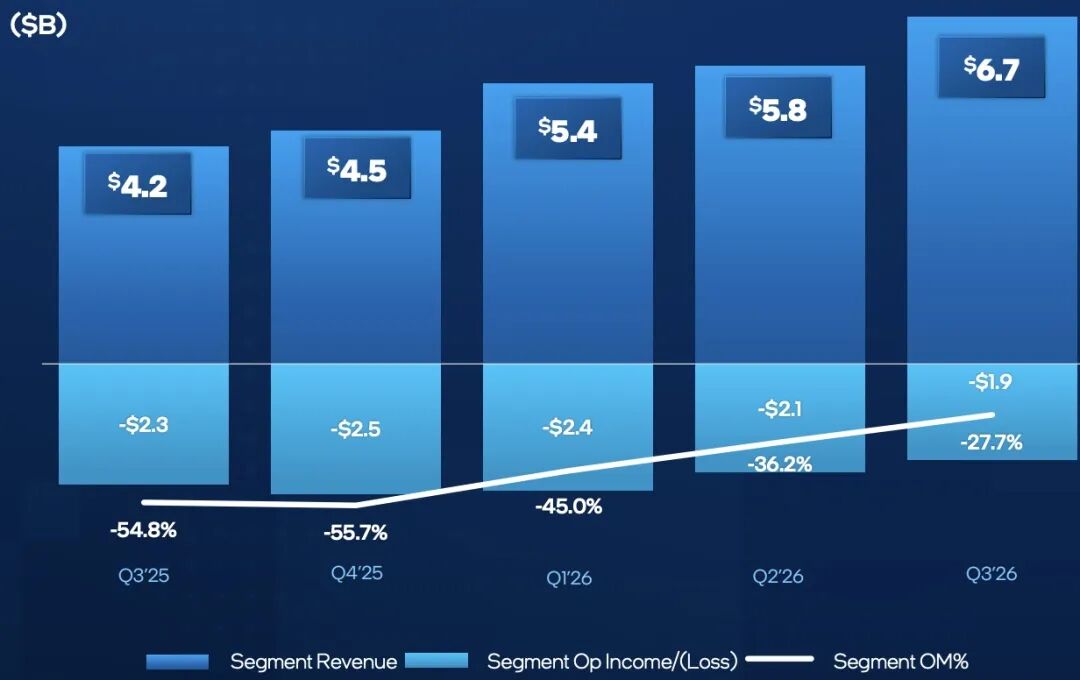
The revenue of Intel Foundry segment was 6.7 billion US dollars (equivalent to about 44.65 billion RMB), up 58% year on year, with an operating loss of 1.85 billion US dollars (equivalent to about 12.33 billion RMB), and the loss rate narrowed from -54.8% in the same period of last year to -27.7%. The company said that the improvement of yield and production cycle is reducing wafer cost.
Under the GAAP standard, Intel generated cash flow of 5.1 billion US dollars (equivalent to about 33.98 billion RMB) from operating activities in the third quarter, compared with 2.546 billion US dollars (equivalent to about 16.97 billion RMB) in the same period of last year, an increase of about 100% year on year, which mainly benefits from the high revenue growth of Data Center and AI business and the improvement of operating efficiency. After adjustments for items such as partner capital contribution, the company's free cash flow was 1.6 billion US dollars (equivalent to about 10.66 billion RMB), up about 83% year on year.
By the end of the third quarter, Intel's total cash and cash equivalents and short-term investments amounted to about 54 billion US dollars (equivalent to about 359.82 billion RMB). At the same time, the company completed $23 billion (equivalent to about RMB 153.26 billion) of public equity financing, introducing new sovereign funds and long-term growth investors; there is also an extended revolving credit line of 15 billion US dollars (equivalent to about 99.95 billion RMB) on the account.
In terms of fourth-quarter guidance, Intel expects revenue of 15 billion to 16 billion US dollars (equivalent to about 99.95 billion to 106.61 billion RMB), non-GAAP gross margin of 38.0%, and earnings per share of 0.25 US dollars (equivalent to about 1.7 RMB).
For the whole year, the company's capital expenditure in 2026 remains at 20 billion US dollars (equivalent to about 133.27 billion RMB).
The long-term server CPU market size is expected to expand from 40 billion US dollars to more than 200 billion US dollars (equivalent to about 266.54 billion to 1332.68 billion RMB) within five years.
02. Shutdown of Israeli plant will impact Q4 performance, server CPU shipment growth rate exceeds 30% for two consecutive years
Regarding the fourth-quarter guidance and 2027 plan, the gross margin in Q4 will drop to 38% and the free cash flow in 2027 will be negative. Intel gave the corresponding factors: the shutdown of Fab 28 plant in Israel, the tight supply of EMIB advanced organic substrates, and the inventory adjustment of PC clients. The company will hedge through capacity allocation, new product ramp-up and new capacity release in the second half of the year, and at the same time, it will focus capital expenditure on advanced process equipment and expansion of external foundry customers.
David Zinsner disclosed on the conference call that the long-term shutdown of Intel's Fab 28 plant in Israel will bring about 300 million US dollars (equivalent to about 2.0 billion RMB) of revenue loss in the fourth quarter, and the revenue impact in the first quarter of 2027 is expected to be similar.
Regarding the capacity allocation, Tan Lip-Bu replied that Intel will allocate part of the wafer capacity for client products to the server chip production line to ease the tight supply in the data center; the Intel 3 process capacity at the Oregon plant in the United States will be put into production in the second half of 2027.
On the server business side, the market is generally concerned about Intel's share trend next year under supply constraints. Tan Lip-Bu said that the share performance next year will be mainly determined by capacity supply, and Intel's product roadmap is competitive compared with competing products.
He mentioned that the current demand for AI server CPUs is strong, the growth rate of industry server CPU shipments will exceed 30% from 2026 to 2027, and the supply shortage will last until 2027 to 2028; Tan Lip-Bu revealed that many customers intend to sign long-term agreements (LTA) to lock in production capacity, but currently the company cannot fully meet the current demand. Intel's supply will still be tight in the first half of 2027, and will ease with the release of new capacity in the second half of the year, and the growth momentum of Data Center and AI business will continue throughout the year.
On Intel's product side, Nova Lake will fill the gap in the high-end desktop product line. The current PC market shows differentiation characteristics: the high-end AI PC Panther Lake maintains resilient demand against the downward trend of the overall market, while Wildcat Lake, which focuses on cost performance, has achieved significant growth; Intel hopes to rely on Nova Lake to optimize the product structure and drive the market share of the PC business to rise.
In terms of foundry business, Tan Lip-Bu said that many external customers are evaluating Intel 18AP and 14A processes, and a number of cooperation news are expected to be announced in the next two quarters; Intel 14A has released the 0.9 version of PDK to core customers in October, and the 1.0 version will be released in the first quarter of 2027.
In terms of advanced packaging, Intel's EMIB and EMIB-T technologies for internal products have been favored by a large number of external customers. At the same time, Intel has reached cooperation with Lens Technology in the field of TGV through-glass via advanced packaging, cooperated with ASML to accelerate the mass production preparation of High-NA EUV, and cooperated with Lam Research and Applied Materials to expand production and carry out joint R&D.
Regarding the capital expenditure structure in 2027, David Zinsner responded that equipment expenditure has increased significantly this quarter, and the growth will be more obvious in the next quarter. Most of the new capital expenditure will be invested in equipment procurement, and only the Ohio plant in the United States is still in the large-scale construction stage. He also reiterated that 2027 is a year of heavy investment, and positive free cash flow cannot be achieved for the whole year, which is the core reason for the equity financing in August; in the long run, these advanced process nodes are expected to achieve a minimum return on investment of 20%.
03. Conclusion: Servers replace PCs and become the new growth engine of the business
At present, AI workloads are migrating from training to inference and Agentic AI, cloud vendors' capital expenditure continues to expand, and the data center's demand for CPU scheduling, memory and network collaboration is rising simultaneously. Server CPUs have become another rigid demand besides GPUs in AI infrastructure.
The core of Intel's current growth is x86 server CPUs. The volume of AI inference and Agentic AI workloads is directly converted into x86 server CPU orders. The company's current leading position is maintained by production capacity and product rhythm; coupled with the growth of custom chip orders from scratch, the server business has taken over the position of the growth engine from the PC business.
This article is from the WeChat official account "Chipsn", author: Cui Yuanwei, editor: Chen Junda, published by 36Kr with authorization.