Using "DNA movable-type printing technology" to generate biological data for AI, Yongyuan Hesheng has secured 50 million yuan in angel round financing | 36Kr Exclusive
By HU Xiangyun
Edited by HAI Ruojing
36Kr learned that Yongyuan Hesheng Technology (Shenzhen) Co., Ltd. (hereinafter referred to as "Yongyuan Hesheng") has recently completed a 50 million yuan angel round of financing. This round of financing was jointly invested by Shunwei Capital and Yunmu Capital. The funds raised in this round will be used to produce high-value datasets, expand the production capacity of self-developed innovative DNA synthesis technology, and further build data casting infrastructure.
Yongyuan Hesheng is positioned as a "data casting platform in the AI+biology field", providing scientific research institutions, pharmaceutical enterprises and model teams with integrated services from sequence construction, functional experiments to data sorting, and delivering AI-ready sequence-function datasets.
Yang Zongying, Founder and CEO, explained that the reason for choosing this direction to start a business is that for AI biological design teams, after generating candidate sequences, there is a question that must be answered through experiments: How exactly do these designs perform under specified conditions, and which directions should be further optimized in the next round? "We hope to take over this link, connect DNA construction, functional measurement and data sorting, and produce sequence-function data around customers' R&D issues. The data can be used not only for model training, but also for evaluating models, comparing candidate schemes and arranging the next round of experiments."
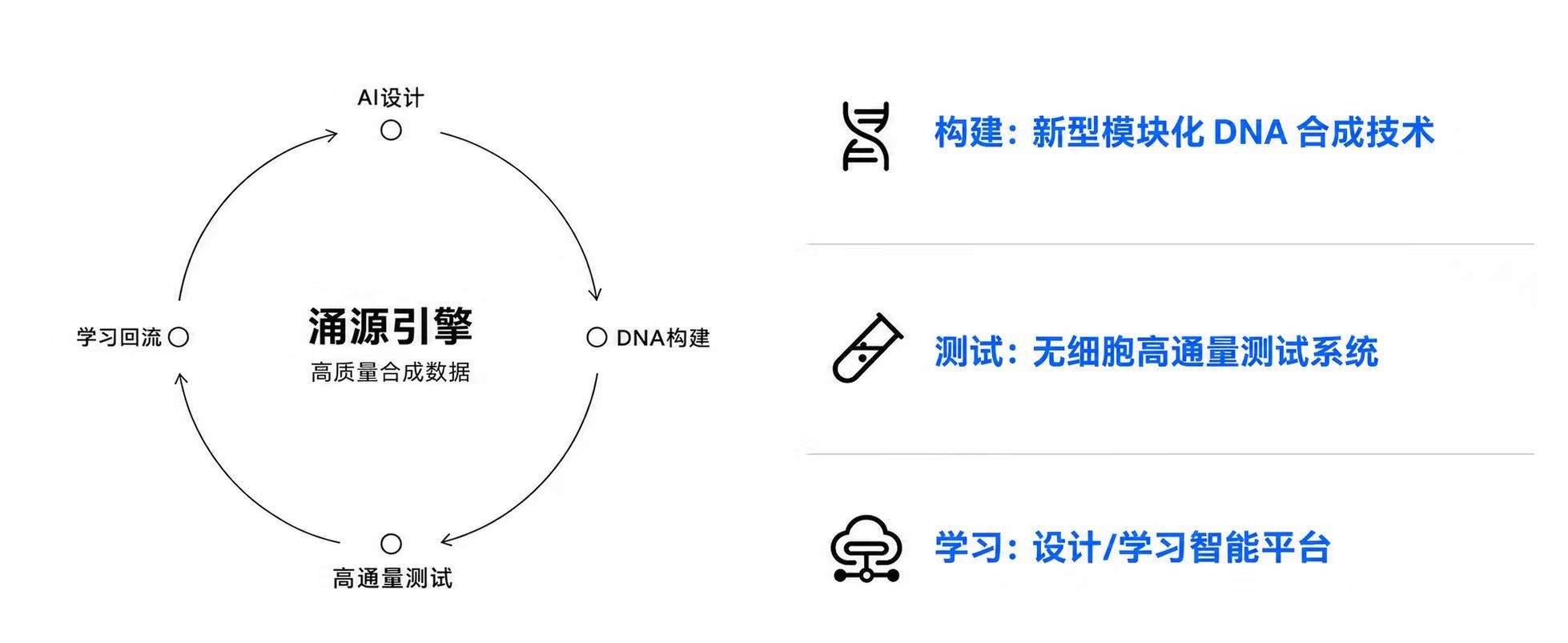
Image source: Yongyuan Hesheng
In 2015, when Yang Zongying was pursuing a master's degree in synthetic biology at Imperial College London, he found that although the discipline was booming, the research paradigm in laboratories was still relatively primitive. "For example, there are more than 20,000 genes in human cells, but researchers often only modify a very small number of gene nodes and then observe the changes of the system, so the information that can be obtained is very limited."
Since it is difficult to decode complex life systems only by manual human operation, can AI, which is better at mining patterns from massive data, bring new breakthroughs?
With this idea, Yang Zongying later went to Newcastle University in the UK to pursue a doctorate in computer science, studying the use of machine learning for genome design. Shortly after the research started, he found that compared with computing power and algorithms, the real gap lies in the large amount of biological data required to train the model. The reason why such data is scarce is largely stuck in the initial link: the cost of DNA synthesis is too high.
The mainstream DNA synthesis methods on the market include chemical synthesis, high-throughput chip synthesis represented by Twist, and the emerging TdT enzymatic synthesis method. These paths have their own advantages in technical dimensions, but in general, it is difficult to fully support the massive data supply required by AI in the three dimensions of cost, speed and synthesis length.
Therefore, Yang Zongying decided to break through the underlying logic of the traditional framework and find a new set of DNA synthesis methods to solve the cost problem of data production. He called it "DNA movable type printing".
Simply put, the underlying logic of traditional DNA synthesis is to splice individual nucleotides one by one. Taking chemical synthesis as an example, although its single-step accuracy is as high as 99.5%, it can generally only synthesize fragments within 200 bases at a time. To obtain a 1000-base gene, further splicing and assembly are required. If calculated according to the single-step accuracy, after 999 reactions, the correct rate of the final product has been greatly reduced, so subsequent quality control screening requires greater investment. Coupled with raw material waste, labor and other cost items, the price of DNA synthesis has remained at a high level for a long time.
"DNA movable type printing" no longer splices individual bases one by one, but builds a "DNA movable type library" in advance. The movable type library is composed of prefabricated double-stranded modules, covering frequently used sequence combinations that can be called repeatedly like movable type.
"After receiving the order, we first plan the synthesis path through intelligent algorithms, select the optimal combination of DNA movable type modules, and complete sequential assembly relying on the self-developed multi-enzyme system. In this way, the reaction that originally needed to be done 999 times now only needs about 99 times; in addition, the single-step accuracy of the enzyme-mediated assembly reaction is higher, and our single-base synthesis fidelity reaches 99.95%. By reducing the number of reactions and improving single-step accuracy, the proportion of the final correct product will be significantly increased, and the quality control cost will also decrease accordingly." Yang Zongying explained.
According to other introductions, the movable type module adopts a double-strand form with stable structure, which can synthesize complex sequences that are difficult to synthesize by traditional processes, such as high GC content (more than 80%), extremely low GC content (less than 15%), hairpin structures, tandem repeat sequences, etc. In addition, the movable type module can be called repeatedly for a long time after one preparation, and the cost allocated to each use is greatly reduced. After the whole process is integrated into the automatic production line, the labor cost is also expected to be compressed.
According to the data provided by Yongyuan Hesheng, the company's single-base synthesis cost has dropped to less than 0.05 yuan, which is about 1/10 of the traditional commercial level; the delivery cycle of 10kb length DNA has been shortened to less than 7 days, while the traditional scheme usually takes 21-35 days. At present, this technology can be stably reproduced in the laboratory environment, and the company is tackling the mass stable production at the factory level.
However, synthesizing cheaper DNA only solves part of the problem. "Our original intention is to solve the gap of biological data required by AI, and the premise of producing biological data at low cost is to have relatively complete DNA synthesis capabilities. After that, the more core work is to extend downstream, convert sequences into experimental data, and supply them to scientific research institutions, pharmaceutical enterprises or large model companies." Yang Zongying said.
To turn sequences into data that can be used to train AI, sequences and functions need to "appear in pairs". For example, for an antibody, it refers to an antibody sequence corresponding to its binding strength value on a certain target. What Yongyuan Hesheng wants to do is to mass-produce this pairing relationship, synthesize thousands of candidate sequences at one time, conduct binding experiments one by one to measure the affinity, and then record these values together with experimental conditions into a table to generate a complete dataset.
At the same time, the cost of the test end is no lower than that of synthesis. Taking Bio-Layer Interferometry (BLI) technology for antibody affinity detection as an example, a single sample costs hundreds of yuan, and thousands of samples cost hundreds of thousands of yuan; traditional cell transformation and expression takes about one week per round, and is highly dependent on labor.
To this end, Yongyuan Hesheng has built a self-developed rapid protein characterization system, eliminating the links of cell culture, transformation and clone screening. "With our method, results can be obtained in about 2-4 hours. After connecting to an automated workstation, the current baseline can reach more than 2000 samples per week." At the same time, Yongyuan Hesheng is also improving a higher-throughput characterization platform, combining innovative characterization technology with high-throughput sequencing technology to realize larger-scale characterization and analysis of biological data such as antibodies.
Yang Zongying mentioned that one of the core tasks of building AI-ready datasets is to supplement metadata. In the past, researchers only needed to record the affinity value corresponding to the antibody sequence, but to train AI, it is necessary to completely record information such as the experimenter, experiment time, temperature, pH, reagent batch, etc., to help the model filter noise. On the other hand, in the traditional scientific research system, researchers basically only publish positive results that meet scientific hypotheses, while AI training requires both positive and negative samples to achieve higher learning efficiency. "Analogous to students preparing for exams, only practicing the questions they can do has limited improvement, and training on wrong questions is more helpful to improve their abilities."
According to the introduction, currently Yongyuan Hesheng's dataset products are divided into two types: general and customized. General datasets are produced in advance for the common needs of the industry and sold in a shelf-style manner, for example, pre-measuring the affinity of a batch of antibody sequences around popular targets, or providing enzyme sequence and function data for industrial enzyme enterprises. "These are also the two types of data with large market demand after the emergence of AI model training requirements."
Customized datasets are provided for customers who come with specific problems. Yang Zongying gave an example that the company once cooperated with a Fortune Global 500 enterprise on UTR sequence design for mRNA, and UTR affects the expression level and stability of mRNA in the host. "After we synthesized multiple groups of DNA, we continued to carry out in vitro experiments, which supported the rapid realization of hundreds of groups of sequence and expression level paired data, and then realized model fine-tuning."
In terms of commercialization, Yongyuan Hesheng has currently cooperated with some trial customers, covering scientific research institutions, pharmaceutical enterprises and large model companies. "In 2027, our revenue is expected to reach tens of millions of yuan." Yang Zongying said.
Yang Zongying introduced that a leading domestic AI model company is one of the customers that have in-depth cooperation with the company at present. The two sides cooperate on the iteration of the antibody generation model, the partner provides computing power and algorithms, and Yongyuan Hesheng provides data casting infrastructure to open up the closed loop from AI-generated sequences, experimental verification to data reflux.