Sanhua: Profit Slides, Are Robots Only Worth the Minimum Guaranteed Price?
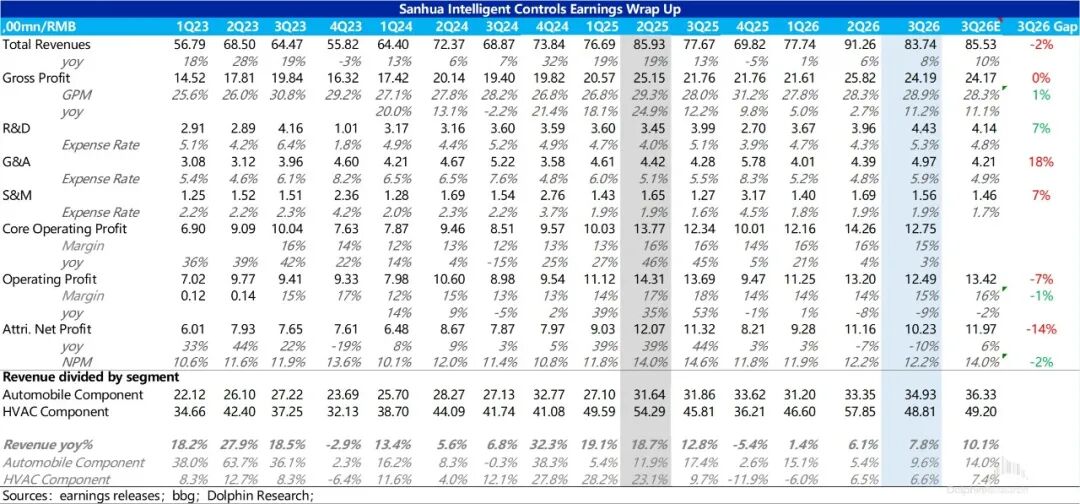
On the evening of October 28 Beijing time, Sanhua Intelligent Controls (2050.HK) released its 2026 Q3 financial report. Overall, the company's performance this quarter remained muted: revenue came in slightly below expectations, gross margin beat forecasts, but rising expenses eroded profits, leading to net profit significantly lower than market consensus. Details are as follows:
1. Revenue slightly missed expectations, but growth rates of both major segments are improving: Total revenue in Q3 reached 8.37 billion yuan, up 7.8% year-on-year, a mild acceleration from the 6.2% growth rate in Q2, but still below the market expectation of 8.55 billion yuan (10% YoY growth). Breakdown as follows:
① Auto component growth rebounded: Automotive component revenue rose approximately 9.5% YoY to 3.49 billion yuan this quarter, a clear pick-up from the 5.4% growth rate in Q2, but below the market's expected 14% YoY increase.
From an industry perspective, domestic new energy vehicle demand remained weak in Q3, with retail sales of domestic new energy passenger vehicles reaching about 3.04 million units, down 11% YoY. The incremental volume mainly came from exports: Sanhua holds a high supporting share in popular models of export-oriented automakers such as Leapmotor and Geely.
In terms of policies, the export tax rebate rate for new energy vehicles will be lowered from 13% to 9% starting from April 1, 2027; before the policy takes effect (from Q4 this year to Q1 next year), a wave of export rush is expected. The company's supporting vehicle exports are counted as domestic sales, so the ratio of domestic to overseas sales in the auto component segment in the first three quarters was approximately 67:33, with the overseas share declining YoY.
In terms of customer structure, the management stated that the combined share of major customers has fallen below 25%, with core customers including BYD, Leapmotor, Geely, Xiaomi, and Li Auto, further reducing reliance on any single major customer. Integrated products increased by 20%-30% YoY this year, accounting for more than 50% of total revenue.
② Refrigeration business growth continues to rise, driven by liquid cooling and overseas markets: Refrigeration business revenue increased by approximately 6.6% YoY to 4.88 billion yuan this quarter, continuing the positive 6.5% growth recorded in Q2, but fell by about 16% quarter-on-quarter after seasonal adjustments.
The industry landscape remains weak: after the national subsidy phase-out, domestic air conditioner output has continued to decline YoY since September 2025, with a drop of around 12% from July to August, and a 16% YoY decline in Q3 output, while shipment side declines were even steeper (domestic domestic sales shipments fell 28% in August). Sanhua's refrigeration segment still managed to achieve positive growth, driven by the following core factors:
a. Data center liquid cooling volume release: Liquid cooling revenue in Q3 increased by 50%-100% YoY, with total liquid cooling revenue in the first three quarters reaching approximately 18-21 billion yuan, including 12-14 billion yuan from data centers (400 million yuan in Q3, continuing to climb quarter-on-quarter) and 600-700 million yuan from energy storage.
b. Overseas markets: Revenue in North America increased by more than 20% YoY (benefiting from data center construction and commercial HVAC demand). Demand in Japan and Southeast Asia is strong, driven by rising temperatures, higher air conditioner penetration, and energy efficiency upgrade policies.
c. However, after excluding liquid cooling, the domestic home appliance business still recorded a slight decline, which is the main reason why refrigeration growth did not meet market expectations. The management indicated that the above trend (growing volume of liquid cooling business overseas) will continue in Q4.
2. Gross margin beat expectations: Sanhua's gross margin in Q3 was approximately 28.9%, higher than the market expectation of 28.3%, up about 0.6 percentage points from Q2, demonstrating strong resilience amid high copper and aluminum prices and unfavorable exchange rate headwinds. Breakdown as follows:
The gross margin of refrigeration components in Q3 increased by 1.5 percentage points YoY, mainly driven by:
a. Structural pull: Both liquid cooling and export businesses have significantly higher profit margins.
Primary-side liquid cooling products (microchannel heat exchangers, filters, sensors) are mainly targeted at North American customers. Larger products with higher process requirements deliver higher gross margins. Secondary-side products (stainless steel brazed plate heat exchangers, chip cold plates, quick connectors, etc.) are the current key positioning area, with orders exceeding supply. The value of some individual products reaches 50,000-100,000 yuan, and the value of liquid cooling components exceeds expectations. The company stated that core customer demands focus on fast delivery rather than low prices, so profit margins are higher than existing commercial products.
Overseas refrigeration business is dominated by commercial applications, with a high degree of customization and a more profitable structure than the domestic market.
b. Endogenous cost reduction: Gross margin is still improving even after excluding liquid cooling and North American business, driven by material substitution such as stainless steel replacing copper and aluminum replacing copper, cost reduction brought by intelligent manufacturing, and a higher proportion of high-margin products. In terms of copper prices, major customers implement copper price linkage clauses, so selling prices rise synchronously when copper prices increase, limiting the impact on gross margin.
The gross margin of automotive thermal management business remained largely flat with a slight decline: The gross margin of the auto component segment in the first three quarters was approximately 28.6%. There are three drag factors:
a. Exchange rate: The euro and yen depreciated by about 5% and 11% respectively against the RMB YoY, hurting the revenue conversion of overseas factories;
b. New factory ramp-up: New overseas production capacity is still in the ramp-up phase, leading to high fixed cost amortization;
c. Annual price reduction: The new energy vehicle industry is highly competitive, and OEMs continue to press down prices on components. The management's response is to shift from "extensive expansion" to "intensive cultivation" – reducing costs across the full value chain, focusing on high-profit projects, and increasing the proportion of integrated products (integrated products have higher profit margins and can drive component sales).
3. Net profit was significantly lower than expected: Q3 attributable net profit was 1.02 billion yuan, down 9.6% YoY, about 15% lower than the market expectation of 1.2 billion yuan; non-recurring profit deducted net profit was 1.02 billion yuan, down 5.1% YoY, while the non-deducted net profit in the first half of the year still recorded a 6.8% YoY increase.
There are two main reasons for the profit decline:
a. Three major expenses rose significantly: Total three expenses this quarter reached about 1.1 billion yuan, up 16% YoY, of which R&D expenses were about 440 million yuan, pushing the expense ratio above 5%, corresponding to increased investment in new businesses including liquid cooling and robotics; management expenses also increased significantly quarter-on-quarter.
b. Other expenses: Increased floating investment losses and exchange losses, and reduced government subsidies recorded in other income (YoY decrease).
Segment breakdown:
Refrigeration segment: Q3 net profit was approximately 550 million yuan, down about 10% YoY, with a net profit margin of about 11.2%, down 0.4 percentage points from Q2. Floating investment losses are mainly recorded in this segment, and the management stated that the segment's profit after non-recurring items deduction is still growing YoY.
Automotive component segment: Q3 net profit was approximately 480 million yuan, down about 10% YoY, with a net profit margin of about 13.6%, up 0.4 percentage points from Q2, but significantly lower than the net profit margin of over 16% in the same period last year.
Revenue grew by nearly 10% YoY while profits declined YoY, which is mainly squeezed by three factors: exchange rate, new factory ramp-up, and annual price reduction.
Dolphin Analyst View:
Overall, Sanhua Intelligent Controls' 2026 Q3 performance remained muted: revenue grew 8% YoY, slightly accelerating from Q2 but still below expectations. Gross margin beat expectations driven by the structural pull of liquid cooling and North American business, but ongoing exchange losses, rising R&D and management expenses, plus reduced subsidies, led to a 9.6% YoY decline in attributable net profit, about 15% lower than market consensus.
More notably, the non-recurring profit deducted net profit also fell by 5% YoY. Even after excluding factors such as exchange losses, the core operating profit (gross profit minus core three expenses) defined by Dolphin Analyst only increased by 3% YoY.
In terms of full-year performance, the management only stated that after excluding floating investment losses and exchange losses, the company can still achieve its initial annual target (the original target was about 15% profit growth). However, according to actual financial statements, the attributable net profit in the first three quarters reached 3.07 billion yuan, down 5.4% YoY. Therefore, Dolphin Analyst estimates that Sanhua's 2026 net profit will be 4 billion yuan, down 3% YoY, and core net profit will be 4.88 billion yuan, up 6% YoY.
The medium and long-term targets released by the management this time are more noteworthy – the 2026–2030 new five-year plan:
a. Traditional household refrigeration: average annual growth of about 10% (excluding liquid cooling and commercial applications);
b. Commercial refrigeration and microchannel: double current size by 2030, with 15%-20% annual growth; controllers have a low base, and may grow 3 to 4 times in five years;
c. Automotive components: 15%-20% annual growth, driven by rising electrification penetration (still increasing in Europe and Southeast Asia), heat pump replacing PTC brought by autonomous driving (penetration in China may exceed 90%), and product integration.
Dolphin Analyst believes that these targets are significantly higher than the company's actual growth rate in the past two years (revenue only grew 5.2% in the first three quarters of 2026). Whether these targets can be delivered depends on the sustainability of the two incremental growth drivers: liquid cooling and overseas business.
For Sanhua's stock price, most of its valuation comes from the progress of its high-growth imaginative businesses:
(1) Data center liquid cooling: This is the most substantial progress this quarter, and also the most quantifiable short-term growth driver. Liquid cooling revenue in the first three quarters reached 18-21 billion yuan, and the full-year target of 50% YoY growth is achievable. The management stated that "50%-100% growth" for liquid cooling business next year is visible.
In terms of products and customers, multiple breakthroughs were achieved on the secondary side in Q3: the brazed plate heat exchanger project for Taiwan-funded CDU manufacturers was mass-produced and added to the approved supplier list; projects for customers such as Vertiv and Schneider Electric were landed; in the liquid cooling projects for next-generation self-developed ASICs of North American cloud vendors, Sanhua's sensors and flow control valves have entered mass supply; Sanhua has entered the NVIDIA system through Taiwan-funded enterprises, and is also in direct contact with NVIDIA at the same time.
The market share of primary-side microchannel products exceeds 50%, with orders locked in until next year, and new production capacities in Mexico and Thailand are being put into operation.
In terms of value proportion, the company's existing products cover 20%-30% of the total value of the liquid cooling system, which is expected to rise to 40%-60% after secondary-side products are mass-produced, with quick connectors and manifolds being the main incremental contributors.
Currently, primary-side products account for about 70% of Sanhua's total liquid cooling sales, and the ratio of primary-side to secondary-side products in ongoing negotiation projects is about 5:5. After secondary-side products ramp up next year, the revenue structure will gradually shift to a 3:7 ratio.
Dolphin Analyst estimates that the combined revenue of liquid cooling and energy storage will reach about 3.2 billion yuan in 2026. If it grows by 50%-100% in 2027, the corresponding revenue will reach about 4.8-6.4 billion yuan, accounting for 12.5%-17% of the company's total revenue. In addition, the profit margin of secondary-side products is higher than existing commercial products, which will also positively drive gross margin.
The company insists on only producing components instead of complete CDU units to avoid competing with customers such as Vertiv and Invicool, but will develop regional module integration, which is a relatively prudent positioning.
(2) Humanoid robots: The company still did not give a clear timeline or revenue figure, only stating that information about actuators will be subject to official announcements from major North American customers, some projects will start mass production by the end of the year, and robotics revenue next year will double compared with this year.
In terms of products, the company has deployed body joint actuators, finger joint modules, robot thermal management, and sensors, covering approximately 60% of the total hardware value of a robot. The hollow cup motor module for dexterous hands has been launched with leading domestic dexterous hand manufacturers, entering the small-batch production phase.
From an industry perspective, Tesla confirmed on its Q3 earnings call that Optimus has been put into production at the Fremont factory and started internal deployment, and the ramp-up speed did accelerate in Q3:
According to a September 25 report by The Information, the weekly output of Optimus at Tesla's Fremont factory rose to hundreds of units in August, about ten times higher than the dozens of units per week in Q2. The target is to build a continuous automated production line with a weekly output of more than 1,000 units by the end of the year, reaching about 20,000 units per week by the end of 2027.
On the order side, according to a report by CLSA, Tesla issued a bulk order of about 5,000 units to its core supply chain in early September, and launched a new round of factory audits for core suppliers including Tuopu, Sanhua, and Joyson.
However, it needs to be reminded that the ramp-up of complete machines does not mean the market's expectations for Sanhua's robotics business are rising synchronously. On the contrary, market sentiment has cooled significantly: First, the ramp-up of complete machines follows a "slow start" S-curve – the assembly of dexterous hands and joints still heavily relies on manual labor, insufficient alignment accuracy of assembly equipment leads to a high rework rate, and there are also reliability issues with dexterous hand durability and tactile sensors, making mass production delivery slower than previously expected. Second, more new entrants are entering the actuator market, intensifying competition, and the market's previous optimistic assumption that "Sanhua will capture more than 50% market share" has started to loosen.
From a valuation perspective, assuming that the after-tax core operating profit of 2026 (excluding disturbances such as exchange losses) is about 4.15 billion yuan, representing a 6% YoY increase. Considering that Sanhua's traditional main business is a global leading player in thermal management with strong certainty, we assign a 15x PE to the main business in 2026 (close to the historical bottom of 13-15x in A-shares from 2012 to 2014, lower than the long-term average of about 22x), corresponding to a reasonable valuation of about 62.3 billion RMB for the main business.
For the robotics imaginative business, we give a valuation range: under the conservative scenario (1 million global humanoid robots in 2030, Sanhua's share of 20%), the corresponding valuation is about 45 billion yuan; under the neutral-to-optimistic scenario, we use the assumptions from last quarter (1 million units of Optimus annual sales in 2030, single-unit actuator value of about 50,000 yuan, Sanhua's share of 50%, net profit margin of 15%, 30x PE), the corresponding valuation is about 112.5 billion yuan. Considering intensified share competition, Dolphin