Intel: The PC sector has "collapsed" — Is this merely a minor stumble or a real sacrificial opening?
Intel released its Q3 2026 financial report (ending September 2026) after U.S. stock market hours on the morning of October 30, 2026 Beijing Time, the key points are as follows:
1. Core Metrics: Next-quarter guidance "collapses"
The "extremely disappointing" guidance is the "fuse" for the sharp post-market slump. Intel expects the company's Q4 2026 revenue to be $15-16 billion, down 3%-9% quarter-on-quarter, significantly lower than market expectations ($17.06 billion).
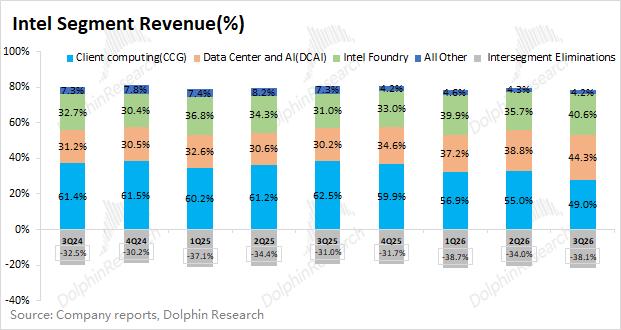
Among them, the Data Center and AI Group (DCAI) maintained double-digit quarter-on-quarter growth, while the Client Computing Group (CCG) "collapsed", declining by more than 20% quarter-on-quarter. This is mainly because the PC market is under the dual pressure of storage shortage and weak end-user demand, and channels are further destocking.
The gross margin in Q4 2026 is 37.1%, down 6 percentage points quarter-on-quarter, far lower than market expectations (41.8%). An explosion occurred at the Fab28 plant in Israel, which impacted gross margin by about 2 percentage points. Even excluding this part, the gross margin still dropped by 4 percentage points, mainly dragged down by insufficient capacity utilization caused by the sharp decline in PC business.
In short, the 2 percentage point impact from Fab28 is a short-term factor, and the gross margin will return to around 39-40%. But to "recover" the extra 4 percentage points of gross margin decline, it depends on the recovery of PC business and the improvement of capacity utilization. According to the management's statement, this recovery will not happen until the second half of 2027 and later.
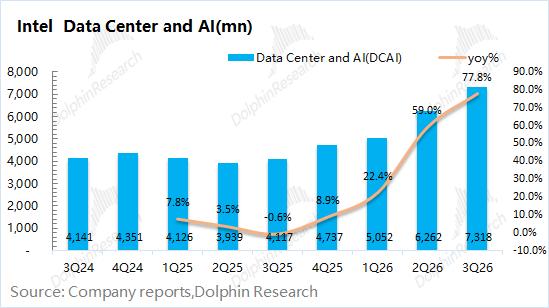
2. Data Center and AI Business: Revenue for this quarter reached $7.3 billion, up 78% year-on-year, beating market expectations of $6.63 billion. The growth still mainly comes from the simultaneous rise in volume and price of Xeon server CPUs, and Granite Rapids remains in a "tight supply" state.
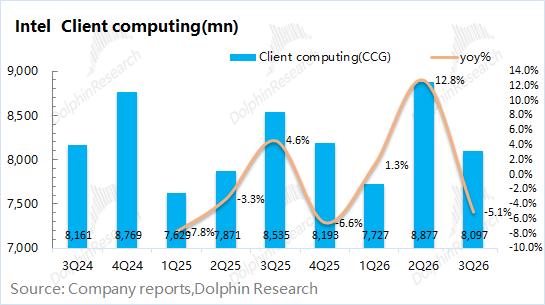
3. Client Business: Revenue for this quarter is $8.1 billion, down 5% year-on-year, far lower than market expectations of $8.84 billion. Previously the market hoped that the company's PC business could stay stable, but it still "failed to hold steady" starting from this quarter.
The company's previous growth mainly came from price increases and product structure optimization (rising proportion of AI PCs), rather than shipment volume. However, due to the continued downturn in the end market, price increases are no longer a "long-term solution" (consumer acceptance is getting lower and lower).
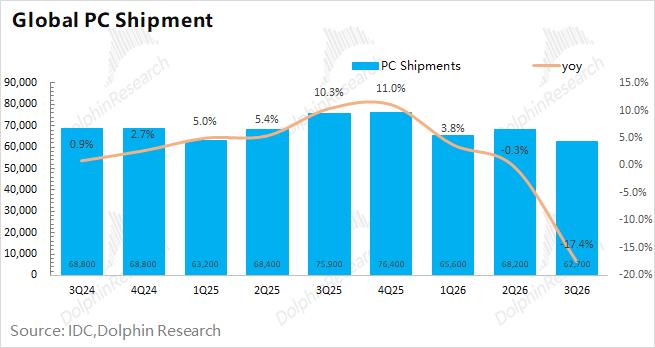
Combined with the 17% year-on-year decline in global PC shipments this quarter, the price increase of memory has pushed up the cost of complete machines, and PC demand continues to be suppressed. Even if Intel is the core CPU supplier in the PC market, it is difficult to "stay unaffected". When end-market demand sees a double-digit decline, it is quite difficult to pass on costs through price increases.
4. Intel Foundry Services: Revenue for this quarter is $6.7 billion, up 58% year-on-year, beating market expectations of $6.12 billion. The company's foundry business currently mainly serves internal customers, so the total figure mainly reflects the performance of the company's own products.
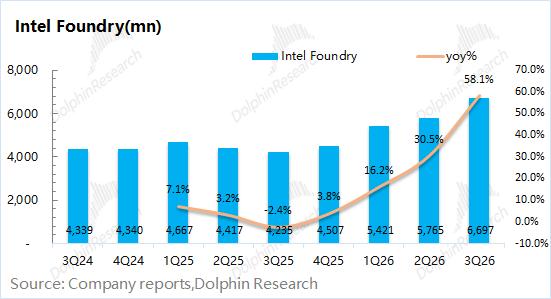
Combined with internal offset items, Dolphin Research estimates that the company's external foundry revenue this quarter is about $400 million, which is still quite low. Foundry revenue mainly grows along with the wafer production of the company's own products (volume ramp of 18A Panther Lake); external revenue is still dominated by advanced packaging (EMIB-T) and mature process nodes, and external orders for 14A/18A have not yet generated revenue.
The company disclosed its progress in the foundry business: 18A-P will be fully deployed in all internal products before the end of the year, and the company is in contact with several strategic customers; for 14A, the 0.9 PDK was released to specific customers in October as promised, and risk production will start next year.
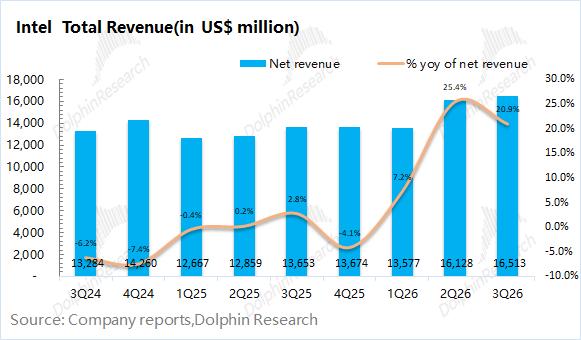
5. Operating Data: The company achieved revenue of $16.5 billion this quarter, up 21% year-on-year, in line with market expectations ($16.53 billion), which is mainly driven by the continued volume growth of data center and AI business, while the client business has started to decline.
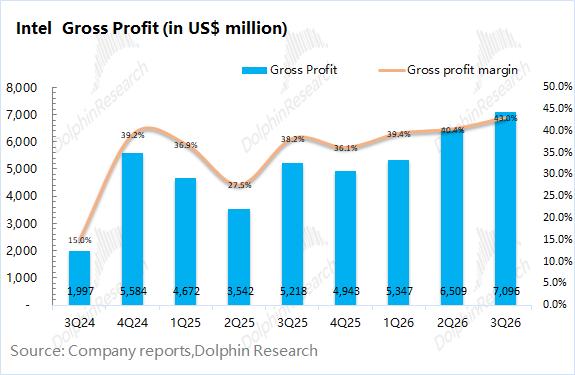
The gross margin this quarter is 43%, beating market expectations (41.1%). The previous continuous improvement of gross margin was driven by CPU price increases and yield improvement. However, the company's guidance indicates a significant decline in gross margin next quarter, which is mainly dragged down by the Fab28 plant incident and the decline of the PC market.
6. Progress of headcount reduction and cost control: The company's core operating expenses (R&D expenses + sales, general and administrative expenses) this quarter are $4.5 billion, with a core operating expense ratio of 27%, down 0.8 percentage points quarter-on-quarter. The company is still cutting headcount to control costs, and the total number of employees this quarter is 81,000, down 1,200 quarter-on-quarter.
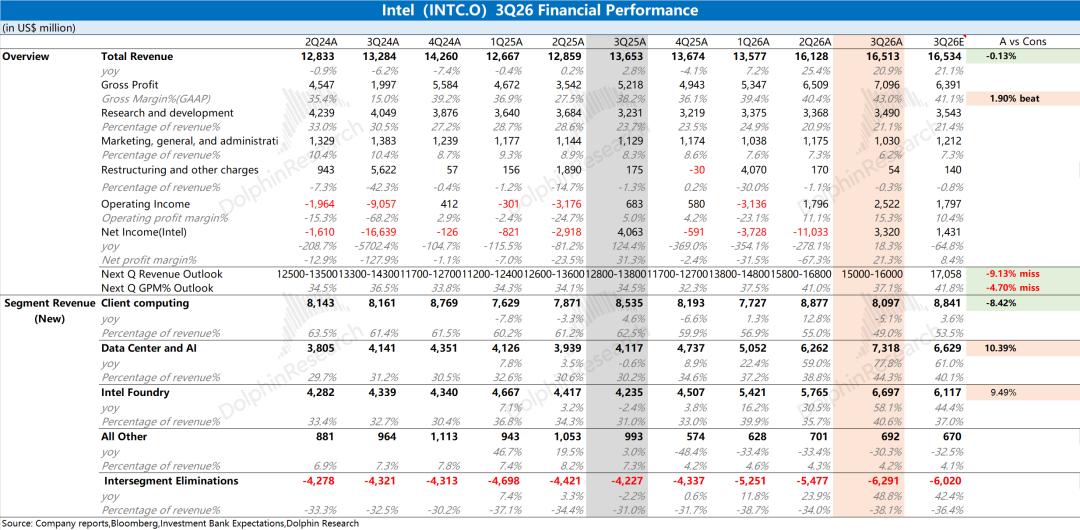
Overall view of Dolphin Research: The overall performance is in line with expectations, the key point is that the next-quarter guidance "collapsed".
Intel's next-quarter guidance is far below market expectations, with both revenue and gross margin declining quarter-on-quarter, forming a sharp contrast with the better-than-expected results of the last quarter, which is the direct cause of the sharp post-market decline.
The management attributed the reason to the explosion and shutdown of the Israel plant and the cliff-like decline in PC demand. Looking deeper, the market's original expectation of "sustained volume growth in data center business and stable PC business" has failed: rising storage prices, superimposed on the shift of memory production capacity to HBM, plus channel destocking, the PC business has collapsed, and it is also questionable whether the subsequent CPU price increase can be implemented. To restore market confidence, we can only look at whether server CPUs and external foundry business can exceed expectations.
As for capital expenditure, the company maintained the caliber given last quarter that 2027 capital expenditure will be significantly higher than that of 2026 ($20 billion), and added that the deterministic order growth for equipment vendors is nearly 40%. If estimated at 40%, the 2027 capital expenditure is expected to reach $28 billion, which is basically in line with market expectations ($26-30 billion).
For Intel, the market mainly pays attention to the progress of the following aspects:
a) CPU market share: the fundamental base of Intel's performance
Intel and AMD basically hold a monopoly position in the CPU market, but AMD has been "eroding" Intel's market share with the "CPU+GPU" portfolio. According to Mercury data, Intel's server x86 CPU shipment share has dropped below 70%, and the PC CPU share has also dropped to around 60%, and the server share may continue to decline in the next few quarters.
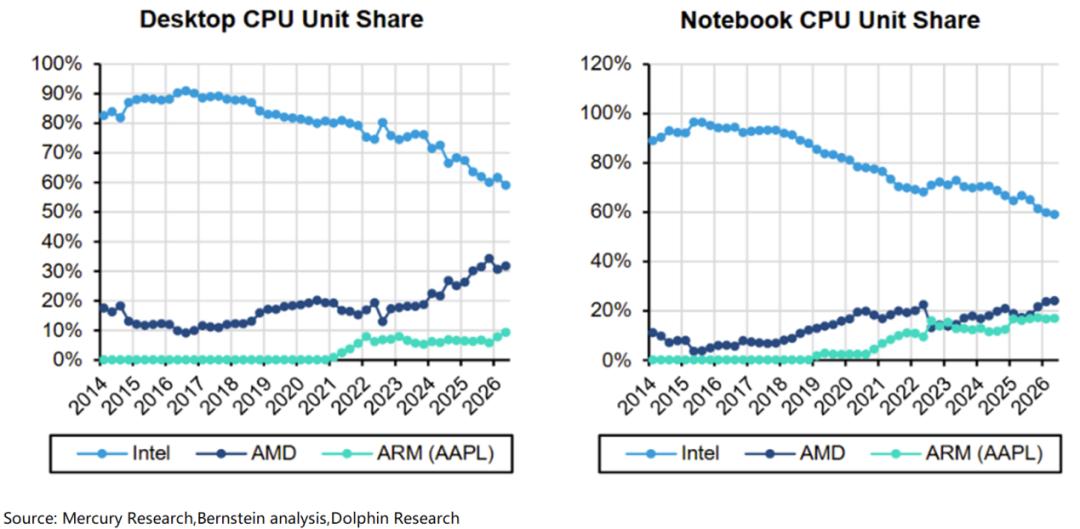
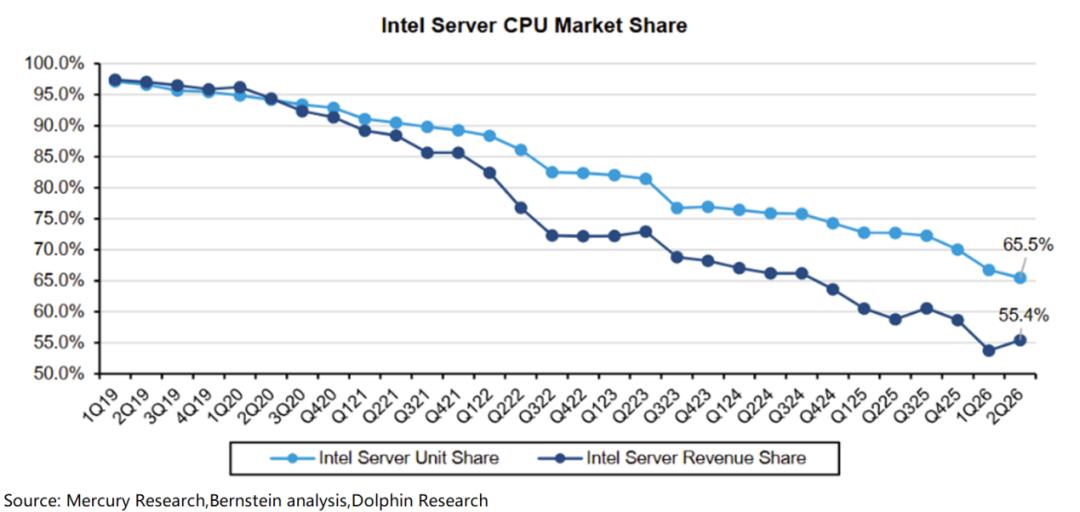
The growth of the company's data center and AI business this quarter is still mainly driven by the increase in overall downstream server CPU demand and the company's product price increases.
This financial report confirms the market's concerns about Intel: ① With the price increase of memory pushing up the cost of complete machines, how much upside space is left for CPU ASP, currently it seems that PC customers may have started to resist; ② Facing new products such as AMD Venice/Verano, how will the company stabilize its server market share.
b) Progress of Foundry business: the core narrative that determines the valuation multiple
① 18A: 18A yield continues to improve, 18A-P will be fully deployed in all internal products before the end of the year, and the company is in contact with several strategic customers;
② 14A: 14A released the 0.9 PDK to specific customers in October as promised, and will start risk production in 2027.
③ Advanced packaging EMIB-T: Google/MediaTek TPU and Meta MTIA have completed evaluation, mass production is expected to start at the end of 2027, and the opportunity for a single customer exceeds $1 billion.
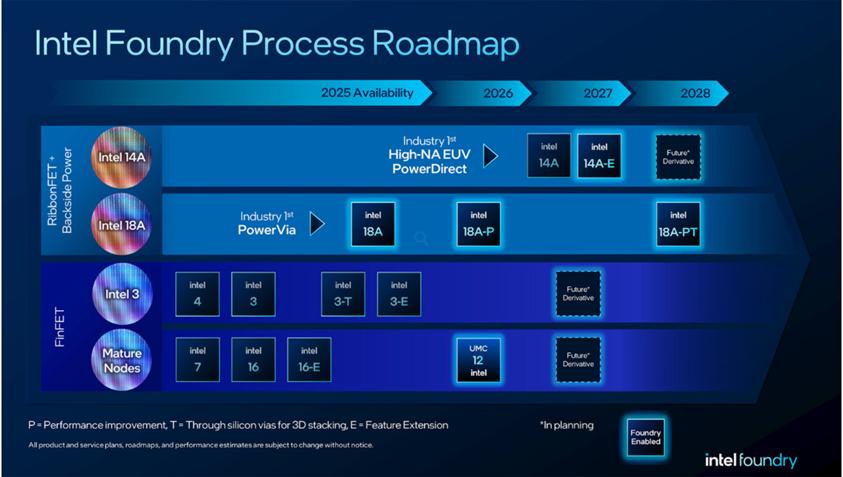
With the advantage of local U.S. manufacturing, the market is willing to believe that Intel has the opportunity to get "overflow orders" from large manufacturers, which is also the main reason why the market is willing to give the company a relatively high valuation.
Previously rumored potential partners in the market include Google (EMIB-T advanced packaging), Apple (M-series), AMD and SpaceX, etc. But so far, the only publicly landed large external order is to supply 14A for Musk's Terafab project (Tesla/SpaceX).
Among them, Apple previously reached a preliminary foundry framework (18A) with the company, and there were rumors that part of the wafers for the basic M7 model may be produced by 18A-P in U.S. factories, but no final mass production contract has been signed; and recent rumors that TSMC may participate in the operation of Terafab have made the market start to doubt Intel's position in this "only confirmed order". The substantial implementation of external foundry business can bring greater growth space to the company.
Combined with Intel's current market value ($483.7 billion), it corresponds to a non-GAAP after-tax core operating profit of about 37x PE in 2027 (assuming a two-year compound revenue growth rate of 17%, non-GAAP gross margin of 43%, tax rate of 10%).
In terms of stock price, Intel has fallen back from its June high (about $142) to around $90 currently, with a decline of about 36%, significantly larger than the semiconductor sector (-20% to -25%).
The stock price experienced a "roller coaster" during the quarter: after raising about $19.7 billion through private placement at $95 per share in August, the stock price stabilized around $90; the news of the third round of PC CPU price increase (about 10%) in September superimposed on the popularity of Agent CPU, the stock price once rebounded to $127; in early October, the market spread the news that TSMC may participate in the operation of Musk's Terafab factory, which shook Intel's narrative of "the only local U.S. foundry option", and the stock price fell by about 29% cumulatively in October.
