Embodied robots, winter is coming
In mid-October in Shanghai, osmanthus blossoms are in full fragrance, and a slight chill has crept into the warm autumn sunlight.
Tide Surge AI attended an embodied intelligence industry forum in Shanghai, where Fan Haoqiang, co-founder of Forcelink Tech, said on stage: "The cold winter is coming, and investors should have more faith in entrepreneurs."
This is not an isolated case.
Recently, Tide Surge AI has contacted a number of investment institutions, which have begun to tighten their investments in embodied intelligence projects, and are no longer making large-scale investments as they did before.
Some embodied intelligence enterprises are also consciously preparing for the winter: laying off staff, scaling back business, pausing expansion, while striving to secure the last round of financing before the winter. Large amounts of capital are preferred, and if large sums cannot be obtained, take as much as possible. The reasoning is consistent: the capital available next year may not be as abundant and hot as it is this year.
There are still some companies that failed to wait for the next round of funding.
Nanjing Boundless Dynamics was exposed to have suspended operations and defaulted on wages only 8 months after its establishment, with both employees and the CEO stating that they could not contact the actual controller; Shenzhen Yinhe Robotics held its first creditors' meeting on October 19; Shanghai DeepBlue Robotics had its bankruptcy and liquidation application accepted by the court in May...
The long-noisy embodied track is long due for a cool-down.
From Frenzy to Turning Point
Let's first look at two sets of non-interchangeable statistics.
Data from IT Juzi shows that in the first half of 2026, the embodied intelligence industry saw 935 billion yuan in financing across 322 deals, with the number of financing events rising 137% year on year, and the number of unicorn companies valued at over 10 billion yuan increasing from 3 to at least 22.
Another statistic based on publicly disclosed amounts recorded 288 financing deals involving 226 enterprises, with the total disclosed amount exceeding 460 billion yuan; among them, the top 20 companies raised a total of about 330 billion yuan, accounting for more than 70% of the total, while the remaining more than 200 companies shared only about 124 billion yuan.
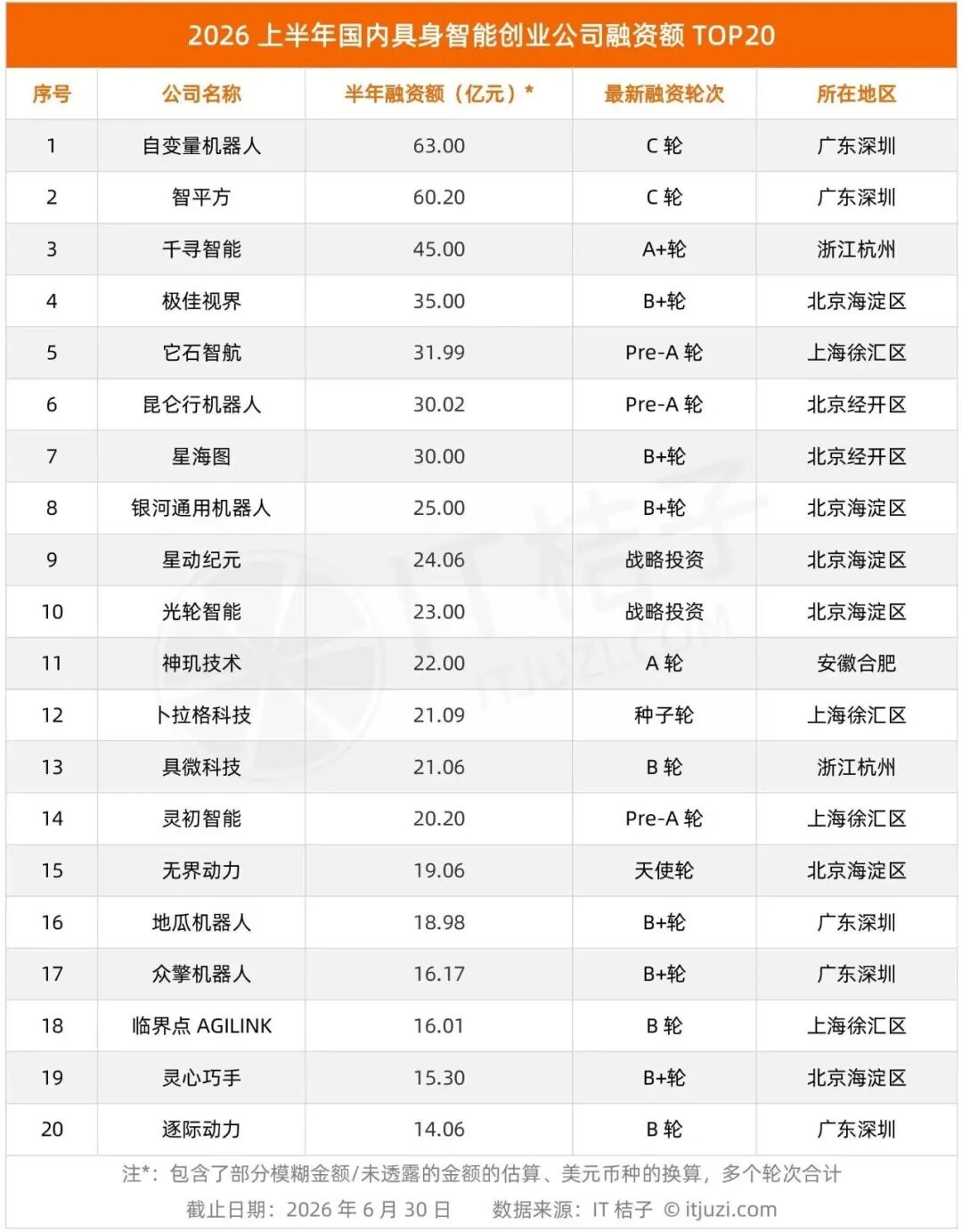
Source: IT Juzi
Large-scale financing deals came one after another.
In March, Galaxy General completed a 2.5 billion yuan financing round led by the National Artificial Intelligence Industry Investment Fund; Qianxun Intelligent completed four consecutive rounds of financing with a total amount of nearly 5 billion yuan, pushing its valuation to 20 billion yuan; Zhisquare saw its valuation rise from 10 billion yuan to 20 billion yuan within four months; in April, Tashi ZhiHang secured a single 455 million US dollar financing deal, setting a new industry record at that time; in June, the monthly financing amount of the global embodied intelligence track counted by the Humanoid Robot Scenario Application Alliance reached 315 billion yuan.
New entrants are also getting younger.
Huang Yi, born in 2004, founded RoboParty in 2025, and by July 2026, his company had raised nearly 500 million yuan in financing; Yuanche Taichu, founded by Qin Shentao, a PhD candidate at Tsinghua University, raised more than 500 million yuan in financing within 5 months of operation; Inverse Matrix, founded by Chen Boyuan, a graduate of Yuanpei College of Peking University, raised more than 100 million US dollars in its Seed++ round, with a valuation of over 5 billion yuan.
The peak of the hype was August 19.
Unitree Technology landed on the Sci-Tech Innovation Board with an issue price of 150.80 yuan, opening at 1100 yuan, up 629.44% from the issue price, with its market cap once hitting 444.9 billion yuan. With a winning rate of 0.0181%, the maximum floating profit per lot reached about 475,000 yuan, and its issue P/E ratio of 219.23 times was far higher than the static P/E ratio of 38.56 times for the general equipment manufacturing industry it belongs to. One investor put his logic very bluntly: "Don't get tangled up in valuation, grab the money as fast as you can."
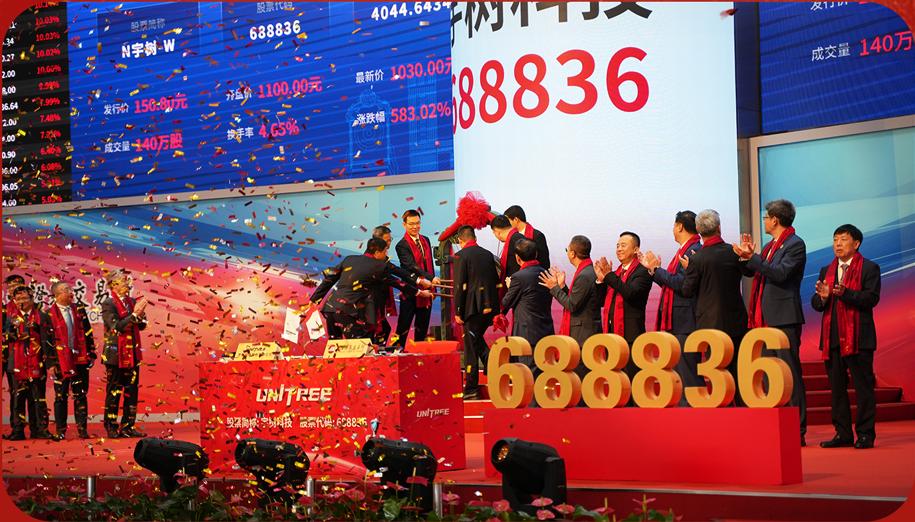
Unitree Technology's IPO
The voice of turning point first came from those who had already invested.
Wang Huadong, Managing Partner of Matrix Partners China, was the exclusive lead investor of Unitree's Series B1 round in 2021. He recalled in the video podcast *Detailed Talk* that in March 2024, he walked into a robotics lab in Silicon Valley, where 8 Unitree robots were still usable, while products from other brands were mostly broken. He believes that DJI is one of the domestic companies that can achieve absolute global leadership in its field, and Unitree is another.
But in the same interview, he also put forward two judgments: angel investments of hundreds of millions of yuan and valuations of tens of billions of yuan are unprecedented in China's commercial history, even during the craziest period of the mobile internet era; the concentrated listing of leading companies will most likely be the peak of this round.
Forty days later, the second node arrived.
On September 28, AMD announced that it had signed a definitive agreement to acquire World Labs, the world model company founded by Li Feifei, in an all-stock transaction valued at approximately 8.2 billion US dollars; the transaction is still subject to regulatory approval and is expected to be completed by the end of 2026; after the closing, Li Feifei will serve as AMD's Executive Vice President and Chief Scientist; World Labs' public valuation after its financing in February was about 5 billion to 5.4 billion US dollars, which has risen by about 50% to 60% in seven months compared with the transaction valuation.
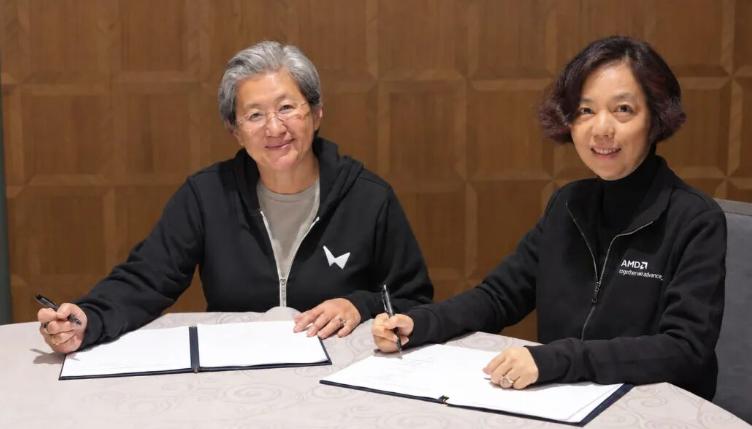
Lisa Su, Chairwoman and CEO of AMD (left), Li Feifei, Founder of World Labs (right)
One investor in the embodied track commented more directly: Founded for more than two years, it has only produced demos, and the roadmap of the world model is still unclear. This transaction is more like cashing out and exiting.
In the eyes of some domestic embodied entrepreneurs, the world model seems to have suddenly "lost its flag bearer", and panic outweighs envy.
On one hand, domestic humanoid robot companies have set astonishing IPO first-day pricing, and on the other hand, star scientists choose to sell their companies at a high point.
The two nodes, separated by forty days, jointly remind the market: At the hottest moment, some people have already arranged their retreat.
How Did the Capital Cool Down
The capital hit the brakes in September.
In early September, The Information, citing people familiar with the matter, reported that regulators, through informal "window guidance", slowed down the listing process of some humanoid robot enterprises; Reuters followed up and reported that the regulatory concerns included excessive valuation, and whether the revenue related to government-supported projects can reflect real market demand, while the China Securities Regulatory Commission did not respond to requests for comment.
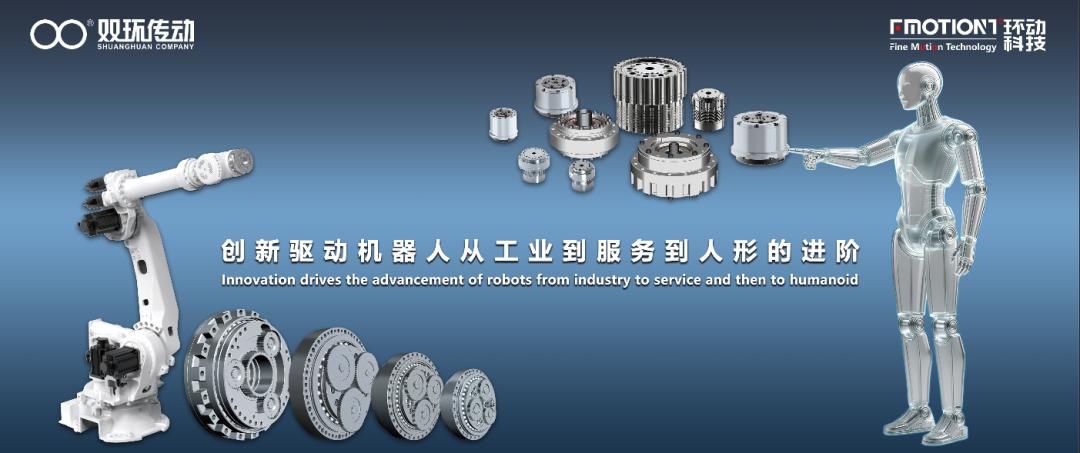
On September 21, the Shanghai Stock Exchange terminated the Sci-Tech Innovation Board listing review of Huandong Technology after the company and its sponsor voluntarily withdrew their application. This company, which mainly produces high-precision reducers for robot joints, became the first robot IPO project whose review was terminated on the Sci-Tech Innovation Board this year. On the Hong Kong stock market, as of mid-August, more than 50 embodied intelligence enterprises have submitted listing applications but have not yet gone public.
On October 15, data from IT Juzi further showed that in the first half of October, a total of 19 financing deals took place in the industry with a total amount of 4.934 billion yuan; while in August, there were 91 deals totaling 31.323 billion yuan. Only half a month of data was counted for October, which also spanned the National Day holiday. Even if we simply extrapolate the first-half amount to the full month, the total is still less than one-third of that in August.
The actual temperature may be even lower than the disclosed data.
Most of the financings announced now are transactions that were finalized several months ago. As one industry insider put it: "The real changes in the market often take some time to be reflected in the data."
Capital has not left the track, but is further concentrated in the leading companies.
The report released by Zhongtai Securities on October 13 shows that the embodied intelligence industry raised about 438 billion yuan in the first half of the year, of which companies with embodied brain as their core business obtained 222.53 billion yuan, and ontology and complete machine companies obtained 5.6 billion yuan, with the former amount being nearly four times that of the latter.
Leading companies are still scrambling for capital.
According to *Caijing* reports, Zhiyuan has launched a new round of financing of 1 billion to 1.5 billion yuan with a valuation of about 50 billion yuan, and as of the report, Zhiyuan has not responded to this news; Stardust Intelligent announced the completion of a 1 billion yuan Series B+ financing on the same day, which is its fourth round of financing within half a year; XPeng's robot business completed its first round of financing of over 900 million US dollars in August.
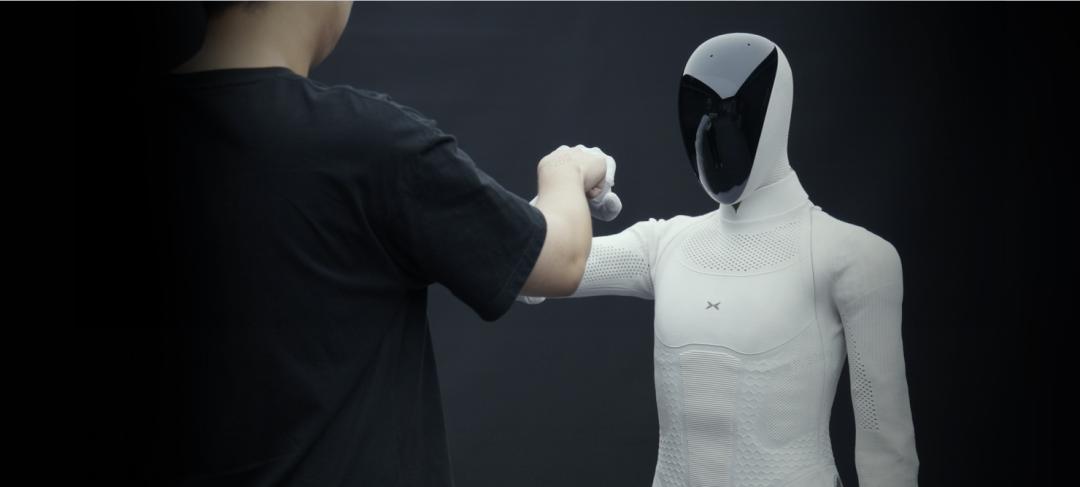
XPeng Robotics
Mid-tier companies are beginning to lower their expectations.
According to Tide Surge AI, companies that previously refused to accept any financing below 1 billion yuan are now taking 100 million yuan deals. Further down the tier, it has become very difficult to get any capital at all.
The old share market is more straightforward: according to 36Kr reports, old shares are already being sold on the market at a valuation of 12 billion yuan, but few investors are willing to participate in capital increase at a valuation of 22 billion yuan.
Concentration is the inherent nature of this business. R&D costs are calculated in hundreds of millions of yuan, and talent, supply chain, scenarios and capital are all indispensable. Only a small number of teams are destined to be able to enter the track.
When the market was hot, mid-tier companies could still get a share of the pie; once the capital tightens, the track quickly returns to a game for a few.
The secondary market is also re-evaluating the prices of the primary market.
Mech-Mind listed on September 1 at an issue price of 101.7 Hong Kong dollars, broke on the first trading day, and later fell to 78.05 Hong Kong dollars, about 23% lower than the issue price. After Unitree's market cap fell from its first-day peak, it rebounded to about 200.6 billion yuan on October 19, still more than 240 billion yuan less than its peak. UBTECH's share price once fell from its peak of 328 Hong Kong dollars to a low of 40.8 Hong Kong dollars, with a maximum drawdown of about 87%.
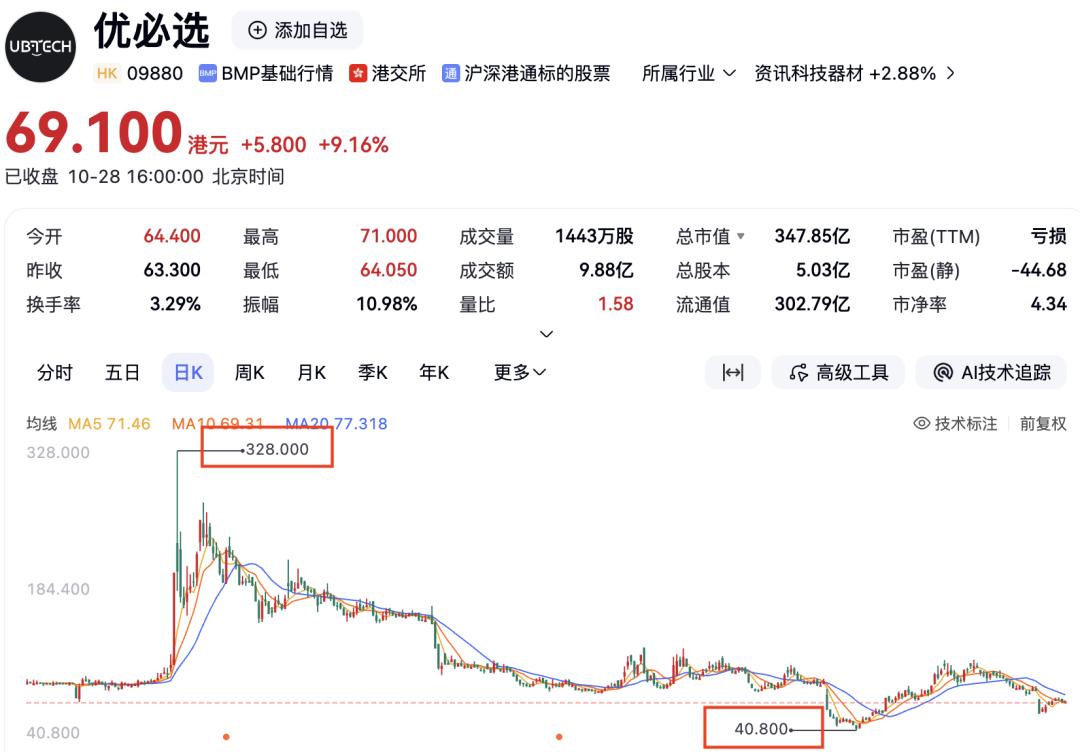
Source: Fin$cope
For a group of companies that are still raising financing at a valuation of 20 billion yuan, IPO no longer necessarily means a decent exit, and may mean re-pricing instead.
Huang Lichong, President of Hudson International Capital, put it bluntly: A robot company with a post-money valuation of 50 billion yuan does not mean that the secondary market is willing to take it over at the same market cap.
The First to Fall
Before the winter comes, some people have already suffered frostbite. The latest cases did not even survive this summer.
Nanjing Boundless Dynamics was only established on February 11 this year, focusing on industrial-grade quadruped robots, selling robotic dogs to the electric power, petrochemical, energy and mining industries. In June, the company disclosed that only 4 months after its establishment, it had signed framework orders of nearly 500 million yuan with many central SOEs, plus nearly 500 million yuan of local reserve orders, and announced that 110 million yuan of financing had been in place.
Its core team has about 20 members, most of whom have backgrounds from Tsinghua University, Zhejiang University and Shanghai Jiao Tong University, and some members come from Zhejiang Lab, Zhiyuan New Innovation and Star Age. In September, it launched the Rock P25-Ex explosion-proof wheel-foot robot, claiming to reach the IIC T6 explosion-proof grade; another substation inspection quadruped robot was originally scheduled for delivery in October.
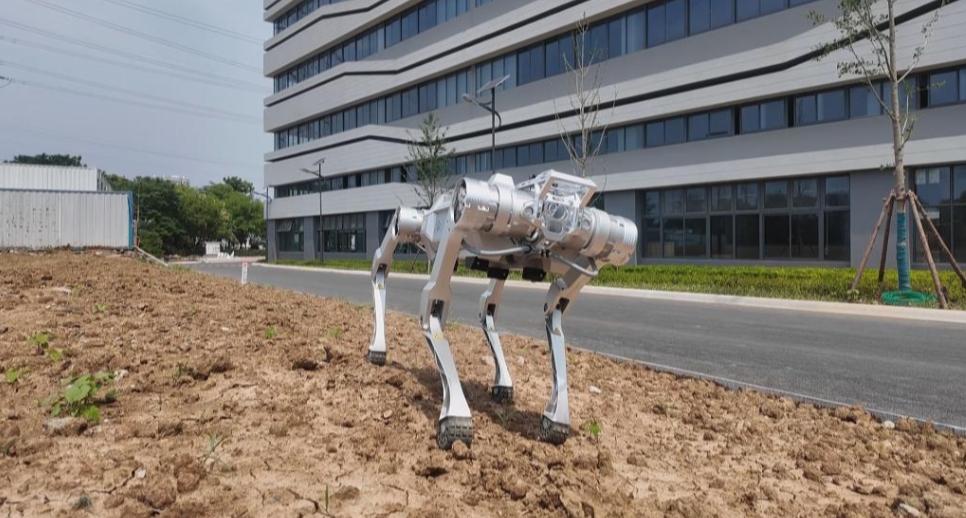
Boundless Dynamics quadruped robot
On October 23, employees reported to the media: the company began to default on wages in August, stopped paying housing fund in September, and stopped paying social security in October. More than 30 employees were owed a total of nearly 8 million yuan, the company suspended operations, and some employees have applied for labor arbitration.