Starbucks and Sam's Club have started to reject "free-riding".
Starbucks and Sam's Club have recently started setting new boundaries for consumers.
Starting from October 22, Starbucks China officially implemented the "consumption before seating" policy, which in principle requires customers to make a purchase before using in-store seats. The day before, Starbucks China also announced two other initiatives: the release of the "Third Space Initiative", and an additional investment of over 300 million yuan in the new 2027 fiscal year, to increase staffing during peak hours, upgrade systems and equipment, and renovate around 1,000 stores.
In the past, people could sit in a Starbucks outlet for an entire afternoon even without buying any coffee, but this long-standing loose practice is now being changed.
On October 16, the new version of Sam's Club membership rules came into effect. According to the membership regulation revision plan announced on October 9, one real-name identity can activate the family card of no more than 2 primary card members within every 365 days, and only one family card can be bound at the same time. Previously, as long as the old card was unbound, the same person could rebind new cards unlimited times, which was exactly the channel for scalpers to resell secondary membership cards.
One regulates seating access, the other regulates membership cards. What the two companies are taking back are all the benefits that they previously allowed consumers to enjoy for free.
During the expansion stage, open seating and loose secondary card rules were both customer acquisition investments for the two companies in China: the former endorsed the brand premium of Starbucks' "Third Space", while the latter lowered the threshold for consumers to enter Sam's Club. Now the two companies have entered different development stages: Starbucks China has changed its major shareholder, the joint venture has to pay for brand licensing, and must improve the efficiency of each individual store. Sam's Club has more than 10 million members, and its focus has shifted from attracting new users to improving member quality and membership renewal rate.
The two companies with different operating situations have both entered an era of "meticulous cost control" in China.
01. Two companies, two different challenges
For Starbucks, a seat is far more than just a chair.
The concept of the "Third Space" was popularized by Howard Schultz, former chairman of Starbucks, referring to a place for people to stay outside of their homes and offices. A considerable part of the price of a 30-40 yuan cup of Starbucks coffee pays for this space, which is also one of Starbucks' core brand assets.
Operating an open space has costs, but Starbucks previously adopted a relatively loose attitude and welcomed all people by default for many years. Public opinion in China has experienced a complete reversal: in May 2024, consumers in Xi'an and other places reported that they were reminded to place orders or even asked to leave by store staff when they sat down without consumption, and the related topic became a trending search. At that time, most public opinions stood by non-paying customers, but recently, the public's complaints have shifted to non-paying people occupying seats for a long time, playing music out loud, and bringing their own drinks, leaving customers who actually bought coffee with no seats to sit.
Public opinion has changed, and Starbucks' situation has also changed.
In the past few years, the competitive rules of China's coffee market have been completely rewritten. Luckin Coffee has competed for consumers with lower prices and a denser store network, and its number of stores exceeded that of Starbucks China for the first time at the end of 2019. In 2023, Cotti Coffee launched a 9.9-yuan price war, which Luckin followed, and low-price competition further spread. In the same year, Luckin Coffee's revenue in the Chinese market also surpassed that of Starbucks for the first time.
Changes in the competitive landscape have directly impacted Starbucks' brand premium. According to data from Euromonitor International cited by Reuters, Starbucks' share in China's coffee market dropped from 34% in 2019 to 14% in 2024. As of the end of June 2026, Luckin Coffee had 36,087 stores in the Chinese market (including Hong Kong), about 4.5 times the number of Starbucks China stores.
Starbucks began to take the initiative to adjust: cutting prices, launching new products, and boosting food delivery services, which brought a recovery in transaction volume, but also kept the average order value under continuous pressure. In the fourth quarter of fiscal 2025, Starbucks China's same-store transaction volume increased by 9% year-on-year, while same-store sales only increased by 2%, and the average order value decreased by about 7%. More people are buying coffee, but the revenue generated by each order is lower.
A turning point came at the start of fiscal 2026. In the first quarter, Starbucks China recorded revenue of 823 million US dollars, a year-on-year increase of 11%; same-store sales increased by 7%, of which transaction volume rose by 5% and the average order value also rebounded by 2%. This is a positive signal, but whether the brand premium can continue to recover remains to be seen.
It is in this round of operating adjustments and performance recovery that Starbucks has completed its biggest operating model transformation in more than 20 years since entering the Chinese market.
In November 2025, Starbucks announced that it had reached an agreement with Boyu Capital to establish a joint venture to co-operate its China business. In April 2026, the transaction was officially completed: funds under Boyu Capital hold 60% equity of the joint venture, Starbucks retains 40% equity, continues to own the brand and intellectual property, and licenses the joint venture to use them, and about 8,000 directly-operated stores were converted to franchised stores.
This means that Starbucks Global has turned its China business into an asset-light business that collects licensing fees. The joint venture led by Boyu Capital bears the licensing fees and takes full responsibility for operating results. For the new controlling shareholder, the core goal is to improve the profitability of each individual store.
In the last quarter before the transaction closed, the momentum of recovery had slowed down significantly. In the second quarter of fiscal 2026 (ended March 29, 2026), Starbucks China's revenue was about 800 million US dollars, a year-on-year increase of 8%; same-store sales increased slightly by 0.5% year-on-year, of which transaction volume rose by 2.1%, but the average order value decreased by 1.6%.
This is also the last Starbucks China performance report that the public can see. After the transaction was completed, Starbucks no longer separately announced the revenue and same-store sales of the Chinese market.
Therefore, the operating moves of the joint venture have become the main window to observe Starbucks China. The "consumption before seating" policy plus an investment of over 300 million yuan in store renovations is the first major set of measures taken by the new controlling shareholder half a year after taking over.
On October 29, Starbucks released its performance for the fourth quarter and full fiscal year 2026. During the earnings call, Starbucks CEO Brian Niccol said that the performance of the Chinese market in fiscal 2026 exceeded the established targets. The management also revealed that the international market is expected to add about 1,100 net new stores, and the Chinese market will contribute about half of that number. In the long run, Starbucks believes that the store scale in the Chinese market still has room to double.
This means that despite facing fierce competition from local coffee brands, Starbucks remains optimistic about the growth potential of the Chinese market.
Compared with Starbucks, Sam's Club is facing a completely different challenge: how to maintain the value of membership after excessively rapid growth.
Sam's Club is the fastest-growing business of Walmart China. In the second quarter of fiscal 2027, Walmart China's net sales reached about 7 billion US dollars, a year-on-year increase of 20.7% at constant exchange rates, and comparable sales increased by 9.7%. The financial report stated that the growth of operating profit in the international division was mainly driven by China and India, and the growth engine in China is Sam's Club. In the past 12 months, Sam's Club added 11 new stores in China, including 4 new stores added in the quarter. In fiscal 2026, Sam's Club China's omni-channel sales exceeded 1400 billion yuan, contributing more than 80% of Walmart China's revenue.
Membership growth is also accelerating. According to reports, Zhu Xiaojing, CEO of Walmart China, once disclosed that Sam's Club China took 21 years to accumulate its first 1 million paying members, but only 9 months to accumulate its third 1 million members. As of the first half of 2026, Sam's Club China's paying members have exceeded 10.7 million.
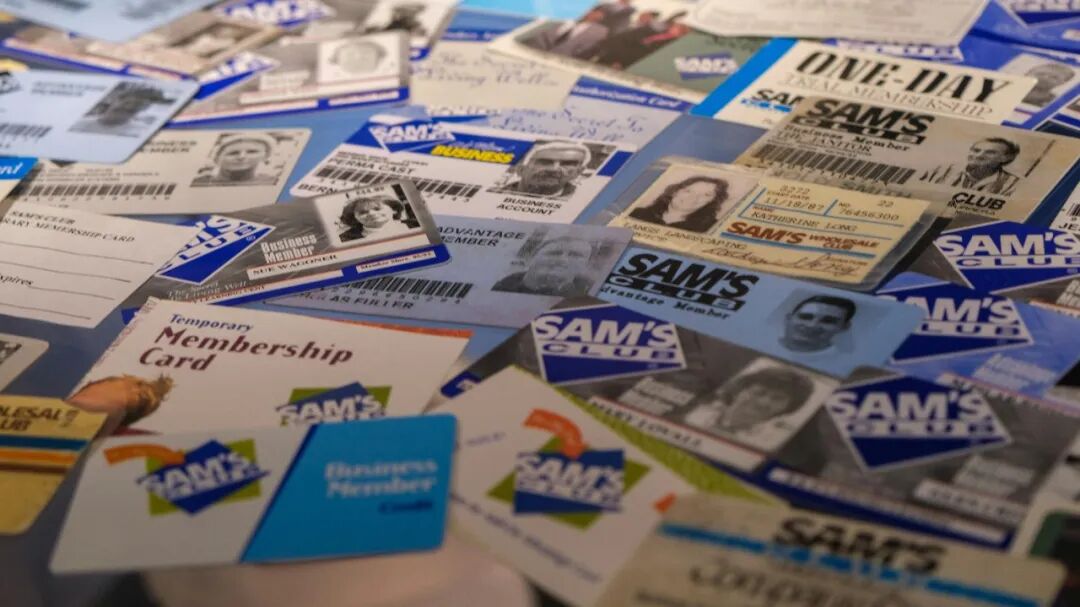
The larger the scale, the greater the impact once there are loopholes in the secondary card rules. The annual membership fee for Sam's Club personal membership is 260 yuan, and 680 yuan for premium membership, with one free family card attached to each membership card. According to the rules, the family card can only be given to family and friends. However, in the past, as long as the old card was unbound, the same person could repeatedly activate the secondary cards of different primary cards, so a mature business chain was formed on second-hand platforms: annual secondary cards, monthly rentals, one-day passes, and even services of bringing people into the store on a per-visit basis.
Source / Unsplash
The value of Sam's Club membership is also being eroded in another way. Members are willing to pay hundreds of yuan every year for the trust that Sam's Club selects products on their behalf, but in the process of rapid expansion, this trust has withstood several tests. For example, in August 2025, green onions sold at a Sam's Club store in Chengdu were notified of excessive pesticide residues; in December of the same year, consumers reported that a live mouse was found in the mochi packaging purchased through Sam's Club's instant delivery service. In March this year, mountain screw peppers sold by Sam's Club were notified of excessive pesticide residues, and its private label freeze-dried strawberries were also detected with relevant indicators that did not meet requirements.
External competition is also intensifying. On the one hand, membership retailers such as Costco are competing for similar mid-to-high income family customer groups; on the other hand, retail brands such as Freshippo and ALDI are diverting consumers' daily procurement needs through private label products, selected goods and price strategies. The development of instant retail also gives consumers more channels to buy fresh food and daily necessities.
In this environment, Sam's Club not only needs to attract new members, but also needs to make existing paying members continue to feel that their membership cards are worth the cost. This tightening of family card rules is essentially to maintain the gold content of membership fees.
One company is re-evaluating its in-store space under growth pressure, the other is tightening membership qualifications during rapid expansion. For Starbucks and Sam's Club with different operating situations, the free benefits they used to attract consumers and drive growth in the past are now being included in their cost accounting.
02. Can meticulous cost accounting bring better performance?
First, take a look at Starbucks. China is not the first market where Starbucks has implemented the "consumption before seating" policy.
Starting from January 27, 2025, Starbucks implemented a new customer code of conduct in its directly-operated stores in North America, requiring customers who use in-store seats and other facilities to make a purchase, ending its nearly seven-year open access policy.
In the early stage of policy adjustment, the performance of the North American market did not improve immediately. From the second to the fourth quarter of fiscal 2025, Starbucks North America's same-store sales decreased by 1%, decreased by 2%, and remained flat year-on-year respectively. It was not until fiscal 2026 that the North American business ushered in a recovery. In the first three quarters, same-store sales increased by 4%, 7.1% and 8.1% year-on-year respectively, achieving three consecutive quarters of growth.
During this period, Starbucks also increased in-store staffing, optimized products and improved service efficiency, so it is difficult to separately calculate how much the "consumption before seating" policy contributed to the performance recovery.
Moreover, Starbucks did not abandon the Third Space because of tightening seating rules. The management revealed in the latest earnings call that in fiscal 2026, the North American market completed the environmental upgrade of more than 1,700 stores, re-added comfortable seats and improved the space experience. The upgraded stores have seen an increase in transaction volume across different consumption periods and channels.
Starbucks China almost copied the same set of combined measures this time: implementing the "consumption before seating" policy on the one hand, and investing more than 300 million yuan to increase peak-hour staffing, upgrade equipment, and renovate about 1,000 stores on the other hand.
Why spend money to renovate the space while tightening seating rules? The answer can be viewed against the background of food delivery business.
Starbucks' product sales no longer rely entirely on customers staying in stores.
From the fourth quarter of fiscal 2019 to the second quarter of fiscal 2022, the proportion of sales from Starbucks China's digital orders (including food delivery and mobile order pickup) increased from 10% to 47%. In the third quarter of fiscal 2023, sales of "Starbucks Delivers" increased by 63% year-on-year, accounting for 25% of Starbucks China's total sales.
A Starbucks store clerk in Beijing told "Dingjiao One" that after the new rule was implemented, there was no obvious change in store foot traffic and sales, and the impact on operation was not significant. However, she explained that her store is small in scale and dominated by food delivery business, "80% of orders are delivery orders", and there are relatively few dine-in customers.
For stores with a high proportion of delivery orders and limited dine-in space, the consumption scenarios that the "consumption before seating" policy can affect are relatively limited. For stores with insufficient foot traffic and empty seats, restricting non-paying customers from sitting in will not magically sell more coffee.
Therefore, the operating value of the "consumption before seating" policy is to re-transform the space from a free public resource back to part of the paid experience. Prioritize seats for paying consumers, and at the same time invest money to make these seats worth paying for. Controlling seating access is only the first step. Making consumers willing to continue to pay a premium for the space is the key to making this business model work.
Then look at Sam's Club. Tightening family card rules is essentially accounting for the value of membership qualifications.
Previously, there were two types of family card reselling: one is shared card pooling. A card pooling merchant on a second-hand platform introduced to "Dingjiao One" that shared cards are divided into primary cards and secondary cards, both valid for one year, and the new rule has little restriction on this model; the other is short-term experience. At present, merchants mainly sell short-term shopping qualifications to consumers by directly providing accounts or temporarily binding family cards, which relies on repeated rebinding.
The core of Sam's Club's rule adjustment this time is to restrict "people" rather than "cards". One identity can only bind two family cards a year, but primary card members can still choose who to give their family card to at any time. The new rule has basically no impact on users who share membership qualifications with family and friends for a long time; but for consumers who rely on repeated rebinding to buy short-term experience qualifications, the access threshold has been significantly raised.
Compared with its peers, this rule is not strict. According to the membership regulations of Costco in Chinese Mainland, each primary card member can apply for one free family card, but the cardholder must be a family member over 18 years old who lives at the same address as the primary card member, and proof