In order to seize young people's time, sports events are collectively seeking changes.
It is extremely difficult for people to live without society, and sports events will also encounter problems if they fail to adapt well to social trends.
Since entering the digital age, there has been a long-standing cliché in the sports industry — "Young people are no longer watching sports."
This is because short-video platforms and social media have continuously changed the way the public accesses information, making short-form content gradually become the mainstream. In contrast, a single sports game often takes as long as two hours, which inevitably makes people wonder whether it can keep up with the current pace of life.
However, if we only look at the data from recent years, it is hard to draw the conclusion that "young people do not watch sports". Whether it is viewing rates, attendance, or discussion volume on social media, many top-tier events are constantly breaking records.
In a sense, sports events are even becoming more popular than they used to be.
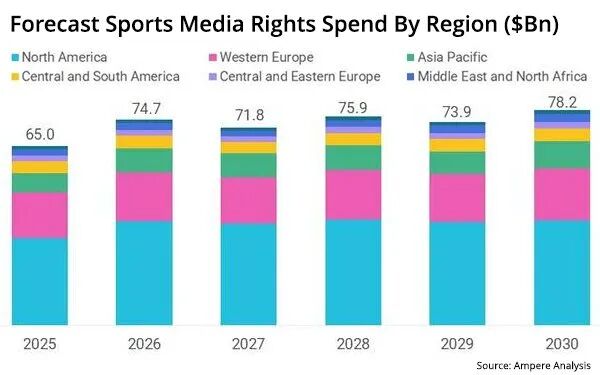
The sports copyright market is still growing. Source: Ampere Analysis
Nevertheless, from a longer-term perspective, the concerns behind this cliché are not unfounded, especially when it comes to the dimension of "new fans". Most event IPs that have maintained growth after decades or even hundreds of years of development have successfully followed the trend of the times and made adjustments to varying degrees.
Shorter Games, More Popular Among Young People?
Not long ago, Andrew Abdo, the newly appointed CEO of Tennis Australia, stated: "Maybe in the future, Grand Slams will adopt different competition systems for different rounds and different stages of the schedule. Maybe we won't play best-of-five sets throughout the whole event, and maybe the scoring method will also change."
In his view, shortening the game duration is a way to attract young people: "If you don't think about this event product in a contemporary way, in a way that can build connections with young people, you will be left behind by the times."
This remark sparked heated discussions and criticism among tennis fans. Tennis Australia later posted on social media that the best-of-five sets system will remain in place in 2027. However, despite some controversies, the reform logic behind Abdo's remarks is still an adaptation to the current trend of the times: cut down the game duration.
Looking across the sports industry, the practice of leagues controlling the game rhythm and "cutting" the overall game duration has become increasingly frequent in recent years, and has achieved certain results. The most typical example is Major League Baseball (MLB) in the United States.
In the 2023 season, MLB officially introduced the pitch timer: when there is no runner on base, the pitcher must start the pitching motion within 15 seconds; when there is a runner on base, the limit is 20 seconds. Before that, there was often a long preparation and waiting period between two pitches, which led to a lot of empty windows in the game and extended the overall duration.
After the pitch timer rule was introduced, these empty windows were greatly reduced, significantly shortening the game duration.
In 2023, the average duration of a 9-inning MLB game was about 2 hours and 40 minutes, 24 minutes shorter than the 3 hours and 4 minutes recorded in 2022. In the same year, the number of games watched in full on MLB.TV increased by 17% year on year.
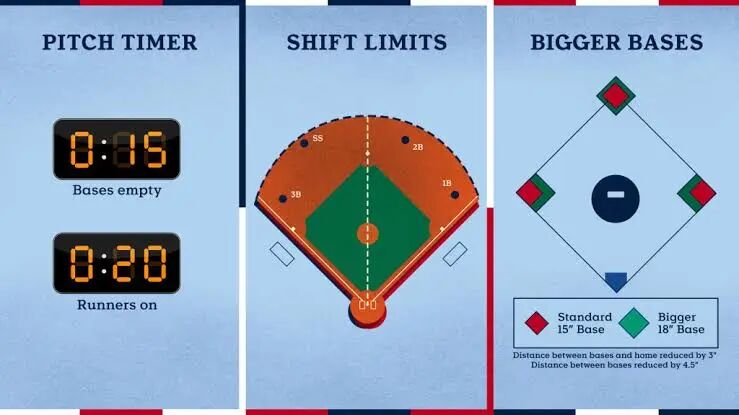
The pitch timer rule introduced in 2023. Source: MLB
Other sports are also making similar adjustments.
On April 25 this year, the 87th Annual General Meeting of the Badminton World Federation passed a new rule: starting from January 4, 2027, the 21-point, 3-set match system that has been used in badminton events for about 20 years will be replaced by a 15-point, 3-set system, "this adjustment aims to shorten the game duration, enhance the sense of compactness of matches and improve the attractiveness to audiences and broadcasters."
During this year's FIFA World Cup held in the US, Canada and Mexico, FIFA also implemented a number of speed-up rules, such as time limits for players to leave the pitch when being substituted, and starting a countdown for delaying goal kicks or throw-ins, to make the game more fluid. As an event product, the viewing rhythm of the World Cup has therefore become more compact. Moreover, many relevant adjustments have been incorporated into the 2026/27 competition rules, and major leagues have successively adopted them.
Under the current logic of communication and content consumption, how long fans are willing to spend watching games can no longer be regarded as a fixed premise. Not only the rhythm of the game needs to be adjusted, but also the way events meet the audience must change accordingly.
Go Where the Fans Are
"From the masses, to the masses" — in an era where communication channels are changing rapidly, this phrase should also be the attitude that sports leagues should uphold.
Last year, in the copyright distribution of Bundesliga in the UK and Ireland, 20 live broadcasts were granted to YouTube anchor Mark Goldbridge and broadcast on his That's Football channel.
In this season, Bundesliga also cooperated with Jamie Vardy's video podcast, authorizing its channel to broadcast some matches live; many platforms in China have also tried to combine event live broadcasts with anchor sales promotion, going a step further on the basis of the traditional second-stream mode.
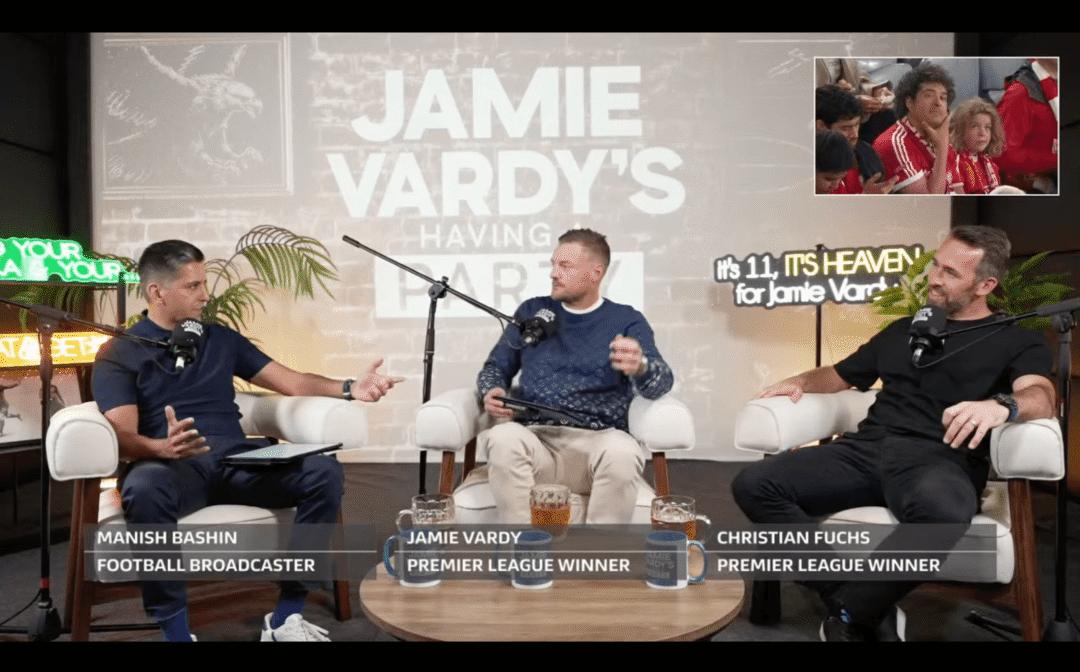
Source: The Athletic
As emotional value is gaining increasing attention, the real-time reactions of anchors, their personal-style comments, and bullet screen discussions have all become part of the viewing experience, which is more attractive to some young audiences than traditional channels. According to official Bundesliga data, in the 2025/26 season, 54% of the audiences watching Bundesliga live broadcasts on Goldbridge's channel are between 13 and 34 years old.
This also provides sports leagues with a new distribution idea: in the past, when leagues sold copyrights, they mainly valued the coverage scale, broadcast capacity and commercial returns of platforms. The participation of anchors brings in community relationships that have been accumulated over a long period of time around individuals — events can use these relationships to enter the scenarios where audiences consume content in their daily lives, and anchors therefore begin to have the value to undertake event copyrights.
However, after events are distributed to more channels, broadcast products also need to adapt to different content environments. The frequently appearing animated and gamified alternative live broadcasts in recent years are the embodiment of this trend.
On December 9, 2024, the NFL game between the Cincinnati Bengals and the Dallas Cowboys was presented in the second stream of Disney+ and ESPN+, where players were moved to Springfield of The Simpsons and appeared in a Q-version form with big heads and small bodies. It is reported that for the NFL Super Bowl in February 2027, ESPN will launch a Star Wars-themed alternative live broadcast.
In previous years, F1 also launched the "F1 Kids" broadcast, which was customized for children from the cartoon driver images to the commentary content, focusing on popular science and fun.

Source: Official F1 Website
The entertaining live broadcast method is also a mutual borrowing of content resources. The excitement of the game itself plus the narrative nature of entertainment IP gives events another way to reach families and general entertainment audiences.
For platforms that have a large amount of entertainment content, these IPs are originally assets that build relationships with users. Using them for sports broadcasts gives platforms more space to participate in event content production beyond purchasing copyrights.
Similar changes are also taking place between sports games and event broadcasts.
During the NBA Cup in December 2024, TNT Sports cooperated with NBA 2K and Genius Sports to overlay the shot meter, player badges and 2K-style perspective from the game on the real game footage, while presenting data such as shooting distance and hit probability.
In addition to gamified live broadcasts, the broadcast language of many current events is further moving towards gamification. For example, at the recent World Athletics Ultimate Championship, the close-up shots of athletes before the game and the visual effects presented a strong visual style similar to track and field games.
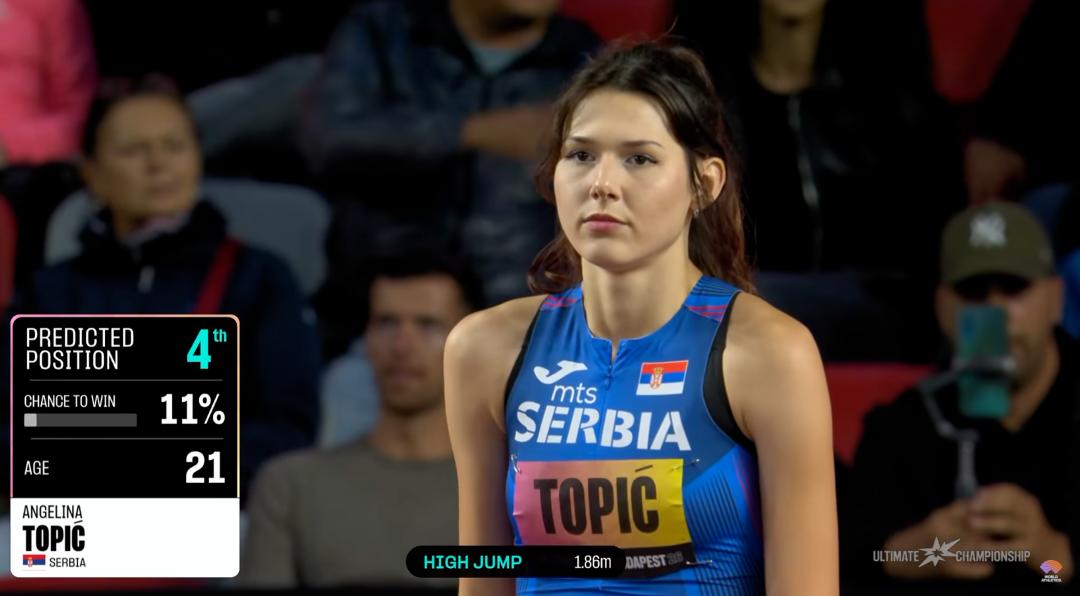
Source: World Athletics Ultimate Championship
In essence, this is also because communication channels are becoming more segmented. The same event or even the same game has begun to emphasize content differentiation to serve audiences with different needs. The value of a channel is increasingly reflected in what kind of audience it can bring to the event and in what way it can reach these people.
This also means that sports leagues need to be more involved in specific content collaborations in their communication operations, and convert the resources they hold into products suitable for target audiences.
Change and Constancy Are Both Challenges
Generally speaking, compared with other entertainment products, sports often have stronger "anti-risk" capability. Because once watching sports becomes a habit, it usually lasts for a long time, and eventually precipitates into consumption and emotional investment.
A large part of the long-term value of professional sports is built on such relationships.
However, under the drastic changes of social trends and channels, when the public's way of accessing information and socializing changes, the conditions for events to reach the audience will also change accordingly. The effective operation methods in the past need to be re-tested in the new environment.

However, the more mature an event is, the more complex the change will be.
An adjustment that seems simple or "should have been done long ago" may affect different dimensions such as competition, commercial cooperation and audience experience at the same time when it comes to actual implementation.
The slow progress of reform in some sports and events is not necessarily just due to the conservatism of managers, but also because the adjustment affects the whole system with one single move, and its impact is far-reaching.
The reason why Abdo's idea about the best-of-five sets system in tennis sparked controversy is precisely because an event carries different meanings in the eyes of operators, athletes and fans. Changes that are attractive to one party may not be immediately accepted by other parties.
Although innovation is part of the DNA of the Australian Open, the best-of-five sets system in tennis will be retained. Source: Australian Open social media
But from a longer time dimension, maintaining the status quo also comes at a cost. The seemingly good viewing data or commercial revenue at present may not fully reflect the distance between the event and the new generation of audiences.
Because in many cases, this kind of change does not always appear in the form of clear opposition. Fans who lose interest in an event will just stop watching it. By the time the league realizes the problem, it may be too late.
For mature IPs, the long-term operation capability is reflected in the specific judgment of changes: being able to understand changes, and being able to distinguish changes; being willing to invest in experiments, and having the ability to continue adjusting according to feedback, so as to implement these judgments into event products and league operations.
Sports inherently has the power to shape living habits. People often adjust their schedules, look for friends and find places to watch games for a match, etc. The ultimate value of event operation will still fall into specific life scenarios.
In order to keep this value alive, events must maintain the ability to evolve.
This article is from the WeChat Official Account "Sports Industry Ecosystem", written by ECO KETI, and published with authorization by 36Kr.