The share price dipped below the issue price immediately after listing, has the leading PCB enterprise fallen out of market favor?
The Hong Kong stock market is never short of stories, but the capital market does not pay for every story.
While the AI computing power industrial chain is booming, Dongshan Precision has encountered repeated setbacks in the capital market.
On October 28, Dongshan Precision officially listed on the Hong Kong Stock Exchange with an issue price of HK$86.80, raising approximately HK$9.88 billion. However, on the first trading day, its H-shares opened at HK$82.40, rebounded to HK$87.10 at one point during the session, and closed at HK$86.15, still 0.75% lower than the issue price.
On October 29, the share prices of Dongshan Precision on both the A-share and H-share markets plummeted simultaneously. Its A-shares hit the 10% daily limit down, closing at 94.14 yuan; its H-shares closed at HK$80, down 7.14% on the day, with a cumulative drop of 7.83% compared to the issue price.
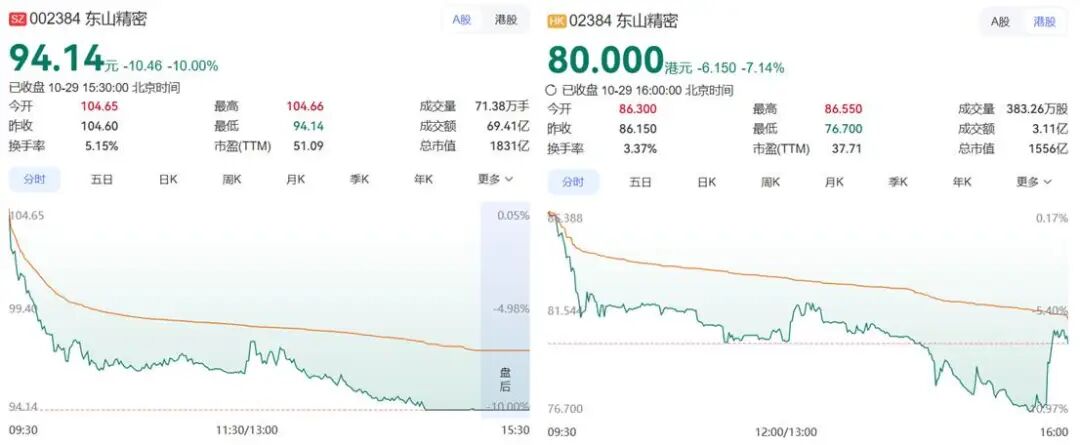
This highly anticipated Hong Kong IPO has no shortage of institutional support. 20 cornerstone investors participated in the subscription, and the allocated shares account for 50% of the total global offering shares.
However, the Hong Kong public offering subscription multiple was only 0.52 times, failing to reach full subscription, while the international placement subscription multiple reached 3.17 times.
As a veteran PCB manufacturer that has long been listed on the A-share market, Dongshan Precision's Hong Kong listing this time targets the growth opportunities in the AI computing power industrial chain. It was supposed to be a concentrated demonstration of its capital strength and expansion ambition, but the capital market simply did not buy it.
Starting from precision manufacturing, expanding into PCB and precision components, and then entering the optical module business through the acquisition of Source Photonics, this time-honored manufacturing enterprise is trying to ride the east wind of AI computing power to open up new growth space.
However, the popularity of the track cannot be directly converted into enterprise value after all. With the completion of its dual A+H listing, Dongshan Precision still faces many problems to solve next.
I
Today, Dongshan Precision's business covers PCBs, precision components, display modules and optical modules.
But 28 years ago, the starting point of this company was far from the now red-hot AI computing power industry.
In 1998, Yuan Fugen and other co-founders jointly funded the establishment of Dongshan Sheet Metal, marking the start of Dongshan Precision. The predecessor of the company was a small sheet metal and stamping factory founded in Dongshan Town, Suzhou in 1980.
In 2010, the company was listed on the Shenzhen Stock Exchange. After that, Dongshan Precision gradually formed a distinctive expansion model: continuously expanding product boundaries around precision manufacturing, and quickly entering new industrial chains by acquiring mature enterprises.
Looking back at this development path, 4G communication, smartphones, new energy vehicles, AI computing power, almost every round of industrial boom can find a corresponding layout in Dongshan Precision's business territory.
In 2014, Dongshan Precision acquired M-Tron Opto and entered the touch panel and liquid crystal display module market. Two years later, the company turned its attention overseas, acquiring American flexible circuit board manufacturer MFLEX for approximately US$610 million to enter the consumer electronics industrial chain of clients including Apple.
In 2018, Dongshan Precision acquired Multek, the PCB business unit of international electronic manufacturing enterprise Flex, with a base transaction consideration of US$292.5 million. Since then, PCB has gradually become one of the core businesses of Dongshan Precision.
From a longer-term perspective, mergers and acquisitions have indeed changed the scale of Dongshan Precision. In 2015, the company's revenue was 3.993 billion yuan, and its attributable net profit was only 31.71 million yuan; by 2021, its revenue had increased to 31.793 billion yuan, and its attributable net profit reached 1.862 billion yuan.
However, the expansion of scale did not drive profit growth all the way. In 2022, the company's attributable net profit reached 2.368 billion yuan, then fell back to 1.965 billion yuan and 1.086 billion yuan in 2023 and 2024 respectively.
At this point, Dongshan Precision is no longer a pure metal structural component manufacturer. Businesses including flexible PCBs, rigid PCBs and display modules have been successively incorporated into its business portfolio, and the company has extended from single precision manufacturing to diversified electronic manufacturing.
This set of expansion ideas was later applied to the automotive sector.
In 2023, Dongshan Precision completed the acquisition of Suzhou Crystal Display to expand its automotive display business. In 2025, the company completed the acquisition of French automotive component group GMD, extending its business territory to the European automotive industrial chain.
In 2025, Dongshan Precision set its sights on an even more popular field: optical communications.
In June of that year, the company announced that it planned to acquire a 97.48% stake in Source Photonics for no more than US$629 million, and provide financial support through methods such as subscribing for convertible bonds, with the total maximum investment amount at approximately 59.35 billion yuan. The transaction was completed at the end of September the same year, and in May 2026, the company completed the acquisition of the remaining 2.52% stake.
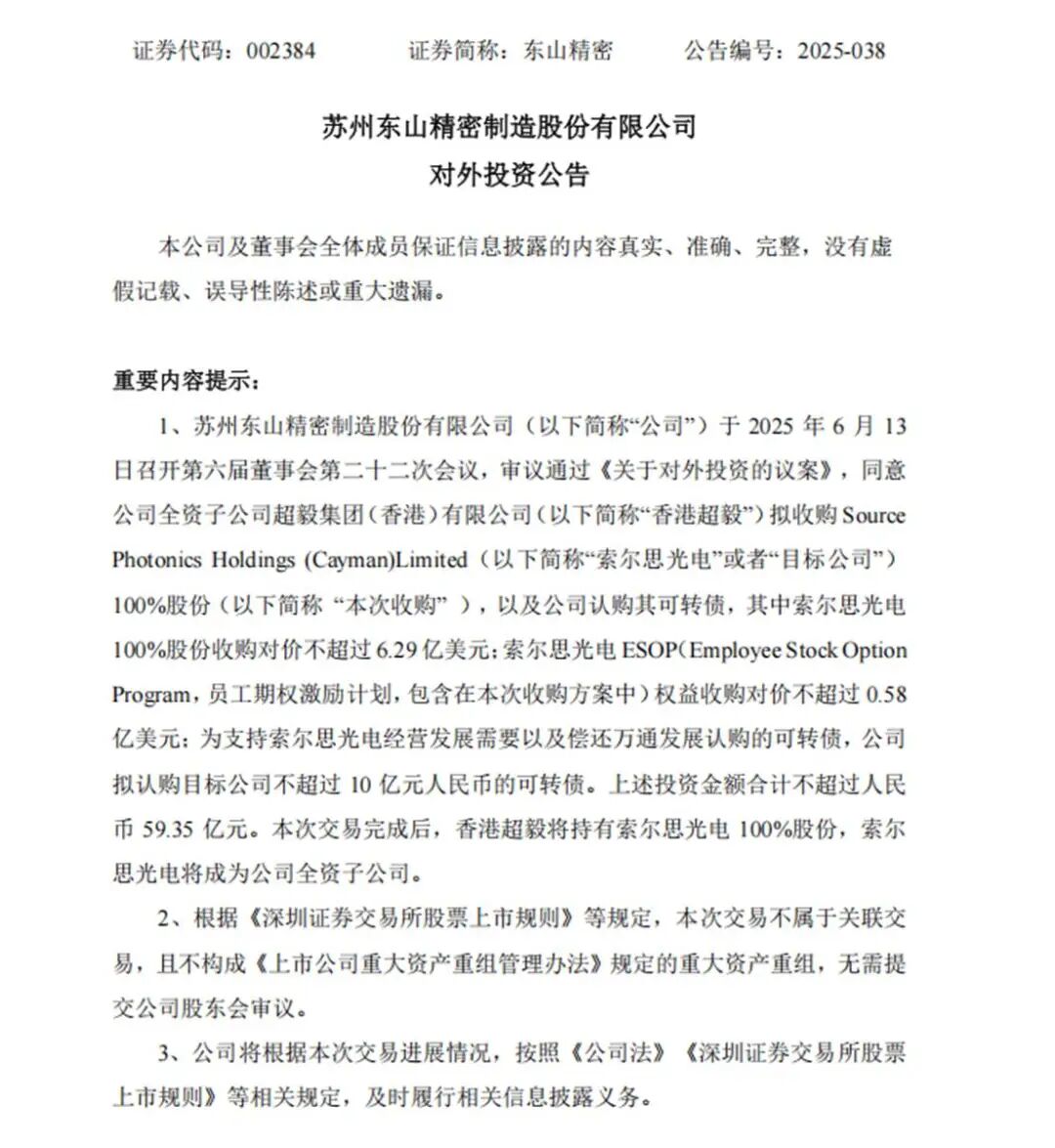
The significance of this transaction lies in the track that Source Photonics is in.
With the acceleration of AI computing power infrastructure construction, the demand for data transmission within and between data centers continues to grow, making high-speed optical modules a key link in the industrial chain. Source Photonics has the capabilities of optical chip R&D and production, as well as optical module design and manufacturing, and its related products cover the data communication and telecommunications markets.
However, the quality of this nearly 60 billion yuan acquisition of Source Photonics ultimately depends on whether AI computing power demand can be converted into sustained profit growth.
II
The most direct landing point of Dongshan Precision's AI story is Source Photonics. Let's first look at its performance before the acquisition.
The post-hearing document of the Hong Kong Stock Exchange shows that in 2023, Source Photonics achieved revenue of 1.305 billion yuan, with a net loss of 90 million yuan; in 2024, its revenue increased to 2.945 billion yuan, and its net profit reached 1.05 billion yuan. Entering 2025, the growth is still accelerating. In the first three quarters, Source Photonics achieved revenue of 3.628 billion yuan, up about 92% from 1.89 billion yuan in the same period of the previous year.
It is the data center optical module business that drives revenue growth.
In 2024, Source Photonics' data center optical module revenue reached 1.94 billion yuan, up 321.8% from 460 million yuan in 2023. In the first half of 2025, the revenue of this business further reached 1.765 billion yuan, compared with 560 million yuan in the same period of the previous year.
However, the rapid growth of revenue has not brought a simultaneous rise in net profit. In the first three quarters of 2025, Source Photonics' net profit was 475 million yuan, down about 46% from 880 million yuan in the same period of the previous year. During the same period, the company's other gains and losses turned from a net gain of 617 million yuan to a net loss of 130 million yuan.
After Dongshan Precision acquired Source Photonics, the proportion of this business has risen rapidly.
Source Photonics has been included in the consolidated statements since October 2025. In 2025, its revenue during the consolidation period accounted for 3.58% of Dongshan Precision's total annual revenue, and its profit accounted for 22.69% of the consolidated profit. In the first quarter of 2026, after consolidation, Source Photonics' revenue accounted for 16.02% of Dongshan Precision's consolidated operating revenue, and its profit accounted for 52.92% of the consolidated profit. As the consolidation period extends, the impact of Source Photonics on Dongshan Precision's overall performance is even more noteworthy.
In the first half of 2026, Dongshan Precision achieved operating revenue of 27.798 billion yuan, a year-on-year increase of 63.95%; its attributable net profit was 2.957 billion yuan, a year-on-year increase of 290.09%. However, this round of growth includes both the contribution from M&A consolidation, and the incremental gains brought by the introduction of new customers and new products for optical modules.
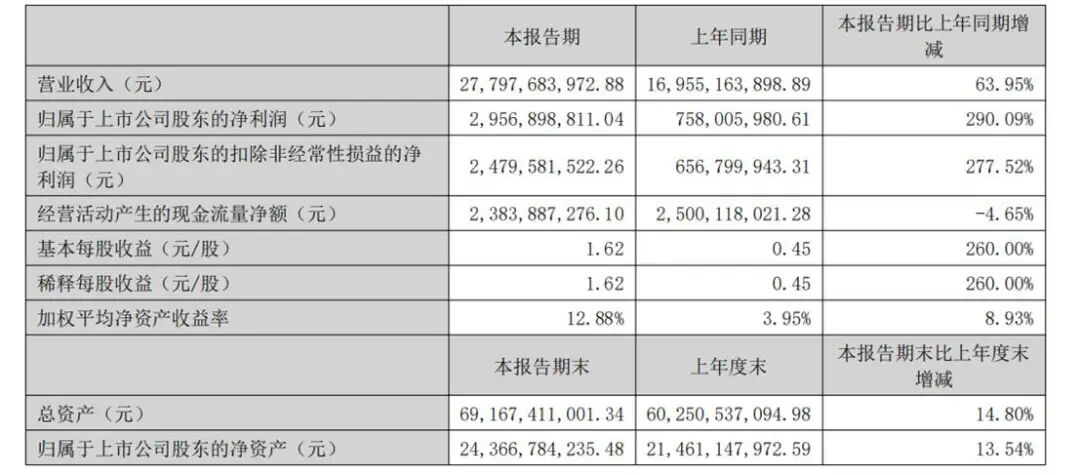
Specifically, the optical module business revenue reached 5.351 billion yuan, accounting for 19.25% of total revenue, with a gross profit margin of 39.33%. In comparison, the revenue of the core business electronic circuit products was 12.53 billion yuan, accounting for 45.07% of total revenue, up 13.29% year-on-year, with a gross profit margin of 18.80%.
The profitability gap between the two businesses is quite obvious. The revenue scale of optical modules is still smaller than that of electronic circuit products, but its gross profit margin of nearly 40% makes it a new performance growth fulcrum for Dongshan Precision. The value brought by Source Photonics has also begun to extend from revenue scale to profit structure.
However, Dongshan Precision's AI story is not limited to optical modules.
The company's original PCB business is also laying out markets such as AI servers and high-speed switches, and continuously promoting the upgrading of high-end products. However, the overall revenue of electronic circuit products covers many application fields, and the company has not separately disclosed the revenue scale of AI PCBs. The existing data is not sufficient to judge how much new revenue the AI demand has actually brought.
However, with the continuous capacity expansion of optical modules and AI PCBs, how Dongshan Precision balances growth opportunities and capital costs will become an unavoidable problem in the next stage.
III
With nearly HK$10 billion raised, Dongshan Precision has no intention of slowing down its expansion pace.
In this Hong Kong stock IPO, Dongshan Precision's final issue price was HK$86.80 per share, with net raised funds of approximately HK$9.717 billion. According to the use of funds disclosed in the prospectus, 64.5% of the funds will be used to build new facilities, upgrade existing production facilities and production lines, with a focus on expanding the production capacity of high-speed optical chips, optical modules and high-end PCBs; 20% will be used for potential strategic investments or acquisitions, another 5.5% will be used to repay part of existing debts, and the remaining 10% will be used as working capital and for general corporate purposes.
This capital allocation continues Dongshan Precision's past expansion logic.
Optical modules and high-end PCBs have become the company's key investment directions, and mergers and acquisitions are still included in the use of raised funds. For Dongshan Precision, Source Photonics may not be the last piece of the puzzle in its expansion.
The problem is that expansion requires continuous investment, and new businesses also need time to deliver returns, so Dongshan Precision faces no light capital pressure.
In the first half of 2026, the cash paid by Dongshan Precision for the purchase and construction of fixed assets, intangible assets and other long-term assets reached 5.253 billion yuan, up about 145% from 2.148 billion yuan in the same period of the previous year. During the same period, the net cash flow generated from the company's investment activities was a net outflow of 5.483 billion yuan, higher than the 1.986 billion yuan in the same period of the previous year.
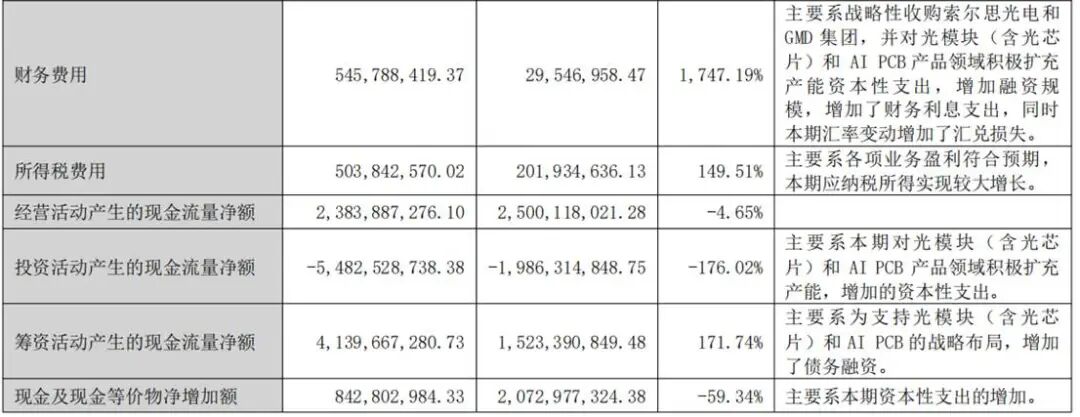
The cash flow from operating activities still maintained a net inflow, reaching 2.384 billion yuan, but down 4.65% year-on-year. The operating cash flow is not yet sufficient to cover the current expenditure on the purchase and construction of long-term assets such as fixed assets, so the company needs to support capacity expansion through financing and other methods.
The increase in capital investment has also begun to be reflected in financial expenses.
In the first half of 2026, Dongshan Precision's financial expenses reached 546 million yuan, compared with about 29.55 million yuan in the same period of the previous year. The company explained in its semi-annual report that this change is mainly related to the increase in financing scale after the acquisition of Source Photonics and GMD Group, the expansion of optical module and AI PCB production capacity, as well as the exchange loss caused by exchange rate fluctuations. During the same period, the interest expense was 296 million yuan, higher than 199 million yuan in the same period of the previous year.
For Dongshan Precision, which is expanding continuously, acquisitions, capacity construction and cross-border business expansion all mean that the company needs to face more tests in capital arrangement and operation management.
At the same time, the capital market's attitude towards the AI supply chain is also changing. The research department of uSMART Securities stated that the Hong Kong market has passed the most fanatical stage of the AI supply chain investment boom, and investors have become more picky. The market begins to worry about how long AI capital expenditure can last, and whether huge borrowings can bring corresponding returns.
This cautious sentiment has already been reflected in the relevant sectors and Dongshan Precision's own share price.
Taking the period from June 25 to October 29 as the statistical interval, the A-share optical communication module index fell from 5180.13 points to 2968.52 points, with a cumulative drop of 42.69%; the PCB index fell from 5344.55 points to 3210.48 points, with a cumulative drop of 39.93%.
Although AI demand and high-end product upgrading are still supported by fundamentals, the market has begun to discuss whether the PCB industrial chain will approach its profit peak in 2027-2028, and whether price increases can continue to be transmitted. This is not good news for Dongshan Precision.
In addition, Dongshan Precision's A-share price once hit an intraday high of 280.08 yuan on July 15. As of the close on October 29, the share price has fallen by about 66.4% from the high point.
For Dongshan Precision, AI computing power is still an important growth opportunity, but at the moment when the market begins to re-ex