In the AGI era, the entire middle class is completely doomed.
I recently came across a paper on X titled "We Won't Be Missed: Labor and Growth in the Age of AGI"
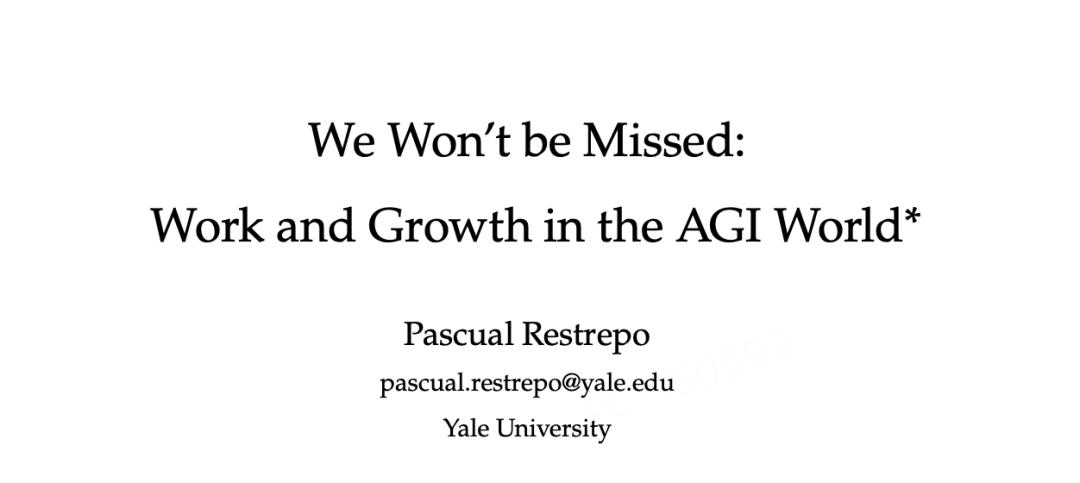
The article states that in the AGI era, the middle class will be completely wiped out.
After endless competition, you end up being a cheap substitute for computing power
Indeed, AI is becoming increasingly powerful these days, so the logical move is to make your work more "irreplaceable".
Competing for higher academic qualifications, working overtime to chase performance, accumulating work experience... From a total rookie at the entry level, you climb the ladder step by step all the way to a management position.
As long as you fight your way to a management post, your work will become indispensable. The company can't do without you, so you won't get laid off.
This logic makes sense on paper, but things don't seem that simple in the AGI era.
David Ricardo, the founding figure of economics, put forward a very famous theory: the Theory of Comparative Advantage.
It was a response to Adam Smith's Theory of Absolute Advantage.
Simply put, if Country A can produce 100 pieces of clothing and 10 watches a year, and Country B can produce 80 pieces of clothing and 20 watches a year, then Country A should devote all its production capacity to making clothes and buy watches from Country B, while Country B should devote its production capacity to making watches and buy clothes from Country A.
Ricardo argued that the logic goes further. What if Country A can produce 100 pieces of clothing and 20 watches a year, and Country B can produce 80 pieces of clothing and 10 watches a year? In this scenario, Country A's production capacity completely outperforms Country B. Does that mean Country B should stop producing entirely? Will Country A no longer import any goods from Country B?
No, the Theory of Comparative Advantage argues that what we should focus on is opportunity cost. Total productivity is limited. For Country A, making one piece of clothing means giving up producing 20/100 of a watch (that is, 0.2 watches); for Country B, making one piece of clothing means giving up producing 10/80 of a watch (that is, 0.125 watches). In other words, Country B has a lower opportunity cost, so it should still produce clothes.
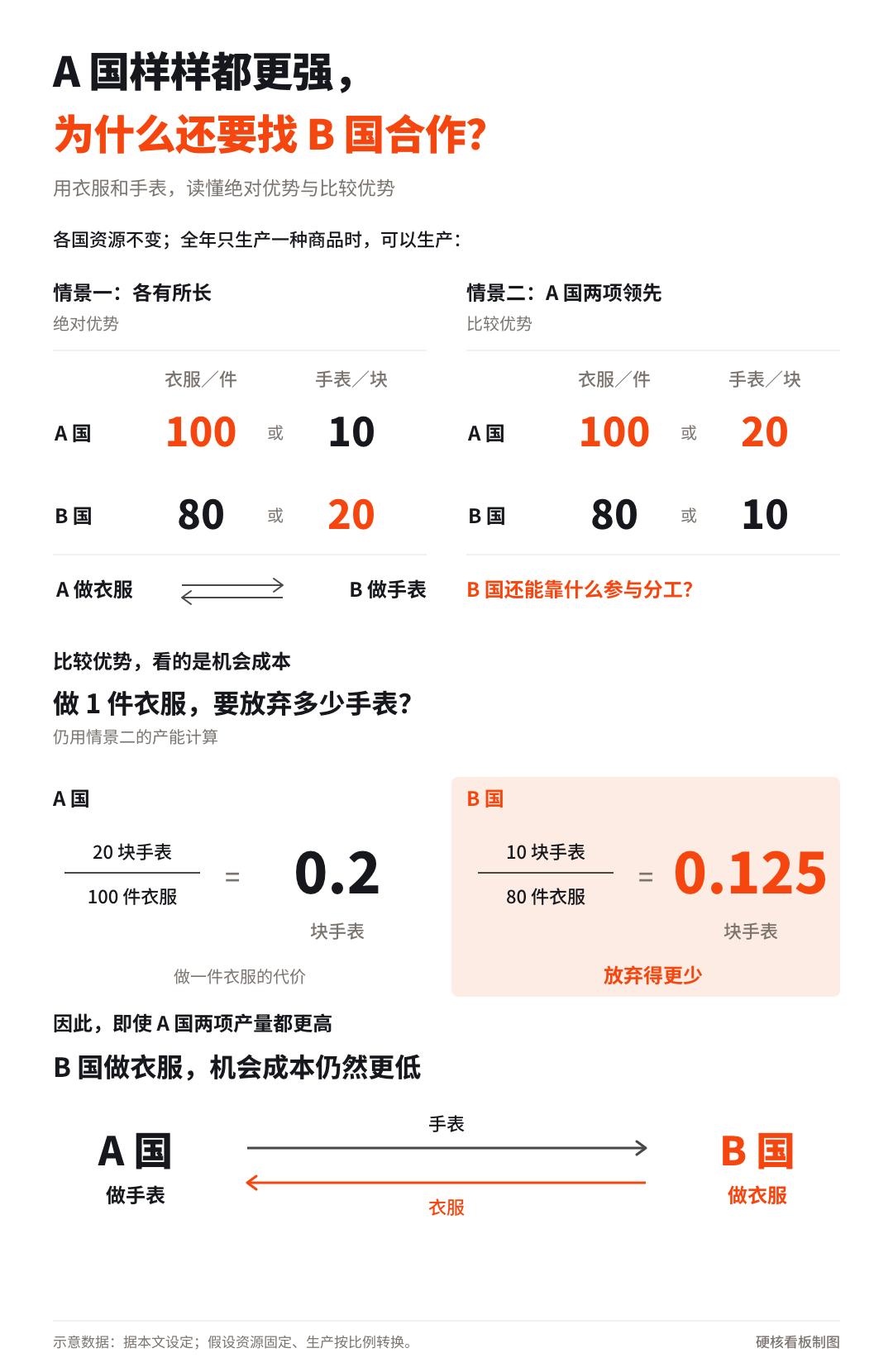
For a long time, this theory has also been used to estimate the future relationship between AI and human labor: Even if the future super AI is capable of doing everything, humans do not seem to need to worry about being completely unemployed.
However, computing power can continue to expand infinitely, while the labor that humans can provide is limited.
Compared with the limited productivity of human beings, the computing power that will expand sharply in the future is almost unlimited, and it can completely complete all labor on its own.
In this AGI-driven future, AI outperforms humans in every aspect, from absolute output volume, production efficiency to product quality, and there will no longer be any advantageous industries exclusive to humans.
There will no longer be a "watchmaking industry suitable for humans", and the status of human labor will plummet.
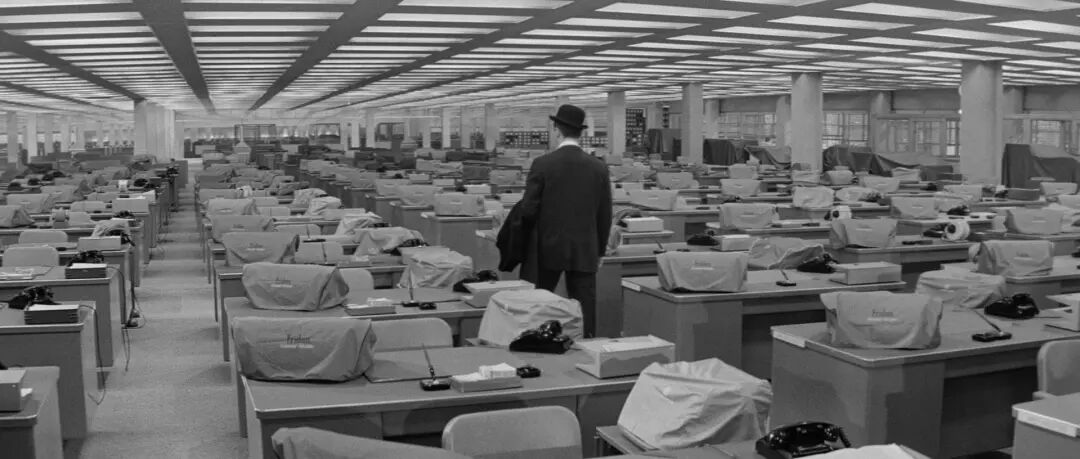
So will all of us be unemployed by then?
Not exactly.
We lose out in output, quality and efficiency across the board, but there is one remaining trick: "launch a price war against AI".
From the perspective of business owners, as long as the salary paid to humans is lower than the cost of computing power for AI, human labor will still remain competitive.
In the paper "We Won't Be Missed", years of human education and experience are ultimately converted into one metric: how much computing power is required to replicate these capabilities, and how much computing resources you can save for the system.
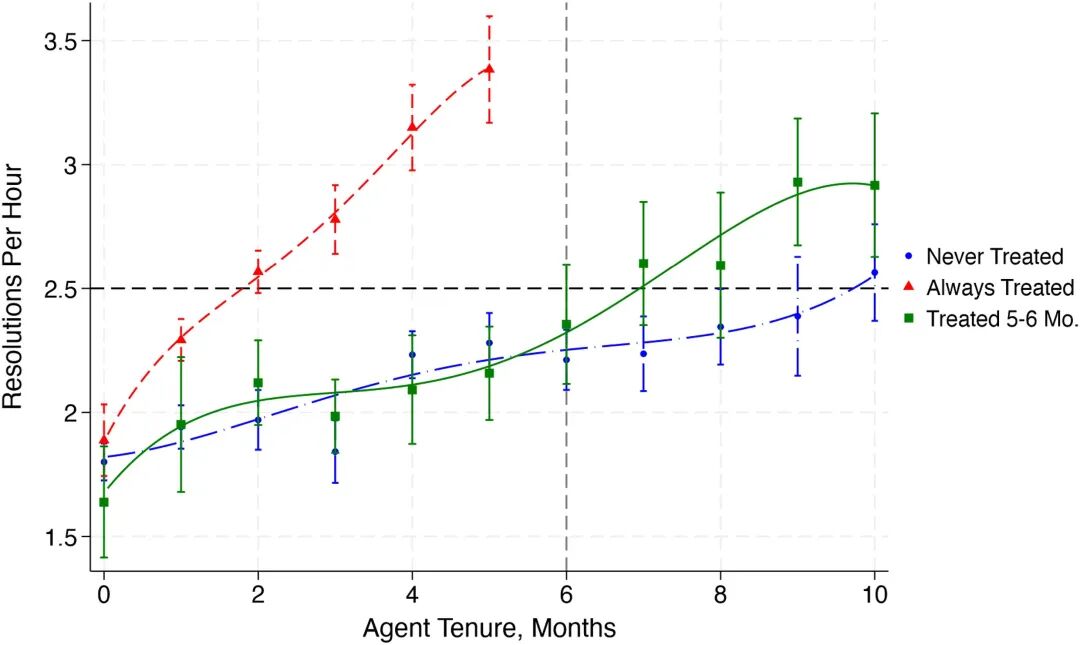
A study published in the Quarterly Journal of Economics in 2025 analyzed the work data of 5,172 customer service representatives. The AI assistant in the study referred to the dialogues of top-performing employees and provided real-time suggestions to other staff. To reach the level of solving about 2.5 customer problems per hour, the group of employees who did not use AI needed to accumulate 8 to 10 months of work experience; the group that used AI from the first day on the job reached a similar level in just two months.
Salaries are rising, isn't that a good thing?
Income increasingly depends on how you participate in the production process, not just what kind of job you do.
But if all workers have to face competition from computing power, why is it the middle class that gets wiped out?
Because for people who earn high incomes mainly by relying on their professional skills, AI may shake the very foundation that made them part of the middle class: earning a better life through labor that is more valuable than others'.
But this kind of high-value labor will no longer be so scarce in the AGI era, so the income gap between them and ordinary workers may shrink significantly...
Sounds like the salaries of the middle class will keep shrinking in the future?
Not necessarily.
In the model proposed in this paper, even if human labor is re-priced "with the price of computing power as the upper limit", the average real wage can still be higher than before the arrival of AGI. Moreover, real purchasing power will indeed improve, and life will truly become better.
That sounds pretty good, right? You still have your job, and your salary can even go up. So why do people say the situation of the middle class has deteriorated?
Because no matter how much your salary rises, you have to compare it with how much total wealth the whole society has newly created.
Another economic research paper released this September gives such a set of data: in the next five years, the total output of the US economy will increase by 60.7%, and the average real wage will rise by 18.5%, but the share of labor income in total output will drop from 54.1% to 39.9%.
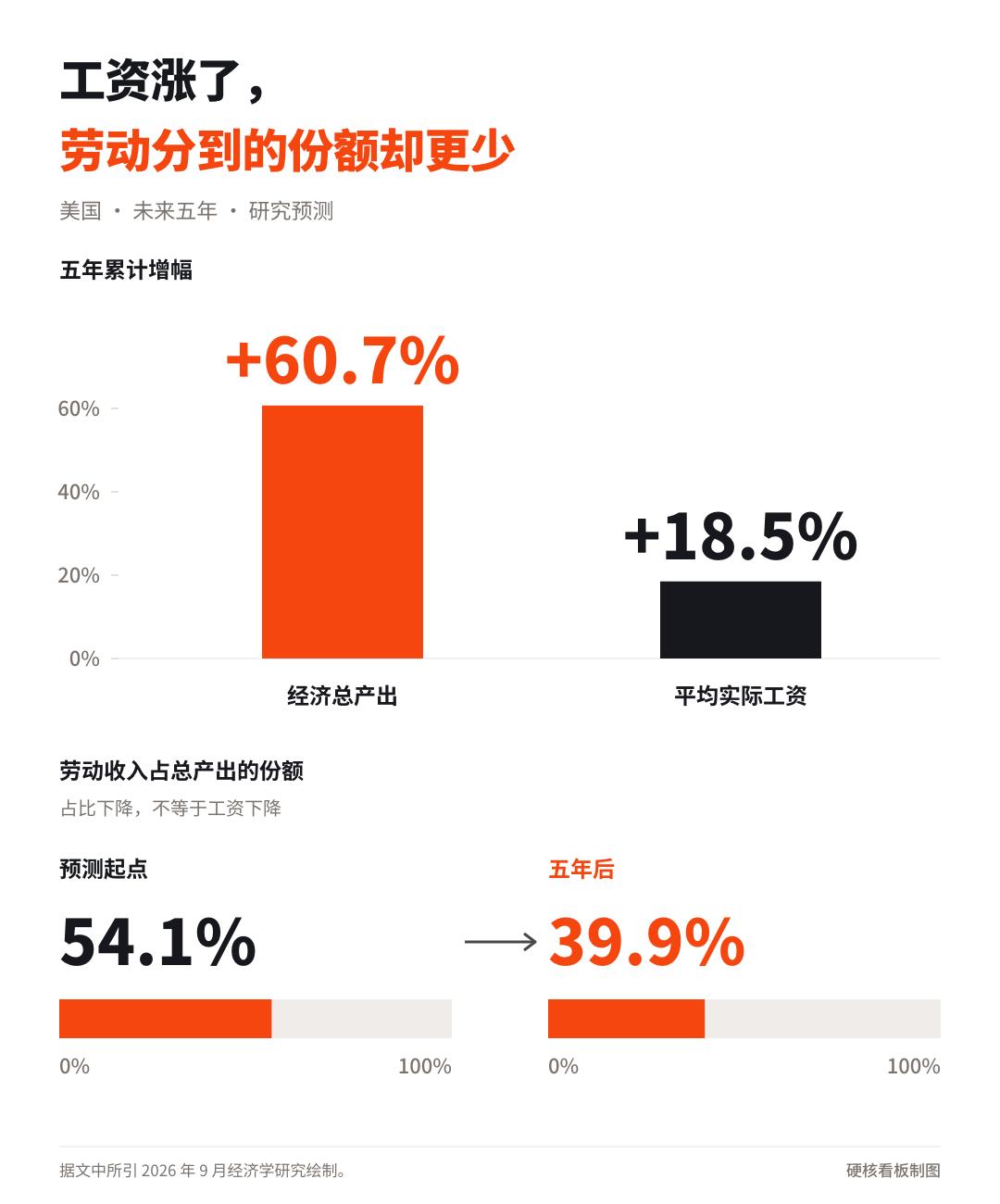
Salaries are rising and purchasing power is improving, but the wealth created by the whole society is growing much faster.
In the model of "We Won't Be Missed", as computing power expands, the share of income obtained by computing resources keeps rising, while the share obtained by labor keeps falling. More and more of the benefits brought by super AI will flow into the pockets of capitalists who control computing resources.
In a report released by Anthropic Research Institute this September, under the extreme scenario it set of "large-scale automation with no new human tasks created", by 2030, compared with the development path without AI, the total labor income will only be 0.5% higher, while capital income will be 81.4% higher. In this scenario, almost all new income comes in the form of capital gains.
From the perspective of these capitalists in the AGI era, the middle class does not bring them more profits, since it is AI that generates more returns. So why should they distribute their earnings to workers and raise their salaries?
In the past, with a well-paying job, you could participate in economic growth and accumulate wealth. In this future, your job can still make your life better, but the gap between you and those who own production resources may keep widening.
Therefore, this "middle class crisis" means that you can no longer get a share of the economic dividends brought by the huge progress of the world just by relying on a decent good job.
Then how on earth can ordinary people get a share of the extra wealth generated in the world?
How to get a share of the dividends when you don't have enough money to be a capitalist?
Then I can just become a capitalist myself, right?
This is not completely unreasonable.
Ordinary people certainly do not need to build a data center on their own to own production resources. You can hold equity in enterprises. One can receive a salary while also sharing the profits generated by the operation of the enterprise. As machines take on more and more work, you get the chance to take a cut of the dividends that originally belonged only to capitalists.
But you need to have principal first.
However, the distribution of existing assets is already extremely uneven. Data from the Federal Reserve shows that in the second quarter of 2026, ranked by household net worth, the richest 1% of households in the United States hold 50.9% of all household corporate stocks and mutual fund shares; the bottom half of households hold only 0.6% in total.
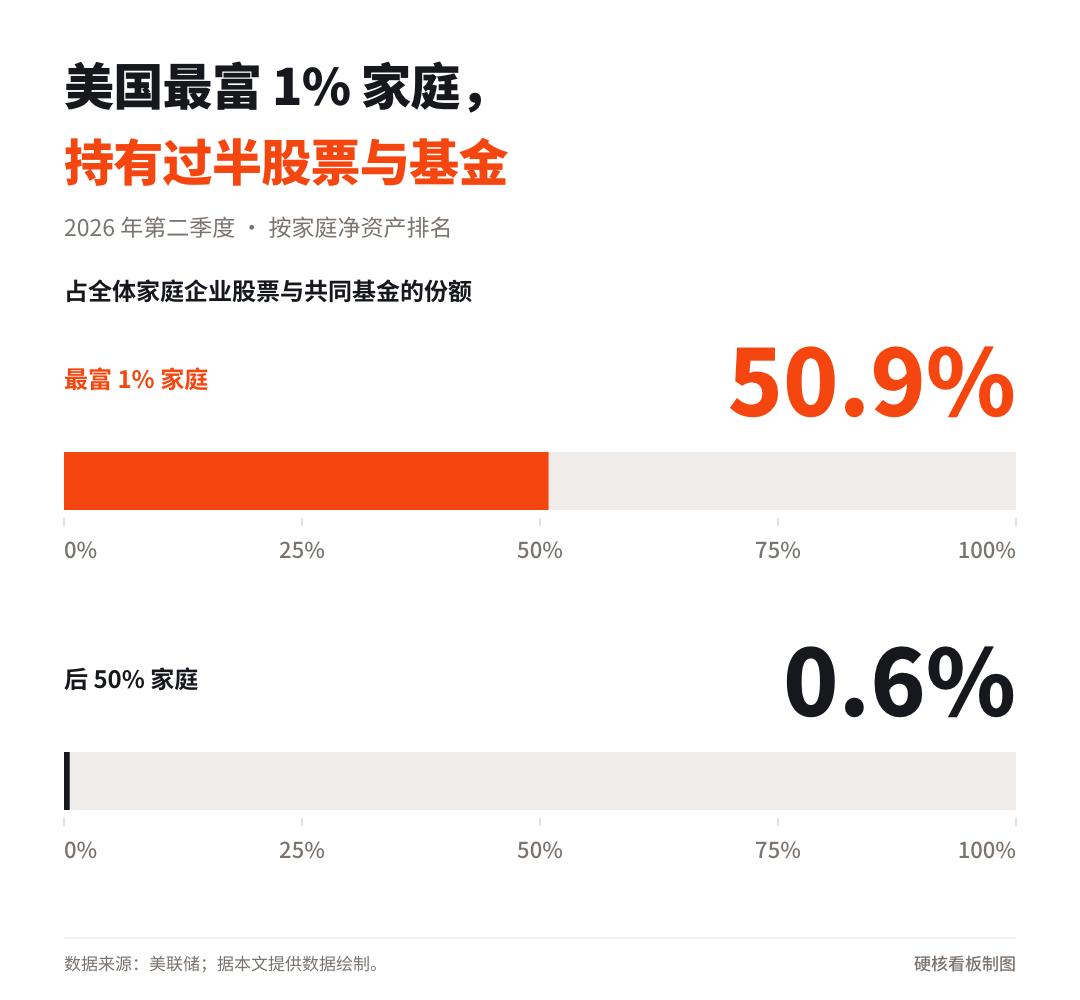
With the same rate of return, will the money you get from investing 10,000 dollars be the same as that from investing 10 million dollars? What about those people whose income is just enough to make ends meet and cannot save much money at all?
If the premise of sharing prosperity is to have enough money to buy a part of it first, then this path obviously cannot cover everyone.
The paper "Redistribution Policies in the Age of Transformative AI" published by a Polish researcher this September lists several ways for ordinary people to share the benefits of AI, including "tax and then distribute the money to the public" and "let the public hold assets collectively".
One of the ideas is to tax capital gains and then distribute the proceeds to the public. Production resources are still owned by their original holders, but part of the generated profits flows to other people through taxation.
Another approach is to let the public directly obtain the right to capital gains. For example, public funds hold corporate equity, and then distribute the profit rights widely to residents. Even if you do not have the money to buy stocks on your own, you can still own a share of them, so that more people are entitled to participate in this "AGI dividend".
Right now, Alaska in the United States is already implementing this kind of dividend scheme with its mining revenue.
The local government accumulates part of the mineral resource revenue into a permanent fund, earns returns through investment, and then allocates funds from the fund to public services and annual resident dividends. In 2026, each eligible resident can receive a $1,000 permanent fund dividend, plus a $200 energy subsidy. It distributes the returns accumulated from resource wealth, so residents do not need to put up their own principal to buy stocks to get a share of the gains.

Following these ideas, ordinary people will have channels other than salary to participate in future prosperity. People who do not have any principal will also have the opportunity to share the huge benefits brought by the AGI era.
In the AGI era, we workers will not be missed. But if we can really live a good life without having to work our asses off, this kind of "not being missed" is not that much of a pity.
This article is from the WeChat official account "Hardcore Dashboard" (ID: yinghekb), written by Wang Rui, and published with authorization from 36Kr.