"North American Doubao" has become the world's most powerful model, and Google's market capitalization has dropped by more than 300 billion US dollars.
After U.S. stock markets closed on October 28 local time, Alphabet released its Q3 2026 earnings report. Just a few hours earlier, Google had just launched its new flagship model Gemini 4 Carbon, which topped the intelligence index ranking of third-party evaluation agency Artificial Analysis. However, after the earnings report was released, Google's after-hours stock price once fell by more than 10%, with a market value loss of over 300 billion U.S. dollars.
Rolling Out the "New Champion" Right Ahead of Earnings Release
Per conventional practice, the launch of a heavyweight model and an earnings call rarely fall on the same day. But Google had these two events coincide this time.
On October 28, Koray Kavukcuoglu, Senior Vice President and Chief AI Architect of Google DeepMind, announced this new model in the official blog post Gemini 4 Carbon: our next frontier model. Only two weeks have passed since the previous generation Gemini 4 Argon went live.
Google positions Carbon as "the most powerful model for cybersecurity and long-horizon tasks". The benchmark scores disclosed in the official blog show that it ranks first with 59 points in the Artificial Analysis Intelligence Index v5.0, surpassing Claude Opus 5.5's 58 points and GPT-6 Astra's 57 points. Indeed, it appears to have finally taken the global top spot; it has set new records across three cybersecurity benchmarks: 88.2% on SEC-bench Pro (vulnerability discovery), 54.8% on ExploitGym (exploit validation), and 71.0% on CWE-bench (automatic patching).
On Artificial Analysis' Intelligence Index V5 leaderboard, Carbon tops the list with 59 points, followed by Opus 5.5 (max with fallback) at 58 points and GPT-6 Astra at 57 points.
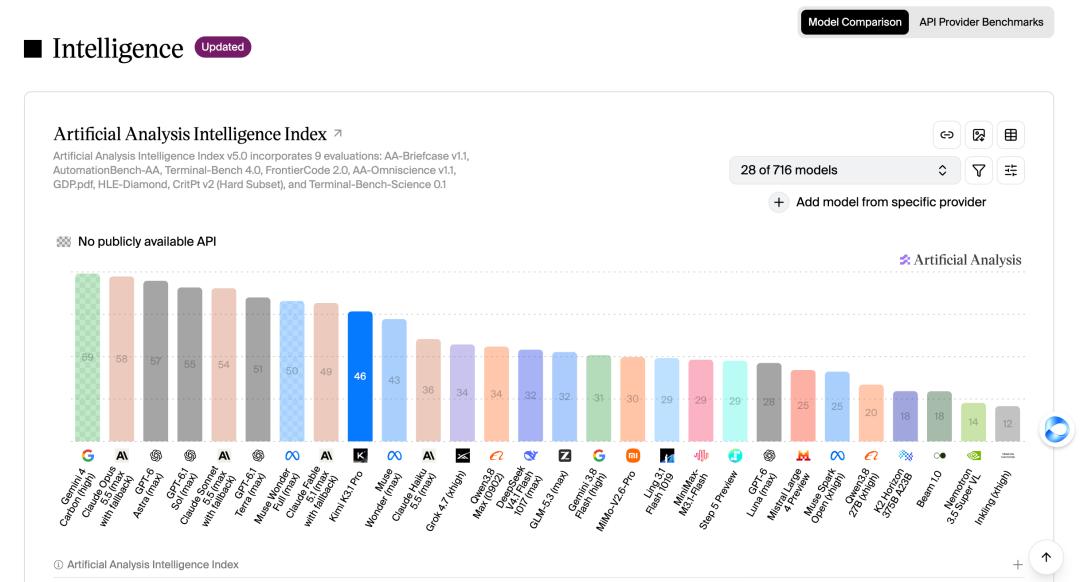
In terms of pricing, during the introductory period, the cost is 2 USD per million input tokens and 10 USD per million output tokens, with a 95% discount for cached inputs; after the introductory period ends, the price will rise to 4 USD and 20 USD respectively. As a point of reference, the Argon model the company released two weeks ago adopted the exact same introductory pricing. This "low entry price, double price after expiration" locking strategy has been used for two consecutive generations of models.
At present, Carbon does not have an open API. Its first release is only available to a small group of audited cybersecurity defenders, and will later be gradually extended to trusted partners through DeepMind's Fairwind program. No timeline has been given for public access for ordinary developers and consumers. Google also revealed that it is participating in the U.S. government's voluntary pre-release testing process for models. A model that claims to have "world-leading" security capabilities has first constrained itself with dual-use risk restrictions.
During the earnings call, Pichai made a very confident statement, saying that the company is "leading at the frontier", and presented a set of figures: the company's annualized revenue has reached 500 billion U.S. dollars; first-party model APIs process nearly 32 billion tokens per minute, more than 4 times the figure from a year ago; the number of Gemini app users has exceeded 1 billion, making it the fastest-growing product in Google's history.
The Second Quarter of Negative Cash Flow in 22 Years Since Listing
However, alongside the most powerful model came continued underperforming business results.
The earnings report shows that Alphabet's Q3 revenue was 127.58 billion U.S. dollars, up 25% year on year, lower than market expectations of 128.22 billion U.S. dollars; net profit was 26.17 billion U.S. dollars, lower than 34.98 billion U.S. dollars in the same period last year, down about 25% year on year, of which 8.66 billion U.S. dollars was a book loss on equity investments, mainly related to its investment in SpaceX. Diluted earnings per share were 2.12 U.S. dollars, while the market expectation was around 3.02 U.S. dollars.
Free cash flow for the quarter was negative 9.07 billion U.S. dollars, marking the second consecutive quarter of negative cash flow, following a negative 5.86 billion U.S. dollars in the previous quarter, which was the first time the company had negative cash flow in its 22-year history as a public company. According to Reuters, analysts had previously expected the figure to be "nearly break-even".
As disclosed in the earnings report, Alphabet's Q3 capital expenditure was 51.36 billion U.S. dollars, up 114% year on year; the full-year capital expenditure guidance remains unchanged at 195 billion to 205 billion U.S. dollars. Anat Ashkenazi, Chief Financial Officer, stated during the earnings call that capital expenditure in 2027 will "increase significantly", and more details will be disclosed at the Q4 earnings call.
To cover these huge outlays, Google's balance sheet has been transformed. Earnings data shows that its long-term debt has climbed from 21.6 billion U.S. dollars a year ago to 125.1 billion U.S. dollars, an increase of about 479%. Earlier this year, according to Bloomberg, Alphabet had issued about 50 billion U.S. dollars in bonds (including 100-year maturity varieties), and raised another 85 billion U.S. dollars in June through share placements and mandatory convertible preferred stock; in August, it planned to borrow another 20 billion to 25 billion U.S. dollars, and this bond issuance received 115 billion U.S. dollars in subscriptions.
If you look for the only bright spot in the entire earnings report, it is Google Cloud: revenue reached 30.71 billion U.S. dollars, up 103% year on year, far exceeding market expectations of about 29 billion U.S. dollars; operating profit for the cloud business reached 11.1 billion U.S. dollars. Thomas Kurian, Head of Cloud Business, took the stage at the earnings call for the first time, revealing that TPU (Tensor Processing Unit) sales have become an important revenue source for the cloud business, and the reported news that OpenAI will purchase Google chips has also added significant value to this business line.
But for a company that relies on advertising for revenue, search is its core business, and this core business is leaking revenue. Earnings data shows that Q3 revenue from search and related businesses was 63.35 billion U.S. dollars, up 12% year on year, a significant slowdown from the 17% growth rate in the previous quarter, and lower than market expectations of 64.96 billion U.S. dollars; YouTube ad revenue also fell short of expectations.
Management stated that query lengths in AI Mode are three times that of traditional search, but "monetization capability is relatively low at this stage". In other words, user search behavior has been reshaped by AI, but it is difficult to commercialize this new behavior.
The End of Cash Burn Leads to the Bond Market
Google's predicament is not an isolated case, but a microcosm of an industry-wide high-stakes bet.
Andrew Sheets, Chief Cross-Asset Strategist at Morgan Stanley, has raised the combined 2026 capital expenditure forecast for the five major tech giants to about 800 billion U.S. dollars, which is almost twice the figure for 2025 and three times that of 2024; the figure is expected to exceed 1.1 trillion U.S. dollars in 2027. When there is not enough cash on hand, the only option is to borrow. Goldman Sachs predicts that the bond issuance scale of hyperscale cloud service providers will reach as high as 420 billion U.S. dollars in 2026, hitting a historical record; JPMorgan estimates that the five major cloud service providers plus NVIDIA will issue about 320 billion U.S. dollars in bonds this year, of which the long-duration portion is equivalent to about 303 billion U.S. dollars in 10-year equivalent terms, accounting for 68% of the new long-term borrowing by the U.S. Treasury in the same period.
The bond market has already started to negotiate terms. According to Reuters data, the credit spread of AI-related issuers is about 115 basis points, significantly wider than the overall investment-grade market average of about 78 basis points; the subscription multiple has dropped from nearly 5 times in February to below 2 times in July. Goldman Sachs warned that the investment-grade bond market is becoming "equity-like", with four large hyperscale tech companies and four large data center financings accounting for nearly 20% of recent duration-weighted issuance. The Bank for International Settlements (BIS) has even directly listed the AI investment boom as a stress point threatening global financial stability.
Societe Generale Chief Strategist Edwards directly warned: the current AI investment boom bears striking similarities to the 1997 Asian financial crisis, not because the technology itself is useless, but because the speed of capital inflow far outpaces the speed of productivity improvement.
Specific to Google's earnings report, Bernstein analyst Mark Shmulik judged that in the market's initial interpretation, negative factors clearly outnumber positive ones. BNP Paribas analyst Nick Jones pointed out a deeper layer of anxiety: the market is worried that AI agents such as ChatGPT and Meta Muse are eroding Google's search business: if agents will browse web pages for users and place orders on their behalf in the future, where will Google place its ads?
Google can certainly push back: the year-on-year growth rate of search query volume has hit a five-year high, the cloud business is doubling its revenue, and its model has just taken the top global spot. But the earnings report presents a different set of facts: search revenue growth is slowing, free cash flow has been negative for two consecutive quarters, and the company will spend even more in 2027.
On November 18, NVIDIA will release its Q3 2027 earnings report, which is regarded by the market as the mid-term exam for global AI capital expenditure.
As for Carbon, a "world's most powerful model" that has not yet been opened to the public, it can win applause, but it cannot win Wall Street's approval for the time being. A deeper question is, at a time when AI efficiency has not yet improved, does the market really need so many most powerful models?
This article is from WeChat Official Account "Ifeng Technology", author: Ifeng Technology, published with authorization from 36Kr.