The AI anxiety among this cohort of middle-class parents comes with a 13,800-yuan price tag.
The same kind of fear is hidden in the WeChat Moments of this group of middle-class parents.
Nowadays, people no longer only fear that their children will perform poorly in one exam, but worry that their kids will not even have the qualification to be eliminated in the future. They are caught in the anxiety that "other people's children have already developed mini-programs with AI, while my son is still playing with Lego".
In parent groups, people share photos of closing ceremonies, logos of large tech companies, and name badges of "teen CEOs". You clearly know it's a bit impractical, but your finger stays on the "registration link" and you can neither click through nor close the page.
As a result, the 6-day, 5-night AI study tour priced at 13,800 yuan has become the most convenient "antidote" to anxiety.
The market size of study tour in 2026 is expected to reach 242.2 billion yuan, up 13.6% year on year, among which the number of AI-themed study tour orders has surged by 370% year on year.
The price of courses ranges from 2,000 yuan to 50,000 yuan, but most of them share similar keywords: "visit top tech companies", "postgraduates and doctors from top universities", "scientific and innovative thinking". However, few people really understand what lies behind these buzzwords.
In this issue of Micro Stories, we interviewed registered parents and institutional lecturers. From their stories, we see that every bit of anxiety has a price tag, but what exactly do people get in return for this sum of money?
The following are their real stories:
Even the grandmother can't sit still
On the last Friday of September, around 9 p.m., Yao Min was lying on the sofa scrolling through Douyin when she suddenly came across a video:
A man in a white shirt stood in the lobby of a building and said solemnly that in the AI era, the most important thing for children to learn is not knowledge, but how to think with AI.
"It's annoying at first glance." Yao Min swiped away the video before it finished playing. She had seen too many such anxiety-stoking course-selling videos and was already immune to them. Yao Min is a marketing executive at a foreign company in Shanghai. Her son Jiang Tongyi, 10 years old, is just in the fourth grade.
Unexpectedly, less than half an hour later, the child's grandmother forwarded the same link to the family group.
The grandmother's biggest hobby after retirement is scrolling through short videos. The algorithm quickly figured out her preferences, and pushed her more and more content about parenting, education, and tech enlightenment, with student achievement videos popping up one after another.
The scripts in the videos are also very similar: closely follow the national artificial intelligence development policy, seize the future technology track, cultivate scientific and innovative thinking from an early age, and all peers are learning ahead of schedule.
Usually, most of these videos are generated by AI. The children in the footage are either operating robots, or experiencing "mind control" with some devices, followed by firm explanations from lecturers and bullet screens of positive reviews from parents.
However, the grandmother believed it completely, and repeatedly reminded Yao Min, "Now the state is strongly supporting AI technology. In the future, people who don't understand artificial intelligence will be illiterates in the new era."
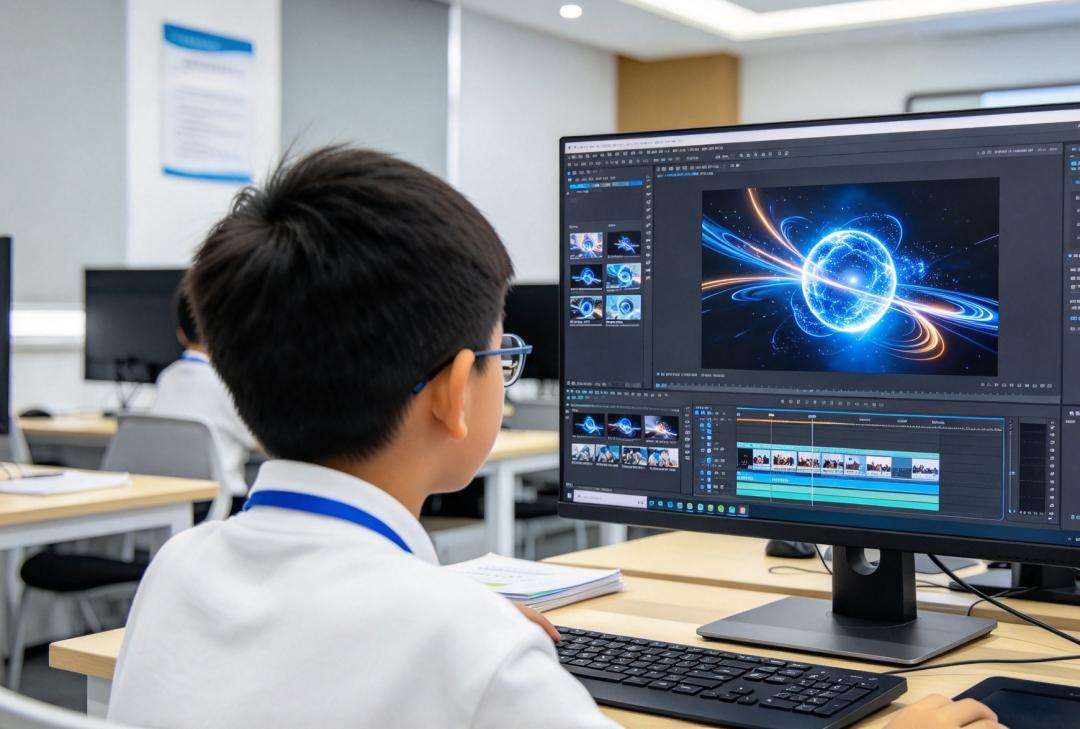
The grandmother even "leads by example". After dinner at 7 p.m. every night, she takes online courses at the dining table to learn how to make AI short videos, and keeps learning until 9:30 p.m. When she doesn't know how to use the transition in the editing software, she writes down every step in a small notebook with large characters.

After learning, the grandmother edited the footage she took at the vegetable market into a 15-second video, sent it to the family group, and added a line: "Grandma can do it too". No one replied in the group. A dozen minutes later, she sent a smiling emoji herself.
Yao Min was initially resistant to this series of operations from her grandmother.
She has worked in advertising for several years, and can recognize such scripts at a glance: such videos usually first create panic that children can't keep up with the times, then build a tech-savvy future, and sometimes add limited-time discounts and other "success cases" of unknown authenticity.
But the grandmother didn't take it seriously, saying those people are professionals. In this way, the grandmother became the family's "AI promotion ambassador". She talks about it during meals, during walks, and even forwards a student video before going to bed.
However, when the grandmother forwarded this video again that night, Yao Min was somewhat shaken.
The reason for her wavering may be related to Yao Min's recent experience.
Since March this year, the company has promoted the use of AI among internal employees. Yao Min and the interns she led revised the plan four times, but the director was not satisfied. Finally, the director threw the demand to AI right in front of them.
In less than 20 minutes, AI generated six different versions for everyone to choose from, and the color matching was better than what Yao Min and her team had made before.
Three months later, two content creators in the department left their jobs one after another, and no new hires have filled the vacant positions up to now.
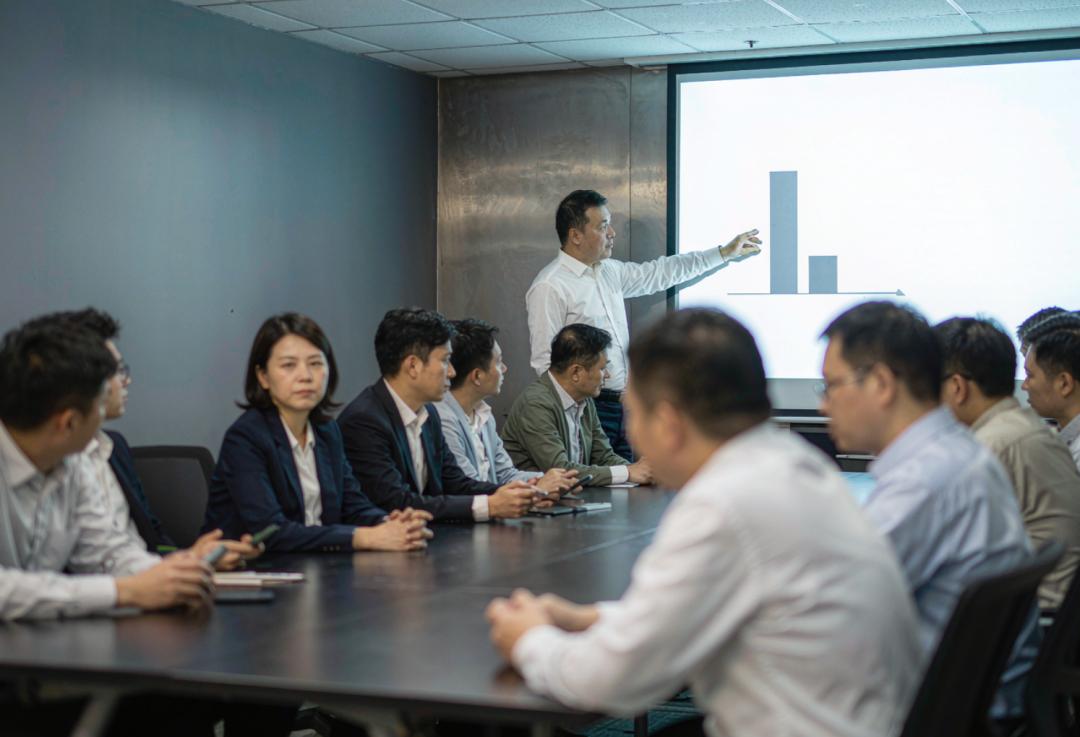
The boss talked about cost reduction and efficiency improvement at the latest quarterly meeting, with a cost sheet on the projection screen: on the left is the annual cost of content outsourcing, on the right is the annual subscription fee for AI tools, the two numbers are side by side, with a tenfold gap.
A dozen people in the meeting room, some bowed their heads scrolling through their phones, some nodded along. Yao Min said nothing.
During that period, the push notifications on her mobile phone also changed. No matter which app she opened, it was talking about which position would disappear next year and which industry had already been reshuffled. As a result, Yao Min always thinks before going to bed now, if she has to find a new job when she turns 40, what else can she write on her resume.
So later she couldn't tell clearly whether she was convinced by her grandmother at the moment of registration, or by that uncertain resume of her own.
Yao Min added the WeChat account of the institution and asked if the course was suitable for a 10-year-old child. The other side replied quickly: "We have courses for children aged 6 to 12, and 10 years old is a very suitable age."
A moment later, another message came: "But to be honest, ma'am, 10 is not early for our courses, several 9-year-old children can already make a mini-program on their own." There was also a 40-second voice message behind it, which Yao Min didn't open, but converted to text.
The customer service saw that Yao Min didn't speak, and kept asking her if she had any concerns. Yao Min's mind was full of the Moments posts that other parents had sent, such as those showing English grade certificates, robot competition awards, and someone even posted a closing ceremony photo with the logo of a large internet company.
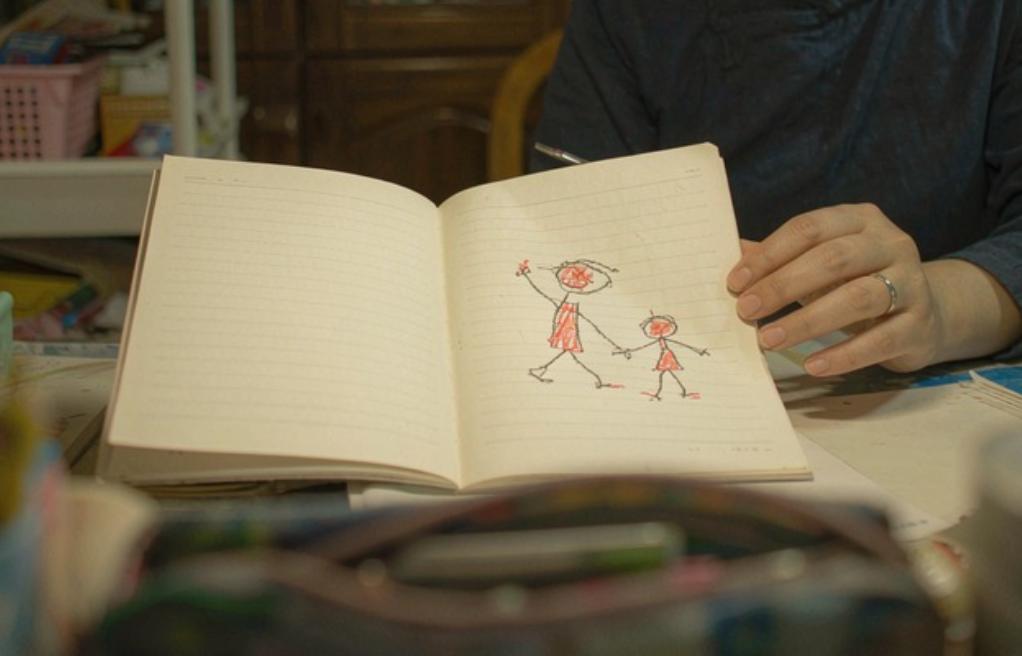
Those days she was distracted at work. When others talked about the second-half plan at the meeting, what popped up in her mind was her son chasing other people's remote control cars in the community. When checking his homework at night, she flipped the notebook to the last page, where two stick figures were drawn.
On the last working day before the National Day holiday, Yao Min and her grandmother together selected the National Day AI study tour course for Jiang Tongyi, located in Suzhou, 13,800 yuan for 6 days and 5 nights.
She calculated that this sum is enough for Jiang Tongyi's four years of Lego classes, and it is exactly the configuration level she hesitated about when changing her car last year. But two seconds later, she thought: what if? What if these six days really make him enlightened, then this 13,800 yuan will be the most worthwhile sum she has spent in the past ten years.
There was a column in the registration form asking for the one thing the child is best at. Yao Min paused there for a while. She wanted to write "good memory", but that was her own judgment; she wanted to write "love to ask why", but was afraid it looked like a filler. Finally, she wrote "building Lego".
Two days before the camp started, the institution sent several student achievement videos, and then a full page of course schedule: popular science of basic AI principles, intelligent robot practical operation, AI animation short film production, scientific and innovative thinking training, study tour in tech enterprises, group scientific innovation project defense. Behind each word are adjectives such as high-end, cutting-edge, immersive.
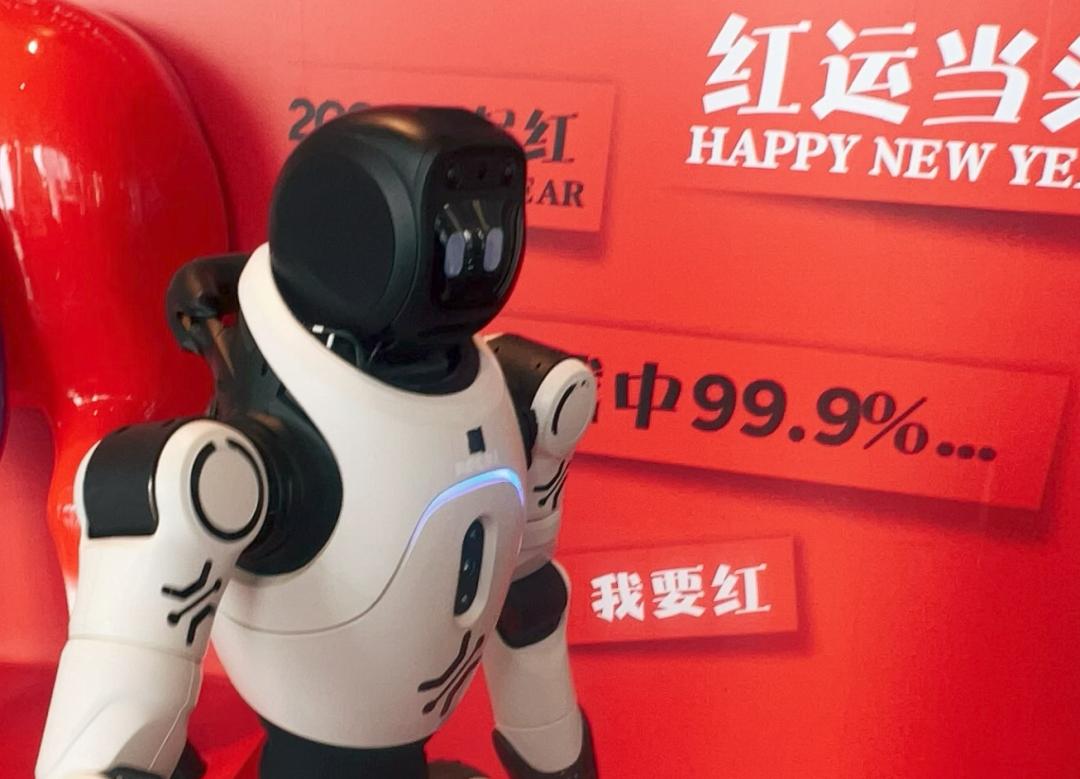
Photo | Robot practical operation sent by customer service
Yao Min printed it out, folded the A4 paper twice, and pressed it on the fridge door with a fridge magnet. Later she admitted that she was actually doing mental accounting at that time.
She planned to ask about each item one by one after the six days ended.
Part-time lecturer paid 500 yuan a day
Xiaofeng got this part-time job in April this year, working as a lecturer in the AI study tour group of an institution.
He posted a moment on social platforms saying that he had been admitted to the postgraduate program of artificial intelligence at a 985 university in Shanghai, and the institution took the initiative to contact him.
The other party said that they were a start-up company, and was cooperating with a large internet company to develop AI study tour groups for children, recruiting doctors and masters from top universities to give AI popular science lectures for participating children, 500 to 800 yuan per day, for both short-term and long-term positions.
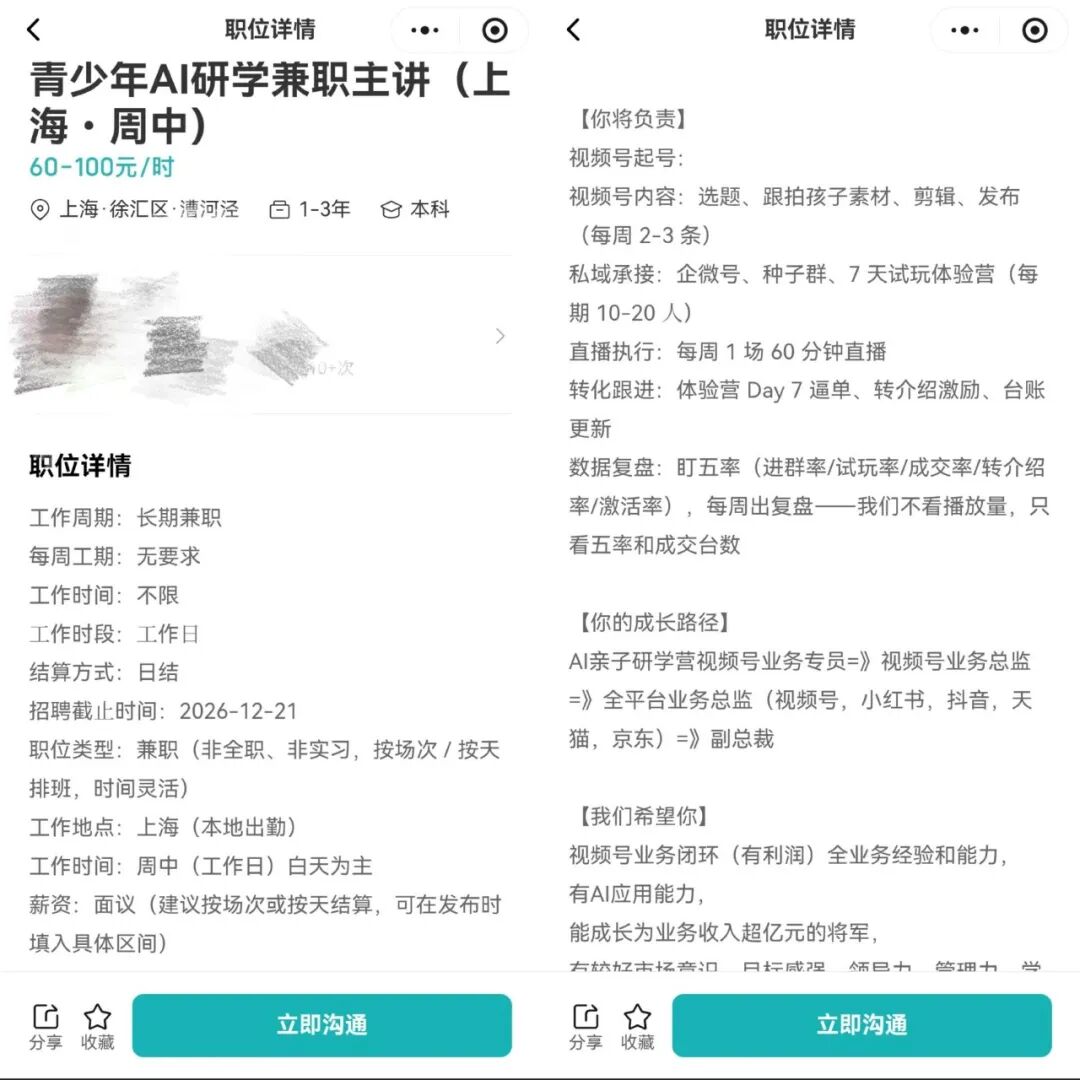
Photo | There are many part-time AI study tour positions on job hunting apps
Xiaofeng had worked as a part-time teacher in a training institution before taking the postgraduate entrance exam, and was optimistic about the education sector. He happened to have free time, so he replied that he could take the job.
After replying, he regretted a little, "I'm worried that these 'genius' children will ask me very difficult questions." He thought this kind of study tour would be similar to the postgraduate recommendation summer camp, which first selects a group of talented children, and then screens them through lectures, written exams and interviews.
After all, the recruitment requirements for lecturers are not low, the study tour locations are well-known companies and top universities, and during that time he often saw news that tech companies were recruiting talents from high schools.
Xiaofeng mentioned this worry to the boss. The boss smiled. "Don't worry, this is an AI study tour group paid by parents, not a training camp for child prodigies. You just need to popularize AI-related knowledge to them."
Xiaofeng's class was held in the conference hall of a university in Suzhou. The hall can seat more than 100 people. That day, there were more than 30 children, aged from 7 or 8 to 12 or 13, wearing the same cultural T-shirt and hanging name badges on their chests.
Xiaofeng described it this way: "With the title of top university postgraduate, I explained AI to a group of primary school students who barely understand it." When talking about neural networks, Xiaofeng paused for a moment, deliberately thinking of an expression that children can understand, and said, "It's like there are many wires in the human brain, connected together, and they light up when powered on."
The children in the audience either played with the lanyard of their name badges, wrapping the rope around their fingers twice before loosening it; or lay on the table, drawing grids on the cuffs of their cultural T-shirts with pencils; or stared at the screen, waiting for him to turn to the next page. No one took notes.
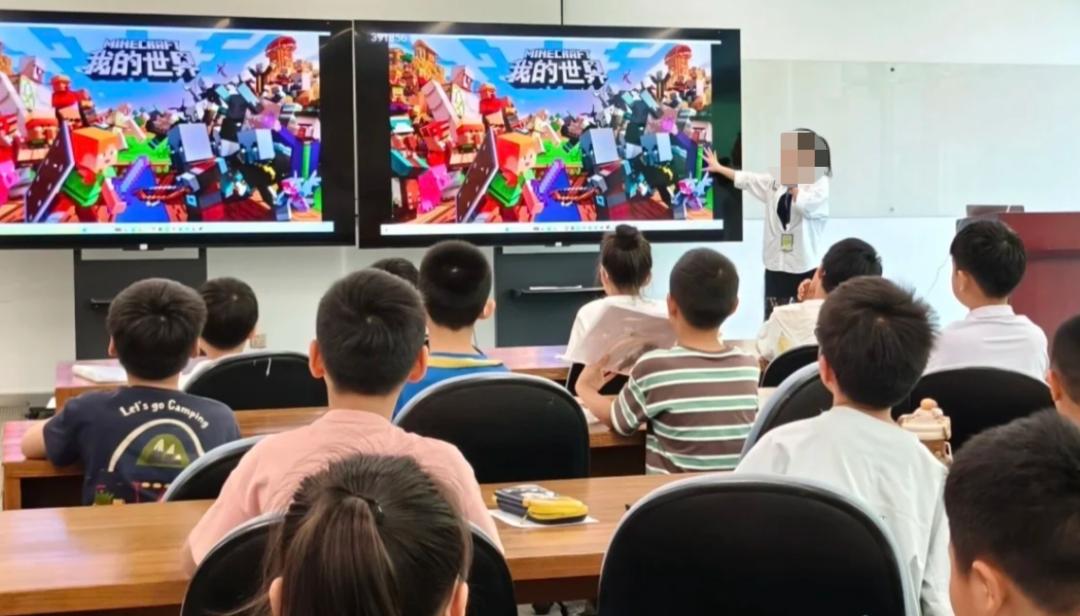
Photo | Children in the AI study tour class are having lessons
The afternoon session was AI experience. The children lined up to wear a headband, and there was a small ball on the screen that would float up when they concentrated. Some children shouted when the ball floated up, while those who couldn't make it float held their breath and tried again. There were several robots in the next room that could dance and turn around following people.
The last item was AI image generation. Xiaofeng saw a boy in the back row save the generated image to his album. The screen showed a family of three standing on the grass, looking like a child's crayon drawing, with four small characters in the lower right corner. The boy looked up and asked if he could send it to his mother, and Xiaofeng said yes.
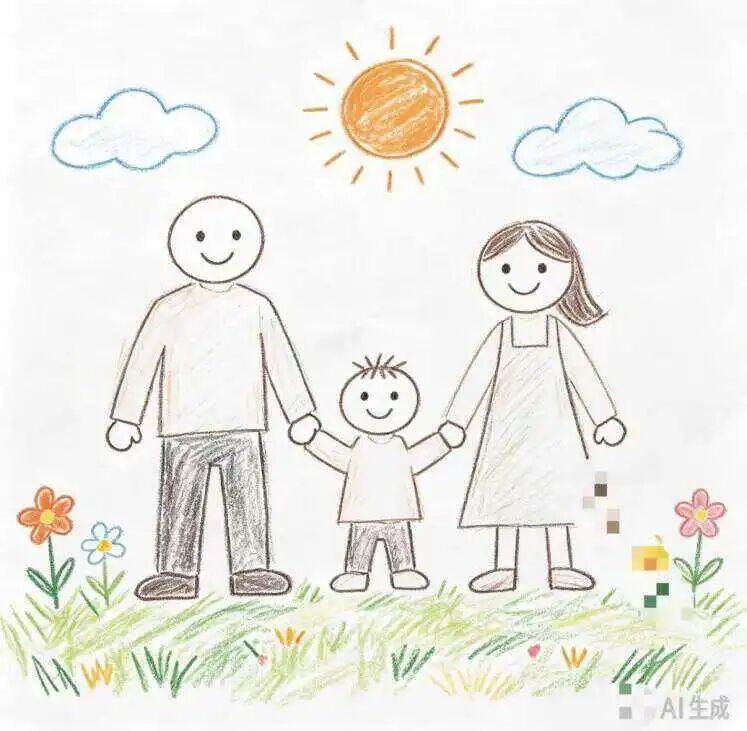
Photo | AI-generated image made by a child
Throughout the whole day of the study tour, a person stood at the back of the classroom shooting