Samsung, which raked in enormous profits, has been doused with cold water by the market.
On October 29, South Korean chip giant Samsung Electronics released its third-quarter financial report, with multiple core indicators hitting all-time highs.
However, this seemingly perfect report card failed to impress the market.
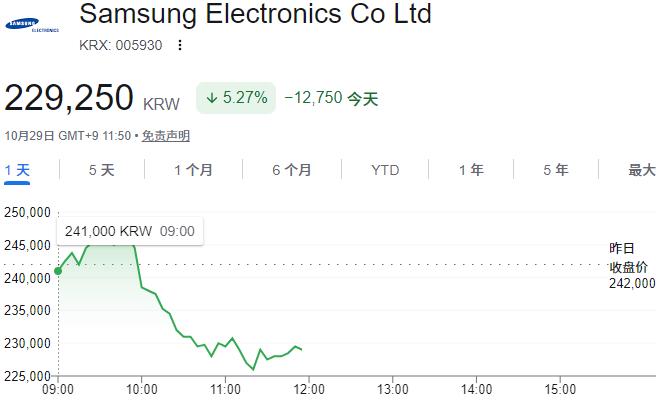
Both the net profit for the quarter and the profit of the semiconductor division fell short of expectations. After the financial report was released, Samsung Electronics' share price fell by more than 5%.
Semiconductor business reaps huge profits, while mobile phone business drags performance down
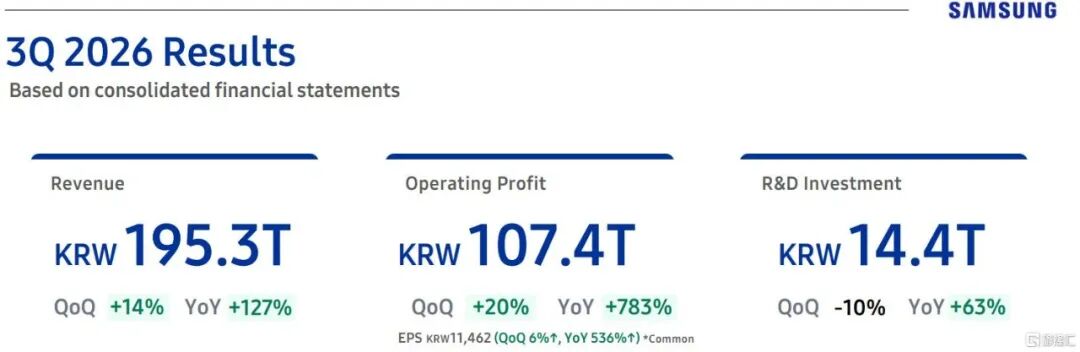
The financial report shows that Samsung's operating profit in the third quarter reached 107.4 trillion won, surging 783% year on year and rising 20% quarter on quarter.
This is also the first time that Samsung Electronics' single-quarter profit has broken through the 100 trillion won mark, with revenue and profit hitting new highs for four consecutive quarters.
The total revenue for the quarter reached 195.3 trillion won, more than doubling year on year with an increase of 127%; earnings per share (EPS) stood at 11,462 won, jumping 536% year on year.
However, beneath the seemingly perfect report card lie hidden worries that the market does not buy into.
First, the net profit came in at 75.2 trillion won, lower than the market expectation of 83.6 trillion won.
Second, the semiconductor division, which contributed almost all the profits, posted an operating profit of 106.5 trillion won, slightly below the average analyst expectation of 108.5 trillion won.
In addition, the total revenue of 195.3 trillion won was only slightly higher than the preliminary data released earlier.
Earning more but still falling short of expectations has become a major weight pressing on the share price.
From the perspective of specific business segments, Samsung's financial report presents an extreme "two extremes" situation: the semiconductor business is raking in huge profits, while the mobile phone and home appliance businesses are dragging down performance.
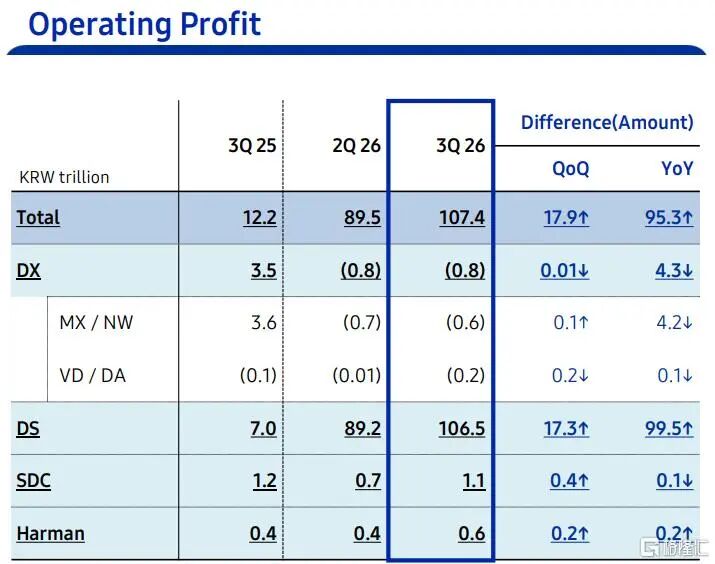
The semiconductor (DS division) is the absolute profit engine. The division contributed 106.5 trillion won in operating profit in a single quarter, accounting for more than 99% of the total profit, with a profit margin as high as 72%.
This is mainly benefited from the substantial surge in sales of HBM4 chips under the AI boom and the strong demand for server SSDs; at the same time, the increase in fab utilization rate and the demand for advanced processes are also continuously improving the revenue of the foundry business.
In contrast, the DX division in charge of mobile phones and home appliances fell into losses. Its operating profit for the quarter was -0.8 trillion won. Although the release of new flagships such as the Galaxy Z Fold 8 drove a quarter-on-quarter increase in revenue, the mobile phone business still recorded a loss of 0.6 trillion won due to cost pressure; the home appliance and TV businesses also saw profit declines due to falling demand after large-scale events and rising raw material costs.
The display panel (SDC) and automotive audio (Harman) businesses maintained steady profitability. The display panel division earned 1.1 trillion won, mainly relying on timely supply of new products to customers with small and medium-sized panels and cost reduction and efficiency improvement for large-sized high-end products. The Harman division contributed 0.6 trillion won in profits, with steady sales of automotive and audio products, supplemented by one-off gains such as US tariff refunds, delivering a stable performance.
While generating huge profits, Samsung is also increasing its R&D investment. Its R&D investment in the third quarter reached 14.4 trillion won, up 63% year on year.
In terms of shareholder returns, 30 trillion won in cash dividends were distributed in the third quarter. The total annual shareholder return is expected to be between 90 trillion won and 110 trillion won. The remaining 55 trillion to 75 trillion won will not only continue to be used for dividend distribution, but also include a large-scale share repurchase and cancellation plan.
AI demand is so strong that supply shortage will be more severe in 2027
Looking ahead, Samsung's performance growth line is almost completely tied to AI.
Samsung is very generous in capital investment. It is estimated that the capital expenditure in 2026 will be about 84.4 trillion won, a significant increase from 52.7 trillion won in 2025, demonstrating its determination to expand production during the AI cycle.
The company expects that capital expenditure on AI infrastructure will accelerate in 2027 as the AI ecosystem expands. The resulting surge in AI demand will make the supply shortage of memory chips more severe than that in 2026.
To capture this wave of demand, Samsung's priority in the fourth quarter is to expand sales of high-value-added products, including HBM (High Bandwidth Memory), server DRAM and SSD, and increase the supply of high-speed server DDR5 and QLC SSD (large-capacity solid-state drives).
The company plans to start mass production of HBM4E, the next-generation AI memory chip, in the first half of 2027.
The driving forces supporting these demands are clear: first, the memory replacement brought by the new generation of CPU/GPU platforms; second, the expansion of personal AI agent services directly drives a surge in demand for QLC SSDs.
By 2027, Samsung plans to stabilize its basic sales volume by locking in long-term contracts and ensure that new products for AI applications are launched to the market in a timely manner.
As for foundry and chip design, the growth momentum in the fourth quarter comes from two aspects: first, stable mass production of flagship mobile phone SoC (main control chips) and 200-megapixel image sensors; second, the foundry business, driven by the mass production of the second-generation 2nm mobile new products and 4nm NPU (Neural Processing Unit), is expected to achieve double-digit revenue growth.
In 2027, the absolute highlight of the foundry business will be the 4nm/2nm advanced processes driven by AI/HPC (High Performance Computing) demand. At the same time, the first fab in Taylor, USA, will be officially put into operation to strengthen the global supply capacity.
For its subsequent performance, Samsung has given a series of optimistic guidelines: It is expected to continue to achieve profit growth in the fourth quarter, with DRAM chip shipments increasing by 15%-20%.
Looking ahead to 2027, Samsung believes that the chip market will remain strong and it is expected to deliver record-breaking performance again.
As for terminal businesses such as mobile phones and home appliances, there are relatively few bright spots. The mobile phone business will mainly rely on the S26 series and foldable phones at the end of the year to drive sales in the peak season, while the network business will strive for new orders against the headwind of telecom investment; the home appliance sector hopes to expand sales of innovative AI products to maintain profit margins.
This article is from the WeChat official account "Gelonghui Finance Hotspot" (ID: glh_finance), written by Chashan, and published with authorization from 36Kr.