Jellycat at 4.2 billion, LABUBU at 14.1 billion, Fuggler at 6.6 billion: who is actually making real profits from the "plush" business?
On October 27, Pop Mart released its business update for the third quarter of 2026. The most notable figure is that the company's total Q3 revenue decreased by 45% to 50% year-on-year. Specifically, revenue in the Chinese market dropped by 25%-30%, and revenue in the Asia-Pacific market fell by 65%-70%.
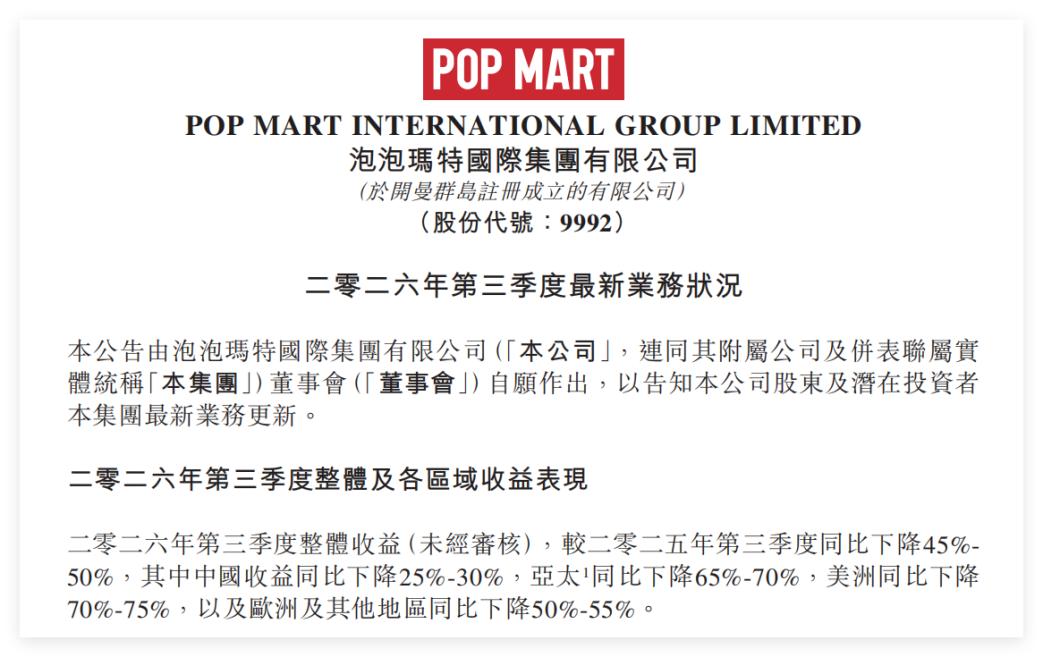
If we go back a year, such figures were almost unthinkable.
In 2025, Pop Mart recorded total annual revenue of 37.12 billion yuan, of which the plush category contributed 18.708 billion yuan, up 560.6% year-on-year, surpassing blind boxes for the first time to become the group's largest category. THE MONSTERS generated revenue of 14.1611 billion yuan, growing 365.7% year-on-year, becoming the first IP in the company's history to exceed 10 billion yuan in annual revenue.
The simultaneous boom of plush products and super IP convinced the market that a new product form combining "trendy toys + plush" had rewritten the growth rules of the trendy toy industry. However, Pop Mart's performance in 2026 poured cold water on the market.
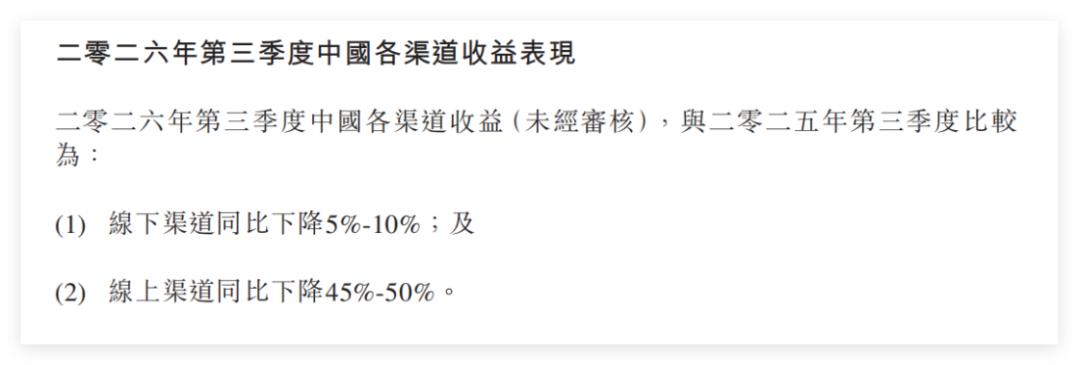
Nevertheless, compared with the overall decline, what is more noteworthy is the huge gap between different channels. In the third quarter, offline revenue in the Chinese market only decreased by 5%-10%, while online revenue dropped by 45%-50%. This to some extent indicates that the consumer demand driven by panic buying, box-drawing and speculation that previously supported the high online growth of plush products is fading rapidly.
Almost at the same time when Pop Mart was troubled by inventory, new product supply and overseas same-store performance recovery, the market began to refocus on another plush brand — Jellycat.
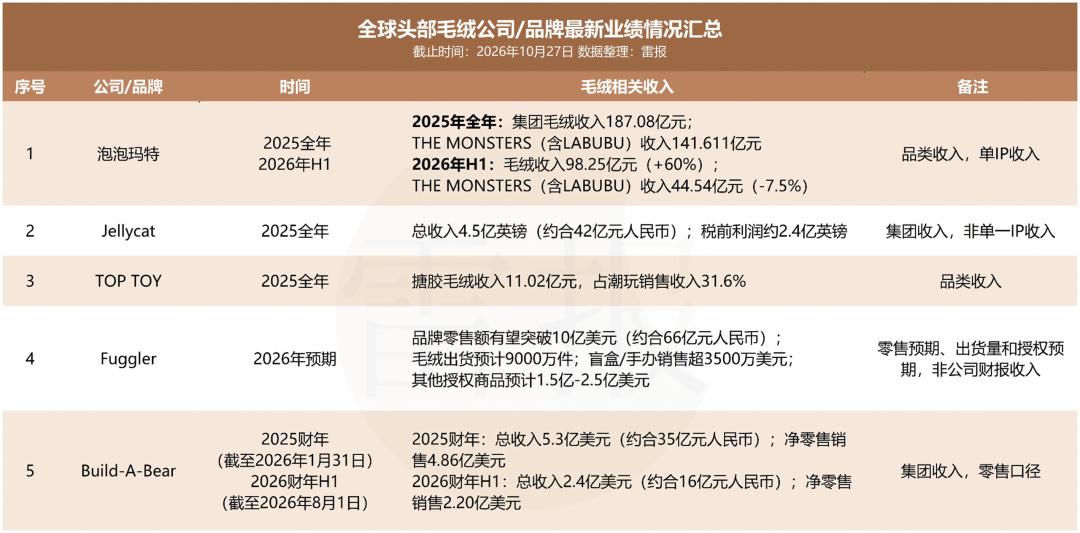
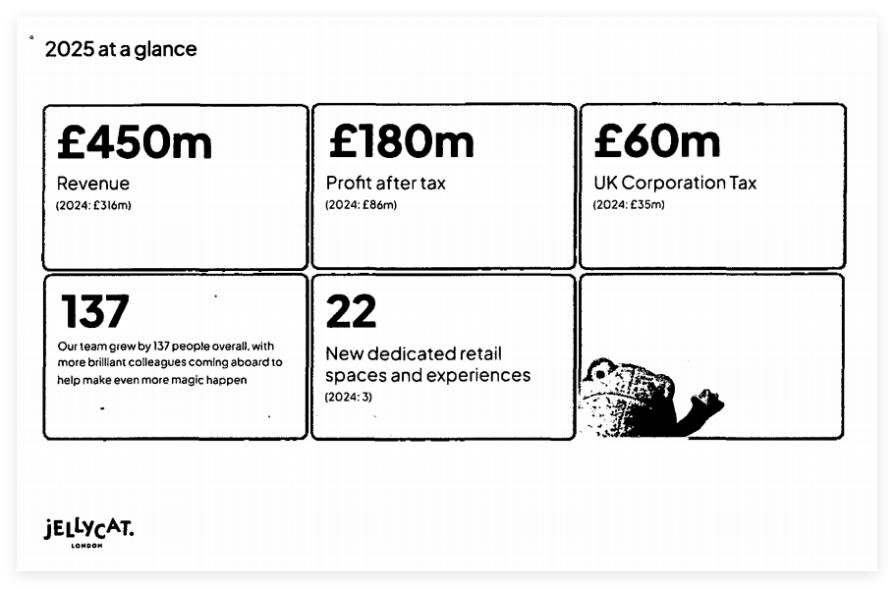
According to the recently disclosed annual report data, Jellycat achieved revenue of 450 million pounds (about 4.2 billion yuan) in the 2025 fiscal year, with a gross margin close to 70%. It does not have super IP like LABUBU with annual revenue exceeding 10 billion yuan, nor does it rely on blind boxes, limited releases and the secondary market to create scarcity, but has formed a completely different growth logic.
In addition, we have also observed the plush toy performance of companies and brands such as Fuggler, TOP TOY and Build-A-Bear. Their statistical calibers are different, so they cannot be directly ranked, but we can still observe different models of the global plush business from them. Next, Leibao will interpret them one by one.
Pop Mart: Q3 Revenue Down 45%-50%, What Remains of Its Plush Business After the LABUBU Craze Fades?
In fact, from Pop Mart's 2025 plush revenue data, we can see the reasons for the sudden explosion of plush brands.
In this year, plush products caught up with a super IP entering the global communication window, and with the help of the innovative process of vinyl plush, transformed trendy toys from the original hand-dominated collection form into products more suitable for carrying, displaying and daily use. IP popularity provides purchase motivation, and the product form expands the consumer group. The superposition of the two forces pushed plush to the core position of the group's revenue.
This also means that LABUBU's performance peak in 2025 was shaped by very specific conditions. It can prove how much commercial energy "super IP + plush" can generate, but it cannot automatically prove that every IP and every plush product can replicate the same growth.
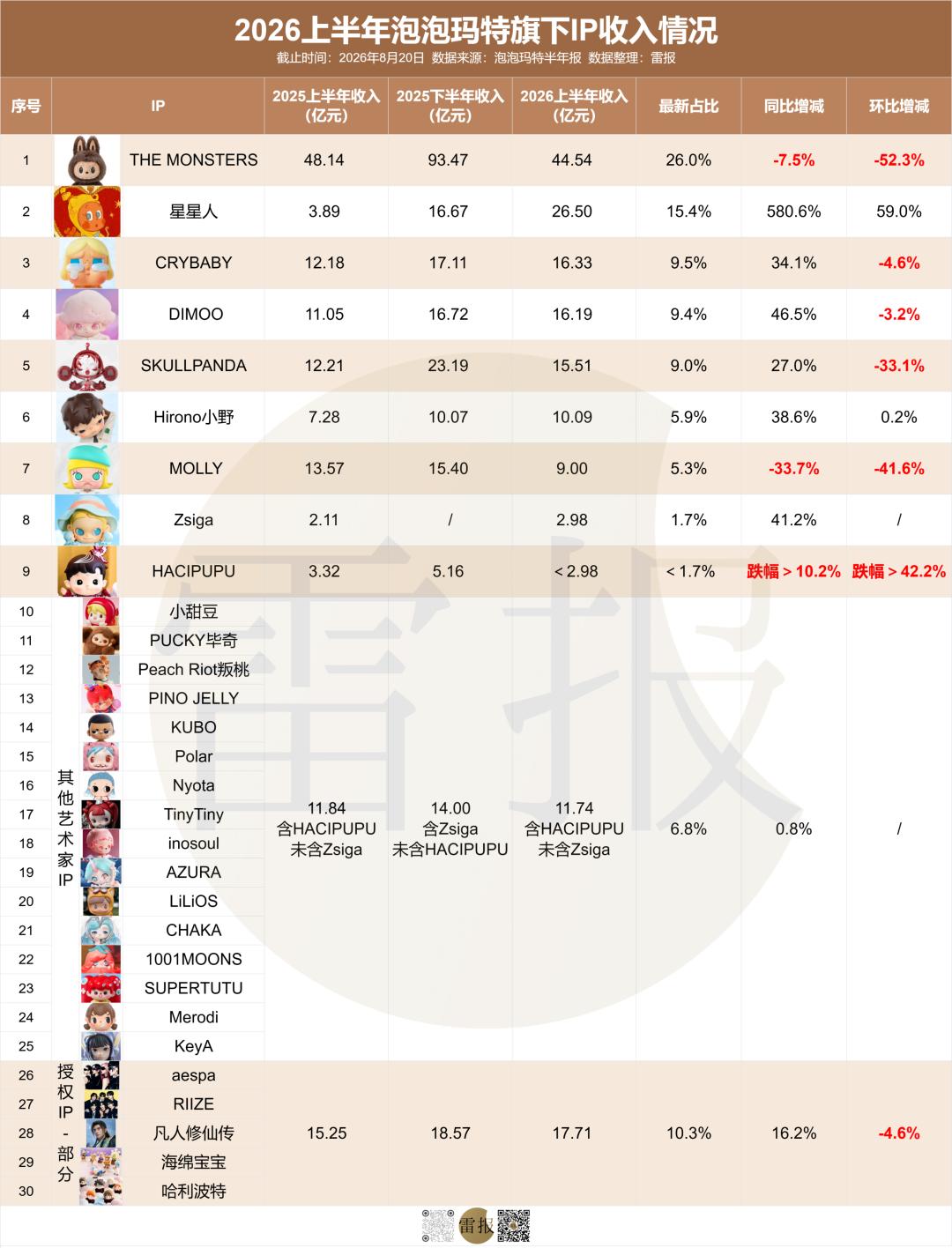
In 2026, after the H1 performance fell short of expectations, Pop Mart's Chinese revenue in Q3 decreased by 25%-30%, of which offline revenue only dropped by 5%-10%, while online revenue fell by 45%-50%.
To a certain extent, it can be seen that panic buying, box-drawing and the secondary market together created a large amount of immediate demand, and also concentrated part of speculative purchases online. After the craze fades, this part of demand disappears first. Consumers in offline stores still enter the stores, browse and choose plush products, and the basic consumption scenario does not collapse synchronously with online traffic.
At the performance briefing on the night of October 27, Pop Mart's management repeatedly emphasized several details: plush is still the main performance-contributing category for Pop Mart in the third quarter, and its contribution is still growing; at the same time, the absolute amount of plush inventory has not increased. The group's inventory has started to decline since August, and by the end of September, there has been a relatively obvious downward trend. The company is not prepared to digest inventory through large-scale promotions for the time being.
In short, these signals all indicate that the demand for plush products has not faded. What the industry is facing is that the plush growth driven by super IP, scarce supply and the secondary market in 2025 can no longer be regarded as the normal operating baseline. Trendy toy plush is transforming from a business of traffic explosion back to a business that requires management of products, channels, inventory and repurchase.
At present, Pop Mart's management actions have also shifted from chasing hit products to operating a complex commodity management system.
It is reported that it has newly established a commodity team at the headquarters level to coordinate global procurement demands uniformly, reducing repeated stock preparation and competition for popular styles across regions. The level of commodity management has also sunk from IP and series to SKU, and the allocation frequency is increased according to the sales progress in various regions. New product supply, inventory turnover rate and cross-category consumption have become key indicators of daily operation.
Pop Mart is also extending the IP lifecycle through content and offline scenarios, including the LABUBU 10th Anniversary Tour Exhibition, the Chinese version of *The Elf Trilogy*, artist book signing events, themed exhibitions, amusement park upgrades, film and television exploration and so on. They may not generate large revenue immediately, but they can supplement stories, images and shared memories for the IP, so that the relationship between consumers and characters is not only built on product scarcity.
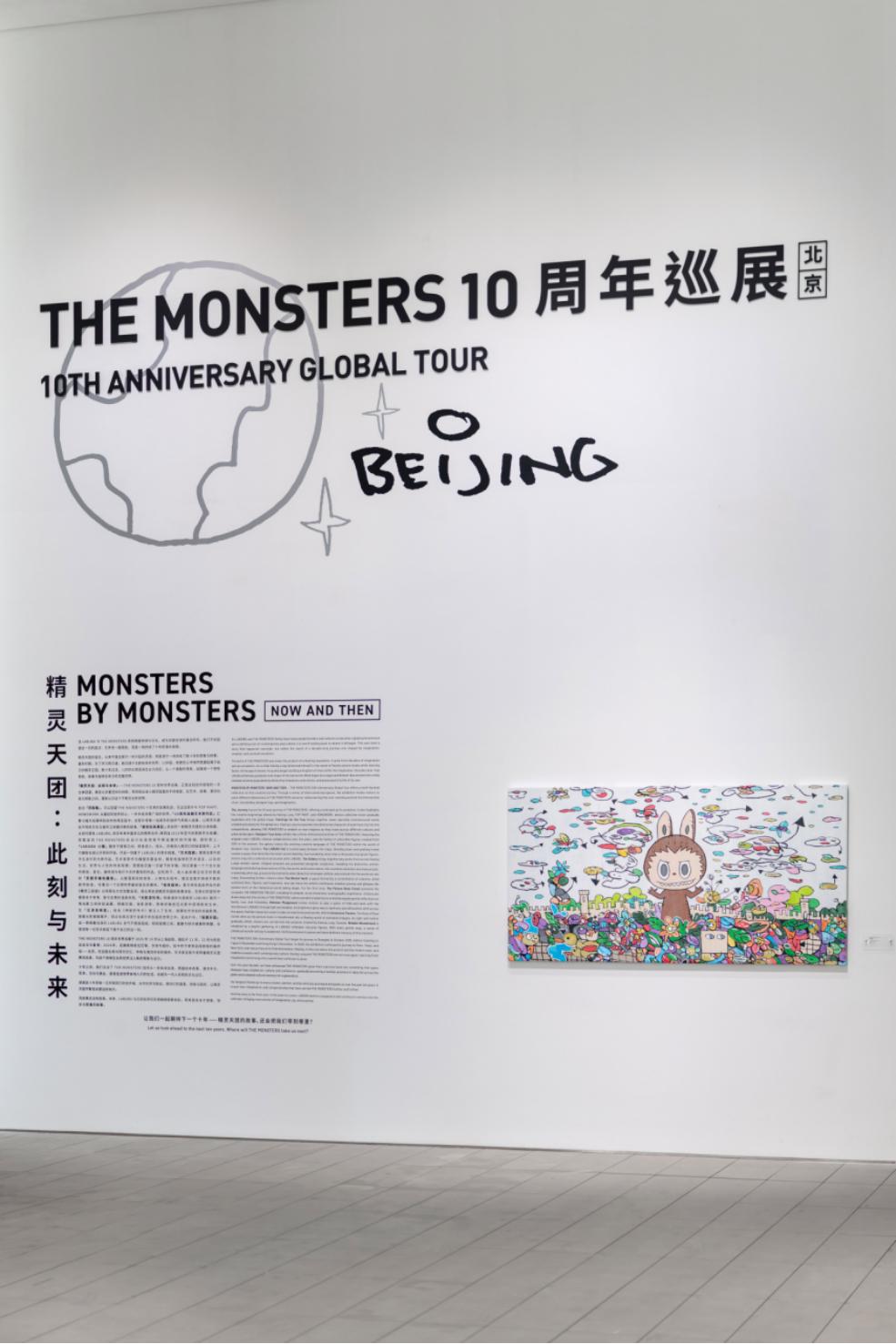
In 2025, Pop Mart changed the market's imagination of the plush category with one product and one IP. The next task is more difficult, and of course closer to the essence of business: without extreme scarcity and explosive panic buying, can it make plush a continuous and stable business through IP portfolio, commodity management and channel operation.
Jellycat: Annual Revenue of 4.2 Billion Yuan, How to Achieve 70% Gross Margin Without LABUBU?
According to Jellycat's annual report data released on October 7, in 2025, Jellycat's total revenue was 450.3 million pounds (about 4.2 billion yuan), up 42.6% year-on-year; gross profit was 308.2 million pounds, with a gross margin of 68.5%; pre-tax profit was 239.8 million pounds, up 97.6% year-on-year; annual profit was 179.7 million pounds, up 108.5% year-on-year.
First of all, it needs to be clarified that Jellycat's growth does not rely on one-off hit items or blockbuster IP, which is a different path from LABUBU. It mainly turns food, plants, daily necessities and animals into products with personality through bean eyes, soft touch, anthropomorphic expressions and slightly quirky creativity.
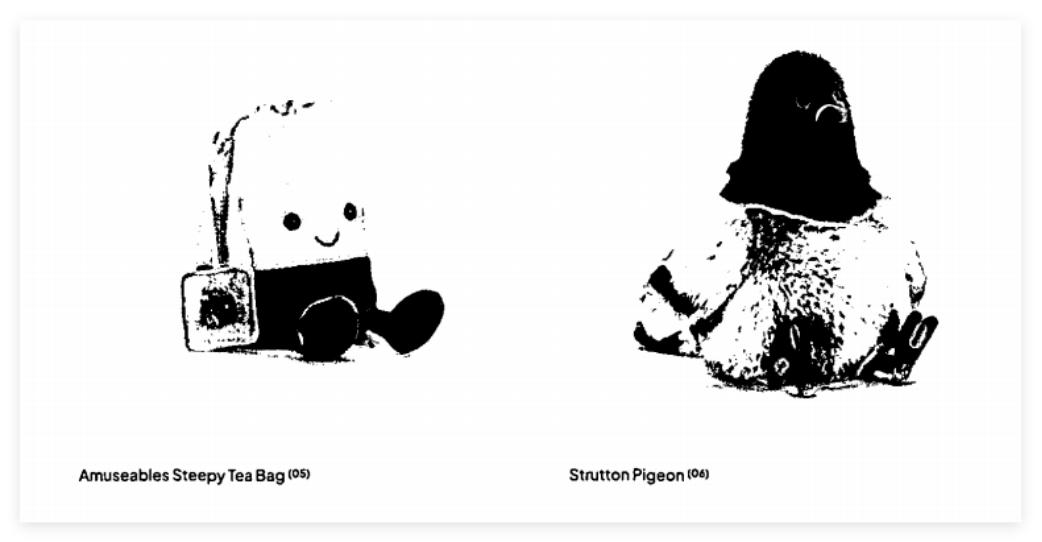
In 2025, Amuseables Steepy Tea Bag, Amuseables Selfridges Bag, Peanut pendants, Clyde Capybara pendants and the Baby Jellycat series respectively undertake different functions such as new product popularity, channel exclusivity, portable accessories and baby gifts. It can be understood that Jellycat's value is scattered in its product system, relying on stable aesthetics to reduce the explanation cost of every new product.
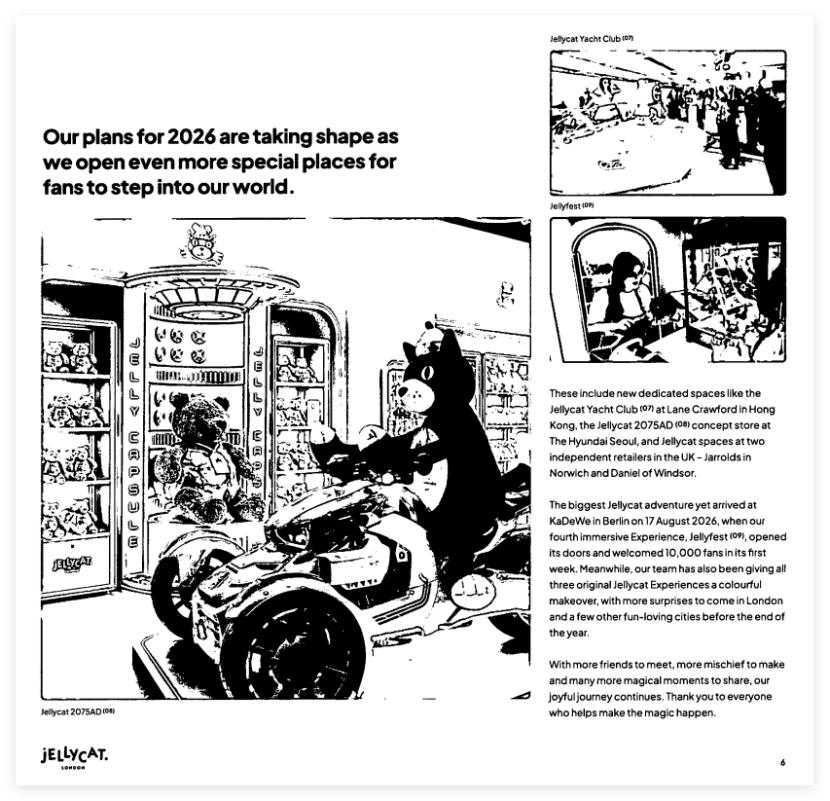
In 2025, Jellycat added 10 exclusive retail spaces and experience projects (compared with 3 in 2024). The company also disclosed that its global independent retailer support program has been strengthened, exclusive characters for independent stores have been launched in the UK, and shop-in-shops, city-limited characters and themed displays have appeared in North America and many other regions.
What is really noteworthy is the relationship between experience and products. In Jellycat's offline experience scenarios, clerk role-playing, themed services, ritual packaging and other practices actually make the purchase experience can also be narrated and spread, creating a shareable lifestyle.
However, Jellycat's annual report does not split the revenue of direct sales, wholesale and e-commerce respectively. Therefore, "the increase of experience spaces" can be used as evidence of brand investment and new product communication, but it cannot further deduce how much growth it directly contributes.
In terms of inventory, Jellycat's inventory increased by 72.9% in 2025, significantly faster than the revenue growth rate of 42.6%; year-end receivables increased by 256.2% to 78.88 million pounds. However, the annual inventory impairment was only 154,500 pounds (the larger the figure, the more the inventory cannot be sold at the original price), and the inventory-to-revenue ratio was only 10% (the larger the figure, the more serious the overstock). To a certain extent, it can be seen that Jellycat's inventory growth does not show obvious unsalable situation at present, but it cannot prove that the channel sales are completely healthy.
By region, in 2025, Jellycat's Asia-Pacific revenue was 154.7 million pounds, accounting for 34.4%, up 52.8% year-on-year; revenue in the UK and Ireland was 138.3 million pounds, accounting for 30.7%, up 47.0%; revenue in the Americas was 113 million pounds, accounting for 25.1%, up 26.4%. Growth is continuing, but the year-on-year growth rate has diverged.
However, the high growth rate in 2025 cannot be directly extrapolated to 2026.
In the spring of 2026, many authorized Jellycat stores rarely launched promotions of 15% to 20% off. Although the activities were stopped soon, it also shows that some channels are under pressure to exchange price for volume.
The secondary market is also cooling down. The limited edition that previously required 800 yuan to snap up is now difficult to resell at 500 yuan in 2026. When the 2026 Halloween series was released, consumers no longer needed to snap up, and some styles were still in stock in October.
On the Internet, remarks such as Jellycat "is no longer popular", "the output is getting more and more perfunctory", and "the products that were previously impossible to grab can be bought casually" have received a lot of likes and discussions.

All in all, in 2025, Jellycat has proved that high-premium plush can cross the trend cycle, but we still need to further track and observe whether this brand system can maintain the same gross margin and cash flow quality in 2026 after global expansion and intensified competition.
Fuggler: Estimated Brand Retail Sales of 1 Billion US Dollars, Supported by Licensing and Channels?
What currently attracts the most attention of Fuggler is a set of figures that are still in the forecast caliber.
According to disclosures from brand operators and media, Fuggler's brand retail sales in 2026 are expected to exceed 1 billion US dollars (about 6.6 billion yuan), with plush product shipments expected to reach 90 million pieces, and plush shipments expected to exceed 120 million pieces in 2027; global sales of blind boxes and figures have exceeded 35 million US dollars, and revenue from licensed products other than plush is expected to reach 150 million to 250 million US dollars.
Fuggler's commercial starting point is different from that of Pop Mart and Jellycat. Fuggler's products have a most fixed symbol: "ugly". After this distinctive symbol is established, it continuously supplements the product personality through character short dramas and creator content. Short video content does not need to explain complex stories, and consumers will only remember the personalities such as "bad ideas" and "pranks" shown in the ten-second plot.
At the same time, Fuggler's products are mainly keychains and small-sized plush products, which reduce the cost of price, carrying and display; convenience stores, mass retail and membership warehouse channels are responsible for increasing the frequency of consumers' contact with products; light licensing categories such as earphone bags,