The refer-a-friend rate is nearly 10%? Communities have staged a full turnaround after the "828 New Policy"
After the "828 New Policy" implements the spot housing sales policy for commercial residential properties, industry discussions have mostly focused on capital supervision, development rhythm and product quality. Community operation is also in the midst of this round of changes: Under the "what you see is what you get" sales model, customers do not only see the completed houses, but also the ongoing life in the community.
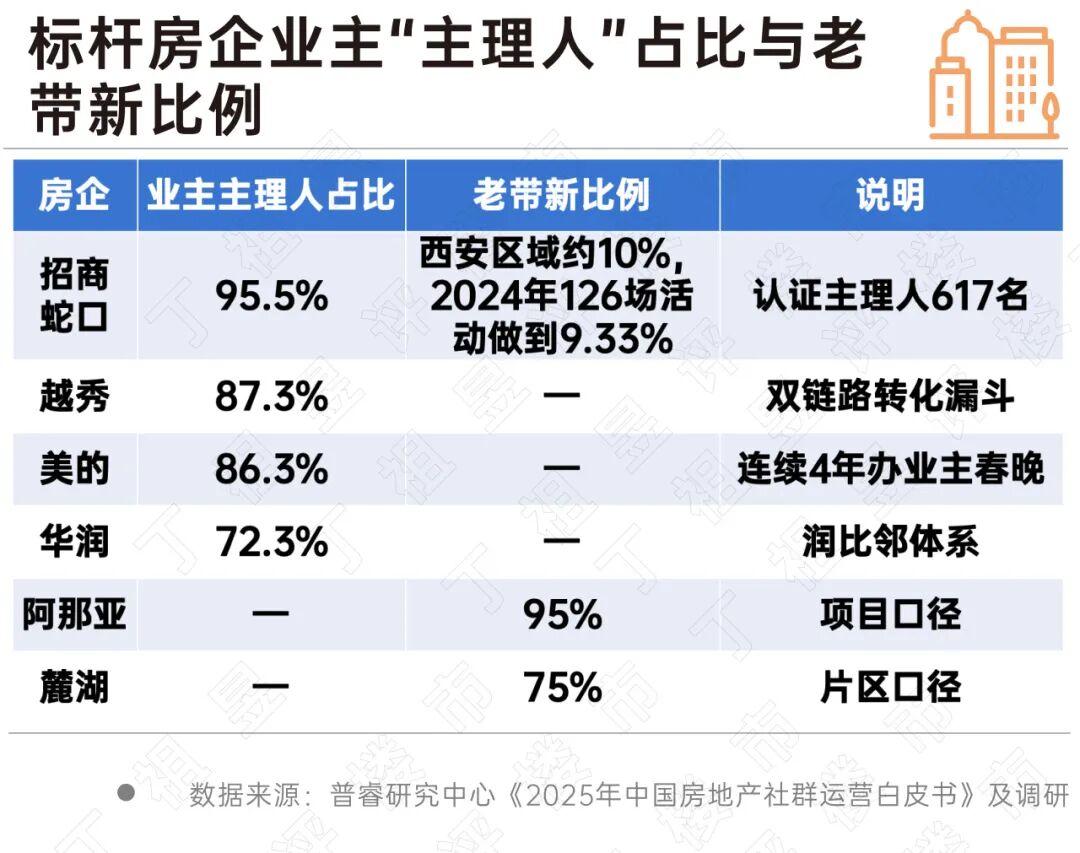
In spot housing projects, the real reviews of existing owners on community life are more convincing than the introduction from sales staff. According to the survey by Pry Research Center, for real estate enterprises with relatively mature community operation, the old-to-new referral ratio of the entire group has increased to varying degrees, and some are even close to or exceed 10%. For some regions or projects with mature community operation, there are even excellent cases where the old-to-new referral ratio reaches 30%.
Two years ago, old-to-new referral was still regarded as a "icing on the cake" for marketing, a last-minute channel when the project could not sell well. Now it is becoming a stable, low-cost main customer acquisition channel for many real estate enterprises.
01
The old-to-new referral ratio of nearly 10% is not an accidental hot sale of a certain project, but the result after a set of community operation system is fully verified.
In the past, communities mostly appeared in the form of warm-up activities such as parent-child activities and community markets, serving the purpose of destocking at opening. Pry Research Center pointed out in the *2025 White Paper on China Real Estate Community Operation* that traditional customer clubs are essentially enterprise-led transaction relationship management tools, and their operation actions are aimed at promoting sales. The community is affiliated to the marketing line. After the project is sold out and the team leaves, it is often unclear who is responsible after delivery, and the community gradually dissipates as the development cycle ends.
Public spaces also have similar problems. Clubs and overhead floors are mostly used for display during the sales period. After delivery, there is a lack of operation content and operation and maintenance arrangements, resulting in the situation of "good-looking but idle". The hardware delivery party is separated from the long-term operation and maintenance party, and the operation and maintenance responsibilities and funding sources are not connected at the delivery node.
This is mainly because under the pre-sale model, there is a long construction cycle between sales and delivery, and customers cannot verify whether the community can continue to operate and whether the public area can be used when signing the contract. This gap is covered by the time difference.
After the "828 New Policy" is implemented, spot housing projects can only be sold after completing the first registration. Customers can move in soon after signing the contract, and there is no buffer between the promises made during the sales period and the life after delivery. The house purchase decision has also changed from "expectation fulfillment" to "what you see is what you get". As a result, the community has changed from a supporting action during the marketing period to display content and a trust carrier before transaction, and assumes a stable role in the whole cycle of the project.
Parallel to the policy change, the operation logic of the community itself has also changed in recent years, the most critical point of which is that the operation subject has shifted from real estate enterprise employees to owner "curators". For example, China Merchants Shekou has certified 617 curators, 95.5% of whom are owners; the proportion of owner curators of Yuexiu is 87.3%, Midea 86.3%, and China Resources 72.3%.
When owners become the organizer of the community, the recommendation behavior changes from the marketing action of real estate enterprises to spontaneous sharing among neighbors. Behind an owner curator, there is often a whole interest circle, and the persuasiveness and credibility of the recommendation cannot be replaced by any sales script.
02
From the practices of benchmark real estate enterprises with strong community operation capabilities at present, the community is no longer just activities of a single project, but gradually becomes part of the urban life and even the annual content IP.
For example, China Merchants Shekou adopts the method of "local growth, one city one IP", which is to cultivate community brands and owner curators by city, forming a foundation that can be called across projects. Chengdu has incubated 68 curators, organized more than 2400 activities, with about 70,000 participants; Xi'an has 122 communities, more than 90,000 members, and more than 500 activities. In 2026, the Shanghai China Merchants Club community held a total of 575 community activities, serving 42468 owner residents, covering people aged from 4 to 75. China Merchants accompanied and 25 local communities were generated in the communities.
These accumulations allow new projects to show customers what kind of people they will live with after moving in when opening, and the value of old-to-new referral rises accordingly.
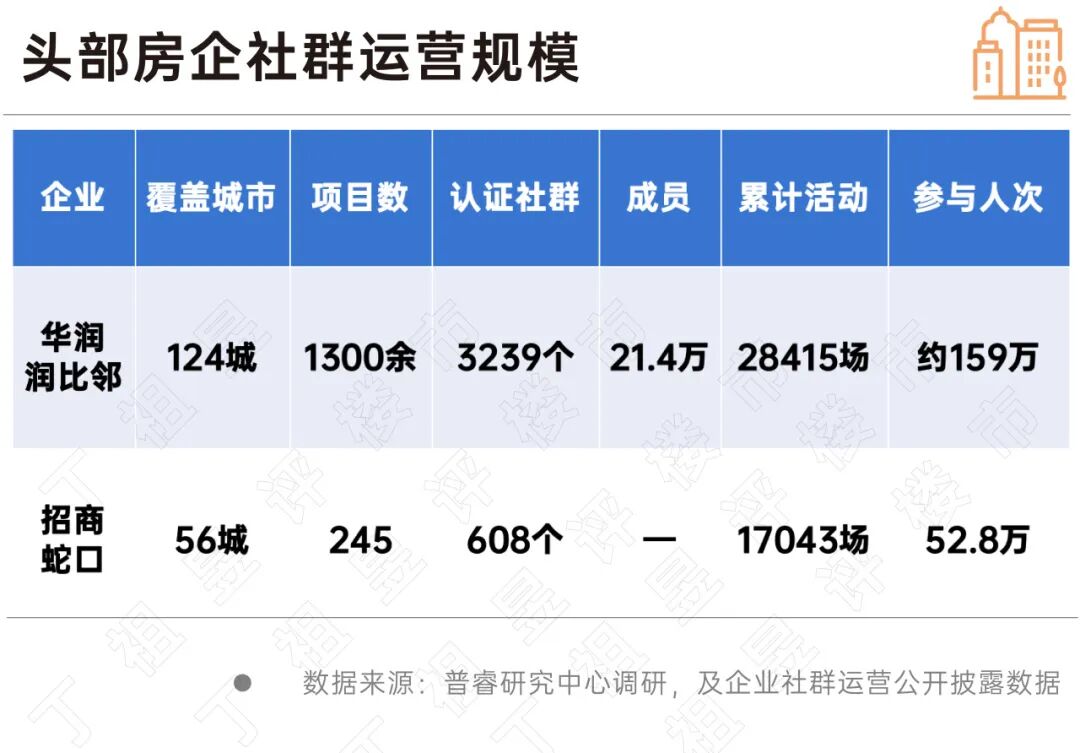
For benchmark real estate enterprises, annualized content IP is becoming a standard configuration. Owner Spring Festival Gala has been upgraded from a single project activity to an annual fixed IP. Midea has held it for 4 consecutive years, Greentown has held its 23rd session, and China Resources set up sub-venues in 24 cities for its first session; Greentown Dolphin Program, Longfor Longmin Festival, Aranya Drama Festival are cross-city high-stickiness IPs. China Resources Runbilin covers 124 cities, more than 1300 projects, with 3239 certified communities, 214,000 members, a total of 28415 activities, and about 1.59 million participants. High-frequency activities turn one-time house purchase into always-online life, so that old-to-new referral has the soil for continuous growth.
03
Under the spot housing model, the community life that can be seen and experienced in advance has become one of the most powerful sales tools now.
Real estate enterprises are transforming from developers to life service providers. The core of competition is no longer just the products themselves such as buildings, facades and fine decoration, but the life atmosphere of the community, the long-term connection between neighbors, and sustainable operation capabilities. Community has been upgraded to the core strategic section of customer operation.
As of 2025, about 60% of the TOP30 real estate enterprises, that is 18, have launched a unified group-wide community brand led by the headquarters, and community business has been upgraded from execution actions to strategic sections. For example, China Jinmao is led by the customer relationship line under the Engineering and HSE Department of the headquarters to coordinate the whole-domain community. Group-wide coordination has become the standard configuration, which means that the community is no longer an impromptu performance of a certain project.
Community capability relies on long-term investment in organization, content, space, manpower and data, and it is difficult to copy quickly like facade or fine decoration. For this reason, real estate enterprises that run through the model first can make old-to-new referral a structural advantage. Under the background of extended development cycle and postponed payment collection, the certain return of community investment is more critical than ever before.
On the whole, the value of the community is being realized in three stages. In the short term, the community is the core carrier for fulfilling ESG and social responsibilities. In the medium term, the community becomes the engine of marketing destocking and brand value-added, and old-to-new referral is the low-cost customer acquisition channel with the highest certainty. In the long run, the community activates property revenue generation and community commerce, and drives property value preservation and appreciation. The property/asset premium of Chengdu Luxelakes and Aranya has verified the value of this long link.
We believe that in 2026, the community will fully shift from "tactical activities" to "strategic assets", and the measurement standard will also shift from how many activities have been held to how much business data and social influence it has brought.
This article is from the WeChat official account "Ding Zuyu Comments on Real Estate Market", Author: Editorial Department, released with authorization from 36Kr.