Double 11 Observation: How the 2026 Double 11 Reconstructs the Value of Large-scale Promotions
The first half of the 2026 Double 11 Shopping Festival has come to an end. This marks the 18th year of Double 11, and it is also a year when the industry needs to re-answer the question of "the new value of large-scale promotional campaigns".
The normalization of promotions has made low prices an increasingly basic capability, and the boundary between Double 11 and daily promotions is becoming blurred. A mere more concentrated large-scale promotional activity can no longer fully explain the significance of the existence of large promotions.
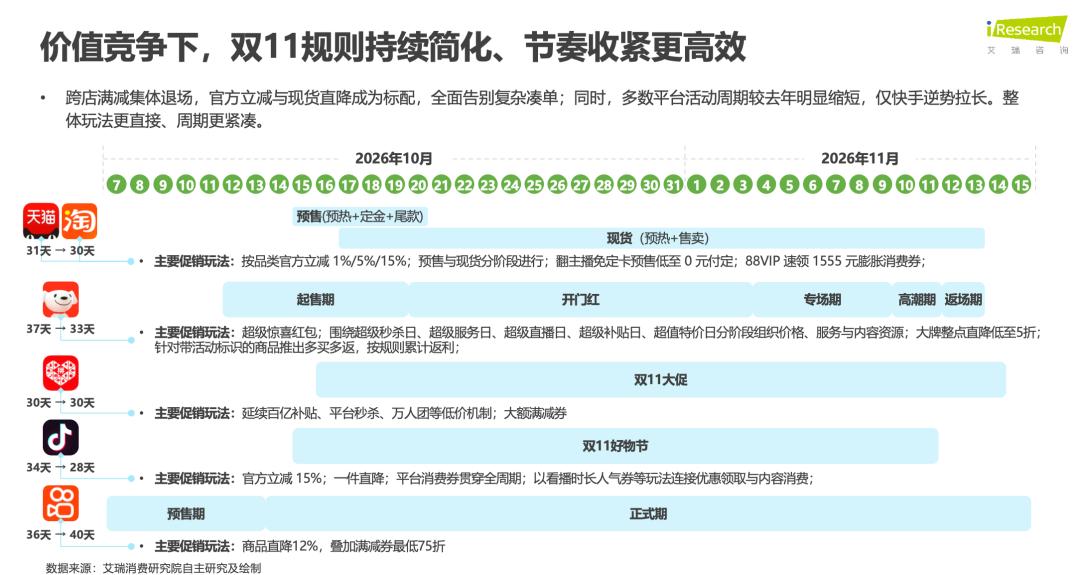
The collective simplification of operations by platforms is a direct response to this change. This year, all platforms for Double 11 have generally moved towards simplified rules and a compact schedule. Taobao/Tmall mainly adopts official direct discounts, JD cancels pre-sales and launches sales with in-stock products, while Douyin, Pinduoduo and Kuaishou also lower the participation threshold through methods such as direct discounts and immediate delivery of in-stock goods. In terms of activity rhythm, major platforms have changed the inertia of extending the campaign period in previous years: the cycles of Taobao/Tmall, JD, Douyin and other platforms have been shortened compared with last year, Pinduoduo maintains a 30-day cycle, and only Kuaishou goes against the trend to extend the cycle to 40 days, showing an overall trend of more straightforward gameplay and a more compact cycle. At the same time, regulatory authorities continue to promote the "Five Excellences" initiative for quality e-commerce, guiding the industry to shift from cut-throat competition on low prices back to focusing on quality and services. Simplified rules and shortened cycles reduce decision-making costs and the fatigue caused by long-cycle promotions, but they have not yet fully answered where large promotions should go in the next stage.
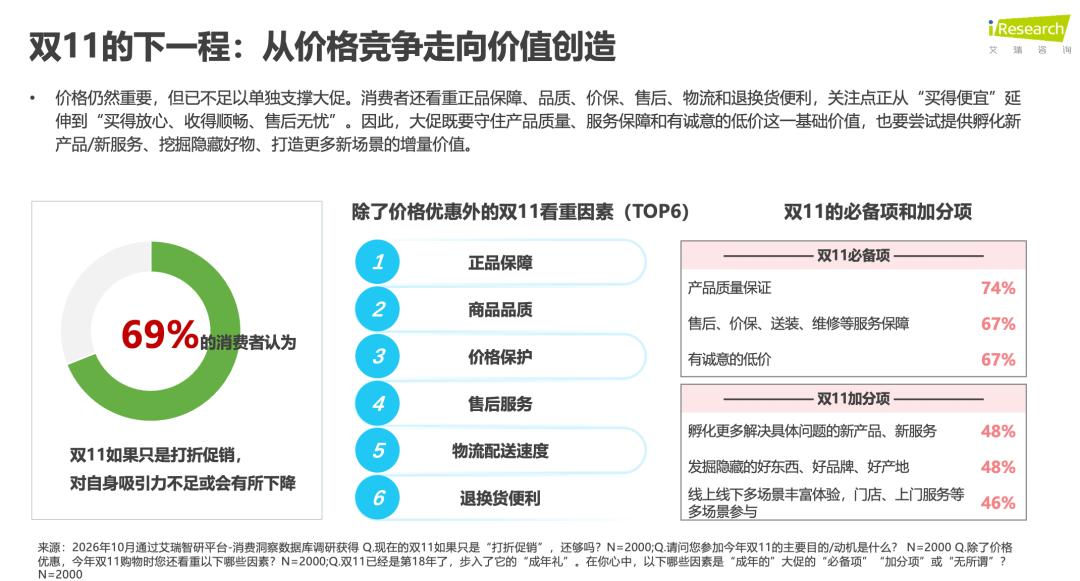
Regarding "where large promotions should go", according to iResearch survey, 69% of consumers believe that if Double 11 only offers discounts and promotions, its attractiveness will be insufficient or will decline. It can be seen that price is still important, but it is no longer enough to independently support the attractiveness of large promotions. In addition to price concessions, genuine product guarantee, product quality, price protection, after-sales service, logistics and distribution speed, and convenient return and exchange have become factors valued by consumers. Consumers' focus is further extending from "buying cheap" to "buying with peace of mind", "receiving orders smoothly" and "having no worries about after-sales".
Further, product quality assurance, service guarantees such as after-sales/price protection/delivery and installation/maintenance, and sincere low prices are regarded by consumers as essential items for "adult large promotions", forming the basic value that large promotions still need to uphold. At the same time, incubating more new products and new services that solve specific problems, exploring hidden good products, good brands and good origins, and multi-scenario participation online and offline have become important plus points, pointing to the incremental value that large promotions need to provide beyond daily promotions.
Therefore, when discussing the new value of Double 11, we cannot only focus on how much subsidies the platforms provide, but further ask: can platforms discover and respond to segmented demands, help consumers find good products that have not been noticed before, reduce decision-making and service costs through AI, and enable the continuous connection of experience, transaction, performance and after-sales between online and offline. This also constitutes the four consumer dimensions for observing the value reconstruction of large promotions in the following part.
New Answers from Consumers: From Purchasing Goods to Discovering New Solutions for Life
New Demands: From Standardized Hit Products to Segmented Products and Services
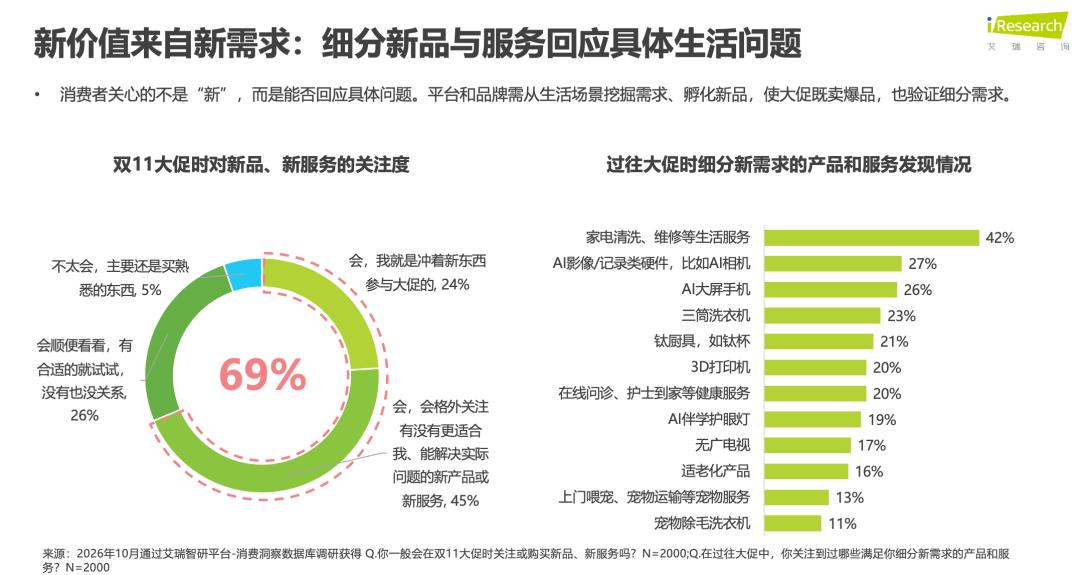
The new value first comes from new demands. According to iResearch survey, 69% of consumers will actively pay attention to or buy new products and new services during Double 11, of which 45% pay special attention to new products or new services that are "more suitable for me and can solve practical problems". In past large promotions, segmented products such as AI imaging and recording hardware, AI large-screen mobile phones, and three-tub washing machines have been perceived by consumers. Compared with whether it is a new product, consumers are more concerned about whether the new product can respond to their specific problems.
This means that the logic of new product incubation is changing. Platforms and brands not only need to push existing products to larger transaction scenarios, but also need to discover demands from real life scenarios represented by co-living of people and pets, health care, and aging-friendly design, and then transform them into new products and categories. As a result, large promotions are not only a centralized sales window for hit products, but also a window for segmented demands to be seen and verified.
New demands do not only occur in physical goods. In January 2026, the General Office of the State Council issued the "Work Plan for Accelerating the Cultivation of New Growth Points for Service Consumption", proposing to optimize and expand service supply and promote the improvement of service consumption for the benefit of the people. Driven by policies and changes in lifestyles, service consumption such as housekeeping, elderly care, health care, and pet care has entered the public vision more, which also extends the platform narrative of this year's Double 11 from "selling goods" to "selling services".
However, the "services" mentioned by various platforms are not exactly the same. Taobao/Tmall focuses more on improving product services around physical transactions, such as integrated delivery, installation and assembly for home appliances and furniture, trade-in, and after-sales guarantee; on this basis, JD further incorporates service-type goods that can be purchased by themselves, such as housekeeping, elderly care, pet care, and health care, into large promotions. The former reduces the transaction cost of physical consumption, while the latter directly expands the category boundary that consumers can purchase.
According to iResearch survey, 73% of consumers know that service-type goods can be purchased on online platforms; among those who are aware of this, 71% have purchased such goods in the past 12 months, and 59% said their demands have increased since the beginning of this year. Services such as housekeeping cleaning, laundry and care, and home appliance installation and maintenance have also become items that many consumers in the survey consider purchasing during Double 11. Service consumption is changing from an occasional supplement to a type of demand that can be centrally selected in large promotions.
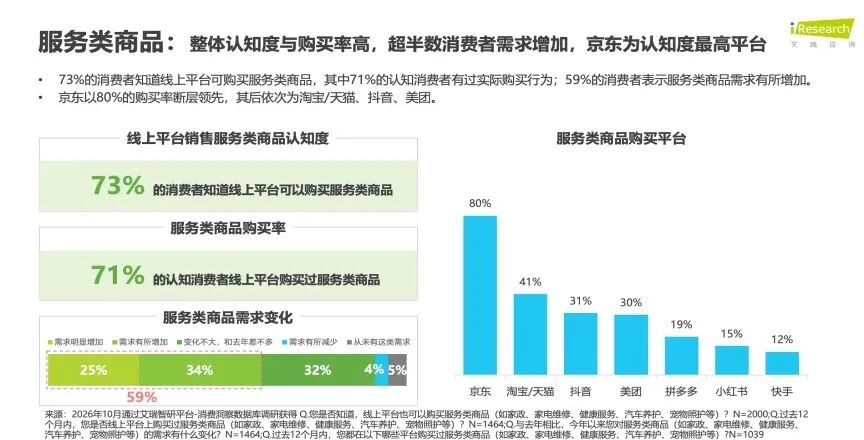
Judging from the key narratives of mainstream platforms in this year's Double 11, JD is the only platform that centrally presents service-type goods as a core section. The difference is not only that it has more services, but also that it operates services as purchasable, bookable, and guaranteed commodities. This year's Double 11, JD for the first time fully displays more than 100 segmented service products, covering core life scenarios such as home, travel, and health, and focusing on emerging demands such as elderly care, pet care, and AI; at the same time, it launches the "333" plan to establish service standards from three dimensions: transparent price, standardized services, and after-sales guarantee. Therefore, JD has become a concentrated sample for observing how consumers pay attention to and choose service-type goods.
According to iResearch survey, among consumers who have purchased or plan to purchase service-type goods on JD, the selection ratios of home services and travel services are 62% and 55% respectively; transparent prices, platform endorsement, large promotion discounts, and rich categories are the frequently mentioned reasons for purchase. It can be seen that whether services can be clearly understood, conveniently purchased and stably guaranteed like commodities is the key for platforms to meet such new demands.
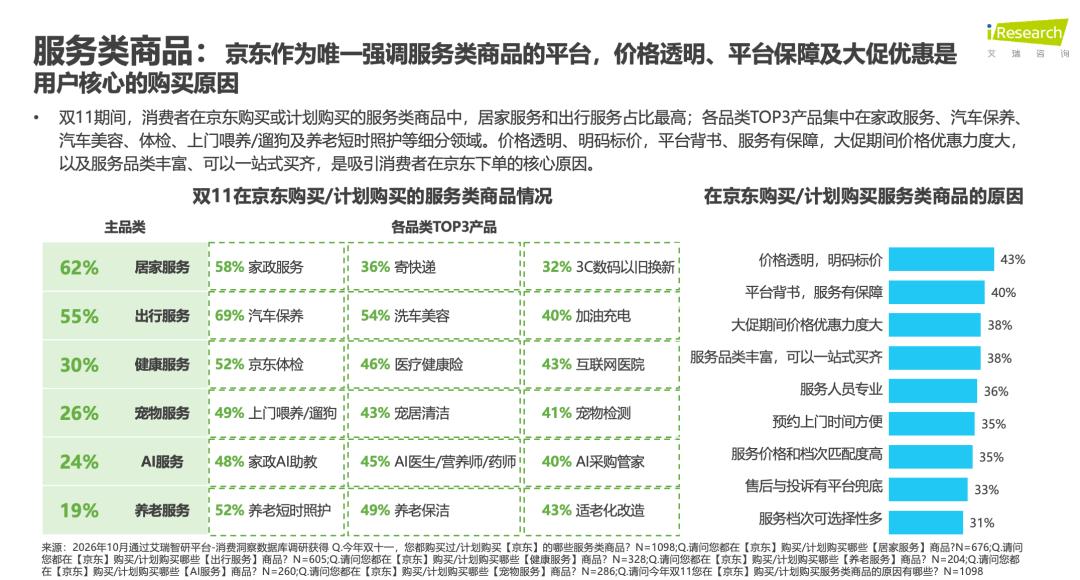
From physical goods to services, what has changed is not just the consumption list, but also the boundary of large promotions. What consumers buy is no longer just a single product, but also the installation, maintenance, cleaning, and care behind the product, or even a complete set of life solutions. Therefore, service consumption should be understood as part of new demands, rather than an additional business outside large promotions.
New Supply: From Familiar Big Brand Hit Products to Undiscovered Good Products
With increasingly segmented demands, different requirements are also put forward for supply. Rich product quantity does not mean easy selection. Another difficulty faced by consumers is: which unfamiliar brands and origins are trustworthy.
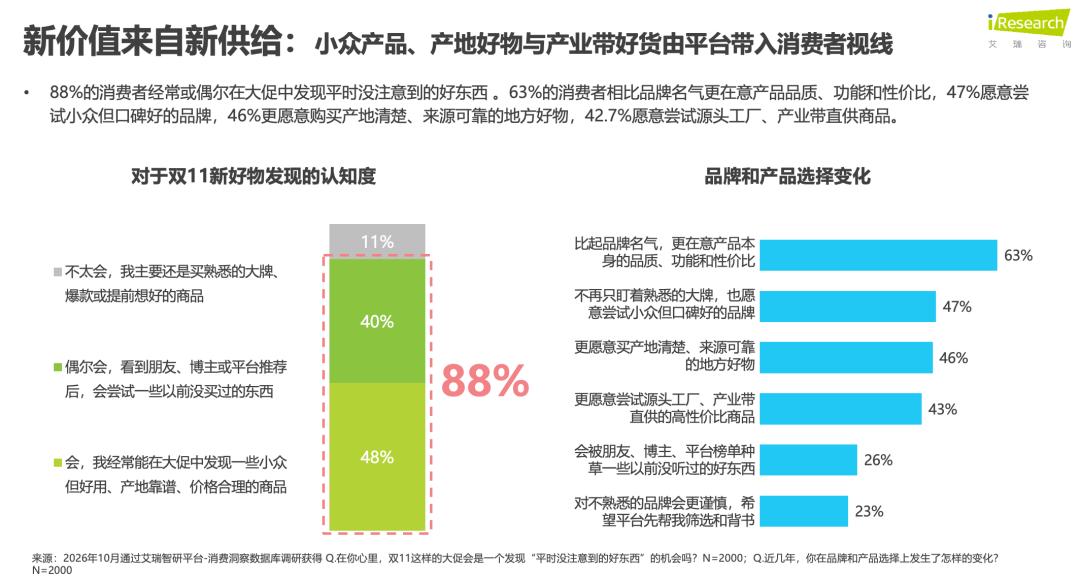
According to iResearch survey, 89% of consumers have often or occasionally discovered good products they usually did not notice during large promotions. The value of new supply is not just to increase the number of products, but to reduce the cost of good products being discovered, understood and trusted. Local fresh products, characteristic food, high-quality goods from industrial belt factories and niche brands need to enter the larger market with the help of platform screening, supply chain organization, origin traceability and content expression. For platforms, supply chain capability is no longer just a back-end indicator of performance efficiency, but has become a product discovery capability that consumers can directly perceive.
New Experience: AI Shifting from Function Display to Solving Real Problems
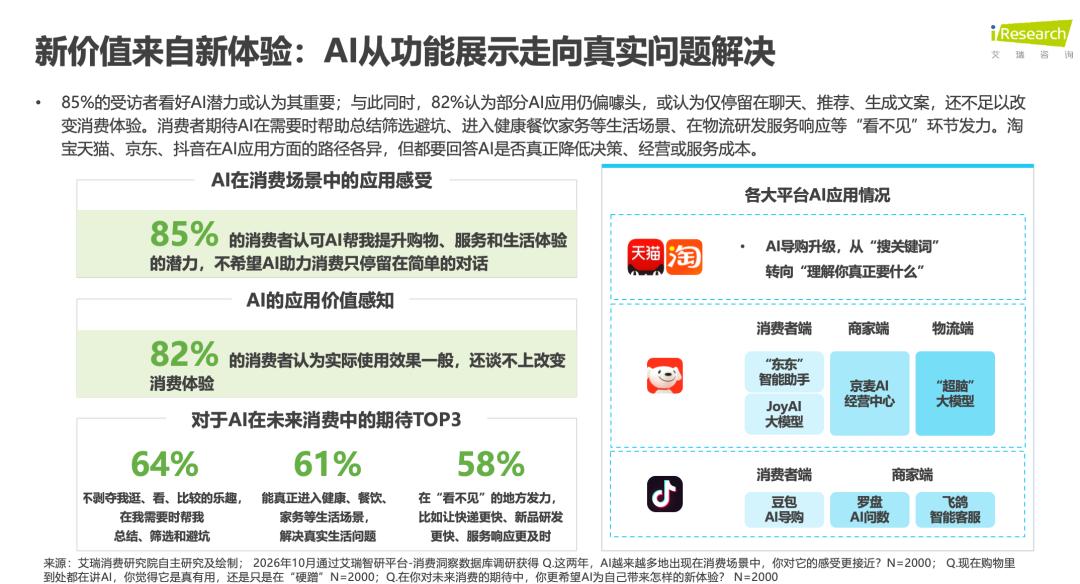
The value of AI on the consumer side is shifting from "adding a dialogue entry" to more specific experience improvement: helping consumers understand vague demands, summarize reviews, compare products, match sizes, and also have the opportunity to enter life scenarios such as health, catering, and housework. How to turn these capabilities into perceptible peace of mind and time saving has become a new focus of this year's Double 11. The more new categories and new supply brought by the AI era, the more information consumers need to process. Therefore, AI is expected to reduce selection and decision-making costs, but the expectation for its potential is not equivalent to full recognition of existing applications.
According to iResearch survey, 85% of consumers are optimistic about the potential of AI or consider it important, but 82% believe that some AI applications are still gimmicky, only staying at chatting, recommending and generating copywriting, which is not enough to change the consumption experience. Looking to the future, consumers hope that AI can help them summarize, filter and avoid pitfalls when needed, enter life scenarios such as health, catering, and housework, and also expect AI to play a role in "invisible" links such as logistics, R&D, and service response.
This seemingly contradictory set of data just marks the watershed of AI competition: consumers do not lack imagination for AI, what they lack is stable and perceptible actual effects. For platforms, Taobao/Tmall focuses on upgrading AI shopping guides, JD applies AI to consumers, merchants and logistics ends, Douyin takes into account both C-end shopping guides and B-end operation tools. Although their paths are different, they all need to answer the same question: whether AI has truly reduced decision-making, operation or service costs.
New Scenarios: From Online Transactions to Continuous Connection of Experience, Performance and After-sales
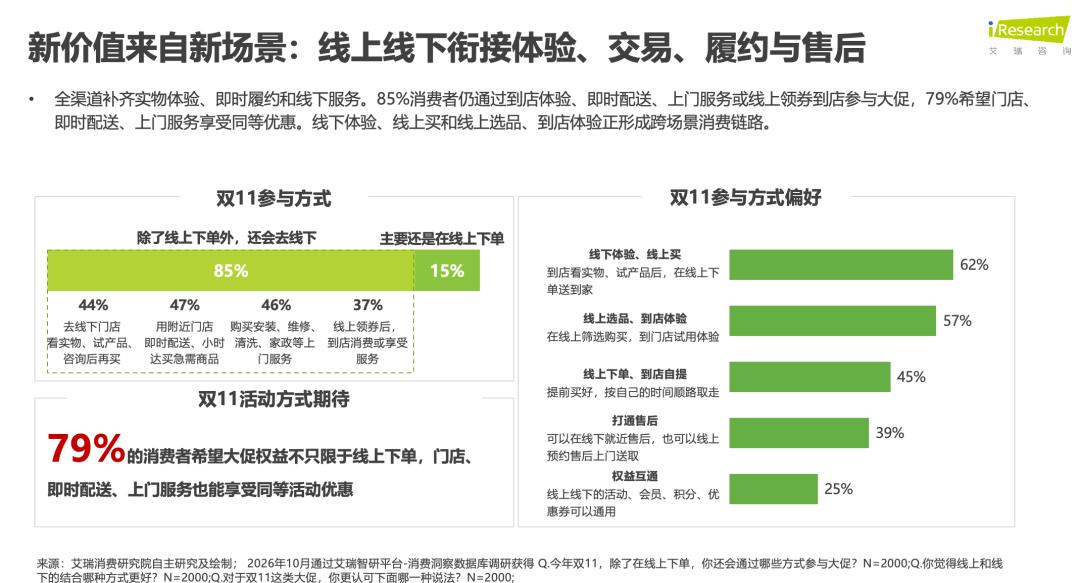
After years of rapid development of online transactions, product richness and purchase convenience have been greatly improved, but physical experience, instant performance and offline services are still links that large promotions need to supplement. Therefore, consumers' attention has extended back to offline stores and door-to-door services: if AI mainly changes the efficiency of information and decision-making, omni-channel attempts to make the experience, transaction, performance and after-sales continuously connected between different scenarios. According to iResearch survey, 85% of consumers will also participate in large promotions through in-store experience, instant delivery from nearby stores, door-to-door services, or receiving coupons online and redeeming them offline; 79% hope that offline stores, instant delivery and door-to-door services can also enjoy the same activity discounts.
Consumers are not obsessed with choosing between online and offline, but care more about whether different scenarios can be freely combined. 62% recognize the model of "offline experience, online purchase", and 57% recognize the model of "online product selection, in-store experience". Viewing physical products in stores, placing orders online, picking up goods nearby or getting delivery, and making after-sales appointments online are forming a cross-scenario consumption link.
Platform cases further illustrate the practical value of this connection. Once many platforms once focused on offline layout, in recent two years, JD has shown more prominent performance in this aspect. Data shows that 65% of consumers have visited JD's offline stores during Double 11, and 87% of the in-store visitors made purchases. Physical experience, same price and same rights, and one-stop after-sales handling have become the main attractions. Therefore, the significance of omni-channel is not just to increase store touchpoints, but to ensure that consumers do not need to bear additional price, rights and after-sales costs when switching between different scenarios.
How Choices Are Made: Popularity Remains, Categories and Platforms Further Differentiate
New demands, new supply, new experience and new scenarios will eventually fall into specific consumption choices. From the overall market perspective, Double 11 has not lost its popularity. According to iResearch UT monitoring, from October 12 to October 23, the average daily number of independent devices and the average daily total effective usage time of online shopping platforms both increased compared with the same period last year.
However, the continuation of popularity does not mean that consumption is still widely scattered. According to iResearch survey, a single consumer has already spent or plans to spend on 2.9 platforms on average, and plans to buy 3.7 categories of products on average, which is 0.8 platforms and 1.2 categories less than the same period last year. Consumers still make multi-platform and cross-category choices, but decisions are concentrating on head platforms and core categories, which makes it more important for platforms to provide differentiated value.
<