Against the backdrop of overseas biotech firms slashing their R&D pipelines and massive capital being heavily poured into the domestic market, why are domestic CAR-T therapies so fiercely sought after by investors?
Recently, a number of leading overseas enterprises in the CAR-T field have announced the termination of their CAR-T pipelines. For example, Caribou has terminated two allogeneic CAR-T pipelines; Cellectis has terminated two allogeneic CAR-T candidates in clinical stages, shifting all its resources to the in vivo gene editing field; Arsenal has completely abandoned its ex vivo autologous CAR-T pipelines, and redirected all R&D resources to the in vivo CAR-T technology platform...
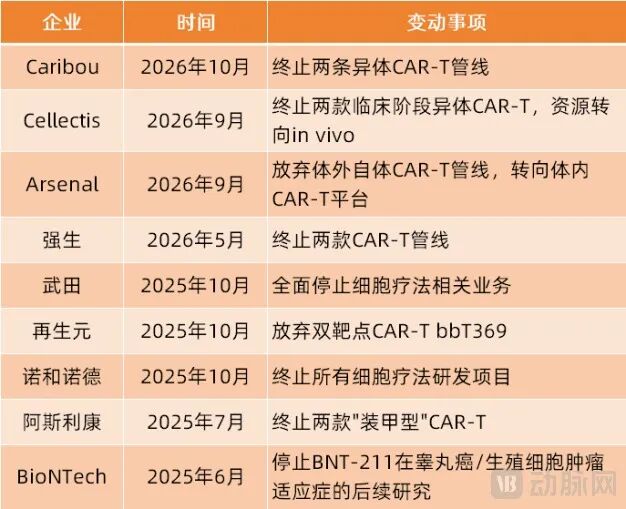
According to statistics from VCBeat, in the past year, at least 12 pharmaceutical companies have terminated or suspended their core CAR-T projects. From the perspective of technical routes, the cut pipelines are mainly autologous CAR-T and universal CAR-T prepared ex vivo. Even many enterprises announced that after terminating their pipelines, they would fully invest resources in the in vivo CAR-T technology platform.
This has led to a misinterpretation among some market participants: the ex vivo preparation route will be replaced by in vivo CAR-T technology.
But this is not the case. To understand the real trend of the industry, we must first analyze the real reasons why these enterprises cut their pipelines.
Collective Shrinkage of Overseas CAR-T Pipelines
According to interviews, the reason why these enterprises cut their pipelines is not only the technical route, but a combination of multiple factors including the evolution of the treatment landscape, changes in the financing environment, failure of clinical data to meet expectations, and corporate strategic adjustments.
The first is the evolution of the treatment landscape. Taking Cellectis as an example, the reason for its termination of two allogeneic CAR-T products is that the treatment landscape of B-ALL (B-cell acute lymphoblastic leukemia) and NHL (non-Hodgkin's lymphoma) has changed.
Dr. Xiang Yu, CEO of Boyal Therapeutics, analyzed: "B-ALL and NHL are both B-cell-derived malignant hematological tumors, only differing in the onset location and manifestations. At present, the hematological tumor market is fiercely competitive with severe homogeneous competition. 7 CAR-T therapies have been approved in the United States, and 7 to 8 have been approved in China."
With more sufficient clinical evidence, new treatment regimens are moving to earlier lines. The progress of frontline treatment regimens has reduced the recurrence rate, resulting in fewer patients entering later-line treatment and compressing the corresponding market space. At the same time, other new therapies such as bispecific antibodies and TCE continue to emerge, intensifying competition in second- and third-line treatments. In this context, even if a new CAR-T is effective, it still needs to answer: what additional clinical value does it add compared with existing treatments?
Dr. Xiang Yu added: "In the high-end overseas market, cost sensitivity is not as high as in the Chinese market. For example, in the European and American markets, CAR-T for the treatment of hematological tumors has been included in medical insurance, with the reimbursement price reaching hundreds of thousands of US dollars. The production cost of autologous CAR-T is only tens of thousands of US dollars, which accounts for a small proportion of the total treatment cost. New therapies such as universal CAR-T and in vivo CAR-T must prove to have other clinical advantages besides low cost, otherwise the market is more willing to use the already proven effective autologous CAR-T."
The second is the change in the financing environment. A few years ago, global capital was still chasing universal CAR-T. At that time, autologous CAR-T was approved for marketing, which initially verified the commercialization path. However, it has multiple limitations: the production cycle takes several weeks, the production cost is high, and the process is difficult to standardize.
In response to these pain points, the industry has explored a universal technical route: using T cells from healthy donors or iPSCs (induced pluripotent stem cells), modified by gene editing technology, so that they can be used for different patients. Compared with autologous CAR-T, universal CAR-T has the advantages of universality, off-the-shelf availability and low cost, so it was once favored by investment institutions.
After that, the industry explored the in vivo CAR-T technology. This technology does not require steps such as collecting patient T cells and ex vivo preparation. It directly delivers the gene encoding CAR (chimeric antigen receptor) to the natural T cells in the patient's body through a non-viral or viral delivery vector, so that they are transformed in situ into CAR-T cells with targeted killing ability in the body, achieving precise killing of tumors. In principle, in vivo CAR-T has the advantages of simple preparation process, short treatment cycle, low cost, retention of T cell function, and no need for lymphodepletion pretreatment.
Professor Yang Hanshuo, founder of Zhenyu Biotech, told VCBeat: "After the emergence of in vivo CAR-T, almost all domestic and foreign investment institutions have turned to deploy in vivo CAR-T."
According to statistics, since 2025, giants including AstraZeneca, AbbVie, Gilead, BMS, Eli Lilly, and Johnson & Johnson have invested a total of nearly 200 billion US dollars to deploy in vivo CAR-T. In China, there have been more than 17 financings in the in vivo CAR-T field this year, with the total amount exceeding 28 billion RMB.
When capital pours into in vivo CAR-T, the financing difficulty of universal CAR-T enterprises has increased significantly. Caribou is a typical example. Its CEO said: "The current financing environment for allogeneic CAR-T makes it difficult for the company to raise the capital needed to advance the project, so we can only terminate the remaining two allogeneic CAR-T pipelines." Even if the previously released pipeline data is impressive enough.
However, regarding the changes in the financing environment, Dr. Xiang Yu provided another perspective. The technical route is indeed very important, but what track it enters is more critical. For example, mRNA technology once rose in value due to vaccine demand, and then its popularity cooled down. However, in October 2026, Novartis reached a BD transaction with Abogen Biosciences for RNA therapy with a down payment of 575 million US dollars and a potential total value of about 72 billion US dollars. The technology is still mRNA, the only difference is that it has entered the autoimmune track.
In the CAR-T field, the homogeneous competition of hematological tumors is serious. The CAR-T pipelines cut by Caribou, Cellectis, and Johnson & Johnson this time are all for hematological tumor indications; the market space for indications such as autoimmune diseases and solid tumors is large. For different technical routes, no matter autologous, allogeneic, in vivo, or even mRNA, pipelines and enterprises with good clinical data are still favored by capital.
Dr. Xiang Yu said: "Professional investors focus on the future commercial return of products, not following the trend to chase popular technical labels. The core is to look at the market ceiling of the disease track. In the field of autoimmune diseases and solid tumors, the annual sales of a blockbuster drug can reach 20 billion US dollars, and the market space is broader. In particular, CAR-T can achieve deep B cell clearance and immune reset, which can create a new long-term treatment mode different from existing monoclonal antibody drugs."
In addition to the evolution of the treatment landscape and changes in the financing environment, the failure of pipeline clinical data to meet expectations and corporate strategic adjustments are also reasons for cutting pipelines. For example, Johnson & Johnson terminated two CAR-T therapies in May 2026. Two months later, Johnson & Johnson announced a strategic cooperation with Sail Biomedicines to advance in vivo CAR-T therapy. To this end, Johnson & Johnson needs to pay a down payment of 785 million US dollars (including 465 million US dollars in equity investment). If it exercises the acquisition option and reaches relevant milestones, it will also pay about 2.72 billion US dollars.
Overall, well-known overseas CAR-T enterprises cut their autologous and universal pipelines more out of considerations of pipeline data, corporate strategy and financing environment.
Domestic CAR-T Track is Expanding Acceleratedly, In Vivo CAR-T Becomes a Capital Hotspot
Since 2026, many leading overseas CAR-T enterprises have shrunk their pipelines, while more than 10 domestic in vivo CAR-T enterprises have completed financing.
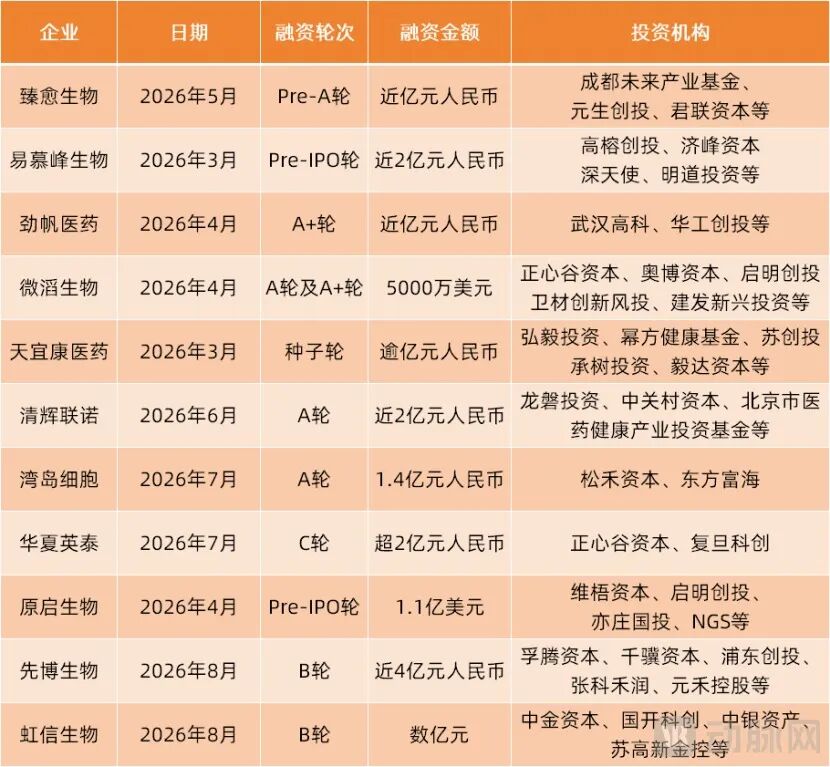
(Incomplete statistics of CAR-T enterprises that completed financing in 2026)
According to statistics, the vast majority of the above-mentioned enterprises that have completed financing have deployed in vivo CAR-T technology. For example, enterprises such as Zhenyu Biotech, Hongxin Biotech, and Weitao Biotech are all focused on in vivo CAR-T technology.
Among them, Zhenyu Biotech has made breakthrough research in efficient delivery, CAR molecular design and long-term expression of mRNA, which has been well verified in patients; HN2301, the in vivo CAR-T pipeline developed by Hongxin Biotech, has enrolled dozens of patients with various autoimmune diseases, showing lasting and excellent safety; GT801, the core product of Weitao Biotech, has initially shown good safety and efficacy in patients with hematological tumors and autoimmune diseases.
In addition, many universal CAR-T enterprises and autologous CAR-T enterprises have taken advantage of this financing boom to deploy in vivo CAR-T. For example, Sinobioway Bio plans to use the funds to accelerate the confirmatory clinical research of SNC103, the core pipeline of universal CAR-NK, and promote the registered clinical development of SNC116, the in vivo CAR-T (in vivo CAR-T) platform; the financing funds of Tianyi Kang Pharmaceutical are mainly used for the development of new-generation autologous rapid process multi-target CAR-T cell therapy candidate products, and the R&D of in vivo multi-target cell therapy candidate products for autoimmune diseases; ImmuneLake Biotech deploys ex vivo and in vivo CAR-T cell therapies for solid tumors, hematological malignancies and autoimmune diseases. The funds from this round of financing are mainly used to deploy cutting-edge in vivo CAR-T technologies and build an independent iMAGIC in vivo generated CAR-T platform.
According to industry news, up to now, more than 100 domestic enterprises have deployed in vivo CAR-T technology. From a macro perspective, the track has been highly involuted, and the pipelines are showing a homogeneous situation.
However, investment institutions are still willing to place heavy bets, because in vivo CAR-T as a new technology has great advantages in principle, and existing clinical signals have verified its value. This makes investment institutions invest in in vivo CAR-T one after another in order not to miss the next generation of technical opportunities. Just like when new technologies and new targets such as ADC emerged in those years, a huge amount of capital poured into the field. In vivo CAR-T is exactly a new direction in the early stage of the industry.
In addition, from the micro level, most in vivo CAR-T enterprises have differentiated innovations in technology.
Professor Yang Hanshuo said: "In vivo CAR-T can be said to be one of the biomedical technologies with the highest complexity at present. The whole chain of in vivo CAR-T is long, and there are many choices in each link, with very many variables: delivery vectors include lentivirus (LV), mRNA-LNP, AAV, VLP, etc. Taking mRNA-LNP as an example, there is a large amount of differentiation in LNP itself, and different lipid molecules have different properties; antibody types and antibody conjugation methods are different; CAR molecular designs vary widely; the selection of targeted binding molecules, targeting different targets such as CD3, CD4, CD8, CD7, the schemes are all different; plus the huge challenge of CMC manufacturing. This means that every enterprise can innovate in each link to build its own technical advantages."
However, not all in vivo CAR-T enterprises can get financing. Enterprises that can complete financing must have core advantages with obvious competitiveness.
For example, Zhenyu Biotech has many years of accumulation in tumor therapy, CAR research and nano delivery. From the early stage of the project, it has made overall consideration from the perspective of the final product: from lipid molecule selection, CMC preparation process, to binder (targeted binding molecule) conjugation method, CAR molecular design, anti-tumor activity improvement, the whole set of modules has been systematically designed in the early stage. At present, each of its modules has made unique progress, which together form obvious comprehensive advantages.
Hongxin Biotech has overcome the industry-restricting problem of "mRNA extrahepatic non-APC targeted delivery", and developed a unique engineered cell targeted delivery platform, reaching the international leading level in engineering and targeted delivery efficiency. Based on this platform, Hongxin Biotech has developed the in vivo CAR-T pipeline HN2301.
Domestic Industrial Layout Logic: Parallel Development of New and Old Pipelines
It can be seen that not only the technical route, these enterprises also focus on fields such as autoimmune diseases and solid tumors. This also demonstrates Dr. Xiang Yu's point of view: professional investors do not follow the trend of popular technical routes, but deploy competitive pipelines and enterprises in large tracks.
This means that capital does not simply pay for technical labels, but looks at the corresponding disease opportunities, human clinical data, applicable scenarios, and the real value of products.
In fact, overseas enterprises are also deploying in vivo technology. Since 2025, overseas giants such as AstraZeneca, AbbVie, Gilead, and BMS have successively acquired in vivo CAR-T enterprises, spending a total of nearly 200 billion US dollars; however, the strategy of overseas enterprises is to cut their original pipelines and invest resources in in vivo technology. For example, Cellectis terminated the allogeneic CAR-T pipeline and shifted resources to in vivo gene editing; Arsenal completely abandoned the autologous CAR-T pipeline and redirected all R&D resources to the in vivo CAR-T platform; even Johnson & Johnson cut two autologous CAR-T therapies, because of changes in pipeline priority and market landscape.
The strategy of domestic enterprises is different. Domestic enterprises are more inclined to continue to promote their existing core pipelines, including autologous CAR-T pipelines and universal CAR-T pipelines, and on this basis build in vivo CAR-T technology platforms to deploy in vivo CAR-T.
For example, Boyal Therapeutics has synchronously deployed autologous CAR-T, allogeneic universal CAR-T, and in vivo CAR-T around autoimmune diseases. It has not fully shifted to in vivo CAR-T, but is still continuously promoting pipelines of autologous and universal technical routes.
At present, BRL-303, the allogeneic universal CAR-T product of Boyal Therapeutics, for the treatment of relapsed/refractory systemic sclerosis (SSc) has obtained the implied permission of clinical trials for its new drug clinical trial application (IND), and has been included in the "Care Program - Extension" pilot project of the Center for Drug Evaluation (CDE) of the National Medical Products Administration. In addition, the phase I clinical study of BRL-303 for the treatment of moderate or severe refractory systemic lupus erythematosus (SLE) is also being carried out smoothly.
As another example, Keji Pharmaceutical stated that it will go all in on universal CAR-T and in vivo CAR-T in the future. At present, two of its universal CAR-T products have submitted IND applications, with a complete remission rate of more than 70%, which is comparable to autologous CAR-T; in terms of in vivo CAR-T, it is advancing the IIT study.
Previously, the autologous humanized CAR-T cell therapy product deployed by Keji Pharmaceutical was approved for marketing by the National Medical Products Administration in June 2026, for the treatment of CLDN18.2-positive, HER2-negative advanced gastric/esophagogastric junction adenocarcinoma that failed at least two lines of treatment, becoming the world's first approved solid tumor CAR-T drug.
Foreign enterprises cut off the universal CAR-T pipelines, while domestic enterprises deploy in vivo CAR-T and universal CAR-T simultaneously. Will domestic enterprises stumble?
In Vivo CAR-T VS Universal CAR-T?
Now, under the changes of overseas enterprises, some domestic industry insiders believe that in vivo CAR-T will replace universal CAR-T. However, from the perspective of scientific development, it may be too early to draw this conclusion.
On the one hand, most of the in vivo CAR-T pipelines are currently in the preclinical or investigator-initiated trial (IIT) stage, and there are many uncertainties in the future.
For example, the CMC manufacturing challenge of in vivo CAR-T is huge. In terms of the lentiviral vector technical route, the lentivirus itself has vector-related side effects and long-term safety risks. Whether the vector will have unexpected genome insertion, and even induce T-cell lymphoma after inserting into T cells, these are all pending questions.
The LNP technical route also has problems: in the past, the dose of subcutaneous mRNA administration was only 25-50 micrograms; while in vivo CAR-T requires high-dose intravenous administration, reaching the milligram level. High-dose intravenous injection brings new toxicity risks,