A 27-year-old assistant professor from Tsinghua University has made a foray into the AI self-evolution track, and the first 35B model has just been unveiled.
Where will the next breakthrough of AI come from? Industry leaders have given their judgments as early as one or two years ago.
In "The Gentle Singularity" [1], Sam Altman mentioned that AI will help humans build more powerful AI systems, and regards the trend of AI participating in improving AI as the early form of Recursive Self-Improvement (RSI). When AI is capable of participating in the R&D of next-generation AI, technological progress will have the opportunity to form a new acceleration cycle.
Dario Amodei also made a bolder deduction in "Machines of Loving Grace" [2], pointing out that AI has the potential to compress 50 to 100 years of future biological progress into 5 to 10 years. Behind this judgment lies the huge potential contained in AI's deep participation in scientific research.
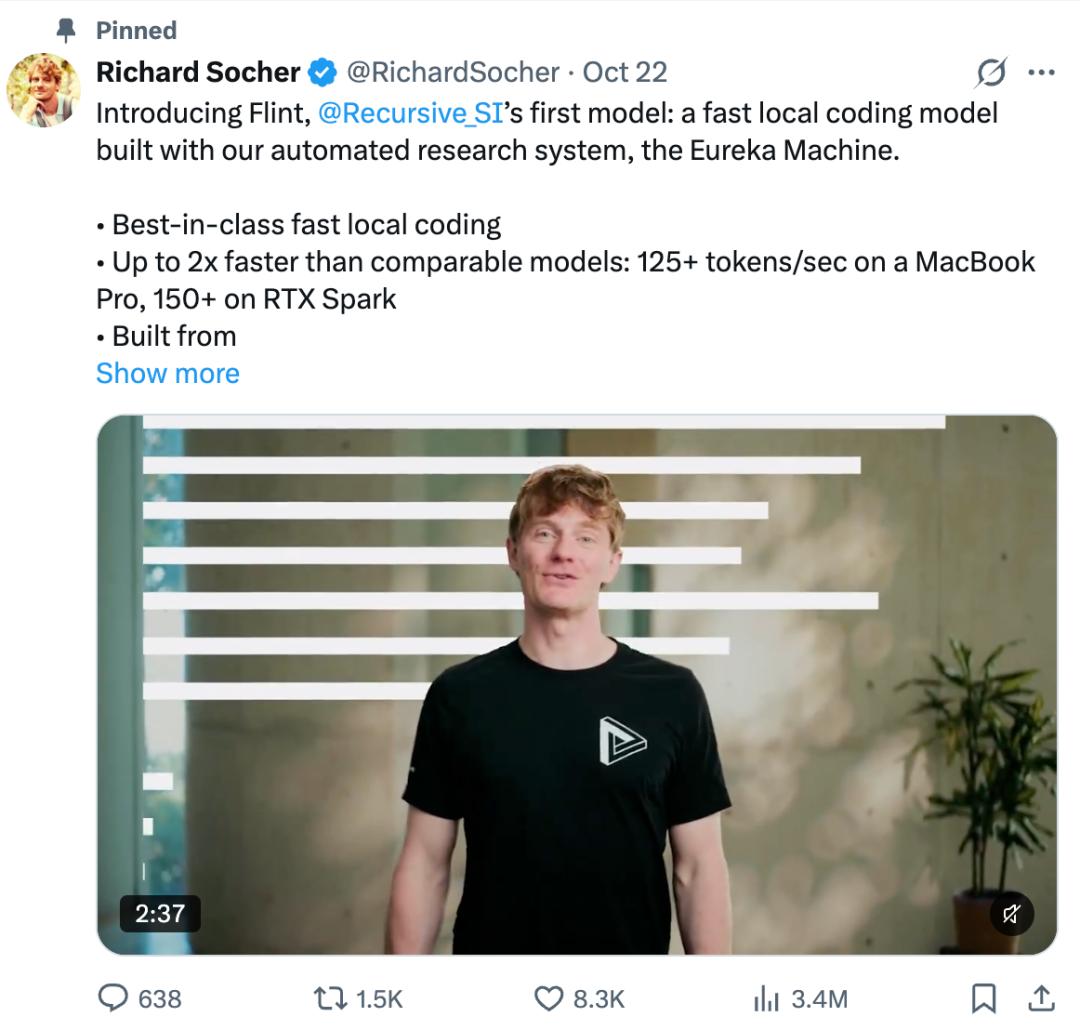
Nowadays, these visions are beginning to be turned into specific products. On October 22, Recursive SuperIntelligence, co-founded by Tian Yuandong, released Flint, a MoE programming model with a parameter scale of 40B, which activates only 2.5B parameters per token and can run locally on laptops.
The company's automated research system Eureka Machine has participated in multiple links of model R&D.
On this rapidly heating track, domestic teams have launched new competitive products.
Chaoyan Intelligence, founded by Chen Yongchao, a 27-year-old assistant professor at the School of Artificial Intelligence of Tsinghua University, has just released its first 35B model, Apex-35B-V1.0.
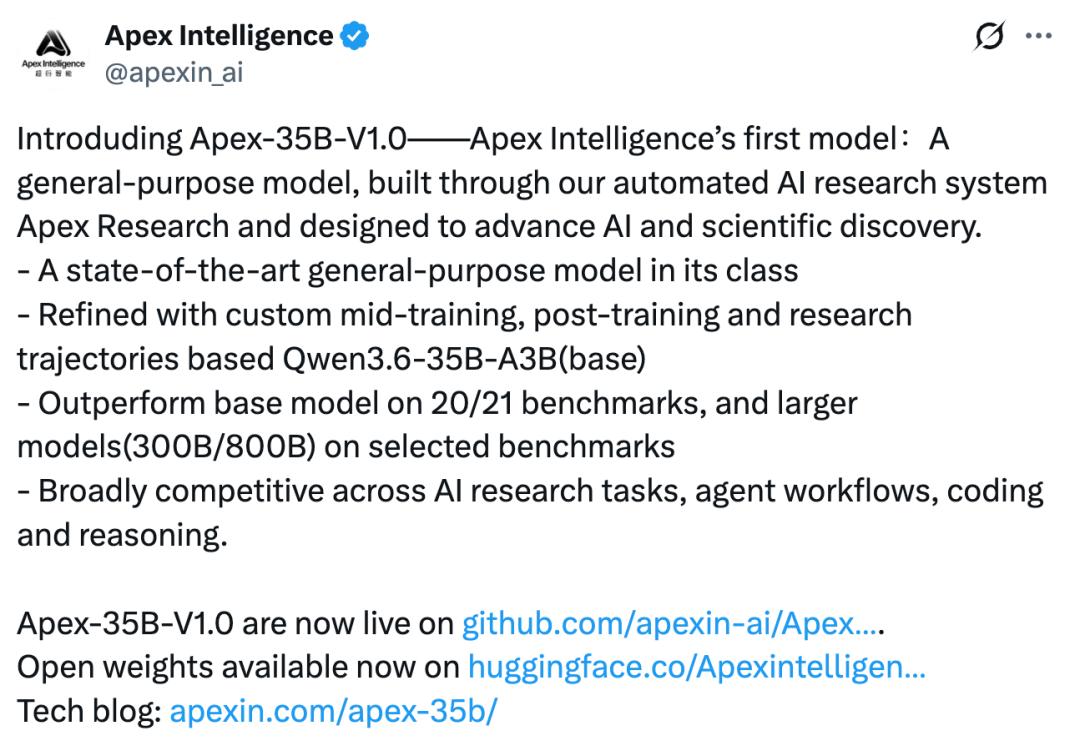
This is a model that takes into account both general capabilities and research capabilities. The Apex-35B-V1.0 model can not only complete conventional tasks such as Coding, Agent, Q&A and deep search, but also deeply participate in AI research, computational science and robot simulation.
In 21 benchmark tests, Apex-35B-V1.0 takes the lead in 20 items compared with Qwen3.6-35B-A3B of the same magnitude; compared with Recursive Flint (40B), it achieves leading results in 18 items and a tie in 1 item, reaching the SOTA level. It even surpasses large-scale models with parameter scales as high as 500B and 800B in some highly difficult evaluations, demonstrating globally competitive model capabilities.

Technical blog: https://www.apexin.com/apex-35b/
Github link: https://github.com/apexin-ai/Apex-35B-V1.0
Hugging Face link: https://huggingface.co/Apexintelligence-AI/Apex-35B-V1.0
This model is subjected to mid-training and post-training based on Qwen3.6-35B-A3B, with a large amount of proprietary datasets and research trajectories of Chaoyan Intelligence added. But what is more noteworthy is its construction method.
Chaoyan Intelligence introduces Recursive Self-Improvement (RSI) into model R&D, allowing AI to participate in experiments and result analysis, and trying to apply verified effective results to subsequent R&D.
Founded only in June this year, this company has completed two rounds of financing in just a few months, with the total financing amount approaching 400 million yuan, which is highly sought after by the capital market. Now, in just four months, it has launched its first model with global competitiveness. Chaoyan Intelligence has responded to the expectations of the outside world with a solid report card.
First look at the benchmark scores: leading in the same magnitude, beating 800B giant in some tasks
Before delving into the technical details, you may wish to take a look at what kind of report card this R&D method has finally delivered.
Nowadays, 35B-level models are no longer rare. However, under the model scale of 35B parameters, even with a mature R&D process, it is still a considerable challenge to take into account general capabilities such as Coding and Agent under a limited parameter scale, while being competent for complex research tasks. What's more, Apex-35B-V1.0 has also explored a new route that allows AI to deeply participate in model R&D and promotes continuous iteration of the R&D process through Recursive Self-Improvement (RSI).
In order to fully demonstrate the strength of Apex-35B-V1.0, we test the model's strength through a total of 21 benchmark evaluations from four capability directions: research, agent, programming and reasoning.
These four types of capabilities fully cover all capability matrices of AI models. Research capability determines whether the model can understand professional problems and explore solutions; agent capability enables the model to call tools, execute tasks, and continuously adjust according to feedback; programming capability converts research ideas into executable codes and experiments; reasoning capability supports the analysis and judgment of complex problems.
For a model that takes into account both general capabilities and research capabilities, it must not only perform well in daily tasks, but also combine multiple capabilities to complete more complex research work.
We start with the evaluation results to see how strong Apex-35B-V1.0 really is.
1. Research capability: leading comprehensively in the same magnitude across 6 evaluations
For a model that can participate in complex research tasks, the real challenge lies in whether it can understand professional problems, propose reasonable solutions, and convert research ideas into practical results.
In the 6 evaluations that best reflect research capabilities, Apex-35B-V1.0 is ahead of both Qwen3.6-35B and Flint. And in some benchmark tests, the performance of Apex-35B-V1.0 even surpasses DeepSeek-V4.1-Flash with 500B parameter level and GLM-5.3 with 800B parameter level.
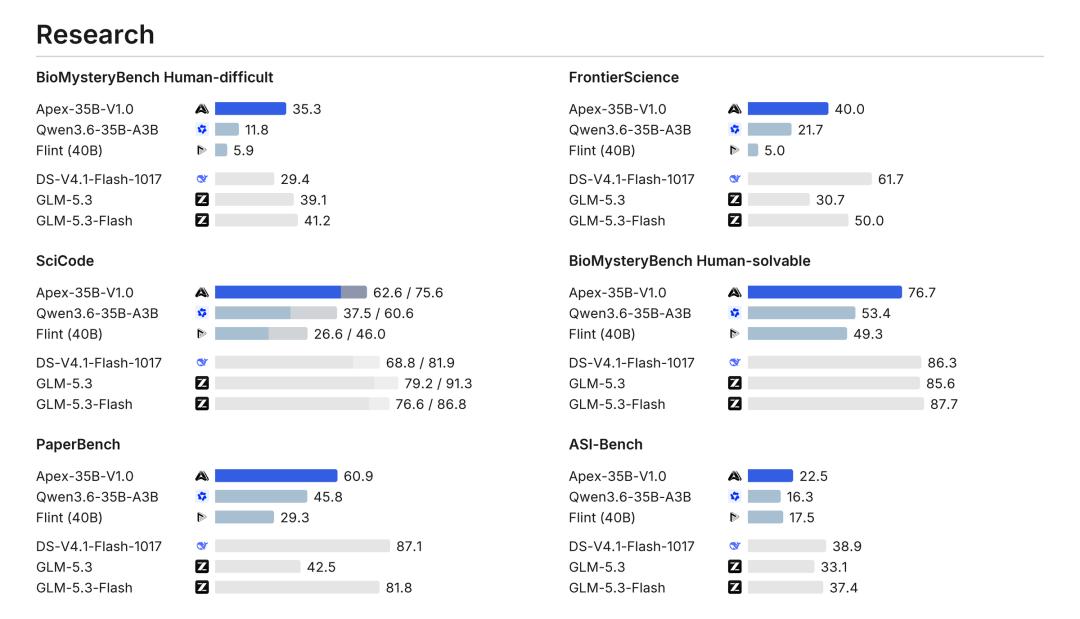
Among these eye-catching data, two evaluations deserve special attention.
The first one is FrontierScience launched by OpenAI in 2025. This evaluation specifically measures the ability of AI to solve highly difficult scientific problems. The topics span physics, chemistry, biology and other fields, including not only problems at the level of International Olympiad competitions, but also complex tasks that doctoral researchers may encounter in actual research, which is far more challenging than answering conventional knowledge questions.
Apex-35B-V1.0 scored 40.0 points in this evaluation, which is 8 times that of Flint, and increased by about 84% compared to the base Qwen model. Even more surprisingly, it also surpassed GLM-5.3 with a total parameter count as high as 753B, which scored 30.7 points.
The other one is PaperBench launched by OpenAI, which directly examines whether AI can reproduce an AI research paper from scratch.
This evaluation selected 20 Spotlight and Oral papers from ICML 2024, requiring the agent to understand the paper's methods, write codes, run experiments, and restore the research results of the original paper as much as possible. In order to measure the completion status, the researchers also refined these tasks into 8316 scoreable items.
In this highly difficult test, Apex-35B-V1.0 achieved 60.9 points, which is about 2.1 times that of Flint, and also far exceeded the 42.5 points of GLM-5.3.
Such results are really surprising. A model with only 35B parameters can release such powerful capabilities in highly difficult research tasks. Especially in scenarios such as professional problem solving and paper reproduction, Apex-35B-V1.0 has surpassed the 800B parameter large model in some evaluations, and also makes the RSI technical route explored by Chaoyan Intelligence shine even brighter.
2. Agent and programming: stable general capabilities
Agent capability determines whether the model can independently call tools, organize multi-step tasks and adjust actions according to feedback; programming capability allows it to directly write and modify codes, carry out experiments, and even handle complex software engineering problems.
In 6 agent evaluations, Apex-35B-V1.0 also leads the models of the same magnitude comprehensively. In 6 agent evaluations, Apex-35B-V1.0 is fully ahead of the base Qwen3.6-35B-A3B, and compared with Flint, it achieves 5 leading results and 1 tie result.
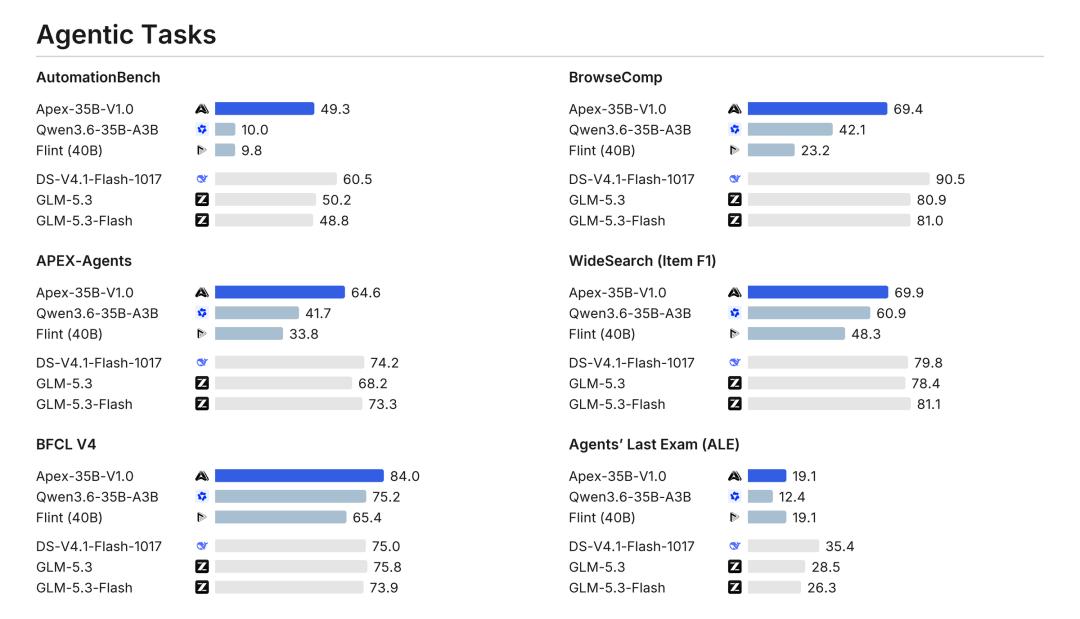
Among them, the most eye-catching one is BFCL V4 (Berkeley Function Calling Leaderboard) launched by the University of California, Berkeley.
This is one of the representative benchmarks for measuring the tool calling capability of large models. The evaluation is not limited to whether the model can correctly call a certain function, but further examines complex agent tasks such as multi-round interaction, information retrieval, and memory operation. This means that the model not only needs to know which tool to call, but also understand when to call, how to pass parameters, and how to maintain correctness in continuous operations.
Apex-35B-V1.0 scored 84.0 points on BFCL V4, surpassing all the models involved in the comparison. Even when facing larger-scale GLM-5.3 and DeepSeek-V4.1-Flash, it leads by 8.2 points and 9.0 points respectively.
Programming capability has long been a mandatory test item for large models. Today's high-difficulty programming benchmarks are no longer limited to generating a few lines of correct code, but also involve understanding complex code bases, modifying existing projects, operating terminal environments, and verifying results through tests.
In the evaluation of programming capabilities, Apex-35B-V1.0 leads the models of the same magnitude in 3 of the 5 evaluations, including SWE-Atlas QnA, Terminal-Bench 2.1 and SWE-bench Pro v2.
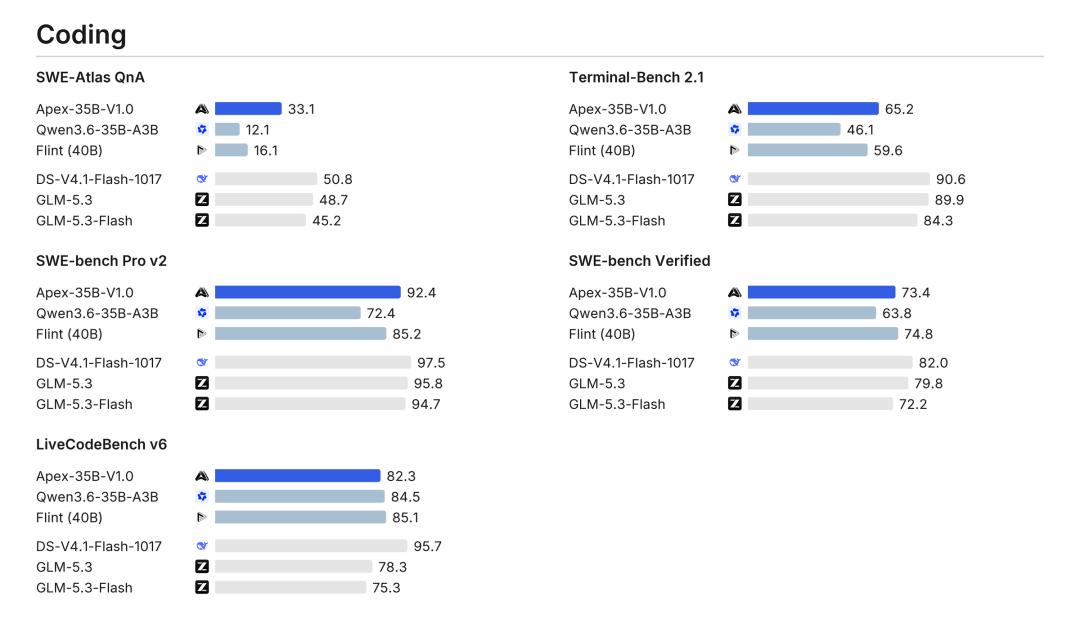
Among them, Terminal-Bench 2.1 is a quite challenging evaluation. It requires the agent to complete tasks such as software engineering and system configuration in a real command line environment. The model needs to independently execute commands, handle errors, and finally deliver results that can pass verification. In this evaluation, Apex scored 65.2 points, surpassing Flint which focuses on Agentic Coding.
Overall, Apex leads Flint in 3 of the 5 programming evaluations. Among them, SWE-Atlas QnA scored 33.1, which is about twice that of Flint; SWE-bench Pro v2 scored 92.4, which is also higher than Flint's 85.2.
Apex can not only call tools and plan tasks, but also has the ability to implement solutions into actual codes and engineering operations. When AI begins to participate in model R&D and complex research tasks, this ability from analyzing problems to hands-on execution is an important foundation for it to play a practical role.
3. Reasoning capability: leading the same magnitude in 4 items, achieving cross-level transcendence in HLE
Whether it is designing experiments, analyzing complex problems, or executing agent tasks that require continuous decision-making, reasoning capability is always the underlying support.
In 4 reasoning evaluations, Apex-35B-V1.0 is ahead of models of the same magnitude, and in some scenarios, its performance surpasses DeepSeek-V4.1-Flash with 500B parameter level.
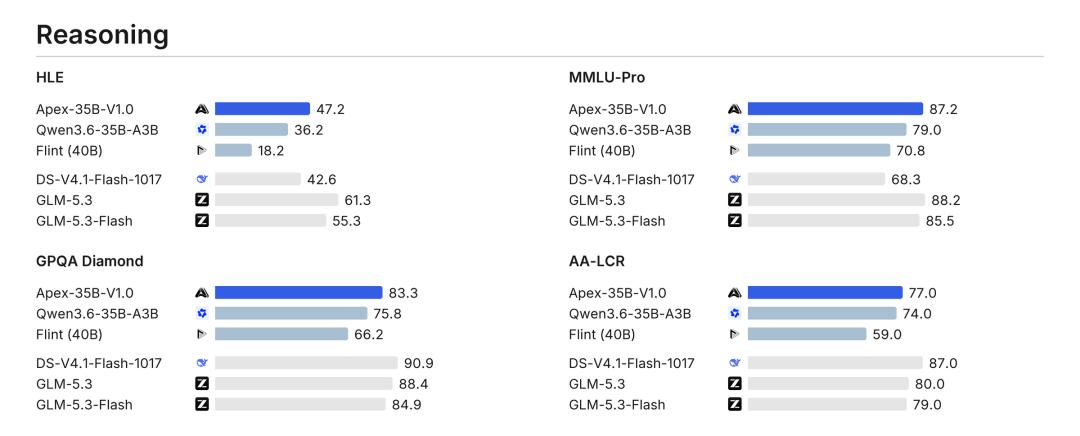
The most noteworthy one is HLE (Humanity's Last Exam), known as "the last exam for human beings". This evaluation was initiated by the Center for AI Safety (CAIS) and Scale AI, and the related research was published in *Nature* in 2026. Its official question set contains 2500 highly difficult questions, covering hundreds of disciplines such as mathematics, physics, chemistry, and biology.
The original design intention of HLE is to solve the problem that traditional evaluations are gradually brushed to high scores by top models, making it difficult to continue to distinguish capability levels. The questions are designed by experts in various fields, and many of them require in-depth professional knowledge and complex reasoning, which cannot be found through simple searches.
In this evaluation specifically challenging the boundary of model capabilities, Apex-35B-V1.0 achieved 47.2 points, which is about 2.6 times that of Flint, leading the base Qwen by 11 points, and also surpassing DeepSeek-V4.1-Flash with much larger parameters.
Another MMLU-Pro examines the comprehensive performance of the model when facing complex knowledge and reasoning problems. This evaluation was proposed by researchers such as TIGER-AI-Lab, which introduces more complex reasoning questions on the basis of traditional MMLU, and increases the number of options for each question from 4 to 10, further increasing the difficulty.
Apex achieved 87.2 points in this evaluation, only 1 point away from the 88.2 points of GLM-5.3 at the 800B parameter level, showing a comprehensive reasoning level close to that of larger-scale models.
4. Head-to-head confrontation with Flint: 21 evaluations, 18 leading
Around the world, RSI has become a highly concerned technical route in the AI field. In this exploration, these two entrepreneurial teams from China and the United States happen to form a rather interesting comparison.