Is Anthropic Pursuing a Cash-burning IPO? What Insights Can Domestic Large Language Models Gain From It?
As models become increasingly powerful, the scale of financial accounting is also growing. Are large model companies simply burning cash, or running a viable business? Now the capital market has received a more complete answer.
On October 26, Anthropic officially submitted its IPO prospectus, with half-year revenue reaching 162.86 billion US dollars, a year-on-year increase of about 1300%, 14 times that of the same period last year, but the net loss on the books is as high as 807 billion US dollars.

While bearing huge computing power expenditures, the company has also achieved rapid growth in corporate revenue.
This adds a noteworthy discussion significance to Anthropic's listing. In the past few years, the large model industry has no shortage of financing stories or technological breakthroughs. However, how much revenue model capabilities can be converted into, and how to recover the high R&D and computing power investment, have always been unavoidable issues.
Domestic large model companies are also calculating this exact account.
In January this year, Zhipu and MiniMax landed on the Hong Kong Stock Exchange one after another. Both companies saw rapid growth in commercial revenue, but continuous high-intensity R&D investment also makes the profitability issue impossible to avoid.
As more and more large model companies enter the capital market, impressive model performance and revenue growth rate alone are obviously no longer sufficient. They also need to prove what scale of business the expensive technical investment can ultimately support.
Anthropic's prospectus just provides an observation window.
With a loss of 807 billion US dollars, is Anthropic really conducting a bleeding listing?
First, let's look at the most eye-catching figure of Anthropic.
In the first half of 2026, the company recorded a net loss of 807.48 billion US dollars, far exceeding its operating revenue of 162.86 billion US dollars in the same period.
However, directly using these two figures to measure Anthropic's operating performance is indeed prone to misjudgment.
Of this huge loss, 723.88 billion US dollars came from changes in fair value of financial instruments such as convertible notes and derivative liabilities. As the company's valuation changes, the book value of relevant financial liabilities is also adjusted, resulting in large non-operating losses.
Therefore, in contrast, Anthropic's actual operating performance is much better.
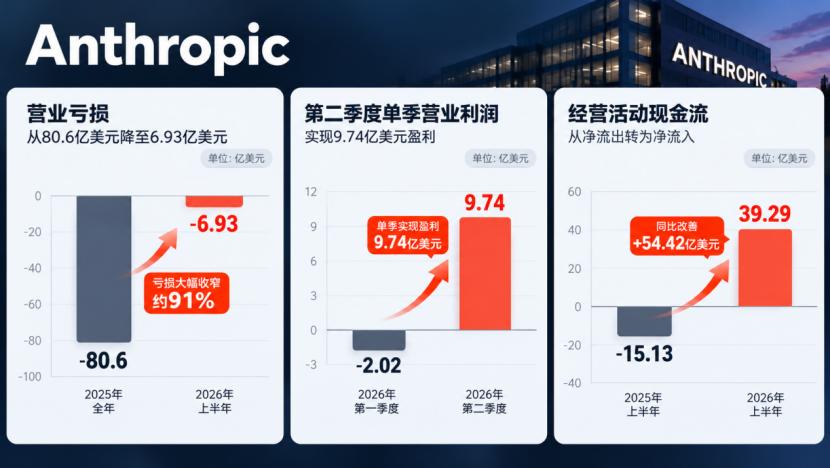
In 2025, Anthropic posted an operating loss of 8.06 billion US dollars. In the first half of 2026, the operating loss stood at 693 million US dollars, and it even achieved an operating profit of 974 million US dollars in the second quarter alone. In the same period, cash flow from operating activities turned to a net inflow of 3.929 billion US dollars from a net outflow of 1.513 billion US dollars in the first half of last year.
AI generated illustration: Data sourced from Anthropic's S-1 Prospectus
Of course, this does not mean that Anthropic has got rid of capital pressure, and future computing power and infrastructure construction still require a large amount of investment. But at least judging from the current financial performance, its operating conditions are indeed improving.
What underpins this change is the rapidly expanding revenue scale.
In 2024, Anthropic's full-year revenue was only 386 million US dollars. It rose to 4.585 billion US dollars in 2025, and in the first half of 2026 alone, revenue has already reached 162.86 billion US dollars.
The core driving force for growth is not the Claude subscription fees paid by ordinary users every month, but the revenue generated by enterprises and developers continuously calling the model.
The prospectus shows that Anthropic's usage-based revenue in the first half of the year was about 131 billion US dollars, accounting for 80% of total revenue. As of the end of September, there were more than 1900 customers who spent over 1 million US dollars in the past 12 months, of which about 250 spent over 10 million US dollars.
These figures indicate that large models have been included in the regular procurement budgets of a number of enterprises. As applications such as programming and Agents gradually penetrate into production processes, enterprises are no longer just purchasing the Q&A capability of the model, but its ability to complete a large number of practical tasks.
However, customers' willingness to spend does not mean that model companies can make money easily. Complex tasks usually mean higher usage frequency, longer call chains, and greater consumption of computing resources.
In 2025, Anthropic's computing power and infrastructure expenses reached 73.26 billion US dollars, equivalent to 160% of its full-year revenue. In the first half of 2026, this part of expenses further increased to 89.45 billion US dollars, but its proportion in the revenue of the same period has dropped to about 55%.
In other words, Anthropic has not reduced its investment in computing power.
Therefore, this prospectus at least shows us a change: cutting-edge large models are no longer just R&D projects that require continuous huge capital investment. The real revenue brought by enterprise customers can already support and cover the high computing power expenses to a considerable extent. Although there is still a distance from stable profitability, Anthropic has demonstrated an operating state different from the early stage of pure financing-dependent expansion.
How far are Chinese large models from earning back their computing power costs?
If we compare Anthropic's commercialization path with that of domestic model companies, we will find an interesting change.
In the past, the industry's discussion on the commercialization of domestic large models mostly focused on one word: low cost.
From DeepSeek to Zhipu and MiniMax, domestic model companies have accumulated a large number of developers and application scenarios by reducing reasoning costs, opening model capabilities and optimizing API pricing. But for model companies that need to continue to invest huge R&D funds, low cost is only a competitive advantage, and how to convert it into revenue and profit is equally important.
Now let's take a look at Zhipu first.
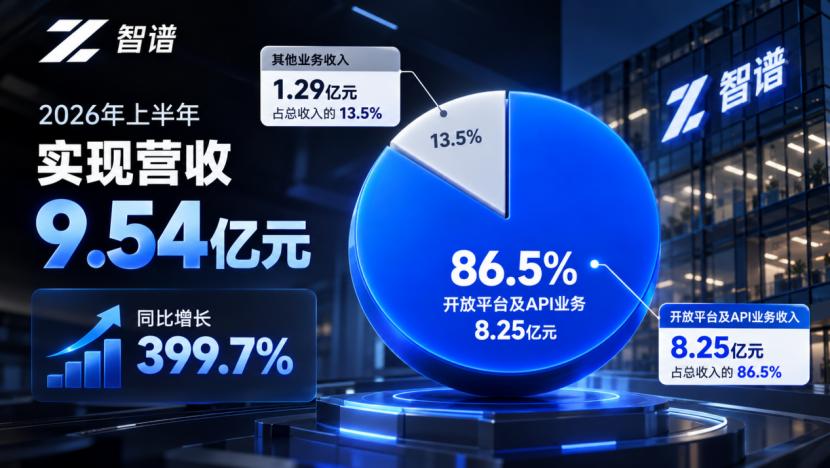
In the first half of 2026, Zhipu achieved revenue of 954 million yuan, a year-on-year increase of 399.7%. Among them, the revenue of open platform and API business reached 825 million yuan, accounting for 86.5% of the total revenue.
AI generated illustration. Data sourced from Zhipu's 2026 Interim Performance Announcement
Compared with the previous revenue structure dominated by localized deployment, API business has become Zhipu's main source of revenue. That is to say, more and more developers and enterprises are continuously calling models through a unified platform, rather than just purchasing one-time deployment services.
It is more noteworthy that Zhipu's revenue growth does not rely entirely on price cuts to drive volume.
According to its half-year report disclosure, the average selling price of Zhipu's API increased by about 101% in the first half of the year, the reasoning cost per Token decreased by 80% compared with the beginning of the year, and the gross profit margin of cloud deployment business also improved to 24.6%.
Although the change in average selling price is affected by factors such as product and customer structure, it at least shows that with the expansion of application demands such as programming, complex reasoning and Agents, some domestic models are gaining greater pricing space.
The situation of MiniMax is also representative.
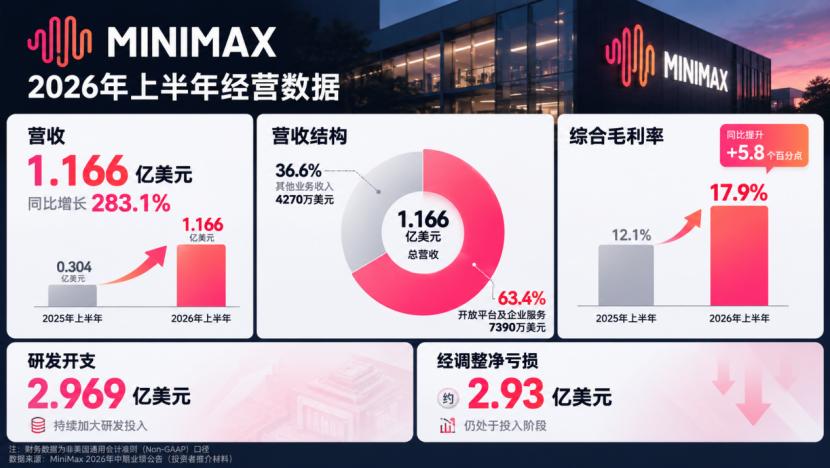
In the first half of this year, MiniMax's revenue reached 116.6 million US dollars, a year-on-year increase of 283.1%. Among them, the revenue of open platform and enterprise services was 73.9 million US dollars, accounting for 63.4% of the total revenue.
At the same time, its comprehensive gross profit margin increased from 12.1% in the same period last year to 17.9%. However, R&D expenditure still reached 296.9 million US dollars, and the adjusted net loss was about 293 million US dollars.
AI generated illustration. Data sourced from MiniMax's 2026 Interim Performance Report
The business paths of the two companies are not exactly the same, but they both reflect a change: The commercialization of domestic large models no longer only relies on low prices to compete for users, and APIs and enterprise services are forming a continuously growing source of revenue.
Of course, revenue growth does not mean that the profitability problem has been solved. For model companies that still need to maintain high-intensity R&D investment, there are several accounts that need to be calculated clearly.
The first is the pricing power.
Different from traditional software, each call of a large model consumes computing resources. Especially for complex Agent tasks, it may involve multiple rounds of reasoning, tool calls and sub-task execution, leading to higher computing power consumption.
Anthropic also reminded in the prospectus that Agent workload may lead to a disproportionate increase in computing power demand relative to revenue.
Therefore, the decline of reasoning cost is certainly important, but the more critical point is whether manufacturers can maintain a reasonable charging level while improving costs, instead of using all the benefits brought by efficiency improvement to cut prices.
This is also why the simultaneous occurrence of the increase in Zhipu API's average selling price and the decline in reasoning cost is more worthy of attention than the simple growth of Token call volume.
Secondly, it is the customer structure and business channels.
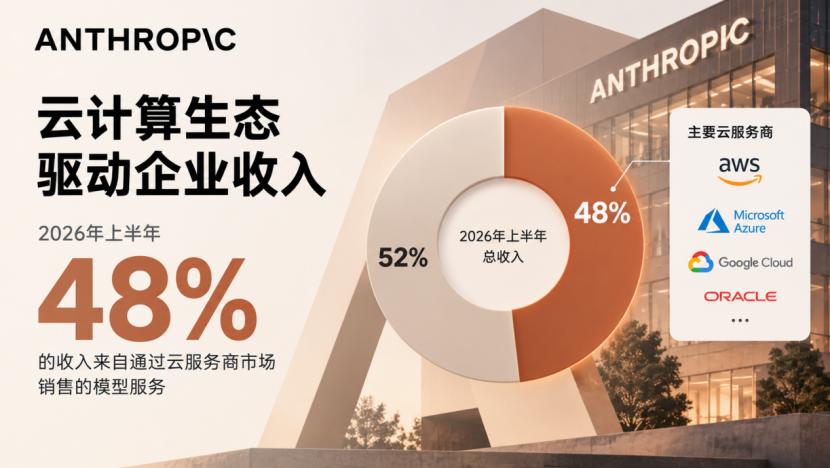
Anthropic's ability to generate huge enterprise revenue is closely related to its customer base and cloud computing ecosystem. In the first half of 2026, about 48% of its revenue came from model services sold through cloud service provider marketplaces.
AI generated illustration Data sourced from Anthropic's S-1 Prospectus
This means that even leading independent model companies need to rely on large cloud platforms to reach customers.
Different commercialization paths also exist in China. Large manufacturers such as Alibaba, ByteDance and Tencent can promote model services relying on cloud computing, office software and existing business ecosystems; while independent model companies such as Zhipu and MiniMax build their own customer groups through open platforms, professional model capabilities and application products.
The two models have their own advantages, but the common problem they face is: when model capabilities are gradually popularized, how to form sustainable business competitiveness through product experience, service quality and customer relationship.
Finally, it is how the capital market evaluates these model companies that are still investing at high speed.
This year, Zhipu and MiniMax have landed on the Hong Kong Stock Exchange, and Anthropic has also officially submitted its prospectus. As model companies move to the public capital market, the outside world will pay attention not only to model performance, financing valuation and call scale, but also to revenue quality, gross profit margin, R&D investment efficiency and operating cash flow.
However, this does not mean that the capital market no longer tolerates losses, and model companies must achieve profitability immediately. For the industry with rapid technological iteration, continuous R&D is still very necessary.
What the capital market will distinguish is whether the enterprise's loss mainly comes from the early technical investment, or the cost is still difficult to be effectively controlled after the business scale expands.
Judging from the current financial performance, Anthropic's operating conditions are improving, and Zhipu and MiniMax have also made progress in revenue structure, pricing power and cost control. However, due to different development stages, financial calibers and business structures of different companies, we cannot simply judge the advantages and disadvantages of business models by the scale of losses.
For domestic model companies, there is no need to copy Anthropic's development path. Domestic models have formed their own competitive advantages in open source ecosystem, reasoning optimization, cost control and application scenarios.
What is really worth referencing from Anthropic's prospectus is not how much loss it can bear, but the operating relationship between enterprise payment, model capability and computing power cost.
For domestic large models that have entered the stage of large-scale commercialization, what needs to be further proved next is how to convert these technical and cost advantages into more stable revenue and profits.
After all, for the same GPU and the same R&D investment, how much revenue can be generated and how much profit can be retained ultimately can better reflect the commercialization capability of model companies than simply comparing which model is cheaper and which company has raised more financing.
This article is from WeChat Official Account "The Fourth Wave", author: Feng Haoqin, published with authorization from 36Kr.