Unitree's first post-IPO earnings release: Why does it register revenue growth without corresponding profit growth?
On the evening of October 28, Unitree, known as "the first humanoid robot stock on the Sci-Tech Innovation Board", released its financial report for the third quarter of 2026.
In the first three quarters of 2026, its operating revenue reached 1.817 billion yuan, a year-on-year increase of 55.71%; net profit attributable to shareholders was 387 million yuan, up 270.54% year on year; non-recurring profit and loss deducted net profit was 349 million yuan, down 18.78% year on year.
This is the company's first financial report after its listing. The financial report shows that Unitree's operating revenue in the single third quarter was 665 million yuan, a year-on-year increase of 69.93%; net profit attributable to shareholders was 113 million yuan, down 17.37% year on year; non-recurring profit and loss deducted net profit was 105 million yuan, down 17.42% year on year.
Q3 Revenue Grows But Profit Does Not?
Overall, during the reporting period, Unitree's revenue growth trend was remarkable, net profit increased synchronously, revenue growth rate continued to rise, and R&D investment continued to increase.
From the beginning of the year to the end of the reporting period, the net cash flow generated from Unitree's operating activities was about 194 million yuan, a year-on-year decrease of 54.69%. The company stated that this was mainly due to the increase in the amount of cash paid for purchasing goods and receiving services, sales expenses, R&D expenses and other items along with the growth of operating revenue.
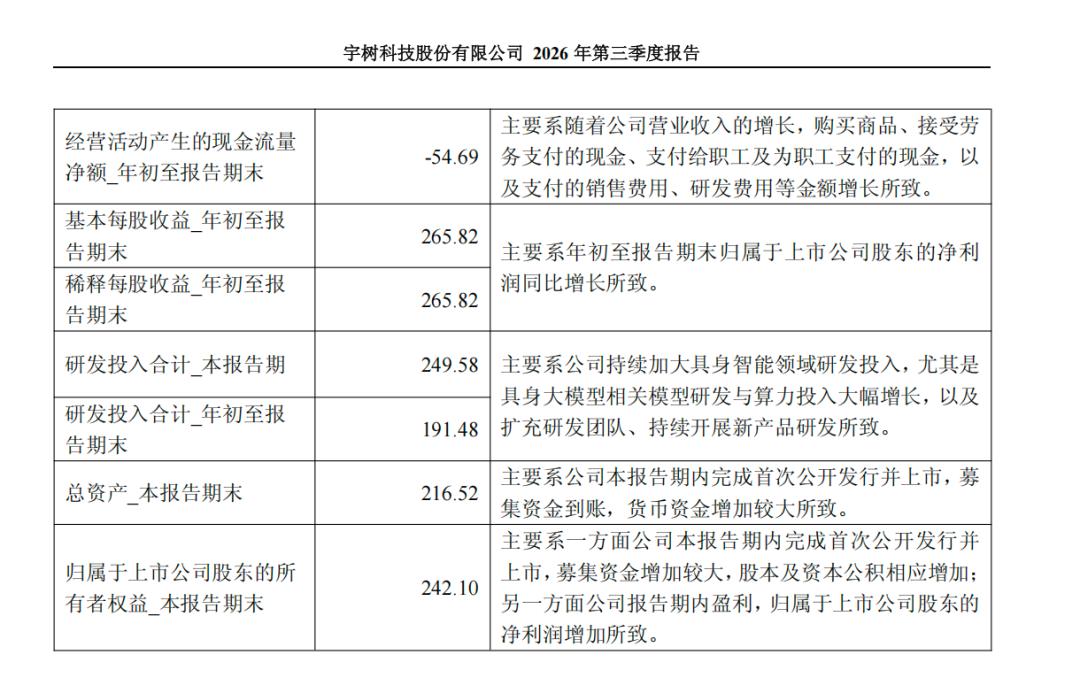
The financial report shows that its R&D investment reached 263 million yuan, with R&D expenses increasing by 191.48% year on year, accounting for 14.47% of revenue, which mainly came from the substantial growth of model R&D and computing power investment. In the same period, sales expenses were 230 million yuan, up 202.4% year on year, and the expense ratio rose from 6.51% to 12.65%. The market believes that this may be one of the key reasons for the profit decline.
At the same time, its gross profit margin dropped from 59.75% to 54.02%, which affected the gross profit by about 104 million yuan converted based on the revenue of the first three quarters; the one-time share-based payment in 2025 was about 349 million yuan.
Previously, in the prospectus of Unitree, it was mentioned that in the first three quarters of 2025, more than 70% of its humanoid robot revenue came from the scientific research and education field, industry applications accounted for less than 10%, total sales from the top five customers only accounted for 12.09% of revenue, and revenue from industrial and commercial scenarios was less than 10%.
Wang Xingxing, founder of Unitree, previously pointed out when talking about scenario implementation that industrial fields and To B commercial services will be faster and more mature than home scenarios. In mid-October, Morgan Stanley also predicted that Unitree's annual humanoid robot sales volume would be 14,000 units, and would further increase to 26,000 units in 2027.
From the perspective of Zhang Xiaorong, Dean of Deep Tech Research Institute, if a robot enterprise follows the "scientific research-driven revenue" model for a long time, "it is obvious that this structure is deformed".
He pointed out to The Fourth Wave that scientific research revenue is the teaching aid dividend supported by policy and academic demand, which provides high gross profit and positive profit in the short term, but driven by research projects, it is not a healthy business model. "It only proves that someone will buy the product, but cannot prove that robots as productivity tools can continue to increase in volume, and the ceiling is visible."
Wang Peng, associate researcher of Beijing Academy of Social Sciences, pointed out to The Fourth Wave that the market pays special attention to this financial report, because it is a key verification node for the industry to shift from "scarcity valuation" to "implementation capability valuation". As the benchmark enterprise first listed on the track, its revenue performance directly calibrates the commercialization quality of the whole industry, puts the high premium previously supported by technological narrative under the test of the public regulatory framework for the first time, and also provides the most intuitive reference scale for the prosperity of the whole industrial chain.
Beyond the Ontology, It Is Also Necessary to Build an Ecosystem
Since Unitree landed on the Sci-Tech Innovation Board on August 19, its stock price has fluctuated sharply under the alternating influence of market sentiment and industrial news.
Compared with the low point of 404.03 yuan per share on October 15, the stock began to rebound from October 16, and as of October 28, the cumulative increase exceeded 70%. Unitree's latest market value has also reached 281.5 billion yuan.
Unitree also issued a risk warning for the successive rise, stating that the humanoid robot industry is still in the early stage of commercialization, and there are uncertainties in technology maturity, downstream market demand cultivation, and industrial chain supporting capabilities.
At the same time, Unitree said that the large-scale implementation of physical AI technology from laboratory demonstration to real scenarios still faces multiple challenges such as perception accuracy, motion control stability, data accumulation and software-hardware collaboration, and the maturity of relevant technical paths and business models still needs time to verify.
According to the data disclosed by Unitree, its actual shipment volume of humanoid robots delivered to end customers in 2025 exceeded 5,500 units, and the mass production of the ontology offline exceeded 6,500 units; as of July 2026, the cumulative production and offline of multiple biped humanoid robots was about 18,000 units.
At the recently held 2026 World Physical AI Conference and the first Unitree Partner Ecosystem Conference, Wang Xingxing said that since the G1 was released in May 2024, the cumulative production and offline volume has been about 10,000 to 20,000 units, making it "the best-selling humanoid robot in the world".
He also rarely talked at length about AI in his speech. He said that physical AI has now shown signs of being "broken through", which will take 1 to 2 years at the earliest and 2 to 3 years at the latest. To this end, Unitree is also promoting its own physical AI system synchronously.
At the same time, Unitree launched the "Unitree Creation Plan" to recruit entrepreneurial partners for the embodied intelligence ecosystem, and plans to incubate more than 200 ecological enterprises in the next five years. In the same period, it cooperates with partners to promote the implementation of robots in education and scientific research, industrial intelligent manufacturing, cultural and entertainment performance, embodied tour guide, service retail, intelligent inspection, emergency fire protection and other fields.
Three days after the above ecosystem conference, JPMorgan Chase directly upgraded Unitree's rating by two levels from "underweight" to "overweight", and raised its target price from 300 yuan to 995 yuan as of December 2027. JPMorgan Chase believes that Wang Xingxing's advancement of the physical AI timeline is a key turning point for the industry.
Globally, not only Wang Xingxing, Jensen Huang and Sam Altman also mentioned the connection between physical AI and robots recently. Industry analysis mentioned that physical AI is expected to raise the market's expectations for humanoid robot enterprises such as Unitree.
But for enterprises, facing practical applications, the industry's competition point is not only the model capability of a single robot. Huatai Securities believes that the humanoid robot industry is in the stage of advancing from prototype verification to production line operation, and subsequent actual shipment, order rhythm and revenue recognition will become important indicators to judge whether the industry has truly achieved volume growth.
From the perspective of Huang Lichong, President of Winsheng International Capital, whether it is Unitree or other robot enterprises, the key is to convert the first-mover advantage of hardware into commercialization advantage. To measure its real business capability, in addition to looking at the revenue figures in the financial report, we also need to look at the customer structure, actual application effect and profit quality.
He gave an example to The Fourth Wave, saying that we should look at the proportion of industrial and commercial customers of the enterprise, the continuous orders and repurchase rate. In addition, whether the robot can work stably for a long time, whether it can really save costs and improve efficiency for customers, the gross profit margin and cash flow of the enterprise are all indicators to measure its commercialization capability. These will be the key dimensions that the market will focus on investigating robot enterprises in the next stage.
(The content and views in this article are for reference only and do not constitute investment advice. Investment is risky, so be cautious when entering the market.)
This article is from the WeChat Official Account "The Fourth Wave", author: Qiu Hui, published with authorization from 36Kr.