Throwing tantrums and burning cash, extended supply shortage, did SK Hynix single-handedly push up the prices of memory stocks?
SK Hynix released its Q3 FY2026 financial report on the 28th Beijing Time, with solid overall performance. While the financial indicators did not bring much surprise compared to the expectations of major financial institutions, the price increases of memory and flash memory both exceeded expectations. Meanwhile, the guidance for the growth rate of memory shipments in the next quarter also accelerated beyond expectations, indicating that the current market supply and demand remains tight, and subsequent performance growth will stay at a considerable level.
01 Overall Performance: Both Revenue and Operating Profit Exceed Expectations, but the Growth Rate Decelerates Quarter by Quarter
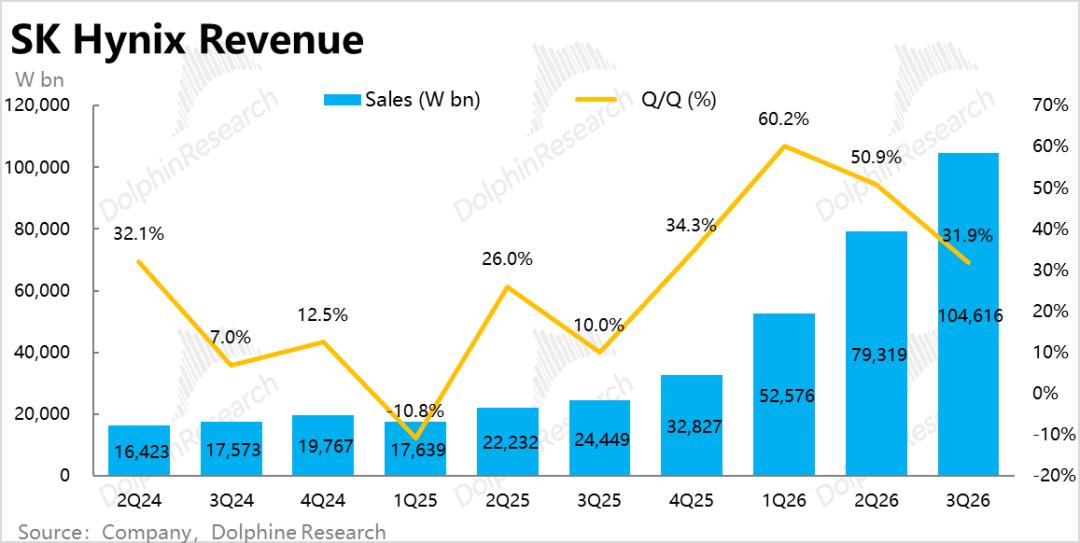
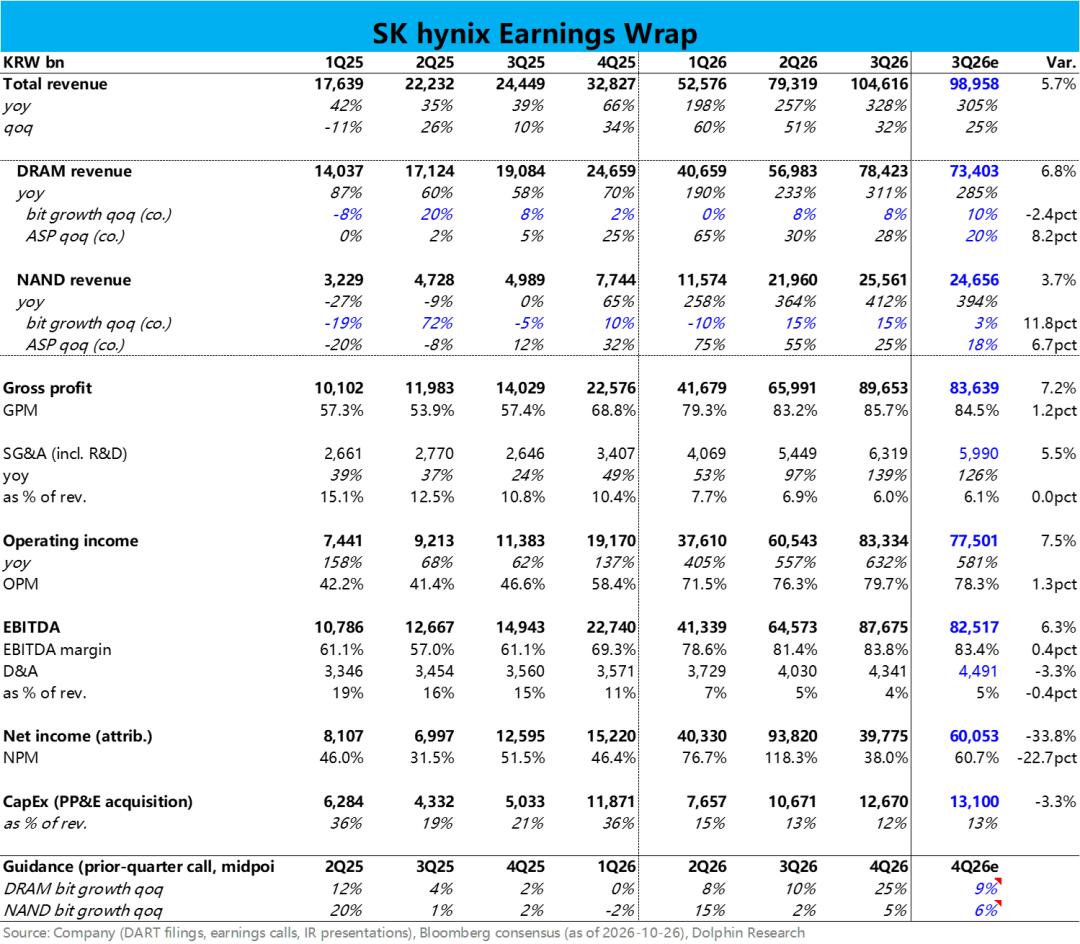
SK Hynix's revenue in this quarter reached 104.6 trillion won, up 32% quarter-on-quarter, about 6% higher than the Bloomberg consensus expectation (99.0 trillion won), and basically consistent with the expectations of some major institutions. The quarter-on-quarter revenue growth rate dropped from +51% in 2Q to +32%, and the high growth driven by price increases decelerated quarter by quarter.
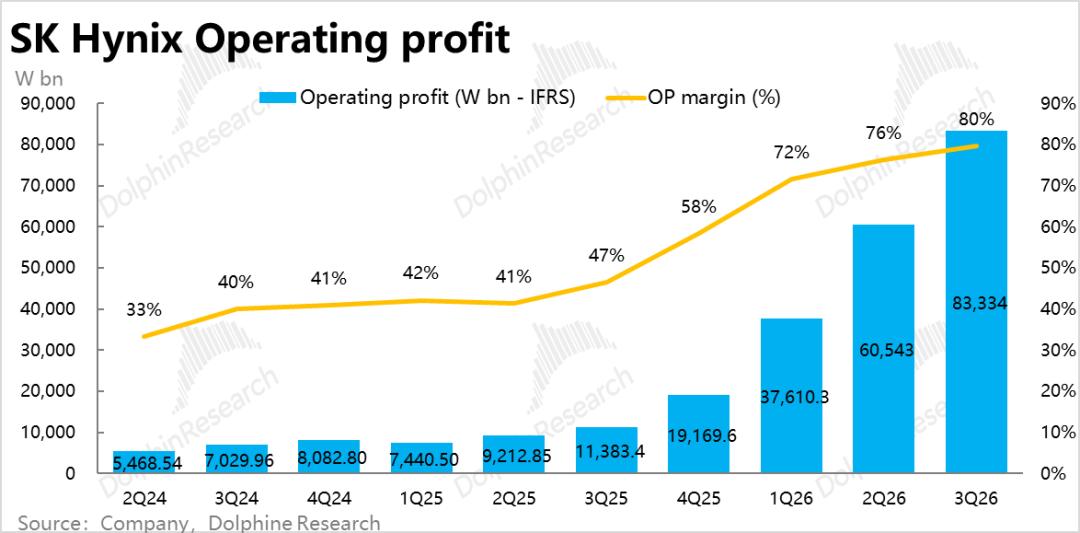
The operating profit was 83.3 trillion won, up 38% quarter-on-quarter, higher than the consensus expectation of 77.5 trillion won, and also roughly in line with the expectations of major institutions. The profit margin continued to rise by about 3.4 percentage points quarter-on-quarter along with product price increases.
The net profit was 39.8 trillion won, significantly lower than the consensus expectation (about 60 trillion won), which stemmed from exchange-related losses and losses related to investment assets brought by the appreciation of the won, but these non-operating factors do not need too much attention.
Overall, the two core financial data of total revenue and operating profit performed well, but it was not a big surprise for relatively optimistic investors.
02 Volume and Price Split (Core): Price Far Exceeds Expectations, Shipments Generally Meet Expectations
a) DRAM: Shipments Meet Expectations, ASP Increase Far Exceeds Expectations
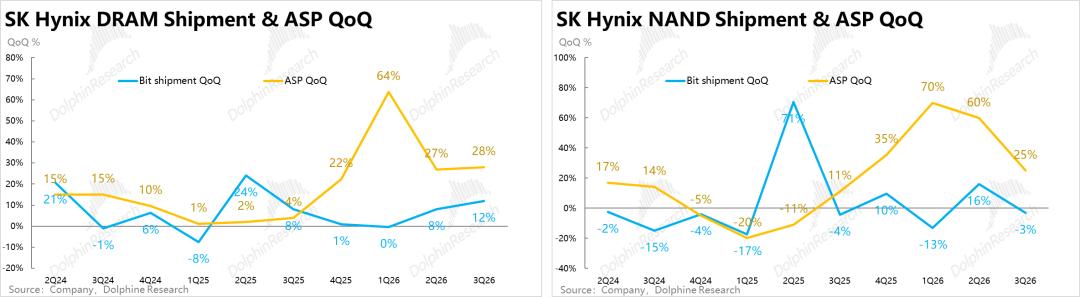
DRAM shipments this quarter increased by about +10% quarter-on-quarter, consistent with the company's guidance and consensus expectations, showing normal performance; the highlight is that ASP rose by as high as 20% quarter-on-quarter, far exceeding the consensus expectation of exactly 20% (slightly higher than the expectations of major institutions). And it only fell slightly from the +30% increase in 2Q. The previously slowing momentum of price increase quarter by quarter has stabilized, which will be interpreted by the market as the supply-demand gap remaining very tight.
However, Dolphin Research would like to remind that the ASP in the company's report reflects the contract price previously agreed with customers, which is significantly lower than the market price. The reflected price increase is more that the newly delivered contract price narrows the gap with the market price. In addition, part of the price increase also comes from the structural impact of the rising proportion of HBM4.
b) NAND: Shipments Decrease Slightly, ASP Increase Also Exceeds Expectations
NAND shipments this quarter decreased slightly quarter-on-quarter, lower than the consensus expectation of about +3%; ASP rose by mid-20% quarter-on-quarter, also far exceeding the consensus expectation of about +18%. The logic behind the NAND price increase should be similar to that of DRAM.
As for the shipments falling short of expectations, the company explained that it actively concentrated sales on high value-added products such as 321-layer enterprise-level SSD, and the ASP of NAND also benefited from the increase in the proportion of SSD. Historically, the growth rate of NAND shipments has often turned negative from time to time, which is not particularly unexpected.
03 Gross Margin Rises, Expense Ratio Shrinks
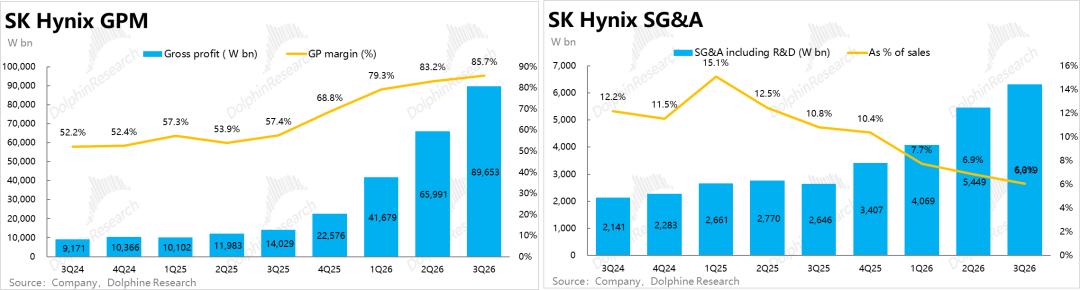
The already high gross margin reached 85.7%. As product prices continued to rise beyond expectations, it rose by about 2.5 percentage points quarter-on-quarter, higher than the consensus expectation of 84.6%. While various operating expenses reached 6.3 trillion won, although they also increased by 139% year-on-year, under the faster revenue growth rate, the expense ratio was continuously diluted, and it shrank by 0.9 percentage points this quarter. The rise in gross margin and the shrinkage of expense ratio jointly pushed up the operating profit margin.
04 Guidance: 4Q DRAM Shipments Accelerate to Mid-20% Quarter-on-Quarter
The 4Q26 DRAM shipment guidance is a mid-20% quarter-on-quarter growth, a leapfrog improvement from the previous growth rate of around 10%, far exceeding expectations; NAND growth is in the mid-single digits, basically consistent with the consensus expectation (+5.7%).
For the substantial acceleration of DRAM shipments, the company attributed it to the impact of capacity expansion of the new 1c node and the ramp-up of M15X (full production by the end of the year). This is undoubtedly a major positive for the company's performance momentum in the medium term. Previously, due to the slow capacity ramp-up, the company's performance growth relied almost entirely on price increases. Even if the price increase slows down later, it can rely more on shipments to take over, maintaining a sales growth rate of 30%~40%.
05 Capital Expenditure:
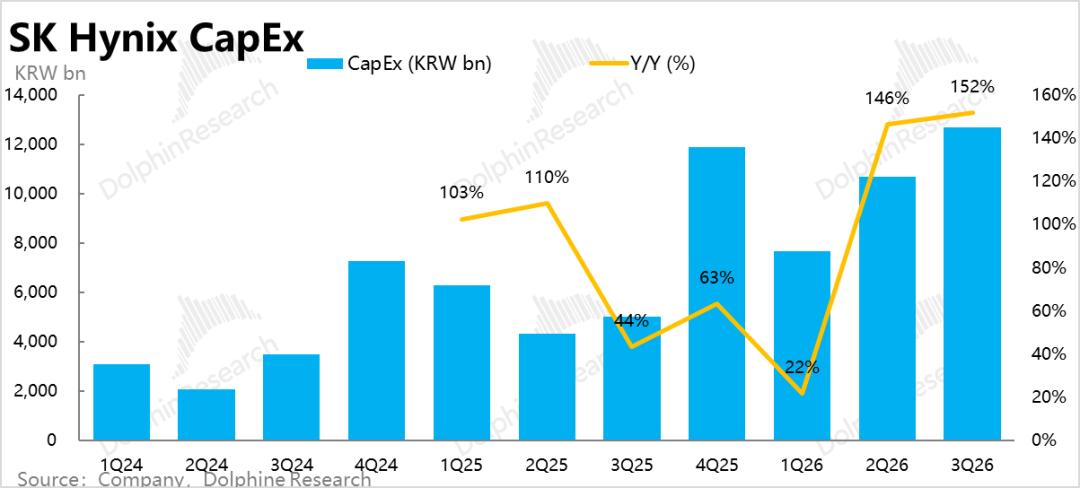
The cash paid for the purchase and construction of fixed assets this quarter was 12.7 trillion won, up 19% quarter-on-quarter, slightly lower than the Bloomberg consensus expectation (13.1 trillion won). According to the company's guidance in July that the 2026 investment scale will be at the high 40 trillion won level, it implies that 4Q Capex will reach about 16~18 trillion won, starting to accelerate significantly.
In addition, the company expects that Capex in 2027 will increase significantly, investing in three areas: equipment investment for advanced processes, the ramp-up of Yongin Y1, and domestic and foreign infrastructure. This is consistent with our expectation that capacity will begin to ramp up significantly in 2027.
06 Shareholder Return: 7%~10% Return Rate for FY26
The company officially announced that the total shareholder return for FY2026 will be about 100 trillion won (including year-end dividends), of which cash dividends will be no less than 30 trillion won, and repurchase and cancellation will be no less than 60 trillion won, accounting for 50% of the free cash flow of the year. It is decided to distribute within the third quarter: ① 14 trillion won in cash dividends; ② New repurchase of 20 trillion won, of which about 10 trillion won is used for shareholder return and all cancelled, and the other about 10 trillion won is used for employee compensation, not included in shareholder return.
According to the total return of about 100 trillion won for the whole year, the rate of return for US stocks is about 7%, and the rate of return for Korean stocks is as high as 10% due to the discount.
07 Long-term Agreement:
Signed long-term agreements have covered more than 50% of the total capacity in 2027 and 2028; 14 major customers have been signed (about 10 in July); the standard term is 5 years, and some customers are in discussions for extension; the price floats within the range agreed with customers according to market conditions. Previously, the market consensus was that SK Hynix's long-term agreement coverage was low, but now the visibility and downside protection of the company's subsequent performance have been significantly improved. The company plans to maintain the long-term agreement coverage at a similar level in the medium and long term, and retain flexibility for the rest of the capacity; the price can also capture part of the upside as the market improves.
08 Downstream Structure: The Proportion of Servers Continues to Rise, Dependence on AI Deepens Further
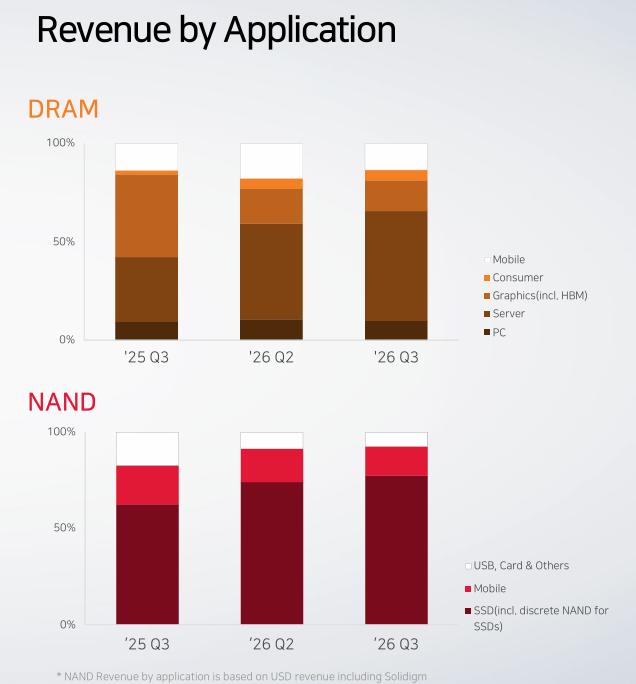
From the perspective of application revenue structure, the proportion of servers in DRAM revenue has risen from about 30% a year ago to about 50% in the second quarter, and further rose to more than 50% this quarter; plus the graphics category including HBM, data center-related revenue has accounted for about 70% of DRAM revenue, and mobile phones and PCs together account for only about 20%. The same is true for NAND, the proportion of enterprise-level SSD has risen from about 60% a year ago to nearly 80%. SK Hynix's growth is increasingly dependent on the capital expenditure of AI server and XPU manufacturers (NVIDIA, AMD and cloud vendors' self-developed chips).
09 Overview of Core Indicators Below
Dolphin Research View:
The total volume of this financial report does not bring much surprise, and the incremental information lies in the structure: the increase in product unit price is stronger than expected, the next quarter's shipments accelerate significantly, and the long-term agreement is quantified for the first time and covers more than half of the capacity. The three points together point to tight supply and demand, and there is no worry about short-to-medium term performance; the real divergence lies in how long the cycle can last.
The signal conveyed by this performance is relatively optimistic. The price increase exceeds expectations, breaking the previous trend of continuous decline in the increase, which can dispel the market's concern about whether memory can no longer rise in price. The shipment growth rate jumps from 10% to more than 20%, so even if the price increase narrows later, revenue can continue to be driven by volume growth, and the sustainability of growth is stronger.
However, the performance elasticity brought by volume increase is obviously less than that brought by price increase, and as the base rises later, the performance growth of memory manufacturers will inevitably tend to "normal". Therefore, after the fastest rising stage ends, "how long can it rise" has become the core issue at present, for which:
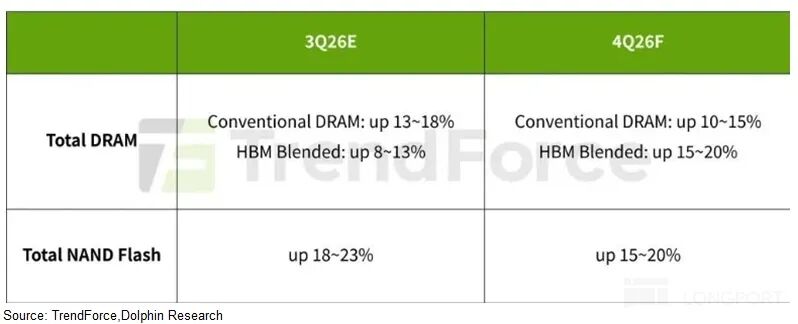
1) Sustainability of prices: TrendForce expects that the conventional DRAM contract price in 4Q26 will increase by 10~15% quarter-on-quarter, and NAND by 15~20%. Most mainstream institutions believe that the price increase will last until the second half of 2027, and there is great divergence in 2028. The demand judgment given by the company this time is undoubtedly relatively optimistic (of course, SK Hynix as a memory manufacturer naturally tends to be optimistic).
2) Cycle length: The company's signal is more optimistic than ours. The company expects that the "achievable demand" of DRAM and NAND in 2027 will grow by mid-20% and high-10% respectively, which is a caliber that takes into account the actual supply, roughly corresponding to the supply growth rate (similar to our in-depth calculation of the 2027 supply growth rate of about +24%).
The more critical signal lies in the structure: customers' HBM demand is more than twice the company's current supply, which is consistent with our calculation that the HBM supply-demand relationship is tighter; including the volume under negotiation, DRAM and HBM before 2029 have been substantially sold out, and the company judges accordingly that the state of supply shortage will last until 2030.
On the other hand, the company's capital expenditure in 2027 will increase significantly, which is consistent with our expectation that capacity will ramp up significantly from 2027, and new supply will be released intensively in 2027–2028, which is also the reason why we are more cautious about 2028.
3) Long-term agreement: From "low volume lock" to covering more than half of capacity. The long-term agreement's coverage of more than half of the company's capacity in 27~28 has changed the previous judgment of the market and us that SK Hynix's long-term agreement coverage is "low", its performance lower limit will be raised, which also means that SK Hynix's performance has marginally shifted from "relatively more flexible" to "emphasizing certainty". However, the long-term agreement will also restrict the upward movement of prices, and the scale of margin and specific price range have not been disclosed, so the specific downward protection strength remains to be observed.
Combining the above 3 points, the performance certainty of SK Hynix and memory manufacturers in the next 1~2 years seems to have improved.
But the fact that performance in the short and medium term is still good does not necessarily mean that the stock price will perform well. Recently, memory stocks have generally pulled back sharply, and the triggering factors mainly come from the macro level rather than the industry fundamentals. Including rumors that the annualized revenue (run-rate) growth of cutting-edge large model manufacturers is less than expected, the credit default swap (CDS) spread of new cloud vendors (Neo-Cloud) widens, the overall risk appetite tightens, and the market doubts the sustainability of AI capital expenditure. These disturbances in sentiment and valuation