Microsoft is set to slash more than half of Meta's workforce in a single large-scale layoff, and Copilot has become the hardest-hit area.
Microsoft has started offering compensation to encourage employees to voluntarily consider leaving their positions.
Around 60,000 employees are eligible for this offer, accounting for more than a quarter of the company's global workforce.
This time, employees do not need to be close to retirement age, nor do they need to have poor performance records. Eligible employees can receive compensation and leave the company by the end of the year, which reflects the company's obvious intention to reduce headcount as quickly as possible.
Even the Copilot team, which Microsoft has placed high hopes on, is covered by this program. Back in this spring, when other departments paused recruitment, the Copilot team was still hiring new staff.
Microsoft remains highly profitable, with a net profit of 133.7 billion US dollars in the last fiscal year. However, as AI investment expands, the company expects its capital expenditure in 2026 to reach about 175 billion US dollars. The public has therefore linked this voluntary separation program to cost control and freeing up funds for AI investment.
01 Microsoft offers compensation for employees to consider leaving
Working at Microsoft, you may now face such a choice: the company offers you a sum of money, would you like to resign?
On the evening of October 26 Beijing time, Microsoft launched a new round of voluntary separation program, and about 60,000 employees in the United States, Canada, the United Kingdom and India are eligible to participate.
Calculated based on the 223,000 global employees at the end of June this year, more than a quarter of the staff can choose to leave with compensation.

What does 60,000 employees mean? Meta had less than 80,000 total employees at the end of last year, and the number of people covered by Microsoft's separation offer is equivalent to three-quarters of Meta's total headcount.
Looking at the recent layoff moves of peers, Amazon cut about 30,000 corporate positions in two rounds from the end of last year to the beginning of this year; Meta cut about 8,000 people in May this year.
It is not yet known how many people will eventually accept the offer, but the number of eligible people alone has exceeded the total number of layoffs from several rounds of the two companies.
The threshold for this separation offer has been lowered significantly. Employees do not need to rank at the bottom of performance appraisals, nor do they need to reach a certain age or length of service. In eligible teams, general managers and some employees with vice president titles can also sign up for the program.
Half a year ago, Microsoft did not expand the scope to such a large extent.
In April this year, the company launched its first voluntary retirement program, which required the sum of the employee's age and the number of years of work at Microsoft to reach 70, and was only open to employees at the level of senior director and below in the United States.
For example, a 50-year-old employee who has worked at Microsoft for 20 years meets this threshold. About 8,750 people are eligible, most of whom are long-serving employees who have stayed at the company for many years.
Many people accepted this plan. About 30% of eligible employees accepted the retirement package. Amy Coleman, Microsoft's Chief People Officer, later revealed that this reduced the number of people the company needed to lay off involuntarily in July.
Now, the age and length of service requirements have been cancelled, and the scope of applicable regions and job levels has also been expanded.
So how much is the compensation exactly?
According to the plan for US employees, compensation is linked to job level and length of service. Most employees can get a maximum of about 9 months of salary compensation, and the plan for some senior-level employees includes a full year of salary. In addition, there are arrangements such as continued vesting of stocks for a certain period of time.
Eligible employees will receive their own specific plan, can consider it until the first week of December, and will arrange to leave the company by the end of the year after acceptance. For people who already plan to change jobs, this may be just the right opportunity, as the company is willing to pay to help them make the transition.
The trouble is that rejecting this offer does not mean that you will not be laid off in the future.
In July this year, Microsoft announced layoffs of 4,800 people, and cut hundreds more in September. The company made it clear that voluntary separation will not replace involuntary layoffs. You can choose to leave with compensation now, but those who stay still may face the next round of layoffs. Employees have to make a choice that involves a certain element of gamble.
This offer also covers Microsoft's most valued AI business. In addition to departments such as finance, human resources, Xbox and Windows, employees related to Copilot are also included in the scope.
02 Why is Copilot also on the list?
Back in March this year, when Microsoft froze recruitment for some cloud business and North American sales teams, the Copilot team was still hiring new staff.
Copilot's business has indeed grown. As of the end of June, Microsoft 365 Copilot had more than 30 million paid seats, with net new seats in the quarter more than double that of the previous quarter. HSBC has committed to purchasing 200,000 seats, and KPMG has expanded its deployment to more than 276,000 professionals worldwide. These enterprises purchase AI services for hundreds of thousands of users at a time.
Of course, behind Copilot's "impressive results" is Microsoft's all-out promotion.
Microsoft has integrated Copilot into Windows, Office and Edge, promoting it with the huge existing user base of these products, eliminating the trouble of finding users from scratch. Microsoft also spent a lot on advertising. According to media reports, Copilot's TV advertising investment reached about 60 million US dollars in 2025.
However, Copilot is like an awkward related party that always gives people the impression that it does not deserve the position it holds.
Nadella once asked the enterprise version of Copilot in the Edge browser to help process the public web page he was browsing, but it failed to complete the task. Nadella then sent a dissatisfied email to the executive in charge of the related business.
In March this year, the company announced the integration of consumer and enterprise-focused Copilot, to link the development of product experiences, platforms, office applications and models more closely. Nadella proposed in the announcement to make these products form a simpler and more complete system.
Some of the previously added Copilot entrances will also be removed. In the same month, the Windows team announced that it would start with applications such as Snipping Tool, Photos and Notepad to reduce "unnecessary Copilot entrances".
By September, Microsoft launched even bigger adjustments.
Before the revision, when users opened Word to write reports, Copilot would provide assistance on the side. After the revision, users can directly generate and modify reports in Copilot without opening Word separately. The same applies to Excel spreadsheets and PPT, as Microsoft has moved these office tools into Copilot.
Nadella said that he wants to build Copilot into an "operating system for work", which is a statement with great ambition.
But the ambition for AI is often accompanied by expanding expenditure.
Microsoft mentioned on its July earnings call that the increase in Microsoft 365 Copilot usage, coupled with the company's continuous investment in improving product quality, led to a slight decline in the gross profit margin of its business division.
In fact, Microsoft and its peers all have to find ways to cover the growing AI expenditure.
03 Major tech companies are raising funds for AI investment
Microsoft is actually very profitable. In the 2026 fiscal year ending at the end of June this year, the company's net profit reached 133.7 billion US dollars, a year-on-year increase of 31%.
But the amount of money it plans to spend is also staggering. Microsoft expects its capital expenditure in 2026 to reach about 175 billion US dollars, which will be used for infrastructure such as data centers and servers.
Therefore, when interpreting this 60,000-person separation offer, the public believes that Microsoft is controlling costs to provide funds for its huge AI investment.
This speculation is well-founded, and Microsoft's peers are also constantly raising funds for AI.
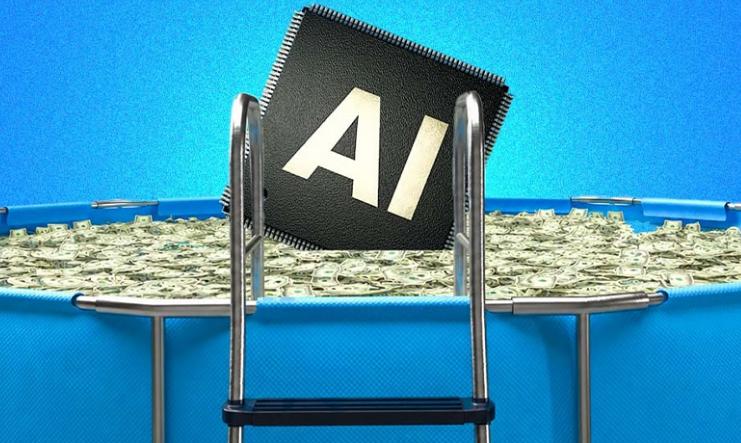
On October 26, Meta announced an equity financing plan of up to 95 billion US dollars. Later, this figure was expanded to 97.5 billion US dollars. According to the updated arrangement, the company will push forward the issuance of common stocks and convertible preferred stocks totaling 37.5 billion US dollars, and plans to raise up to 60 billion US dollars through stock sales in the follow-up period.
Prior to this, Meta had already borrowed a large amount of money. In October last year, the company issued 30 billion US dollars in bonds, and issued another 25 billion US dollars in April this year, totaling 55 billion US dollars.
Looking at Meta's cash flow, you can understand why it is so active in raising funds.
In the third quarter of this year, Meta's operating activities generated 32.79 billion US dollars in cash, but its capital expenditure reached 34.91 billion US dollars, resulting in negative free cash flow of 2.12 billion US dollars. The company expects its full-year capital expenditure this year to reach 135 billion to 145 billion US dollars.
Elon Musk is also looking for solutions, this time using financial leasing.
Also on October 26, SpaceX disclosed an arrangement with a total principal payment of about 400 billion US dollars. A subsidiary under Apollo will first purchase AI chips and servers, and then lease them to SpaceX. Each lease will last for more than five years from the delivery of the equipment. The company expects to finalize the deal before the end of the year, and the lease after equipment delivery will start in the first half of 2027.
In this way, SpaceX can let the financier pay for the equipment first, and pay in installments in the following years. Computing power needs to be obtained as soon as possible, while the payment time can be postponed to later dates.
In addition to raising funds externally, major tech companies are also rearranging their internal budgets.
Microsoft's R&D team has been shrinking. In fiscal year 2026, the number of product R&D personnel decreased from 80,000 in the previous year to 77,000, a reduction of 3,000 people. However, the R&D expenditure in the same fiscal year still increased by 9% to 35.56 billion US dollars. Microsoft explained in its annual report that the increase in expenses mainly comes from investment in computing power, AI talents and data, as well as expenses such as impairment of the Xbox business.
This makes the "layoff to save money" logic somewhat subtle. The company has reduced R&D personnel, but the entire R&D department spends more money. Microsoft will continue to develop models and improve Copilot, and even if some positions are cut, the investment in computing power and talents required for these tasks will continue.
The expansion of infrastructure has not stopped either. Microsoft disclosed in July that it added 88 new data centers in the past fiscal year, and plans to expand the overall capacity by about twice within two years. As more equipment is put into operation, the company still needs staff to maintain these computer rooms.
Therefore, there is a noteworthy detail in the scope of this separation offer — the data center team is not included in this round of program.
This article is from the WeChat Official Account "Letter AI", written by Xiao Jinya, and published with authorization from 36Kr.