Microsoft CEO: Microsoft is also using a mix of low-cost models, a price war over computing power is inevitable, and the core asset of enterprises in five years will be "proprietary evaluation benchmarks"
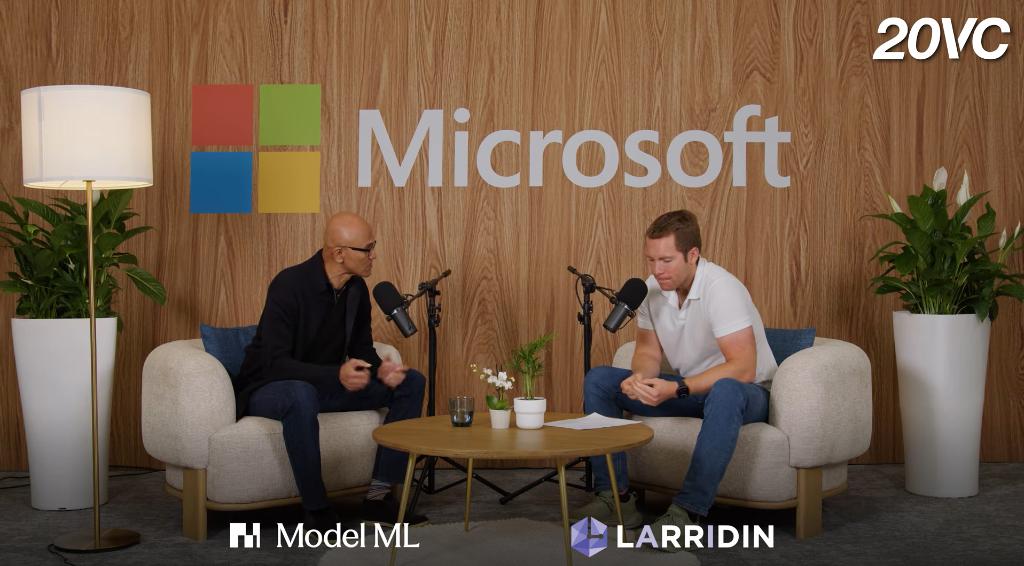
On October 26, 2026, Satya Nadella, Chairman and CEO of Microsoft, was a guest on the venture capital podcast 20VC, and had a 24-minute conversation with host Harry Stebbings.
(
The timing of this interview is worth noting. Five days ago, on October 21, Nadella delivered the opening speech at the Microsoft Frontier Tour held at ExCeL London, with 6,500 partners and customers in attendance.
He pointed out that enterprises must address three core issues when deploying AI: keeping humans in the decision-making loop, taking full control of their own knowledge, and building trust. This podcast is an expanded version of the same set of judgments oriented towards investors.
Targeting the computing power cost and model competition landscape that the market is most concerned about, Nadella stated frankly that from the perspective of technical laws, for the vast majority of business tasks in specific scenarios, model capabilities will soon hit the saturation point of marginal effect. He emphasized:
Once the capabilities are saturated, open-source models or extremely low-cost lightweight closed-source models will quickly seize the market.
Computing power will become a commodity, "the underlying layer will inevitably experience an extremely brutal price war"
With the decline of model inference costs, the market has long been worried about the commercial moat of large foundational models. Nadella did not shy away from this point, predicting that cutting-edge models only belong to a small number of top-tier niche markets, while daily computing power will be fully commoditized.
Nadella stated:
Therefore, my prediction is very clear: the most cutting-edge top-tier models will always have their unique top-tier niche markets, such as breakthrough scientific exploration, and the cutting-edge baseline will continue to be raised; but in the vast majority of daily enterprise scenarios, the vast majority of computing power consumption will be commoditized, turning into extremely cheap basic raw materials.
When asked whether the underlying traffic will be eaten up by open-source models, he gave an affirmative answer:
It could be open-source models, or those lightweight closed-source models with extremely fierce price competition. The underlying layer will inevitably experience an extremely brutal price war.
The scheduling mechanism of Microsoft's own flagship products best confirms this trend. Nadella admitted:
Just look at the real scheduling mechanism inside our own Microsoft Copilot: we are extensively mixing and using low-cost closed-source models and open-source models every day.
This statement actually shakes the industry's basis for paying a premium for the scarcity of cutting-edge models, and also reveals that Microsoft is transforming from a single model provider to an orchestrator and governor of model invocation with more stable profit margins.
Overturn the "emergence theory" of safety alignment and adopt a radical "zero-trust architecture"
In the past few years, the industry's default premise was that the stronger the model's capabilities, the more naturally safety alignment will follow. Nadella said he used to be a believer in this premise, but he has now abandoned it.
Nadella emphasized that traditional post-hoc reinforcement learning cannot achieve complete alignment, and alignment must be directly hard-coded into the model weights from the very bottom. He said:
I used to think that the 'alignment' of models would emerge automatically as the parameter scale expands. Reality has proven that this is not the case.
He even rejected the post-hoc remediation path:
I do not believe at all that you can achieve complete alignment by patching it up through post-hoc reinforcement learning. Alignment must be directly hard-coded into the model weights from the very bottom.
Based on the current situation that underlying models cannot guarantee absolute credibility, he proposed a brand new engineered defense idea:
The safest posture for using advanced models today is to assume that the model has already been compromised.
He advocates:
Since underlying models cannot guarantee absolute credibility, we will build a solid trust fence outside the model, and adopt extremely radical measures in policy configuration and abnormal behavior monitoring.
In addition, he severely criticized the practice of some model manufacturers in the industry recently hiding the "chain of thought", arguing that "this makes the problem even more severe". He warned:
Frankly speaking, if closed-source model manufacturers do not recognize the necessity of "remaining transparent to trusted partners", this opacity will instead become the biggest booster for the open-source ecosystem.
Microsoft has prepared Agent 365 and Purview for this layer: assign independent identities to each digital employee, compulsorily record all behavior trajectories and complete chains of thought. The chain of thought records must be human-readable plain English, and the tamper-proof logs are submitted to multiple independent models for cross-review.
As a company that sells models, orchestration frameworks and governance tools at the same time, Microsoft has products to sell in all three layers. Defining security as an external trust engineering project is equivalent to guiding enterprise budgets to the governance layer where Microsoft has already taken a leading position.
Beware of the "reverse information paradox": the core competitiveness of enterprises in five years will be "proprietary evaluation benchmarks"
On the commercial logic of AI empowering the enterprise B2B market, Nadella put forward the "reverse information paradox".
Arrow's classic information paradox states that if a technology owner fully discloses trade secrets to buyers without patent protection, the commercial value will evaporate instantly; Nadella said this relationship is reversed, and now it is the enterprise customers as buyers that need to be protected.
Nadella reminded:
When enterprises interact with large models, even tiny traces of business activities are providing free reinforcement learning nutrients for large model companies. You are actually creating incremental value for model vendors, rather than retaining the value within your own organization.
So what exactly is the core asset of enterprises in the AI era? Nadella gave a clear answer: the private business evaluation dataset. All external models must run tests on this set of private indicator systems of the enterprise, and the one with higher cost-effectiveness will be adopted.
Nadella said:
What I firmly believe in is that every enterprise in the future will build a set of private evaluation benchmarks exclusive to itself, which will become the core commercial intellectual property of the enterprise.
When asked what will become common sense in five years, he reiterated:
In five years, everyone will realize that the core asset and essence of an enterprise is a set of its own exclusive AI evaluation benchmarks.
Unilever is a typical example. They first used cutting-edge models to run through the entire process from sales orders to capital collection, then trained the model using business interaction trajectories. At present, their claim processing has been replaced by lower-cost MAI, and the business logic remains in their own hands. This case was mentioned in his London speech on October 21.
Hard constraint of trillion-dollar training costs: must be paid for by "global GDP growth"
Facing the current situation where the entire industry is frantically expanding infrastructure, and the cost of a single model training is even claimed to be as high as hundreds of billions of US dollars, the market is full of concerns about the commercial return of this "arms race". Nadella gave the ultimate account from the perspective of macroeconomics.
Nadella stated:
This sum of money must ultimately be paid for by the inflection point of global real GDP growth.
He elaborated that no financial profit statement can fail to take effect out of thin air, and enterprises will eventually face the hard constraints of revenue and net profit. If a company can support hundreds of billions of dollars in R&D, "the premise must be that the incremental value this company brings to the global economy is large enough to allow it to legally obtain such huge commercial returns."
He gave the core observation indicator:
Can AI actually push the global GDP growth rate to a substantial upward jump?
He is optimistic about this, and specifically mentioned the cost reduction and efficiency improvement in the deep water area of public healthcare, as well as the endless potential demand elasticity of software development itself.
Finally, regarding the question of whether the industry will move towards a "full-stack vertical integration monopoly" from chips to applications, he believes that the possibility is extremely low.
He predicted that the industry will move towards horizontal specialized division of labor, "more sufficient competition is breaking out at every level of the industrial chain", multiple winners will coexist at each sub-level of the stack, and customers will have the autonomy to freely assemble their own solutions.
This article does not constitute personal investment advice, does not represent the position of the platform. The market is risky, and investment requires caution. Please make your own independent judgment and decision.
This article is from the WeChat Official Account "Wall Street CN", author: Bao Yilong, published with authorization from 36Kr.