NVIDIA and Oracle Announce Expanded Cooperation
Oracle announced on Tuesday local time that it will expand its computing power deployment for NVIDIA, and plans to launch competing chips including Google TPU on its cloud platform to provide diversified options for different AI workloads. As its Investor Day is around the corner, some institutions expect the company to raise its long-term targets, while high capital expenditure remains a major concern for the market.
According to media reports on October 27 local time, Oracle announced that it will expand its cloud AI chip cooperation with NVIDIA, and at the same time introduce chips from NVIDIA's competitors such as Google and Cerebras Systems on its cloud platform.
According to statements from both parties, Oracle will leverage NVIDIA's latest-generation Vera Rubin AI server to expand its cloud deployment to a "gigawatt-scale" level.
While expanding its cooperation with NVIDIA, Oracle is also enriching its computing power options. Even for NVIDIA-based systems, Oracle will phase out some of NVIDIA's network chips and replace them with its self-developed Acceleron network chips.
In addition, Oracle said it will for the first time provide customers with computing power based on Google's TPU chips under Alphabet on its cloud platform.
Regarding this layout, Mahesh Thiagarajan, President of Oracle Cloud Infrastructure (OCI), said in a statement that different AI workloads have different computing power requirements, and this selection allows customers to flexibly pick the most suitable infrastructure in terms of performance, throughput and cost-effectiveness for each AI workload.
In addition to Google, Oracle also plans to launch the computing power of chips from SambaNova Systems, an AI inference chip maker invested by Intel, and Cerebras Systems on its cloud platform. Both companies focus on AI inference, the computing segment where AI systems respond to user requests.
Media reports point out that NVIDIA dominates the AI training chip market, but the AI inference chip market has more intense competition and a more diversified landscape, which provides entry space for chip manufacturers other than NVIDIA.
Andrew Feldman, CEO of Cerebras, said in an interview with the media that the cooperation with Oracle will greatly expand the company's first-tier customer base, and its chips are being deployed on a large scale in the data centers of other enterprises.
According to reports, Oracle did not disclose how it will fund the aforementioned chip procurement. The company said on its earnings call last month that a growing number of customers are covering chip costs on their own, and it maintains its capital expenditure target of about $90 billion to $95 billion for fiscal 2027.
Investor Day Around the Corner
As of press time, Oracle's share price rose by about 4%. The market is paying attention to the company's Investor Day to be held in Las Vegas on October 28 local time.
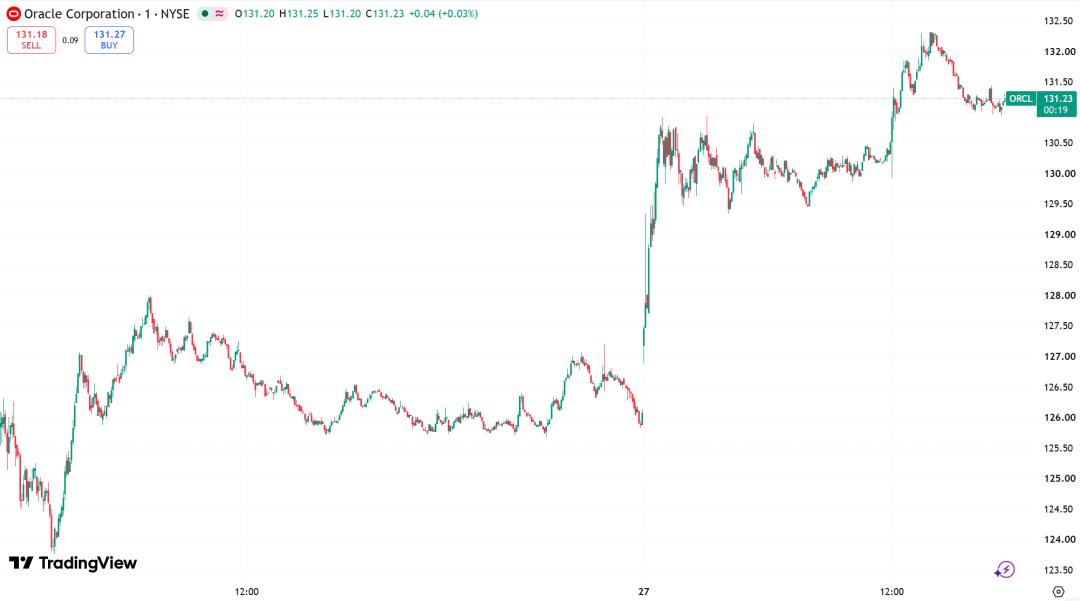
Trend of Oracle's stock price in the last two trading days, Source: TradingView
This is the second time Oracle has held its Investor Day after a one-year interval. At its financial analyst conference in October 2025, Oracle set targets of $225 billion in revenue and $21 in earnings per share for fiscal 2030, and raised its OCI revenue expectation for fiscal 2030 by $22 billion to $166 billion.
Wall Street institutions already expect that the targets are likely to be raised again this time. Wall Street investment research institution Bernstein SocGen Group reiterated its "outperform" rating and $325 target price, believing that the strong growth of remaining performance obligations (RPO) in the past four quarters makes it possible for the management to raise financial targets.
Remaining performance obligations refer to the amount that the company has contracted but not yet fulfilled and recognized as revenue, which can be understood as "locked future revenue" and is often used to measure the business reserve of subscription-based enterprises such as cloud service providers.
Barclays reiterated its "overweight" rating and $252 target price, believing that Oracle's remaining performance obligations, which reached $664 billion, up about $209 billion year-on-year, are sufficient to support the share price to double from recent levels.
However, investors' concerns about high investment have not dissipated. While reiterating its "outperform" rating, Mizuho pointed out that Investor Day will be a key window for the management to respond to market concerns such as high capital investment and the path to positive free cash flow.
This article is from the WeChat official account "CLS", Author: Li Ying, published by 36Kr with authorization.