Tonight, the Federal Reserve rate decision day is coming.
As Federal Reserve officials gather for their policy rate-setting meeting this week, the outside world expects them to engage in fierce debate over whether the central bank can, should, and will take measures to tackle inflation that shows no sign of abating in the short term.
According to the schedule, the Federal Reserve will announce its October interest rate resolution at 2 a.m. Beijing time on Thursday, and Fed Chairman Walsh will hold a regular press conference at 2:30 a.m. The market generally expects that after raising interest rates by 25 basis points in September, the Fed is likely to keep interest rates unchanged at this meeting. The CME FedWatch Tool shows that the probability of the Fed raising interest rates tonight is only about 7%.
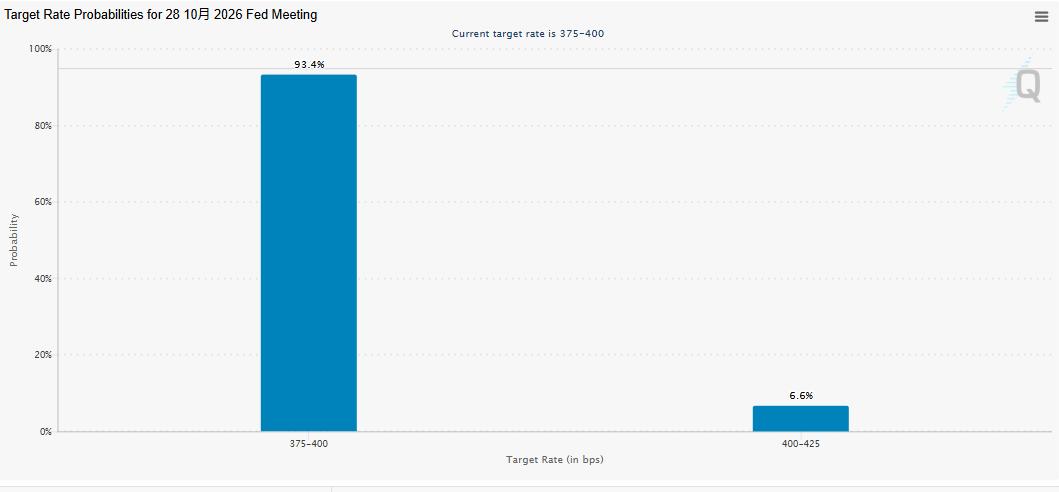
However, despite the near-zero possibility of an interest rate change this time, investors are expected to closely watch the clues on future interest rate actions released by policymakers, especially Fed Chairman Kevin Walsh.
Brett Ryan, senior U.S. economist at Deutsche Bank, said he will pay close attention to the signals Walsh sends on future policy moves.
Ryan wrote in a note to clients, "The Fed Chairman is likely to signal that recent inflation data reinforces the judgment at the September meeting that further policy tightening is still necessary later. But skipping the October rate hike will give officials more window period to assess the trend of data."
A "Pause" Amid Persistent Inflation
The latest U.S. inflation data shows almost no sign of easing price pressures — inflationary pressures since the start of the year continue to build up.
As a core reference indicator, the year-on-year increase of the U.S. September Consumer Price Index (CPI) reached 3.7%, driven mainly by skyrocketing energy prices. Even excluding the volatile food and energy costs, the year-on-year increase of core CPI still reached 2.6% — significantly higher than the Fed's 2% policy target, and rebounded by 0.3 percentage points from August, a trend clearly deviating from positive expectations.
But at the same time, the latest macro data confirms further pressure on the real estate market: mortgage rates above 7% have left the market in a difficult position. The job market is stuck in a stalemate of "no layoffs and no new hires" — the number of layoffs is at a historic low since the late 1960s, while unemployed people repeatedly face difficulties in finding jobs.
Under the current situation, Walsh advocates that the Fed adopt a more flexible policy — avoiding revealing the policy direction, but letting the market interpret signals on its own based on the latest data — which makes policy calibration more complicated.
Analysts pointed out that pausing rate hikes this month may give the Fed more time to assess the impact of previous rate hikes on the economy and financial conditions. Of course, if signals of further policy tightening in the future are released, it may still put greater pressure on the housing and labor markets. Walsh and his colleagues must show that they are ready to curb inflation, while avoiding prematurely committing to the magnitude or speed of rate hikes.
In essence, the Fed can curb inflation by adjusting interest rates, but at this critical juncture of assessing fundamentals, the central bank is most likely to choose to wait and see. As for the next step, the market and academia still hold divergent views with serious disagreements.
Potential Divergences Lurking Inside the FOMC
The Fed's September rate hike resolution was passed unanimously. But many Fed watchers expect that if the Fed stays put this month, two to three dissenting votes may still emerge among the 12 officials who have voting rights this year.
Among them, Cleveland Fed President Beth Hamak and Dallas Fed President Lori Logan are seen as the dissenters most likely to vote in favor of a rate hike.
Both officials have previously expressed deep concerns that the current level of the Fed's policy rate is not high enough to curb economic overheating and effectively bring down inflation.
Ironically, some economists point out that these potential dissenting votes are actually a shot in the arm for Walsh and the Fed — it confirms to the outside world that there is still a hardline force within the decision-making body that supports continued policy tightening.
At the last meeting in September, Walsh defied pressure from Trump and decided to raise interest rates. This move strongly countered previous market doubts — the outside world once worried that the new chairman would become the president's "puppet megaphone" as described by Massachusetts Senator Elizabeth Warren.
It should be noted that Trump publicly declared in January this year before nominating Walsh that the Fed chairman he picked must support interest rate cuts. James Knightley, chief international economist at ING, said that the September rate hike, which dared to go against the will of the White House, largely dispelled market concerns. "Judging from the current performance, I think market sentiment has been greatly boosted."
The Road Ahead Is Full of Uncertainties
Obviously, against the backdrop of little possibility of a rate hike tonight, industry insiders expect the biggest highlight of the Fed's resolution to be whether the Fed will reveal clues about the future path of interest rates.
According to CME's FedWatch tool, trading data from the federal funds futures market shows that the probability of the FOMC raising interest rates this week is about 7%, but the probability of a rate hike in December exceeds 80%. The market expects another rate hike in March 2027, followed by roughly a 50-50 chance of a final rate hike by the end of next year.
At present, there is still considerable controversy in the industry over whether the Fed should continue to tighten policy. For example, analysts at Citigroup believe that the easing of inflation data in the coming months will give the Fed reasons to keep interest rates unchanged, and may even start cutting interest rates next year, although the institution forecasts a rate hike in December this year.
Mohamed El-Erian, chief economic advisor at Allianz, said he expects the Fed to raise interest rates further, but this move could be a mistake as it will hurt vulnerable sectors such as housing and widen economic gaps.
"I think the market got half of it right: the Fed won't take action this time, but Walsh has to wrap this decision in very hawkish rhetoric because all inflation indicators are more stubborn than expected," El-Erian said in an interview on Monday, "My core concern is that this is completely the wrong prescription at the moment."
He added that the solution to concerns about inflation and rising Treasury yields should be "fiscal containment, not monetary tightening".
"But what we will end up with is still monetary tightening, which will trigger what I call the '1 minus X' dilemma: 'X' represents the technology industry — this type of asset is resilient and limited in impact;" El-Erian emphasized, "The rest of the real economy will bear the brunt of the shock — mortgage loans, auto installment payments and various consumer credits, these are the real areas under severe pressure."
Significant Implementation Risks
Krishna Guha, chief economist and head of central bank strategy at Evercore ISI, also pointed out that under such circumstances, the possibility of the Fed making mistakes is very high.
"Although Walsh claims he does not like to pander to investors, he is alert to market risks and should be able to show a calm and steady attitude," Guha said in a report on Monday. "But there are significant implementation risks."
For example, the Fed has not elaborated on how it assesses the risks facing its dual mandate of low inflation and full employment, as well as how it views the pace and intensity of monetary policy tightening, which poses major challenges.
The Fed is obviously in urgent need of weighing financial conditions when formulating policies now. The Chicago Fed's National Financial Conditions Index shows that since the September rate hike, financial conditions have tightened slightly due to factors such as stock market volatility.
Recent remarks by key Fed officials — such as Vice Chairman Jefferson and New York Fed President Williams — suggest that the possibility of raising interest rates every other meeting is high. But to what extent the Fed needs to raise interest rates is still unknown.
Guha interpreted Walsh's recent speech at the World Bank and International Monetary Fund in Bangkok as being consistent with the FOMC's "mainstream view". In effect, this means the Fed will advance policy at a "prudent and methodical baseline pace — i.e. raising interest rates once a quarter — while not ruling out adjusting the pace according to information obtained along the way, nor ruling out the magnitude of the final possible rate hike, nor the possibility that the pace of rate hikes may need to be accelerated at some point in the future."
"If inflation continues to exceed expectations and/or the momentum of economic growth does not slow down, the Fed will raise interest rates further," he added.
This article is from the WeChat official account "CLS.cn", author: Xiaoxiang, authorized for release by 36Kr.