Sweeping reshuffle of 9,700 stores: young people are stepping into the era of "purely focusing on practical down-to-earth daily life"
Service consumption has become the "ballast" that underpins current consumption growth and the "core engine" driving future consumption expansion.
Data from the National Bureau of Statistics for the first three quarters of this year shows that retail sales of services increased by 5.0% year on year, far outpacing the 1.0% growth in retail sales of goods. Behind these figures, the brand portfolio of benchmark shopping malls is undergoing a drastic transformation of "phasing out old players to make room for new ones".
According to Winshang Big Data, benchmark shopping malls in 12 cities saw a total of over 9,700 stores adjusted in the third quarter of this year, with a store opening-to-closing ratio of 1.10. The opening-to-closing ratios of all five major business formats are above 1, showing structural differentiation in expansion.
On the one hand, big brands that once occupied prime storefronts and the first generation of internet-famous stores that once drew massive foot traffic are collectively losing momentum; on the other hand, light outdoor, BM-style spicy girl outfits, stress-relief toys, cutting-edge tea drinks, fresh snacks, and omakase Japanese cuisine are rapidly expanding their footprint.
As young people who prioritize "down-to-earth daily living" no longer blindly worship brand personas, but place greater emphasis on real offline experiences, the tenant recruitment logic of shopping malls has been completely rewritten. In this article, we break down the brand "new launch" logic in the new business cycle through the data of over 9,700 opened and closed stores.
01.
Q3 Shopping Mall Renovation and Adjustment Map
New Stores on the Ground Floor and F2 Show Strong Momentum
In the third quarter, the sample benchmark shopping malls in 12 cities adjusted a total of over 9,700 stores (newly opened + newly closed). The average number of adjusted stores per project exceeds 35, and about 18% of the projects adjusted more than 50 stores, which is basically the same as the previous quarter. Typical projects include Shanghai Cloud Nine City Life Center, Longfor Hangzhou Binjiang Paradise Walk, Wuhan Wushang MALL, Longfor Chongqing Times Paradise Walk, Nanjing Golden Eagle World, etc.
F&B and experience store expansion is active in mid-range/mass-market shopping malls
Compared with the second quarter, mid-range/mass-market shopping malls showed greater resilience in the third quarter, with the opening-to-closing ratio rising to 1.16; high-end/mid-to-high-end shopping malls rebounded from the trough, with the opening-to-closing ratio recovering to 1.03.
By business format: Retail under pressure: The gap between the proportion of newly closed stores and newly opened stores has further widened, and the contraction is more significant in mid-range/mass-market shopping malls, which has become the main factor dragging down the overall performance; Catering continues to rise: It has become the main engine of incremental growth, and the expansion pace is more active in mid-range/mass-market shopping malls; Parent-child formats show differentiation: They expand against the trend in mid-range/mass-market shopping malls, while facing contraction in high-end/mid-to-high-end shopping malls; Culture, sports & entertainment and life services expand actively: Both sectors are more active in mid-range/mass-market shopping malls, reflecting the accelerated transformation of consumption towards experience and daily services.
Ground Floor and F2 lead strongly, upper floors face pressure
From the perspective of the store opening-to-closing ratio by floor, benchmark shopping malls in Q3 present a pattern of "ground floor and F2 expand, B1/B2 reshuffle, upper floors face pressure".
■ Floors with high proportion of new retail stores: F1~F3
The ground floor has an opening-to-closing ratio of 1.17, continuing to lead the market. The proportion of newly opened stores reaches 64.2%, but the proportion of newly closed stores is also high. Brands with strong rental capacity and high market influence are accelerating the replacement of outdated brands.
The F2 floor has an opening-to-closing ratio of 1.14 — the new "hinterland" for retail. Although there is some contraction, as the floor with the highest proportion of new retail stores, it carries the spillover momentum of ground floor retail, while enjoying lower rent than the ground floor and a stronger shopping atmosphere. The adjustment volume of catering and other experience formats on F2 is relatively small, with a low presence.
The F3 floor is shedding its exclusive "parent-child dedicated" label. Culture, sports & entertainment and life services are seizing the market here. The business format on this floor is transforming from traditional children's retail and amusement to experience-focused parent-child leisure and high-quality services.
■ Floors with high proportion of new catering stores: B1/B2, F4, F5
The B1/B2 floor has an opening-to-closing ratio of 1.10, maintaining a high adjustment volume. The catering sector is undergoing drastic reshuffling, with high elimination rates for casual dining and Chinese catering. Exotic-style catering, accessories, trendy digital products, and IP-themed stores are actively expanding, maintaining the youthful and trendy vitality of the underground commercial space.
On the F4 and F5 floors, the proportion of new catering stores fully exceeds that of retail stores. The F4 floor can still maintain slight expansion through effective supplementation of life services, culture, sports and entertainment; the F5 floor suffers severe retail loss, and even with the supplementation of catering and life services, it cannot fill the gap caused by massive retail store closures.
02.
Characteristics of Business Format Evolution in Shopping Malls
In the third quarter, among the over 9,700 adjusted stores, the opening-to-closing ratios of the five major business formats all remained above 1.0, showing an overall expansion trend. Among them, retail and parent-child formats rebounded from the trough, shifting from contraction in the previous quarter to upward growth; culture, sports & entertainment and life services saw a large number of new store openings, while the catering sector grew steadily.
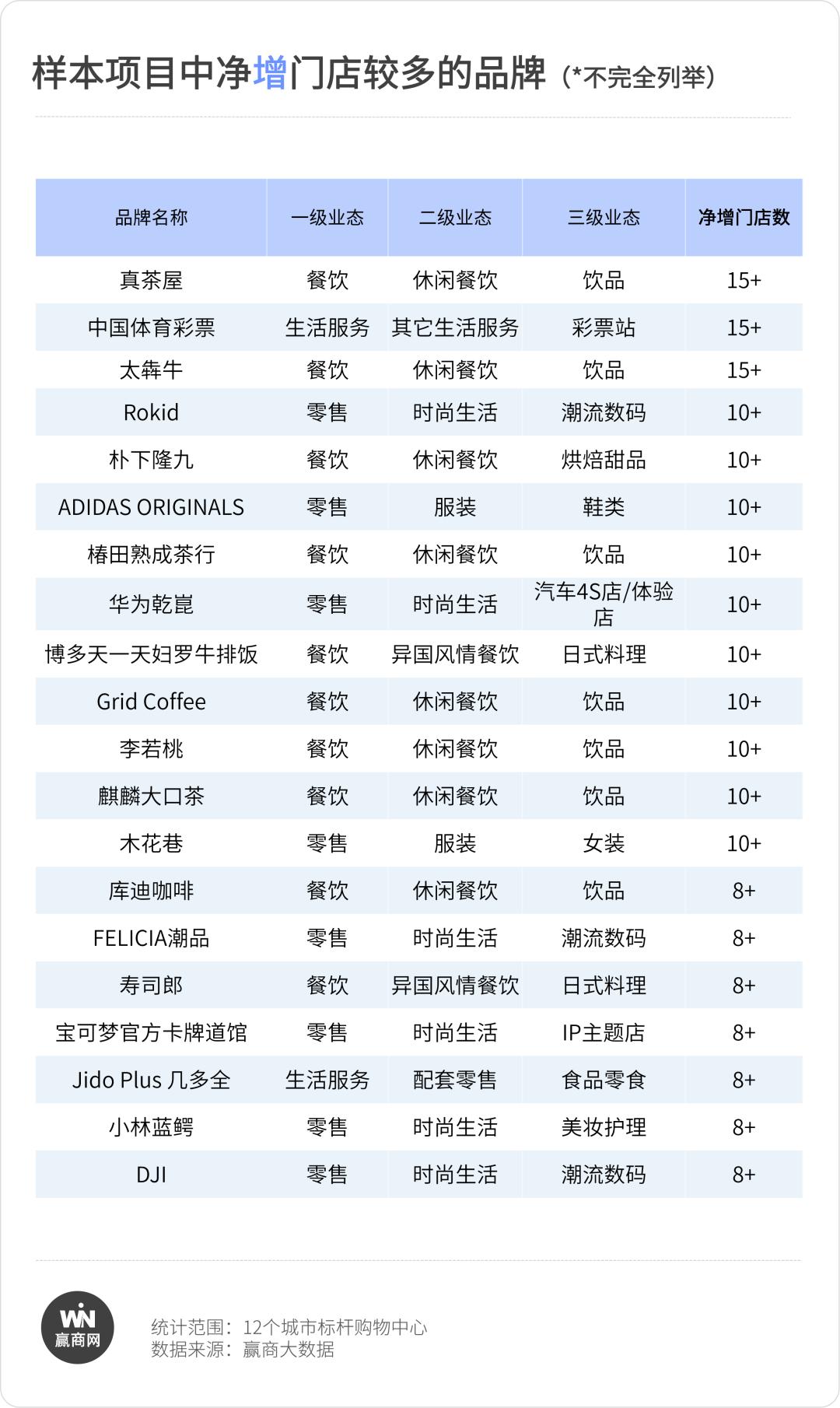
Brands with a large number of net new stores, such as Wuhan tea drink brand Zhen Chawu, Pokémon Official Card Gym, Jido Plus and other brands are emerging rapidly. Nanjing tea drink brand Taibanniu and emerging bakery brand Puxialongjiu continue to gain popularity; AR glasses brands Rokid, Huawei KUNLUN also delivered outstanding performance.
They reflect the current tenant recruitment preference of shopping malls. Cutting-edge tea drinks and bakeries, fresh snacks have become the "sharp weapon" for shopping malls to retain foot traffic and drive high-frequency consumption; IP-themed stores, lottery stations that can bring "small but definite happiness" and meet the fragmented stress relief needs of young people continue to be sought after. In the recession period of traditional retail, trendy digital products, new energy vehicles with strong rental capacity and high sense of experience have become the "hard currency" for shopping malls to fill vacant storefronts.
In contrast, among brands with a large number of net closed stores, New Balance leads the decline, and a large number of traditional sports brands are collectively contracting; well-known high-end catering brands such as Coucou Hotpot, Xibei, as well as internet-famous drink brands such as Blueglass and BONJOUR are also facing cold market response.
Shopping malls are "squeezing out the inflated bubble". By vacating the stores of brands that can no longer draw foot traffic and have lost their luster, they allocate high-quality storefronts to "new species" with stronger comprehensive operation capabilities and better alignment with current consumption trends, so as to revitalize the commercial space and enhance asset value.
Retail - Apparel: Rebound from the trough, emotion and style become the "growth engine"
In the third quarter, the number of newly opened and newly closed stores in the retail sector both exceeded 2200.
Nearly 1200 apparel stores were newly closed, while less than 1000 new apparel stores were opened. The opening-to-closing ratio stands at 0.85, but it has shown a rebound from the trough compared with the previous quarter. Most sub-categories continue the contraction trend, and the opening-to-closing ratios of all categories are below 1 except for apparel accessories and characteristic clothing; men's wear continues to underperform. Behind the overall market contraction, the internal evolution of categories is extremely drastic.
■ Sports apparel and footwear reshuffle, "pan-sports" trend recedes, professionalism and comfort take over
Former large-store mainstay brands such as New Balance, Under Armour, Champion, PUMA are contracting.
Light outdoor brands such as BENLAI, Fitness Pony, as well as professional outdoor brands including Outopia, Wilson, Pelliot, mont·bell continue to expand; Crocs, BIRKENSTOCK that focus on extreme foot feel and relaxed vibe, and NB1906 with American retro style, accurately target the fashion dressing needs of Citywalk, daily commuting, camping and cycling trends.
■ Women's wear "tired of old and fond of new" trend intensifies, design capability and cost-effectiveness compete at the same time
The light mature literary women's wear brand Muhua Alley opened more than 10 new stores in sample projects within the quarter. Brands that integrate street leisure and fashion workplace style RicoVea, brands that focus on French relaxed style Mardi Ladin, brands with artistic genes RE'VAN, new Chinese-style apparel brand YuLan that caters to the current national style boom, all opened several new stores, seizing the market with distinct styles.
Domestic "BM-style" brands such as W.Management, one moment, with large warehouse-style stores, sweet and spicy girl style, and pricing around 100 yuan, have overtaken Korean fast fashion brands represented by chuu.
At the same time, women's wear brands without obvious style labels, vague positioning and inflated pricing are accelerating their withdrawal from the market.
■ Selling "emotion" is better than selling "function", "non-standard" apparel expands strongly
WASAI LIVING, as a global color lifestyle collection store, uses interesting items such as socks, hats and clothes in high-saturation "dopamine color system" to create a highly "visit-worthy" stress-relief general store; muva. injects emotion into leather accessories, accurately "heals" young customers with smooth and rounded outline design and vintage colors. It not only frequently opens new stores in benchmark shopping malls in China, but has also successfully expanded to Southeast Asia.
Retail - Fashion Lifestyle: International big brands face sluggish sales, "affordable self-pleasure" categories become rigid demand
The fashion lifestyle sector has an opening-to-closing ratio of 1.23. Trendy digital products are expanding rapidly, with the opening-to-closing ratio rising to 2.46 from the previous quarter; beauty care, fashion accessories, gold and jewelry, IP-themed stores, outdoor products maintain expansion; auto 4S stores/experience stores, eyewear reverse the downward trend; while luxury goods, watches and clocks that used to rely on storytelling and selling premium prices rank at the bottom.
Consumers begin to reduce spending on illusory "brand personas", and instead spend money on more specific, cost-effective "small but definite happiness".
■ Beauty care: Big brands lose their luster, light-weight beauty improvement and scent therapy are favored
Young people enter the era of "down-to-earth daily life" and refuse to pay for brand premium. Beauty collection stores or international big brands such as SEPHORA, Watsons, Lancôme, as well as internet-famous brands such as Perfect Diary all saw store closures.
"Small but definite happiness" brands are rising, such as trendy wearable nail brand Xiaolin Blue Crocodile, which meets the demand for light-weight beauty improvement; fragrance brands such as Song Dynasty Aroma, Turtle Treasure Fragrance House use "scent therapy" to comfort urban residents.
■ Fashion accessories: Breakthrough by niche personality and pragmatic affordability
Young people are willing to pay for "niche resonance and personal expression". Traditional light luxury jewelry faces cold market response, apm monaco, Pandora continue to close stores in the Chinese market, while local subculture brand BLACKHEAD expands against the trend. It recently completed Series A financing, with revenue exceeding 150 million yuan in the first 8 months of this year, store performance increased by 15% year on year, and overall scale increased by about 60%.
The globally popular American fashion hair accessory brand TELETIES focuses on high-looking telephone line hair ties, shark clips and other products, with most items priced between 60~80 yuan. Its first China store opened in Beijing China World Mall; MAREIS advocates "achieving jewelry freedom with three-digit price", meeting consumers' pragmatic demand for accessories.
■ Gifts & toys, IP-themed stores: Spend small money to get great stress relief
Trendy toys, trading cards and IP peripheral products have become the "social hard currency" for young people. This type of business format with low unit price and high emotional value is becoming the "king of per-unit area efficiency" for shopping malls to attract young foot traffic.
Local trendy toy collection stores such as Haoyun Liande under Damai Entertainment, and MITAKI founded by the daughter of the founder of Seazen Holdings are accelerating store expansion, attracting fans with frequently updated blind boxes and cultural and creative products.
Pokémon Official Card Gym has become a social space for young people through card battles and community operation; Sanrio continues to harvest the "cute economy" with evergreen IP; stress-relief toy Tangle sold over 1 million units within less than one year of entering the Chinese market; Fuggler provides alternative healing feeling with its "ugly-cute and quirky" image.
Catering: Overall expansion, sub-sectors show starkly different performance
In the third quarter, the catering sector opened more than 1600 new stores. Except for hot pot/ braised pot/ dry pot, the opening-to-closing ratios of all sub-catering formats exceeded 1.
Casual dining: Drinks expand, bakery and desserts shrink slightly, casual snacks shrink significantly. Chinese catering: Gan cuisine, Yunnan-Guizhou cuisine, seafood (river seafood), fashion fusion cuisine draw high attention, Northwest cuisine shrinks sharply, Sichuan cuisine, Jiangzhe cuisine decline slightly; Chinese fast casual catering remains flat.
Exotic-style catering: Increased sharply compared with the previous quarter, the opening-to-closing ratio of Japanese cuisine is higher than 2, other exotic cuisines generally shrink. Hot pot/ braised pot/ dry pot: Differentiation is obvious, net new stores are concentrated in small hot pot, braised pot/ dry pot, while characteristic hot pot, Sichuan-style hot pot, Cantonese-style hot pot all decline. Barbecue/ teppanyaki: Continue to expand rapidly, affordable self-service "beautiful barbecue" brands are sought after.
■ Casual dining: Characteristic dark horses rise strongly, "infl