Limit up, the earnings are incredibly strong.
In the morning trading of October 28, Jinguo Anji opened with a full one-word limit-up, closing at 58.59 yuan with an increase of 10.01%.
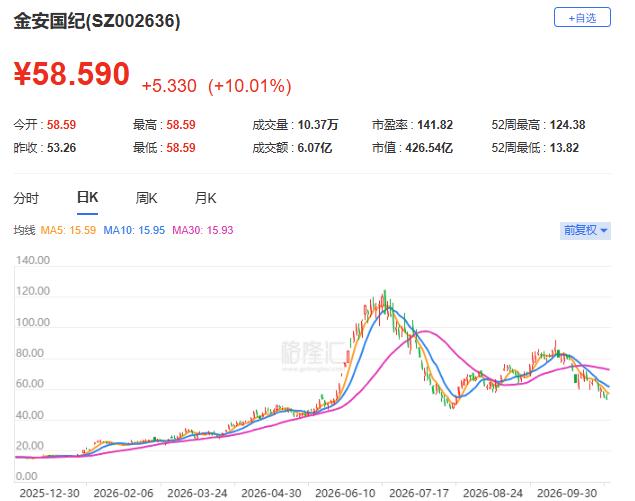
(Stock price trend of Jinguo Anji; Gelonghui)
Over 200,000 pending buy orders piled up at the limit-up board, the trading volume reached 598 million yuan in the first hour after opening, with a turnover rate of 1.41%, and the total market value exceeded the 42.6 billion yuan mark.
In the past year, this stock has recorded a total of 22 limit-ups.
Driven by the leading stock, the PCB industry chain has shown a collective upward trend. Nanya New Material surged 6.68% to close at 226.44 yuan, Shanghai Electric Power Co., Ltd. rose 4.61% to 103.77 yuan, Shengyi Technology rose 4.29% to 101.80 yuan, Dongcai Technology surged 8.12%, and Shenghong Technology rose 3.00%.
The overall market was also boosted, with the Shanghai Composite Index closing at 3667.34 points, up 0.52%. There were 1815 rising stocks in the whole market, and the number of falling stocks dropped to 439.
The direct reason for the strong pursuit of market capital is the impressive Q3 financial report disclosed by the company after the market closed on October 27.
Data shows that Jinguo Anji achieved operating revenue of 6.543 billion yuan in the first three quarters, a year-on-year increase of 101.25%; net profit attributable to shareholders was 1.924 billion yuan, a year-on-year increase of 1012.67%; non-recurring profit and loss adjusted net profit attributable to shareholders was 1.933 billion yuan, a year-on-year increase of 1179.19%, with earnings per share of 2.643 yuan.
The performance of a single quarter is particularly outstanding. In the third quarter, the company achieved operating revenue of 3.145 billion yuan, a year-on-year increase of 161.88%; net profit attributable to shareholders reached 1.158 billion yuan, a year-on-year increase of 1030.57%. Compared with the company's total net profit of 301 million yuan in 2025, the profit of the third quarter alone has reached 3.85 times of the total profit of last year.
At the same time, the adjusted net profit after non-recurring gains and losses (1.933 billion yuan) is slightly higher than the net profit attributable to shareholders (1.924 billion yuan), indicating that this round of performance explosion is completely driven by the strong main business.
Observing the quarterly evolution curve of earnings, the company achieved a net profit of 202 million yuan in the first quarter, rose to 564 million yuan in the second quarter, and jumped to 1.158 billion yuan in the third quarter, with a quarter-on-quarter growth of 179% and 105% respectively, showing extremely strong development momentum.
However, this also means that the company's performance base in the fourth quarter has been greatly raised from 128 million yuan in the same period of last year to a high level of 1.158 billion yuan.
The revenue doubled while the profit increased tenfold, and the core source of this performance elasticity lies in the sharp rise of product prices.
In the first three quarters, the company's comprehensive gross profit margin was as high as 41.69%, a sharp increase of 27.51 percentage points compared with 14.18% for the whole year of 2025.
In the typical cyclical industry of Copper Clad Laminate (CCL), simply doubling the production and sales volume is difficult to squeeze out ten times the profit space. Only a sharp rise in product unit price can catalyze such huge profit elasticity.
The price increase of upstream core raw materials constitutes the starting point of this round of price transmission. Taking the 7628 model electronic fabric as an example, its price has skyrocketed from 3.9 yuan per meter in September 2025 to the current 13.5 yuan to 14 yuan per meter, with a cumulative increase of more than twice. The price of G75 model electronic yarn increased by another 3000 yuan per ton this month, and the unit price of 2116 and 1080 model thin fabrics was raised by 2.5 yuan per meter.
Among the three core raw materials (copper foil, electronic fabric, resin) that account for about 80% of the total cost of copper clad laminates, the price of electronic fabric has risen the most drastically.
Even if the cost of raw materials rises sharply, CCL enterprises still have extremely strong smooth transmission capacity. The fundamental reason is that downstream PCB manufacturers are also facing a serious shortage pattern.
Panasonic raised the price of copper clad laminates from September 1, with some high-end products increasing by 30%; Kingboard Laminates issued the eighth round of price increase notice this year on October 13, uniformly raising the price of plates and prepregs using 2116 and thinner fabrics as substrates by 15%. This round of industry shortage is mainly concentrated in the thin high-end material end, and the price increase of general thick plates is relatively moderate.
The research report of CICC points out that this round of price increase tide is driven by three factors: rigid constraints on the cost side, shortage of production capacity on the supply side, and expansion of AI computing power demand, so the price increase dividend can be smoothly transmitted to the middle and lower reaches of the PCB industry.
The performance elasticity of different enterprises in the price increase cycle depends on their initial base and product structure.
The gross profit margin of Jinguo Anji's CCL business in 2025 was only 11.75%. Due to the low initial base, the same price increase brought several times of performance amplification effect to the profit end.
In contrast, Shengyi Technology, the leading enterprise in the industry, achieved revenue of 12.357 billion yuan from CCL and adhesive sheet business in the first half of 2026, and its gross profit margin has remained at a high level of 29.16%. Under the high base, its marginal elasticity is relatively limited.
The positioning of the two companies is also different. As the world's second largest rigid CCL manufacturer (with a market share of 13.5% in 2025), Shengyi Technology has a more high-end customer structure; Jinguo Anji's CCL revenue in the first half of the year was 3.289 billion yuan, accounting for 96.76% of the operating revenue, and its product line mainly covers general-purpose FR-4, halogen-free and high-TG series.
At present, Jinguo Anji's two major production bases in Hangzhou and Ningguo are operating at full capacity, and are accelerating the upgrading to high-frequency and high-speed products. Since the revenue of the company's pharmaceutical and medical device segments accounts for less than 3%, almost all the profit dividends of this round of industry boom cycle are deposited in the main CCL business.
Both upstream and downstream targets in the industrial chain show strong performance realization ability. Nanya New Material achieved a net profit of 990 million yuan in the third quarter, a year-on-year increase of 1296%, and its stock price rose 6.68% on the same day; Shanghai Dian Gong's net profit in the first three quarters increased by 106.87% year-on-year, rising 4.61% on the same day; Ultrasonic Electronics' net profit in the third quarter reached 239 million yuan, a year-on-year increase of 276.24%, with an increase of nearly 4% on the same day.
However, from the cumulative trend of the secondary market, the valuation digestion process has already started. The CCL sector index fell rapidly from 1171.84 points on September 30 to 865.72 points on October 27, with a pullback of 26.1% in less than a month.
Although it rebounded to 918.62 points today, the cumulative decline this month still reached 21.61%. In the same period, the electronic fabric sector fell by 21.04%, and the overall electronic sector fell by 18.32%, making CCL the sub-sector with the deepest pullback in this round of adjustment.
In terms of valuation, Jinguo Anji's total market value of 42.6 billion yuan corresponds to the net profit of 1.924 billion yuan in the first three quarters, and the annualized P/E ratio drops to 16.6 times, which is at a low quantile among similar targets in the industrial chain.
Looking back at the stage of the 2025 annual report disclosure, the P/E ratio of Jinguo Anji calculated at the stock price at that time was as high as 112 times. It only took one year, and under the situation of similar stock prices, its P/E ratio has converged to 16.6 times, and the 85% valuation compression has been fully filled by the outstanding profit explosion.
In cyclical industries, this sharp convergence of valuation indicators often occurs at the stage when the profit slope of enterprises is the steepest.
However, the record low P/E ratio of cyclical stocks is usually accompanied by the risk of peaking the single-quarter profit of enterprises. Jinguo Anji's net profit of 1.158 billion yuan in the third quarter corresponds to the operating revenue of 3.145 billion yuan, and the single-quarter net profit margin is as high as 36.8%.
In the physical manufacturing industry, such a high net profit margin may be difficult to maintain for a long time. Once the product price stops rising and falls in the future, the profit denominator will face the pressure of mean reversion.
From the perspective of capital expenditure and long-term supply, 17 listed companies in the PCB industry have disclosed or completed private placement plans this year, with a total financing scale of about 32.996 billion yuan. The funds are mainly invested in cutting-edge fields such as high-order HDI, high multi-layer boards and optical module substrates. The financial impact of the capacity released by this batch of capital injected by the capital market will gradually appear in the next two years.
Jinguo Anji once launched a 1.3 billion yuan private placement plan in November 2025, which is used to build a high-grade CCL production capacity with an annual output of 40 million square meters, clearly targeting high-frequency and high-speed materials required for AI servers. The capacity release time of this project is expected to be around 2027.
The current supply and demand shortage in the industry is mainly reflected in insufficient supply of high-end production capacity. After the new production lines are put into operation in a centralized manner in the future, the price elasticity of general-purpose plates will face the risk of fading first. At that time, only through the customer certification barrier of high-frequency and high-speed products can gross profit be maintained. A considerable part of the cash flow accumulated in this round of price increase cycle still needs to be re-invested in the capital expenditure of high-end equipment.
For the medium and long-term demand capacity of the industry, institutions generally give optimistic expectations.
Goldman Sachs predicts that by 2028, the global market size of AI server PCB and CCL will reach 84 billion U.S. dollars and 48 billion U.S. dollars respectively. According to Prismark's statistics, the global PCB output value in 2025 is 85.8 billion U.S. dollars, and it is expected to break through the 100 billion U.S. dollar mark in 2026. Omdia's forecast is more aggressive, predicting that the year-on-year growth of semiconductor revenue in the computing and data storage fields in 2026 will exceed 150%, and the overall scale will approach 1 trillion U.S. dollars.
Jinguo Anji's performance trajectory maps the evolution of cyclical forces: the company lost 79 million yuan in 2023, turned around to make a profit of 37 million yuan in 2024, rose to 301 million yuan in 2025, and exploded to 1.924 billion yuan in the first three quarters of this year.
From loss to a profit volume of 2 billion yuan in three years, its huge span benefits from the dividend of this round of product price increase cycle, and will also be subject to the objective law of subsequent industry cycle fluctuations.
The market's pursuit of the one-word limit-up board today is not only the pricing confirmation of the better-than-expected Q3 report, but also the bet on the sustainability of high profits in the fourth quarter.
Whether the single-quarter net profit margin as high as 36.8% can be smoothly maintained until next year will ultimately depend on whether the downstream CCL price increase can continue to be implemented and fulfilled in the supply-demand game.
This article is from the WeChat official account "Gelonghui APP" (ID: hkguruclub), author: Gejila, authorized by 36Kr for release.