Anthropic, the "King of AI", works for the likes of Elon Musk and Jensen Huang.
In Anthropic's prospectus, US-listed tech giants are likely the biggest winners.
In the risk warning section, Anthropic mentioned the "take-or-pay" model for cooperation with giants, which refers to an agreed minimum payment amount regardless of actual usage.
The prospectus mentions a total of approximately 6.37 trillion US dollars in computing power commitments, among which Broadcom, SpaceX, Google and Amazon each have commitments reaching hundreds of billions of US dollars.
By July this year, Anthropic's ARR (Annual Recurring Revenue) was only 65 billion US dollars, one order of magnitude lower than the total commitment. In essence, Anthropic has given all its revenue for the next few years to tech giants.
The so-called king of AI is still working for the giants at this stage.
Optimal Valuation Window
This is a very favorable listing window for Anthropic, which is mainly reflected in three aspects.
First, Anthropic is in a stage of rapid expansion, and its current growth rate is the most attractive to investors.
According to the prospectus, Anthropic's revenue rose from 41 million US dollars in 2023 to 45.85 billion US dollars in 2025. In the first half of this year, Anthropic's revenue reached 162.86 billion US dollars, a year-on-year increase of 13 times. Despite the seemingly rapid growth, the performance in the third quarter is still outstanding. Calculated based on the information mentioned in the prospectus, the revenue in the third quarter is about 165 billion US dollars, which has exceeded the revenue of the first half of the year, and the year-on-year growth rate still reaches 10 times.
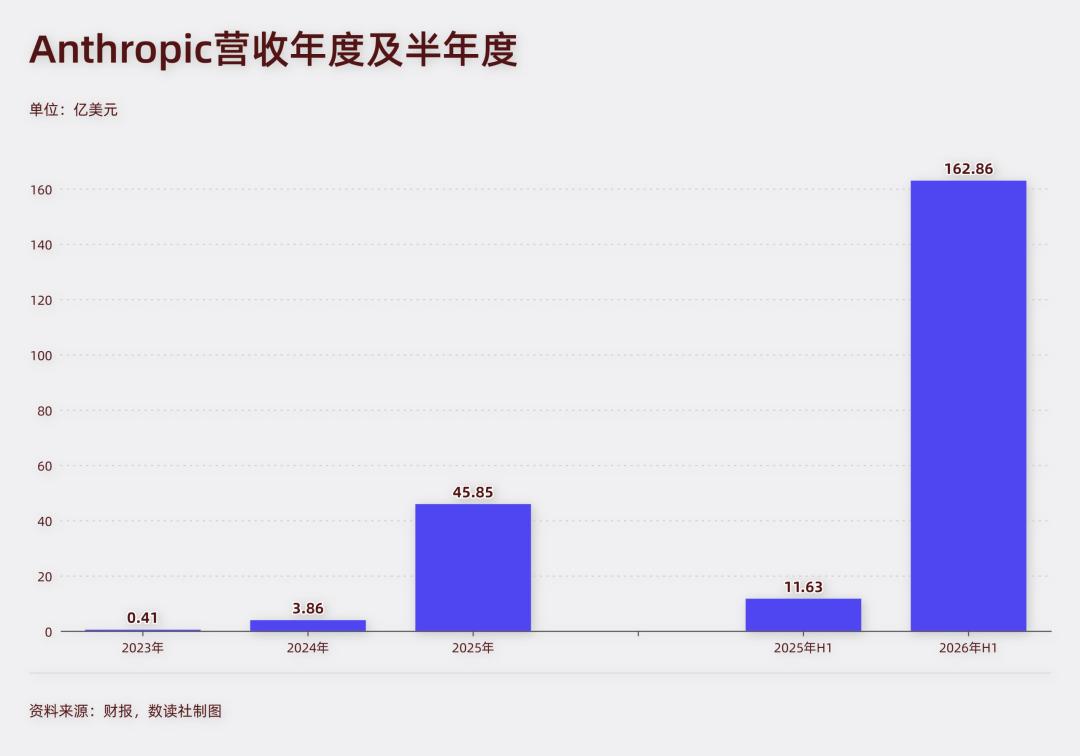
The details shown by ARR also cross-verify this conclusion. At the beginning of 2025, Anthropic's ARR was only 10 billion US dollars. By April this year, it had exceeded 300 billion US dollars. According to media reports, it reached 650 billion US dollars at the end of July, and this growth rate is probably rare in human history.
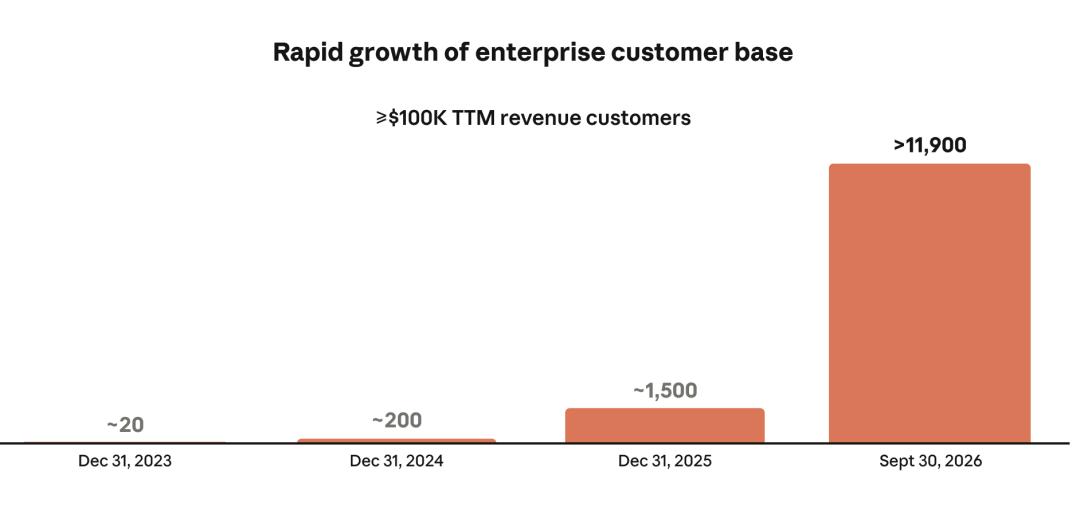
Second, Anthropic is still the most user-recognized company in the AI world, which can be reflected in user data. Anthropic counts customers based on the TTM (trailing 12 months revenue) caliber, and divides customers into groups of under 100,000, over 100,000, over 1 million and over 10 million.
As of September 30, the number of customers contributing over 100,000 US dollars reached 11,900, an increase of 10,400 in three quarters. The number of customers contributing over 10 million US dollars has reached 250, and the number of customers contributing less than 100,000 US dollars has reached 40 million.
How arbitrary is Anthropic to its customers? The prospectus mentions that part of its revenue comes from "customers who have violated the usage policy or commercial terms", that is, customers whose accounts have been banned. Even if these customers have recharged money, refunds may not be issued. Many users in Chinese mainland may have perceived this and even complained about it. But even so, many customers still cannot do without Anthropic.
The core reason is that Anthropic's technical capability is still leading, which is also an important "selling point" for Anthropic's current listing.
Finally, Anthropic has proved at this stage that its technological leadership can support a viable business story. In the first half of this year, Anthropic's net loss was 807.48 billion US dollars, but this was mainly determined by financing. The loss from convertible bonds, derivative liabilities and fair value changes accounted for 723.88 billion US dollars, and the actual operating loss was only 693 million US dollars.
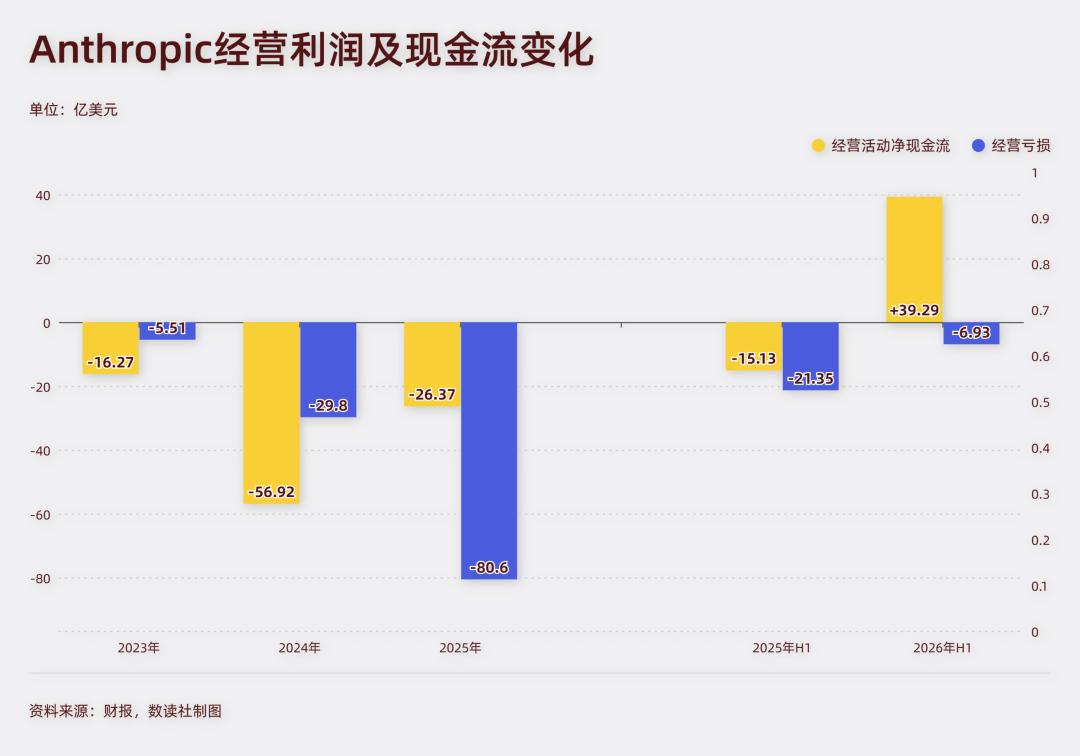
Calculated by the operating profit caliber, Anthropic recorded 9.74 billion US dollars in operating profit in the second quarter, achieving positive operating profit in a single quarter for the first time. In the first half of the year, the net cash flow from operating activities was 39.29 billion US dollars, realizing positive cash flow, which means the large model business model has strong profitability.
Listing at this timing can help Anthropic get a favorable valuation. It has high user recognition and strong willingness to pay, and strong market bargaining power. It is in a stage of rapid expansion with a very impressive high growth rate. At the same time, it has demonstrated to the capital market the sustainability of its business model: it is only in the investment stage for the time being, and the business model is proven to be feasible.
Hidden Worries of the "AI King"
It would be even better if it could catch up with the listing window of SpaceX. When the latter went public in June this year, driven by the promising AI prospects it presented, its valuation once soared to 1.77 trillion US dollars.
Now, according to Reuters, some investors who attended Anthropic's Investor Day have lowered their expectations for the IPO valuation, from the previous 2 trillion US dollars to about 1.5 trillion US dollars. The core reason is that the company's sequential revenue growth rate has slowed down. According to previous calculations, Anthropic's sequential growth rate in the third quarter has dropped to about 43%.
The current timing is probably already the best opportunity, otherwise it will have to wait for a longer time, face more uncertainties, and the situation may even get worse.
The AI world is changing very rapidly. Before Anthropic, OpenAI was the leader of this market. The latter created the ChatGPT milestone and maintained leading model capabilities for a long time. In 2021, seven former OpenAI employees left to start their own business and founded Anthropic. In just five years, it has surpassed OpenAI.
It is an all-round surpass: in May, Anthropic's valuation reached 965 billion US dollars, surpassing OpenAI; in July, its ARR surpassed OpenAI.
However, Anthropic's leading edge is also shrinking. Data in October shows that the performance gap between top AI models from China and the United States has narrowed to about 3%, hitting a new low. Large models developed in China are continuously catching up.
On the AI model evaluation platform LiveBench, DeepSeek V4.1 Flash ranks sixth in the world. Its overall performance is already comparable to the leading models of Anthropic and OpenAI. The Kimi K3.1 Pro launched by Moonshot AI has performance close to Opus 5.5.
Chinese models have lower costs and higher cost-effectiveness, which may bring impact to Anthropic in both the technical capability and commercialization tracks. More critically, Chinese models are more open and will not be subject to global export control like Fable 5.
Perhaps at some point in the future, Anthropic will no longer hold the leading position, and its commercial monetization will face huge impact. In addition, with the rapid growth, the base will become larger and larger, and the slowdown of growth rate is inevitable. The valuation in the future will probably be lower than that at present.
To avoid this situation as much as possible, Anthropic has taken countermeasures.
Anthropic has cut prices to a certain extent, especially for small models. In October, it released Claude Haiku 5.5, its smallest and most cost-effective model. The unit prices for input and output were significantly reduced compared with the previous generation. The standard input price was reduced to $0.10 per million tokens, and the output price was reduced to $0.50 per million tokens, with a unit price reduction of about 90%.
The flagship models also have price cuts, but the intensity is very small. For example, in September, Anthropic released Fable 5.1, priced at $10 / $50 / $0.25 (input / output / cache read, per million tokens, the same below). It is the same as Fable 5 released in June, but Fable 5.1 reduces the cost of typical workloads by about 25% compared with Fable 5, and the savings for complex coding and high-intensity agentic tasks can reach up to 45%, which also reduces the usage cost of the model.
Before submitting the prospectus, Anthropic released Claude Opus 5.5, priced at $4 / $20 / $0.20. Combined with the improvement of model efficiency, the cost of a single task is about 40% lower than that of Opus 5.
However, such prices still have a huge gap with domestic large models in China. For example, the newly released DeepSeek Flash V4.1 1017 charges $0.15 per million tokens for input, $0.60 for output, and $0.003 for cache read. Compared with Anthropic, its price is almost extremely low. Kimi K3.1 Pro charges $2 for input, $10 for output, and $0.20 for cache read, and its input and output prices are only half of those of Opus 5.5.
Anthropic's price cut is very reserved, and its price is still much higher than that of Chinese large models. This is determined by cost and business logic. Even if more than 90% of new contributions to Anthropic's codebase in September were written by Claude, the cost can be reduced, but its price is unlikely to reach the extremely low level of Chinese models.
Therefore, Anthropic will not have a price advantage for a very long period of time.
To maintain its global leading position, there is only one way left — technological leadership.
Intricate Capital Maneuvers
The premise of technological leadership is guaranteed computing power. Anthropic has become a big spender for giants including Broadcom, SpaceX, Google, Amazon and Microsoft.
SpaceX's third-quarter report shows that its AI business revenue reached 75.6 billion US dollars, a year-on-year increase of 830%, surpassing launch and communication businesses to become its largest business. SpaceX has not mentioned many of its clients, and Anthropic is the only one mentioned and also its largest external client.
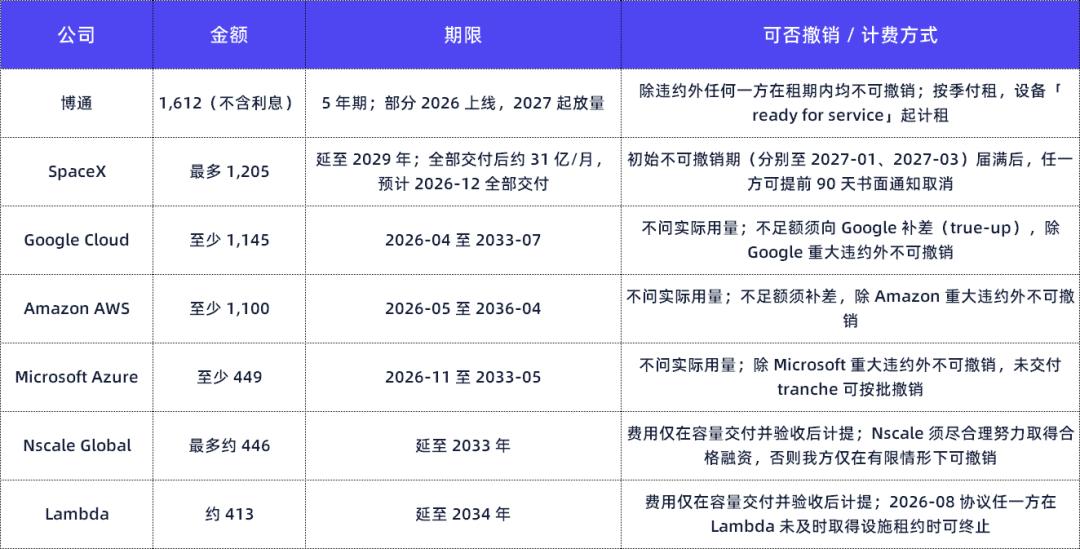
In the prospectus, Anthropic mainly mentions 7 companies. Among them, Broadcom is the largest procurement source, and the two parties have signed a five-year master equipment financial lease with a rent of about 161.2 billion US dollars, paid on a quarterly basis.
The total procurement amount for SpaceX is up to 120.5 billion US dollars, with cooperation lasting until 2029, and the orders before 2027 are irrevocable. After the deadline, either party can cancel the cooperation with a 90-day notice. This is regarded as the cooperation with the most flexible exit terms.
Google's computing power service is as high as 114.5 billion US dollars, which is a typical no-fixed-usage commitment with top-up for insufficient usage, and it is irrevocable except in case of Google's major breach of contract. Moreover, Anthropic also promised to make additional TPU procurement of 125-150 billion US dollars from 2028 to 2031.
Amazon's computing power service amounts to 110 billion US dollars. Like Google, it follows the no-fixed-usage rule with top-up for insufficient usage, and cannot be revoked except in case of major breach of contract. Microsoft's computing power service commitment is 44.9 billion US dollars, which is no-fixed-usage and partially revocable.
Just from these few giants, Anthropic has promised a maximum procurement of more than 500 billion US dollars. Even calculated by an ARR of 100 billion US dollars, Anthropic has basically handed over all its revenue for the next 5 years to the giants, which can almost be described as working for the giants.
However, Anthropic does not have sufficient funds. As of the end of the first half of the year, Anthropic's cash and equivalents were 112.4 billion US dollars, and short-term investments were 19.3 billion US dollars, far from enough to cover the huge procurement orders.
Therefore, Anthropic can only solve this problem through financing means.
The most typical one is NPA (Note Purchase Agreement), which in short means that relevant funds can be drawn conditionally through financing. For example, the NPA with Google sets TTM revenue targets. The cooperation with Broadcom puts forward requirements for revenue growth rate. Amazon's 15 billion US dollar NPA is unlocked according to the delivered computing power: Anthropic can withdraw corresponding funds only when Amazon AWS delivers a certain amount of computing power.
The second financing method is convertible bonds, mainly the 6.2 billion US dollar convertible bond related to Amazon, whose conversion price is the lower of the fixed price and the IPO price.
To avoid its control being divided up by giants, Anthropic has adopted 5 types of equity structures. The publicly issued Class A shares carry economic rights. The founder team holds Class F shares, which have no economic rights but own 50.1% of the voting rights for general voting matters. The conversion channel corresponds to Class N shares, employee incentives correspond to Class E shares, and Class T shares hold the right to elect and remove board members.
It can be seen that the seven founders hold the decision-making power of the company, while external tech giants are not listed as shareholders, and there will be shareholding caps for them in the future.
Through methods such as financing, conditional unlocking, and different rights for different share classes, Anthropic maintains its computing power supply as much as possible, which actually makes the entire AI industry face the doubt of being trapped in "self-entertainment".
Looking through all these capital-level arrangements, the real value of Anthropic still lies in its customer count and ARR indicators.
Judging only from these indicators, Anthropic is a phenomenal company in a stage of rapid expansion. What makes it special is that it is in the AI industry, an industry that may determine the future direction of humanity, and Anthropic is the king of this industry. But the leading edge of this king is not eternal. At this stage, it may instead be the best timing for its listing.
This article is from the WeChat official account "Shudu She", written by Lu Su, and published with authorization from 36Kr.