Profits have surged sevenfold, and SK Hynix has earmarked 100 trillion won for shareholder returns.
The super cycle of memory chips is lifting SK Hynix to an unprecedented height.
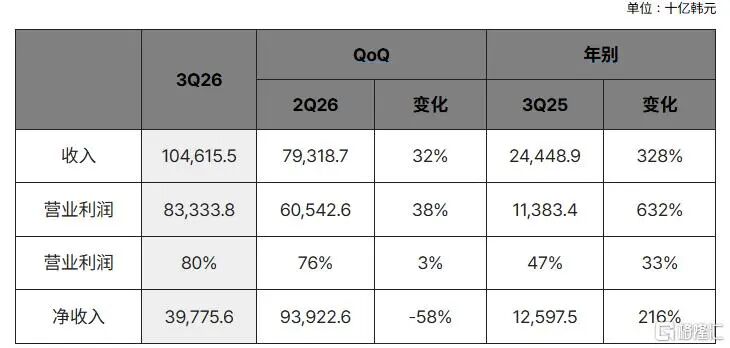
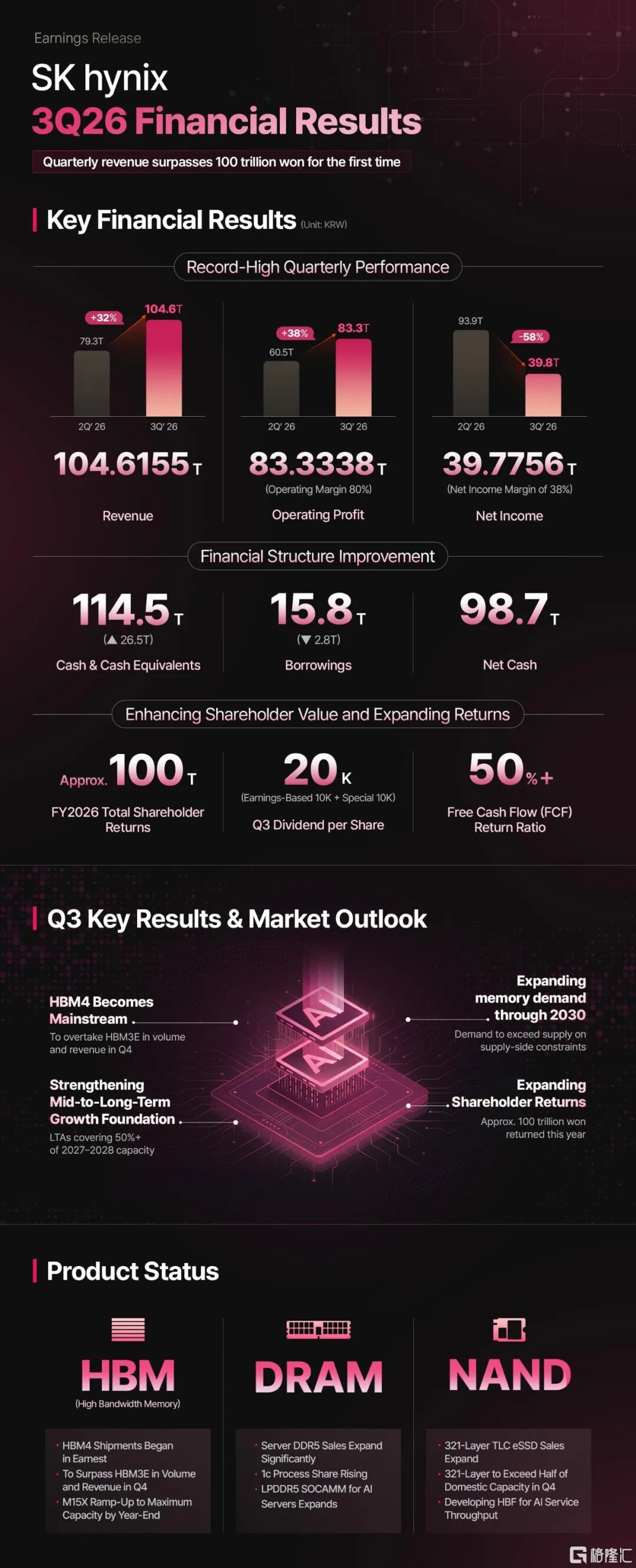
On Wednesday, SK Hynix announced that the company's revenue in the third quarter reached 104.62 trillion won, marking the first time in history that its quarterly revenue has exceeded the 100 trillion won threshold; its operating profit hit 83.33 trillion won, surging sevenfold year on year, and both indicators outperformed market expectations.
However, the net profit came as an unexpected downside surprise, recording only 39.53 trillion won, far below the expected 60.73 trillion won, making it the biggest unexpected variable this quarter.
The company also announced that it will return approximately 100 trillion won (about 75 billion US dollars) to shareholders in fiscal year 2026, with an unprecedentedly large scale.
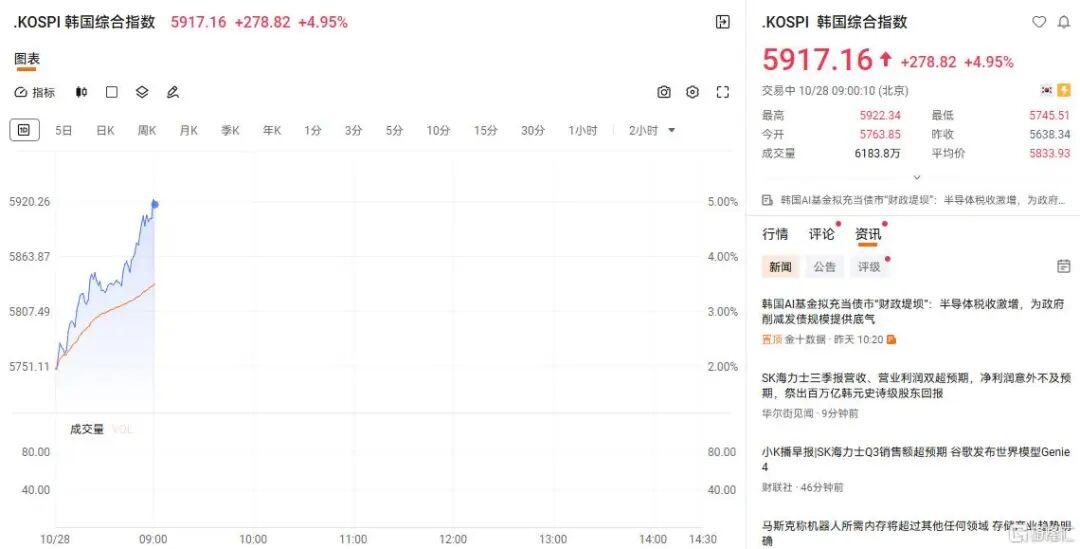
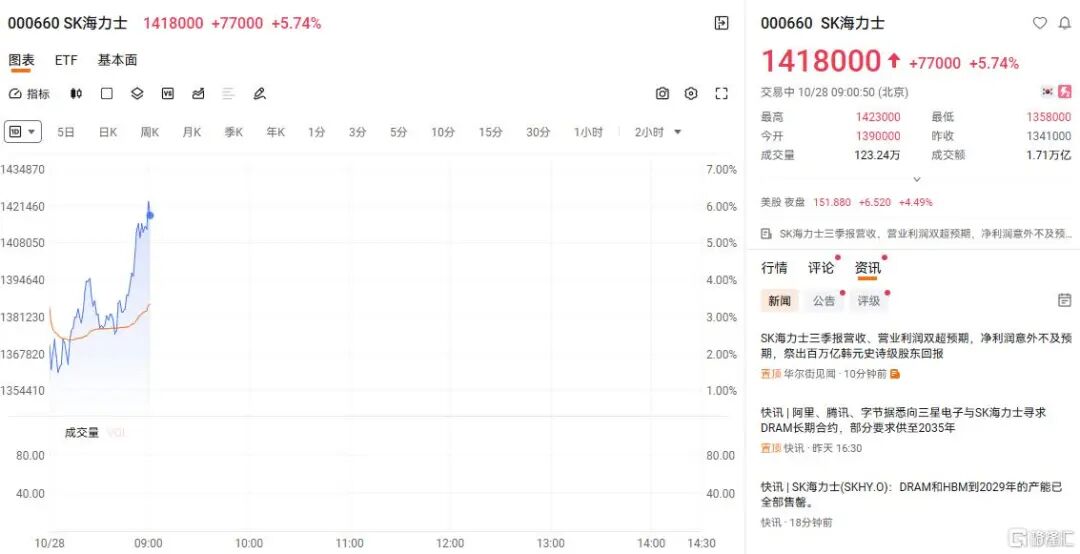
After the financial report was released, South Korea's KOSPI index rose nearly 5%, currently trading at 5917.16 points. Among them, both SK Hynix and Samsung Electronics rose by more than 5%.
During intraday trading, the Korea Exchange activated the SIDECAR mechanism to suspend programmatic buy orders for the KOSPI.
Mixed Q3 Financial Results
Purely judging from the figures, this quarter is almost impeccable.
Revenue increased by 32% quarter on quarter, operating profit rose by 38% quarter on quarter, and the operating profit margin reached as high as 80%, hitting a record high in history.
Compared with global tech giants, its single-quarter operating profit is second only to Samsung Electronics and NVIDIA.
The driving forces come from all sides: HBM4 has fully launched mass shipment, server DDR5 sales have increased significantly, 321-layer TLC enterprise-level solid-state drives continue to see volume growth, and high value-added products for data centers are booming across the board.
The company stated directly that the continuous expansion of AI infrastructure investment has pushed up the price and demand for high-performance products, allowing the company to refresh the record set just last quarter.
It is worth noting that the main driver of this round of profit surge is not HBM, but DRAM and NAND.
The company disclosed that the average DRAM price in the third quarter rose by as much as 20% quarter on quarter, and the average NAND price rose by a mid-20% range quarter on quarter.
MS Hwang, Research Director at Counterpoint Research, pointed out that while HBM prices are certainly on the rise, the explosive profit growth this quarter is mainly attributed to the rapid price hikes of traditional DRAM and NAND.
According to Macquarie's calculations, memory currently accounts for about one-third of the total expenditure of AI data centers, and this proportion will continue to climb as HBM prices are expected to more than double by 2027.
As for why the net profit "underperformed expectations", the answer lies more in the accounting dimension rather than the operational dimension.
In the second quarter, the company recorded approximately 63 trillion won in gains from the sale and valuation of investment assets, pushing net profit to 93.92 trillion won; this one-off gain faded in the third quarter, coupled with non-operational items such as taxation and exchange rates, the net profit fell to 39.78 trillion won.
Total 2026 Shareholder Return Scale Reaches Approximately 100 Trillion Won
Looking ahead, the management's optimism is almost unreserved.
SK Hynix pointed out that the virtuous cycle formed by AI-driven productivity improvement and new revenue in fields such as software development, customer service and search will boost AI adoption, which in turn drives the growth of infrastructure investment.
Based on this, the company reaffirmed that the pattern of insufficient storage supply will continue until 2030.
On the demand side, the company expects DRAM market demand to grow by a mid-20% range year on year in 2027, and NAND growth rate to be in the high double-digit range.
On the production capacity side, the M15X factory will reach full capacity by the end of the year. In the fourth quarter, both shipment volume and revenue of HBM4 will exceed those of HBM3E, making it the official main product; the proportion of 321-layer NAND process in South Korea's local production capacity will also rise to more than half.
More critically, the company has signed long-term supply agreements with 14 core customers including leading global cloud vendors, locking in more than half of its production capacity from 2027 to 2028, and the agreements embed market-based adjustment mechanisms within the agreed price range.
Shareholder return is another "blockbuster" of this financial report.
SK Hynix announced that it will return a total of approximately 100 trillion won (about 75 billion US dollars) to shareholders in fiscal year 2026, covering more than 30 trillion won in cash dividends and more than 60 trillion won in share repurchases and cancellations.
Among them, the dividend per share in the third quarter is 20,000 won, including a special dividend of 10,000 won per share derived from the investment income of Japan's Kioxia.
The board of directors also approved an additional 20 trillion won share repurchase, half of which will be cancelled directly.
The company made it clear that dividends are determined by performance, large investment income will be returned in the form of special dividends, and repurchases will continue on a quarterly basis.
Kim Dong-won, an analyst at KB Securities, commented that at a time when performance is hitting a record high and valuation is at a historically low level, the expansion of the largest-scale shareholder return in history is a key opportunity to resolve the undervaluation of corporate value.
This article is from the WeChat Official Account "Gelonghui APP" (ID: hkguruclub), written by Sun on the Mountain Top, and published with authorization from 36Kr.