Just now, Google's world model Genie 4 has been put to practical test: it can generate games within 30 seconds, support 24-frame real-time interaction, and allow modifications while playing.
What if AI no longer just generates a short video, but directly creates a world that you can step into, modify at any time, and even interact with the characters inside?
Google's newly released Genie 4 is turning this vision into reality.
On October 27 local time, Google DeepMind officially launched the new-generation world model Genie 4, calling it "the most realistic and interactive world model to date".
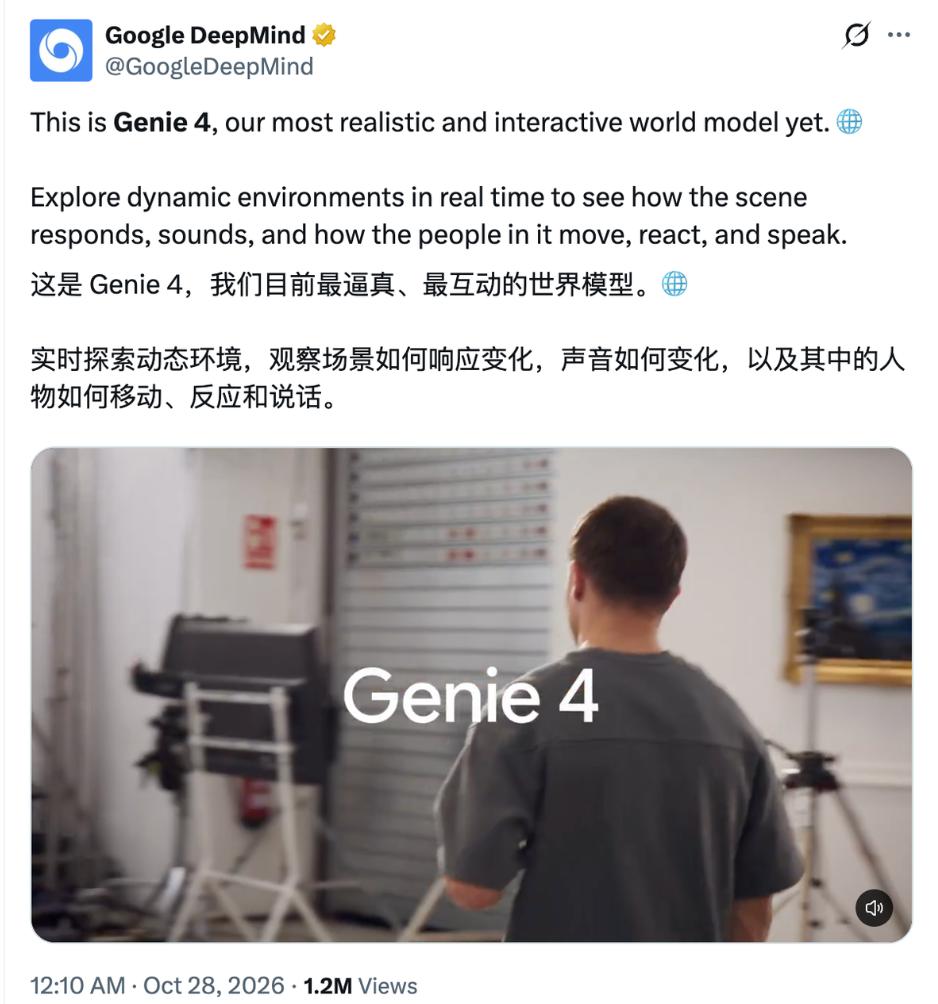
Compared to Genie 3, which previously made major breakthroughs in real-time scene generation and interaction, the new model further introduces native audio generation, real-time natural language control, complex physics and character behavior simulation, and leverages the Gemini series of models to achieve multi-step event deduction.
In the official demonstration, users use the keyboard to control navigation and camera movement, and modify the scene with text prompts: change the weather, move the camera, add people or objects to the scene. For example, you can make a pink silk ribbon appear on a grass field, or place the camera in the basket of a hot air balloon above the Antarctic ice sheet. The scene responds in real time, and the characters continue to act according to the new settings.
This set of capabilities is managed by the Gemini series of models. Gemini Omni is responsible for making visuals align with the appearance and behavior of the real world, while other Gemini models are responsible for translating requests into actions, planning complex events, observing the footage and tracking progress. When users change their instructions, Gemini adjusts the plan on the spot.
In another set of demonstrations, Gemini 4 Argon even began to direct Genie 4, simulating the entire process of a humanoid robot playing checkers step by step.
It is clear that this is no longer traditional AI video generation, but a step forward toward an interactive, controllable world simulation system that can be used for AI training. At present, Genie 4 has opened a research preview to a small number of trusted testers, and will gradually be made available to Google AI Ultra subscribers, as well as early partners of the Gemini API and Google AI Studio.
In terms of parameters, the interactive experience generated by Genie 4 in a single session can last up to 2 minutes, while the previous generation Genie 3 had a maximum duration of 1 minute. This figure may seem unremarkable, but for game developers to verify a single gameplay segment and film and television creators to preview a set of shots, it is more than enough to cover the most basic testing needs.
The AI world starts to "come alive"
This time Google has demonstrated capability upgrades in four aspects: real-time world modification, physics and character behavior simulation, native sound generation, and complex event deduction combined with Gemini.
Some of these demonstrations are already very close to the combination of interactive games and real footage.
First, users do not need to design the entire scene in advance, and can modify the world at any time during the generation process.
In one demonstration, a saxophone player in a brown suit stands on a floating platform in the middle of a lake, surrounded by a misty forest, slowly flowing lake water, and a sphere emitting warm light.
The character plays continuously, with natural transitions between finger movements, breathing and body swaying, while the camera can move independently to observe the entire environment from different positions. The key here is not to make the footage look like a movie, but to allow the camera to freely explore the scene while maintaining the spatial relationship between characters, objects and the surrounding environment.
Users can also control movement and perspective via the keyboard, and use text instructions to change the weather, introduce new characters or objects in real time. Gemini will understand these requests based on the current environment, and help maintain the development of the scene when the user does not continue to input.
Second, objects are no longer just decorations in the frame, and characters and the environment begin to show more complex motion patterns.
In another batch of cases demonstrated by Google, a whole watermelon is placed on a stone platform, maple seeds spin and fall into the grass; there is also a rural Japanese railway station crowded with passengers, where people walk on the platform, wait for trains, and together with the surrounding environment form a dynamic scene.

Google emphasizes that Genie 4 has improved its simulation capabilities for physical phenomena such as aerodynamics and collisions, and has made particularly obvious progress in character movements. The model can generate more natural human movements, allow characters to react according to the surrounding environment, and accept real-time control.
However, the physical simulation here is still the result generated by the model based on the learned laws of the world, which does not mean that all physical processes have undergone precise calculation.
Third, Genie 4 enables the AI world to have natively generated sounds for the first time.
In the demo video, you ride on the back of a dragon through the mountains, with other riders around you. It feels like you are sitting on the back of a giant dragon, crossing the mountains at the speed of 140 kilometers per hour set by the prompt, and the WASD prompt in the lower left corner tells you that you are indeed "playing" this generated scene.
Along with the flight, there are not only peaks and castles sweeping past quickly, but also the roar of the giant dragon flapping its wings, the howling airflow at high altitude, and the sound of volcanic activity in the distance. These sounds are not added later in the post-production of the demonstration, but are directly generated by Genie 4.
Furthermore, the model can also generate character dialogues in real time. Characters in the scene can give verbal responses according to user input or events happening in the world, instead of only repeating pre-prepared lines.
This change is quite important for virtual characters, interactive narratives and even game development. What developers need to create no longer has to be characters with every line and every reaction hard-coded, but may be simulated characters that can continuously generate behaviors and dialogues as the situation changes.
In the video actually generated by developer Justine Moore (who is also a partner at a16z), a more complex fully real-time generated game world is demonstrated. The entire scene is generated from a single prompt, with environment plus characters, and then events can be changed with prompts.
In the video, a character in a wetsuit explores in a cave, with gold coins scattered under his feet and a wooden barrel next to him. There is prompt text at the top of the screen that reads "Describe changes to your world...", next to which are several task options such as Ai Suggested, Giant Kraken Reach. The frame rate panel on the right shows that the current frame rate is 24.6 FPS, the minimum is 17, and the average is 23.8.
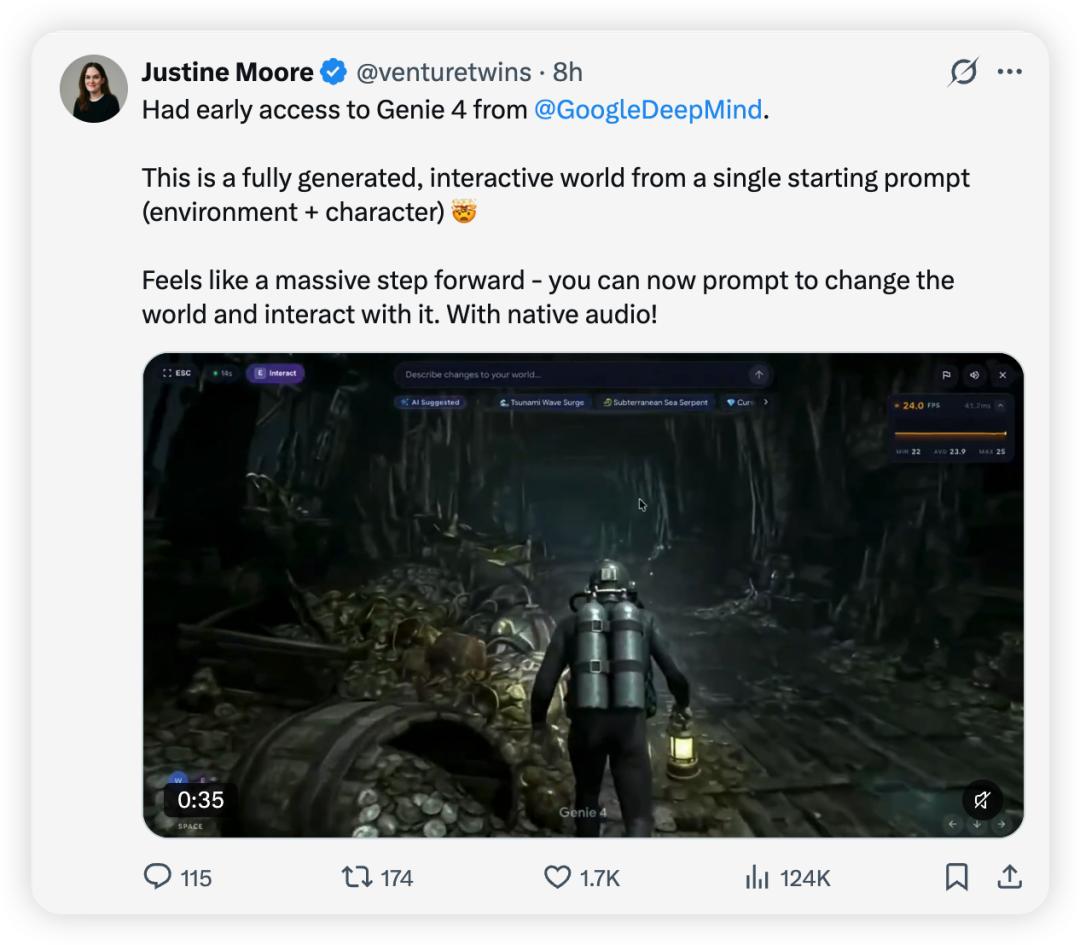
Justine Moore stated that she got access to Genie 4 in advance, and said that the speed of creating a world is usually less than 30 seconds, with a real-time interaction window of about 2 minutes. Users can move via the keyboard and mouse, and can also modify the world with natural language, such as changing the weather, moving the camera, and adding a character. The Gemini series of models will process these instructions to ensure the coherence of the scene.
In addition, Gemini 4 Argon breaks down tasks into a series of steps, and then guides Genie 4 to gradually present the execution process through text instructions. As the simulation progresses, the system can continue to adjust the subsequent steps. This is equivalent to letting a model that is good at reasoning and planning direct another model that is good at generating the environment in real time.
Genie 4 Technology Uncovered
From a technical perspective, Google is trying to solve two long-standing problems faced by world models: how to make the simulated environment change in real time with user operations, and how to maintain logical consistency for consecutive events, behind which two "brains" play a role: Gemini is responsible for thinking, and Genie is responsible for generating the physical world.
To understand this change, we must first clarify the difference between world models and ordinary video models.
- Traditional video generation models mainly generate images with a relatively determined time range based on conditions such as text and images.
- World models need to further answer: If the user walks left, what changes will happen to the field of view? If someone knocks over an object on the table, what will happen next? If the character leaves the room and comes back again, does the previous environment still exist?
This capability involves two key concepts: Action-conditioned Generation and World Consistency.
The former means that the next frame cannot only be predicted based on the previous frame, but must also take into account what action the user has just taken; the latter requires the model to remember the generated environment, and try to avoid unexplained changes in characters, objects or spatial relationships over time.
In fact, when Google released Genie 3 in 2025, it had already achieved real-time interactive generation at 24 frames per second and 720p resolution, and supported environment simulation lasting several minutes. Genie 3 adopts a frame-by-frame autoregressive generation method, which does not rely on pre-establishing a complete explicit 3D scene, but continuously generates subsequent content based on previous frames and user operations.
However, this also brings new technical challenges: the longer the generation time, the more historical information the model needs to refer to, and errors may continue to accumulate. For example, if a user passed a building a minute ago and walks back now, the model must try to keep the appearance and position of the building unchanged.
Genie 4 continues the direction of real-time world generation, but the most prominent change this time is the introduction of the Gemini series of models into the simulation process. According to official disclosures, the entire system involves at least three different levels of capabilities.
The first layer: Genie 4 is responsible for generating visuals, sounds and dynamic environments in real time. It needs to continuously generate new images and sounds based on the current world state and input, and present character movements, environmental changes and interaction results.
The second layer: Gemini Omni strengthens the connection between the simulated world and real-world laws. Google says that Gemini Omni provides the appearance and behavioral basis of the real world for simulation.
The third layer, which is also the most important breakthrough this time, uses Gemini 3.8 Flash as a real-time guiding agent. When Genie 4 continuously generates the environment, Gemini 3.8 Flash will constantly observe the scene, break down complex goals into multiple steps, and then check the newly generated images to determine whether the current step has been completed.
Once the user intervenes or the world state changes, Gemini can readjust the plan. The importance of this mechanism lies in introducing the language reasoning capability of large models into the dynamic environment generation process. In the past, even if a world model could generate realistic robot movements, it could not necessarily ensure that there was correct task logic between multiple actions. Now, Gemini can continuously provide planning, inspection and adjustment, making the system more likely to maintain the coherence of complex events.
It is worth noting that Google is also exploring further combinations.
In the Apollo humanoid robot chess-playing demonstration, Gemini 4 Argon is responsible for task planning. It breaks down the user's goal into steps, and then hands over the corresponding text instructions to Genie 4 to drive the simulation process.
Google calls this line the future "Hybrid World Models". Its basic idea is to combine the structured logical reasoning that code and language models are good at, with the rich sensory simulation capabilities that pixel-level generation models are good at.
In other words, the former is responsible for understanding how events should develop, and the latter is responsible for presenting what this process might look like in the real world.
This article is from the WeChat official account "AI Front" (ID: ai-front), author: Qing He, editor: Si Yue, published with authorization from 36Kr.