Hongguo Short Drama Scraps Its Gold Coin Reward Mechanism: The Real Test Only Begins After the Subsidy Tide Recedes
Recently, Hongguo Short Drama released a brief announcement, stating that starting from November 1, 2026, the coin earning function will no longer be available for new users; by the end of December 2026, the coin earning function will be fully phased out.
The announcement is short, but the underlying issue is far-reaching: the coin mechanism can both retain users and boost usage duration, so why is the platform determined to shut it down?
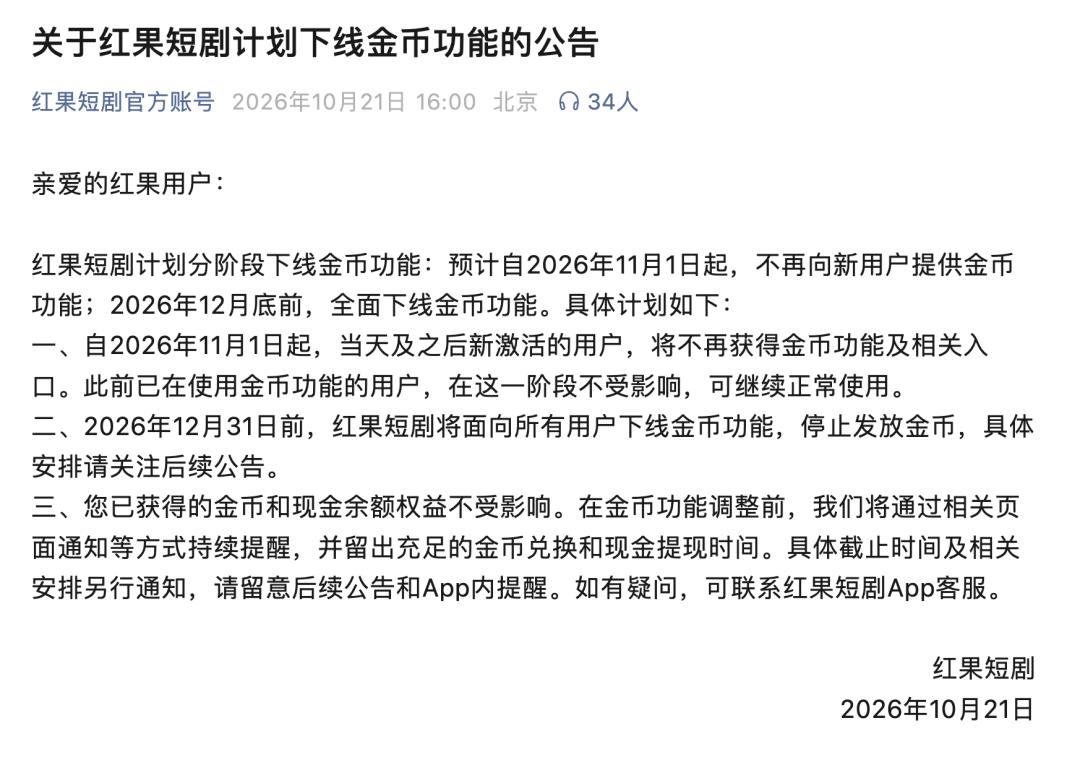
Image source: official account of Hongguo Short Drama
To understand this adjustment, TopKlout believes we need to answer several questions first: What exactly are these coins? After removing the mechanism, what will Hongguo rely on to retain its users?
Coins are not "giving away free money", but the wholesale price of user attention
Open Hongguo Short Drama, and the entry point for claiming coins runs through almost the entire usage process: daily check-in, watching short dramas, meal subsidies, simulated shopping, reservations, browsing products, playing mini-games, and even drinking water and sleeping can earn you coins.
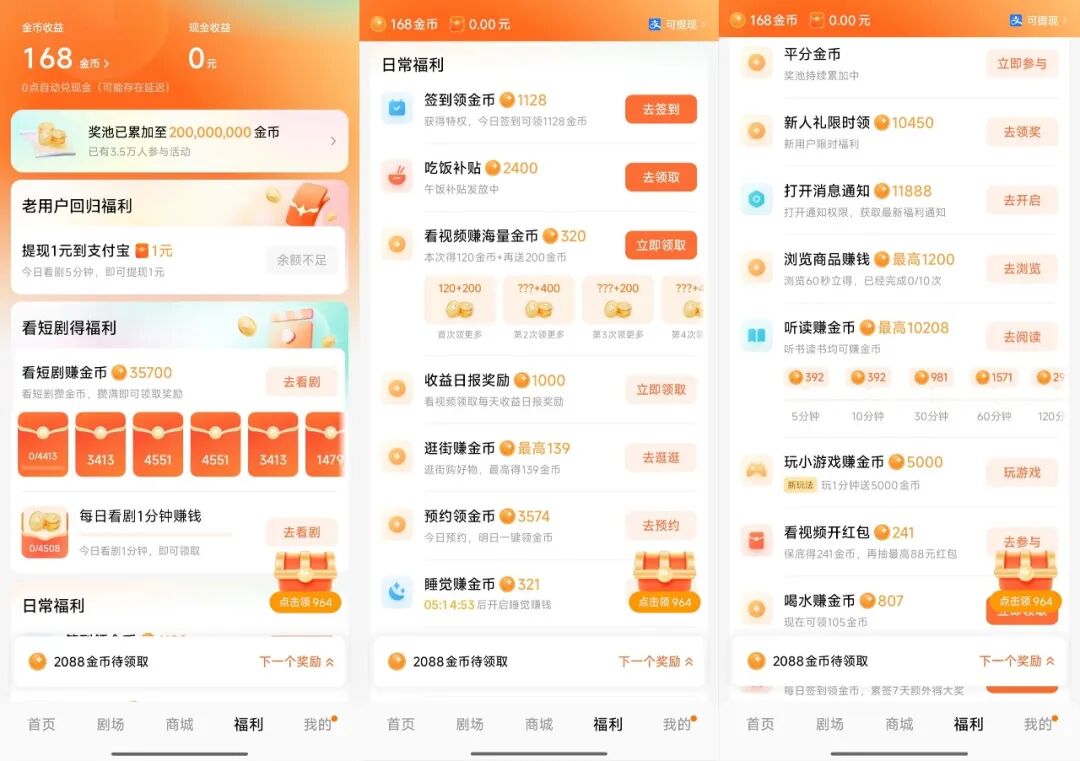
Image source: Hongguo Short Drama
It is no exaggeration to say that it takes a huge amount of time just to collect all these coins every day.
And this is exactly what the platform wants. These actions generate massive clicks and dwell time, and can also divert users to advertisements, mini-games and products along the way — before they know it, some users will pay for games and place orders for goods.
Therefore, while it seems that the platform is "giving away money" to users via coins, the mechanism itself is essentially a complete retention and conversion system: Advertisers pay for exposure, the platform returns part of the revenue to users, and users continue to act as active users of the platform in exchange for the rewards.
At this point, users are not just audiences, but also suppliers of traffic.
As TopKlout mentioned in the article "WeChat Enters the Short Drama Track! With 1.4 Billion Users, Can It Beat Hongguo?":
"Just the operation of earning coins made the author's father play short dramas for more than ten hours a day, just to withdraw a few cents of cash every day. For these ten hours, he did watch the content for nearly half the time, but for the other half, he just kept his phone screen on, charged and playing non-stop."
This shows that it is not only the content that keeps users glued to the screen, but also the operation strategy.
But why is it Hongguo that pushed this gameplay to the extreme? The fundamental reason is that its scale is extremely large.
According to the latest data released by QuestMobile cited by many industry media: As of September this year, the DAU (Daily Active Users) of Hongguo Free Short Drama APP reached 203.2348 million, breaking through the 200 million mark for the first time; the average daily usage duration reached 165.98 minutes.
The huge number of users and long dwell time make it easier for any activities and gameplay on this platform to succeed, and its traffic far exceeds that of other platforms.
In addition, short dramas naturally have a large number of breakpoints, where pre-roll ads, mid-roll ads and incentive videos can all be embedded, providing sufficient "advertising slots". Moreover, most people keep their eyes on the screen when scrolling through short dramas, making ad embedding more natural.
That's why QQ Music and Qishui Music cannot achieve the same effect even if they launch the same coin earning mechanism.
Because when listening to music, most people only notice the coin earning activity when they open or occasionally check the App, and more people listen to music with the screen off (of course, it does not rule out that some users still accumulate coins in this scenario).
Therefore, with the same usage duration, short dramas can split out far more coin earning slots than the music listening scenario, which is the key to the success of the coin mechanism.
Three Challenges Hongguo Faces After the Coin Mechanism Exits
Then here comes the question, this seemingly reasonable model should theoretically be heavily invested in, so why does the platform insist on phasing it out?
Although Hongguo Short Drama did not explain the reason in the announcement, from the perspective of business logic, this at least means that the platform is actively adjusting its way of acquiring and retaining users.
TopKlout believes there may be three reasons:
First, the user base is nearly saturated and user mindshare has been established, so continuous subsidies no longer make much sense.
At present, the total number of short drama users across the entire network has reached 850 million, and the user volume is basically saturated. In addition, Hongguo is already the absolute leader in the industry, and its user mindshare is difficult to be shaken by competitors. As the customer acquisition cost for new users keeps rising and the marginal revenue keeps declining, it is no longer necessary to use coin activities for user acquisition and retention.
At the same time, the unit traffic monetization price is falling systematically. China Economic Net learned from a number of practitioners that the revenue per thousand exposures of live-action short dramas has dropped from around 30 yuan in 2024 to less than 20 yuan in 2026, while the revenue for AI-generated short dramas once rose to 20 yuan and then fell back to around 14 yuan.
With traffic growing, unit price falling, and customer acquisition cost continuing to rise, it is no longer cost-effective to continue to spend money on subsidies in exchange for incremental growth.
Second, filter out "cashback chasers" to make traffic more valuable.
After the user base is saturated, many problems gradually emerge. The users who are most keen on earning coins watch ads mainly to reach the cash withdrawal threshold, and are not really interested in the games and products they click on.
To a certain extent, this group of users will interfere with the platform's advertising pricing benchmark, because for advertisers, the higher the number of such clicks, the lower the conversion rate will be.
From a broader perspective, the difference will become obvious. The core action of all "money-giving" gameplay is only one: to purchase a certain resource from users at a price lower than the unit monetization capacity. The difference lies in what the purchased "resource" is.
Take Pinduoduo's "one-click price cut" activity as an example. It also gives out money, but what it buys is the user's social connection chain. To complete the "one-click price cut" and withdraw cash, a user must use their address book and WeChat groups, which is a reusable asset for e-commerce platforms.
But Hongguo Short Drama itself is a content platform, where users mainly come to watch short dramas. The direct revenue generated by a single user is far less than that of e-commerce platforms like Pinduoduo.
Third, it must rely on content to support a longer-tail market.
No matter the pressure of maintaining its dominant position, or the impact brought by Tencent's Green Bubble Short Drama, Hongguo has reached a point where it must prove its retention and conversion capabilities through high-quality content, and this task has become more difficult than ever.
Many people want to know how much of the nearly 166 minutes of per capita daily usage is supported by the coin mechanism, but TopKlout believes this is not important.
What matters is after removing this part of traffic, whether Hongguo can obtain purer commercial conversion traffic and higher user payment willingness.
The author mentioned in the previous article "Hongguo Short Drama Enters the E-Commerce Track" that Hongguo is backed by ByteDance's ecosystem, so it does not need to build infrastructure such as logistics, supply chain and payment from scratch, and can directly reuse the mature capabilities accumulated by Douyin E-Commerce for many years. Precise user groups, immersive content scenarios and mature e-commerce infrastructure will jointly form the "iron triangle" of Hongguo's e-commerce business.

Image source: Hongguo Short Drama
But are these "precise users" referring to the real audience hooked by the plot and willing to watch the full ad, or the accounts that repeatedly swipe ads just to collect coins? Their value to advertisers and Hongguo itself is completely different.
After the subsidy recedes, whether the remaining users are closer to real audiences, whether ad exposure is closer to effective exposure, and whether e-commerce conversion relies more on content-driven recommendations rather than coin-induced actions, these data can better reflect Hongguo's real operating capability.
Conclusion
Hongguo's phase-out of the coin mechanism is not a simple negation of the previous subsidy gameplay, but a sign that the platform has reached a node where it must switch its growth model.
The coin mechanism helped Hongguo complete the phased tasks of user acquisition, cultivating user habits and expanding user scale. Next, Hongguo needs to answer the question: without the coin mechanism, why do users stay, pay and place orders?
For Hongguo, the phase-out of the coin mechanism is only the first step. The subsequent performance in content, products and operational efficiency is what it really needs to prove.
What do you think of Hongguo Short Drama's move to phase out the coin earning function? Feel free to share your opinions!
This article is from the WeChat Official Account "TopKlout" (ID: TopKlout), written by SU Men, and published with authorization from 36Kr.