Earnings Preview for Microsoft and Amazon in the US Stock Market
Microsoft will release its earnings report this Wednesday, and Amazon will release its earnings report this Thursday.
To prepare for this article, I read through the latest, most authoritative original earnings reports on Wall Street, dozens of pages of English earnings report annotations, and tens of thousands of words of conference call transcripts line by line and word for word.
To be honest, there are overwhelming interpretations of earnings previews on the market these two days, but I was deeply touched after reading them: people are constantly checking "whether revenue exceeded expectations" and "whether EPS beat estimates", but there are very few people who are willing to settle down to break down costs and calculate cash accounts for everyone item by item.
In fact, simply looking at those gorgeous growth figures is no longer sufficient.
What we really want to know is: when upstream construction costs are getting higher and higher, and the capital expenditure of tech giants is snowballing upward, how much real return can each tens of billions of dollars they invest ultimately generate?
It is recommended to like and collect this article first, and take it out for verification before the earnings reports are released.
In-depth Analysis of Microsoft's Earnings Report
Let's start with Microsoft.
In this earnings report, what I care most about is not whether revenue exceeded expectations, nor how impressive the growth figures Azure cloud computing delivered again.
Because the successive earnings reports and stock price reactions of tech stocks last week, including Meta, TSMC and a large number of enterprise software companies, have clearly shown Wall Street's current "reward and punishment criteria": the market no longer buys into pure growth stories as much as before.
Whoever can prove that AI investment is turning into real monetary returns will get a premium from the market;
Whoever is still stuck in the stage of only burning money without delivering results will be revalued even if their book figures look acceptable.
So when it's Microsoft's turn to hand in its report, the only core question I really want to figure out is: after investing tens of billions of dollars in AI construction, has it really started to form a truly profitable business?
I will find the answer to this question in four steps along its business chain
Step 1, look at the application layer: To what extent has Copilot been sold?
Step 2, look at the billing model: Can Microsoft upgrade from fixed subscriptions to usage-based billing driven by agents?
Step 3, look at the infrastructure: Can the huge orders in Azure be delivered smoothly and converted into actual revenue?
Last step, look at the financial bottom line: How much free cash flow can Microsoft retain after deducting capital expenditures?
These four steps are closely linked. If any link fails, the market's valuation logic for Microsoft may be re-examined.
Let's start with the first step, Copilot.
The reason why I put it at the top is that last quarter, the market's attention was more focused on Azure's growth and capital expenditure, which made it easy to ignore a change: the commercialization of Copilot is showing signs of acceleration.
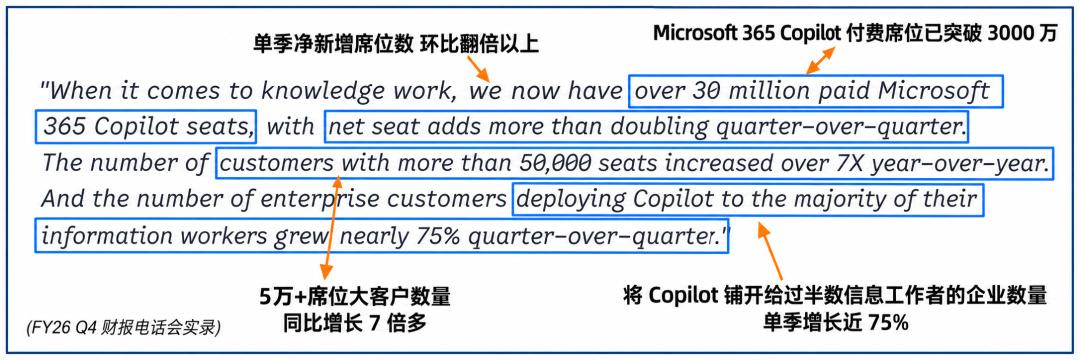
Let's look at the original words of Microsoft CEO Satya Nadella at the last earnings call, and the figures he mentioned are very critical:
The number of paid seats for Microsoft 365 Copilot has exceeded 30 million, while it was just over 20 million in the previous quarter. The net new number of seats in a single quarter has more than doubled quarter-on-quarter;
The number of key enterprise customers with more than 50,000 seats has increased by more than 7 times year-on-year;
The number of enterprises that have rolled out Copilot to more than half of their employees has increased by nearly 75% in just one quarter.
If we map these figures to the specific list of key customers, the perception will be more intuitive:
For example, NHS England, the UK's National Health Service, announced the promotion of Copilot to about 500,000 employees;
EY (Ernst & Young), one of the Big Four global accounting firms, deployed the E7 suite including Copilot for 400,000 employees;
Volkswagen also deployed Copilot for 330,000 employees;
HSBC has committed to purchasing 200,000 seats.
Looking at these figures together, it shows that Copilot is gradually moving from small-scale trials to large-scale procurement by large enterprises. At least at the level of enterprise willingness to pay, Microsoft has made substantial progress.
But one step cannot be ignored here: the fact that enterprises are willing to buy does not mean that this business has been successfully established.
Why do I say that?
Because last quarter, Microsoft 365 commercial cloud revenue increased by about 16% after excluding special factors, while the base of commercial paid seats only increased by 6%. Management said that the sales of Copilot, E5 and early E7 are increasing revenue per user.
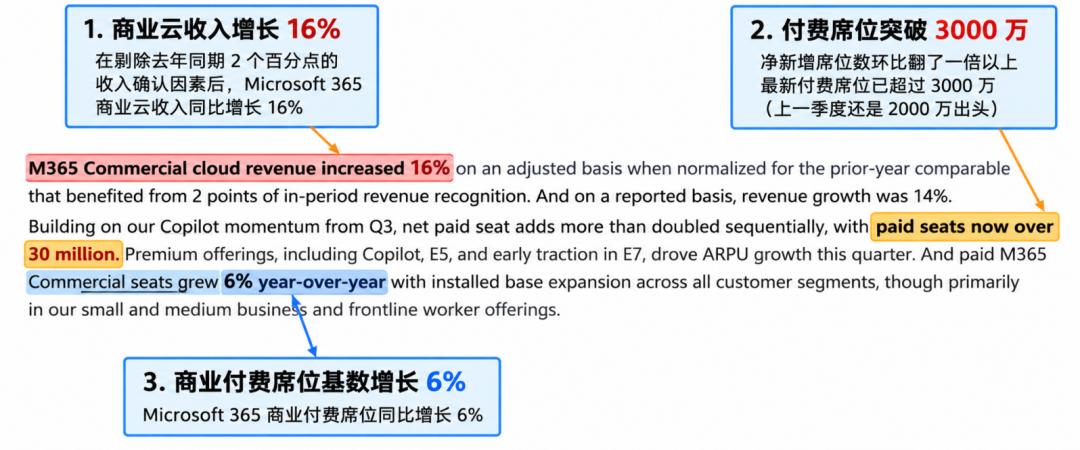
This is a positive signal, but we cannot attribute all this growth to Copilot. Because Microsoft has not yet separately disclosed Copilot's revenue, activity rate and profit margin.
In other words, 30 million paid seats prove that it can be sold, but it has not yet proved that it is a high-profit money printing machine.
So what I really want to hear from this earnings report is not just how many more seats have been added, but
Are customers using it more and more deeply after signing the contract?
When it comes to renewal, are enterprises willing to continue paying, or even purchase higher-priced services?
Because these questions determine whether Copilot can evolve from a business that "can be sold" to a business that "makes real profits".
This leads to the second question: Why is Microsoft emphasizing agents and usage-based billing more and more?
Because traditional software is mainly charged by the number of users, but AI can continuously perform tasks in the background, call tools, read data, and generate results. The more complex the task, the more inference computing power it consumes. If revenue remains at fixed subscriptions, but costs continue to rise with usage, the business model will face pressure.
Microsoft has introduced usage-based billing for GitHub Copilot, and packaged Copilot, security, identity management and Agent 365 with E7. What it wants to sell is the entire system for enterprises to manage AI.
But whether this path can be successfully taken still depends on competition. Now enterprises will not bet on only one large model. Microsoft Foundry platform provides more than 11,000 models, and management said that since the beginning of this year, the number of customers using multiple models at the same time has increased by 5 times.
What Microsoft really wants to defend is the enterprise entry on top of the models: where data is connected, who manages identity permissions, and where agents run.
Nadella's two recent interviews actually explained Microsoft's strategic route more clearly.
He emphasized that enterprises cannot assume that AI models are always reliable. The more powerful the model is, the more enterprises need a set of external security systems to manage which data it can access, which tools it can call, and how to restrict its behavior when anomalies occur.
This means that what Microsoft wants to sell may not just be a Copilot that helps employees write emails and make spreadsheets, but a complete management system that allows AI to enter the core business of enterprises without losing control.
So next, we must look at the third step, Azure.
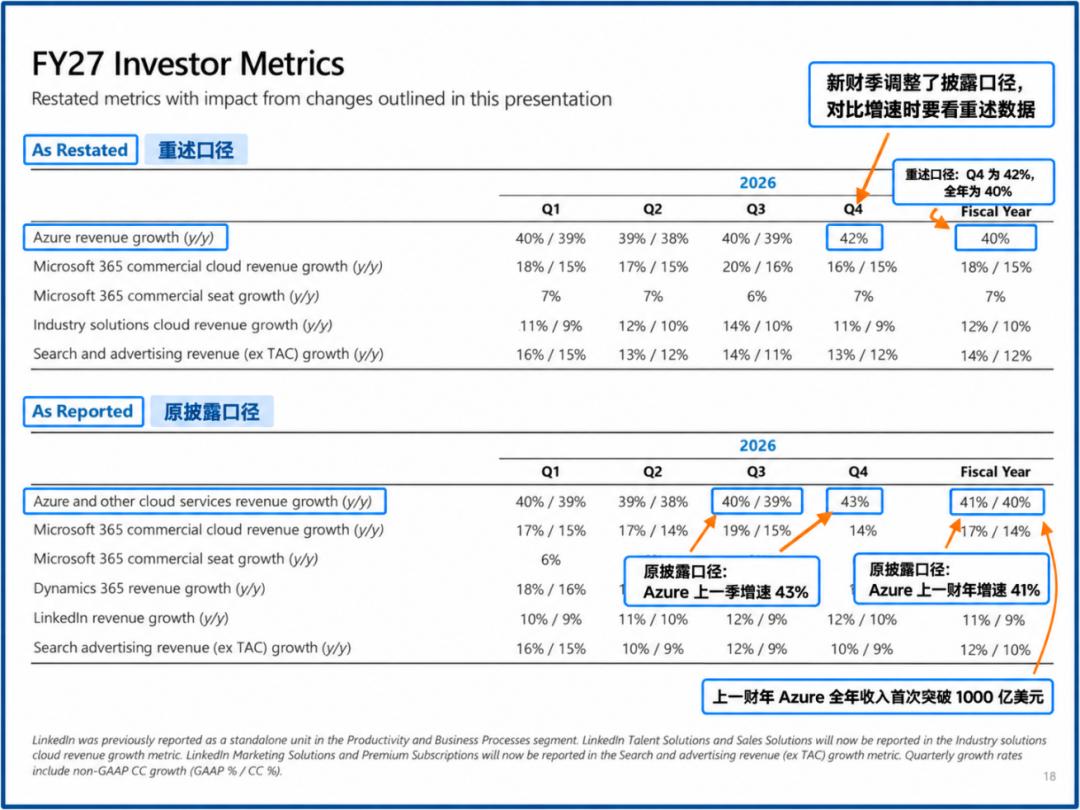
In the last fiscal year, Azure's full-year revenue exceeded $100 billion for the first time, growing by 41%; last quarter, its growth rate accelerated from 40% to 43%.
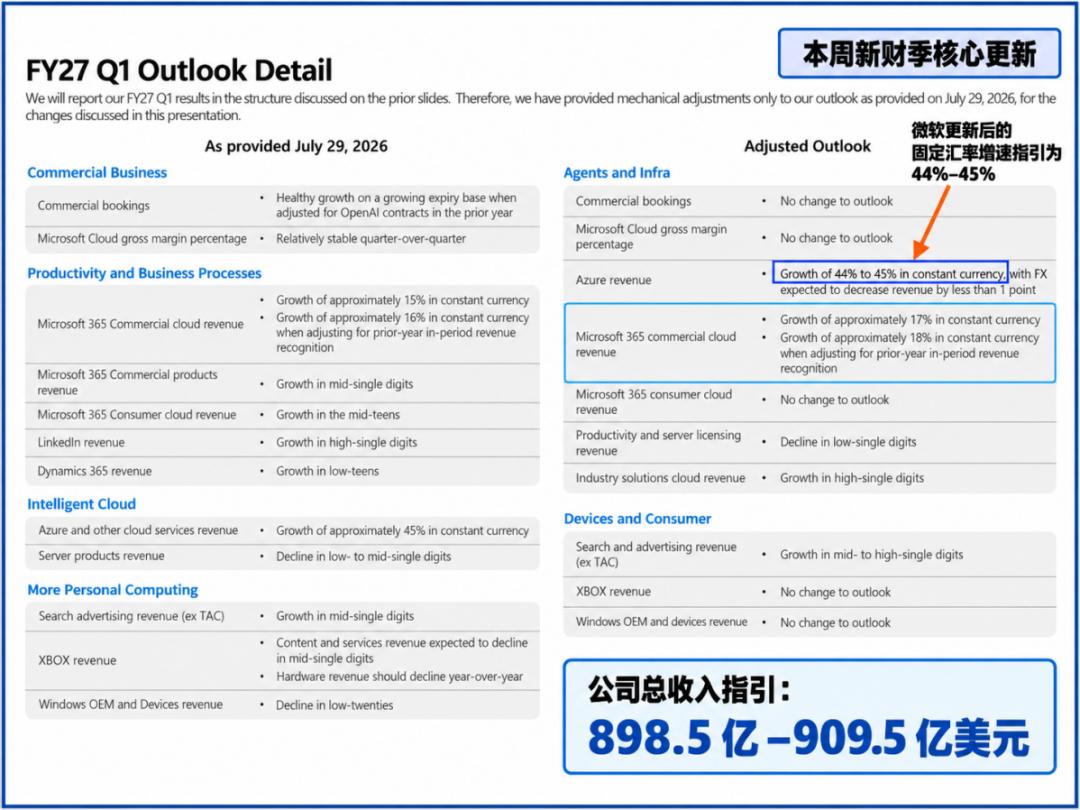
In this quarter of this week, Microsoft's updated constant-currency growth rate guidance is 44% to 45%, and the company's total revenue guidance is between $89.85 billion and $90.95 billion. However, the disclosure caliber was adjusted in the new fiscal quarter, so restated data should be referred to when comparing growth rates.
To see the visibility of future growth, we also need to combine Microsoft's "mountain of orders". Last quarter, Microsoft's total commercial remaining performance obligations, including Azure and office software, namely commercial RPO, reached $6780 billion, a sharp increase of 84% year-on-year.

But we need to interpret this set of data in two layers:
1. OpenAI has a huge pulling effect, but demand from other enterprises is also catching up.
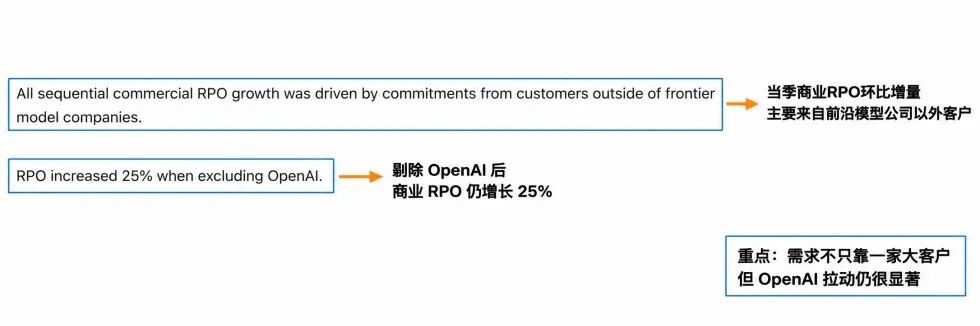
After excluding OpenAI, commercial RPO still grew by 25%, and the quarter-on-quarter increment in the current quarter mainly came from customers other than cutting-edge model companies.
This shows that the demand is not only supported by one large customer, but the 84% vs 25% growth rate difference also reminds us that OpenAI's pulling effect on overall orders is still very significant, and the risk of customer concentration has not been completely eliminated.
2. The contracts in hand need to be converted into revenue in installments.
RPO refers to long-term orders to be fulfilled in the future, not the money earned this quarter, let alone the cash already in hand. Microsoft expects that about 30% of it will be recognized as revenue in the next 12 months, and the remaining part will be fulfilled gradually over a longer period.
Therefore, for Azure this week, what the market really needs to verify is not just the quantity of orders, but whether the newly built data centers can be delivered on time, so that computing power can be truly converted into revenue for the current quarter.
Because Microsoft has not precisely separated the release of new production capacity, price improvements, and OpenAI-related demand.
So in this earnings report, I will focus on clarifying: if the growth continues to accelerate, does it come from new customers, or from orders previously restricted by computing power that start to be recognized? If revenue fails to keep up, is it because the delivery of computer rooms is stuck, or because customers are slowing down their procurement?
After all, how fast orders can be fulfilled and how much computing power cost will be paid during fulfillment directly determines the return rate of this business.
This brings us to the 4th question, which is also the one most likely to determine the stock price reaction after the earnings report: return on capital.
Let's first calculate a cash account: last quarter, Microsoft's operating cash flow was $55.4 billion, but capital expenditure together with financial leases cost $41 billion, leaving only $19.6 billion in free cash flow in the end, and it is also the only cloud giant with positive free cash flow.

In this quarter, Microsoft expects capital expenditure to exceed $50 billion. You see, Microsoft's money-making speed is accelerating, and its money-burning speed is also accelerating. More critically, as the costs of upstream chips, storage and infrastructure rise, building a data center of the same scale is becoming more and more expensive.
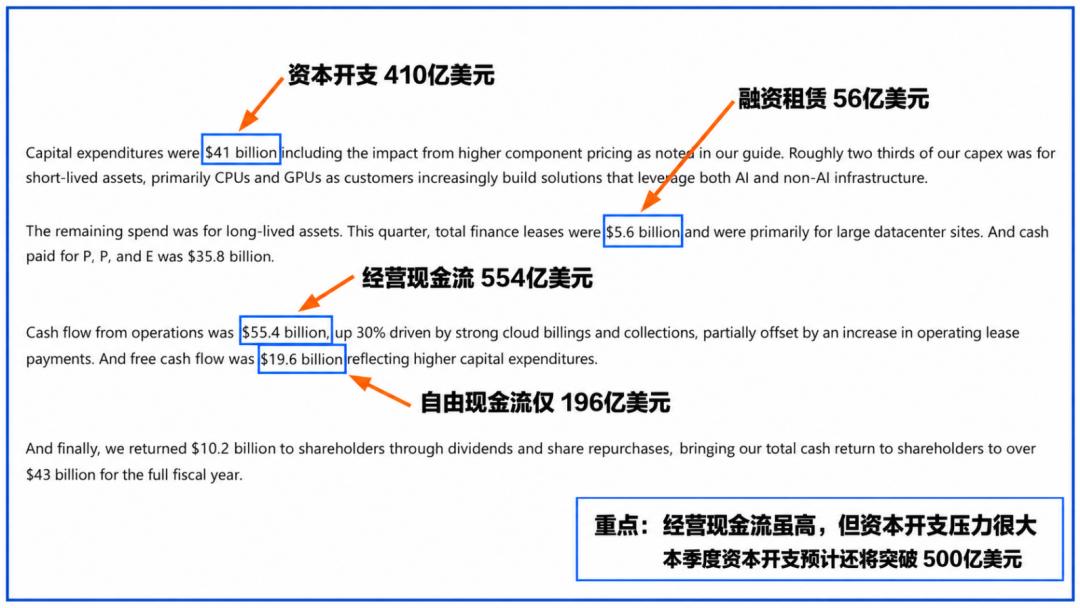
No matter how strong the demand is, if revenue growth cannot outpace cost inflation, the cash left in hand will be continuously eroded.
Moreover, when looking at this earnings report, we must not only focus on whether the book "EPS" and "net profit" exceeded expectations. Because there are two details that must be viewed separately:
First, the adjustment of accounting depreciation.
Microsoft extended the expected useful life of data center buildings and office buildings from 15 years to 25 years. This will directly reduce future book depreciation and make the income statement look better; but this does not mean that the GPUs inside can suddenly be used for 10 more years, nor does it mean that the real money spent has decreased.
Second, the interference of non-operating factors.
The growth rate of Microsoft's net profit last quarter was significantly faster than that of operating profit, which was largely affected by non-operating items such as investment income.
In other words, book net profit can be polished by extending depreciation and investment income, but cash flow does not lie. So when I look at this earnings report, I will definitely put operating profit, operating cash flow and free cash flow together for analysis.
All in all, this time I will not only see whether Microsoft can sell AI, but also see whether it can convert demand into revenue, and then convert revenue into cash that can really be retained — this is the real key to the outcome