Controlling 50.1% of Voting Rights with Only 7 USD: The True Face of Anthropic
On October 26, Anthropic officially submitted its IPO application to the U.S. Securities and Exchange Commission, with the stock ticker ANT, targeting a valuation of USD 1.5 trillion to USD 2 trillion. Tech media outlets have repeatedly covered figures including "USD 16.2 billion in half-year revenue", "USD 80.7 billion in net loss", and "a valuation of USD 1.5 trillion to USD 2 trillion that is expected to surpass the historical record set by SpaceX". If we restate these figures again, readers will most likely just scroll past with a yawn.
However, this 300+ page prospectus is worth reading slowly. Because it does not answer the question of "how profitable Anthropic is", but a far more fundamental one: when an AI lab grows to a trillion-dollar scale, what kind of company will it eventually become?
After going through the full document, the conclusion is that it is more like a combination of three types of companies: a computing power "energy" purchaser, a To B enterprise software vendor, and a mission-driven experimental entity with a special governance structure.
The following five counter-intuitive details piece together its true profile.
Treat computing power as energy for procurement: take-or-pay clauses valid up to 2045
This is the most noteworthy part of the entire document that deserves slow reading.
In its prospectus, Anthropic refers to computing power as a "key input", with the total value of signed contracts exceeding USD 800 billion, and the longest valid term extending to 2045. The caliber aggregated by brokerages based on the contract table is at least USD 657 billion, and the gap comes from different statistical scopes — the additional USD 125 billion to USD 150 billion TPU procurement from Google between 2028 and 2031 is not even included in the contract commitment table.
Major contracts include: approximately USD 161.2 billion for Broadcom AI accelerator equipment lease, which is irrevocable for a five-year term; at least USD 114.5 billion from Google, valid until July 2033; at least USD 110 billion from Amazon, valid until April 2036; at least USD 44.9 billion from Microsoft, valid until April 2036; up to USD 120.5 billion from the AI subsidiary of SpaceX, valid until 2029, with an estimated monthly cost of about USD 3.1 billion after all computing power goes online and reaches full capacity in December; procurement of Helios from AMD starting next year, with an estimated cost exceeding USD 20 billion, plus an option to double the volume; about USD 44.6 billion from Nscale, and about USD 41.3 billion from Lambda.
The key point is not the huge total amount, but the terms. The contracts of Google, Amazon and Microsoft all contain the same phrase: "regardless of actual usage" — you have to pay the money no matter whether you actually use the computing power or not. Google and Amazon also agreed that the shortfall of usage will be supplemented by the difference.
This kind of "take-or-pay" clause was most commonly seen in long-term contracts for natural gas and electricity in the past.
What about the revenue side of Anthropic? About 80% of the revenue is settled based on actual usage, and customers pay for how many calls they make. Costs are locked in more than one year in advance, while revenue fluctuates with call volume. This is a typical heavy-asset infrastructure financial structure: with extremely high operating leverage, but once demand falls short of expectations, long-term contracts will become hard constraints.
Therefore, Anthropic is essentially procuring computing power as energy: long-term contracts, take-or-pay clauses, and costs locked in advance. The financial structure of large model companies is increasingly resembling that of a heavy-asset infrastructure company.
Strict account bans for Claude are clearly recorded in the prospectus
In the eyes of Chinese developers, Claude is probably one of the AI products with the strictest account ban rules and the most rigorous risk control. After going through the prospectus, you will find that this is not product arrogance, but determined by the account books.
In the first half of 2026, Anthropic's revenue reached USD 16.286 billion. Among them, usage-based revenue was about USD 13.1 billion, accounting for 80%; subscription revenue was about USD 3.2 billion, accounting for only 20%. And within this 20% of subscription revenue, enterprise Team and Enterprise plans are also included — the proportion of individual Pro and Max subscriptions will be even lower.
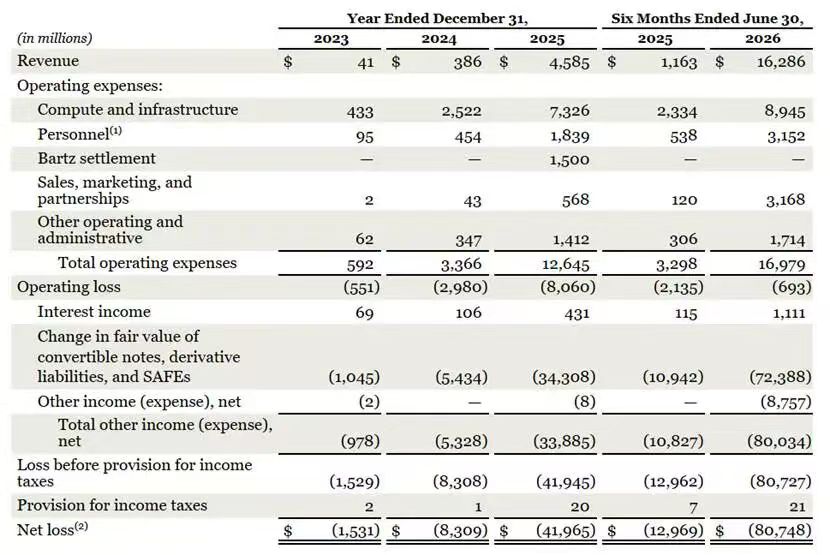
Image source: Anthropic S-1 Prospectus
Where does that 80% of revenue come from? Enterprise and cloud service provider channels. 48% of the revenue is sold through the marketplaces of AWS, Google Cloud, and Microsoft Azure; the number of customers with annual consumption of more than USD 100,000 surged from 950 in September 2025, to 1500 in December 2025, and then to more than 11900 in September 2026.
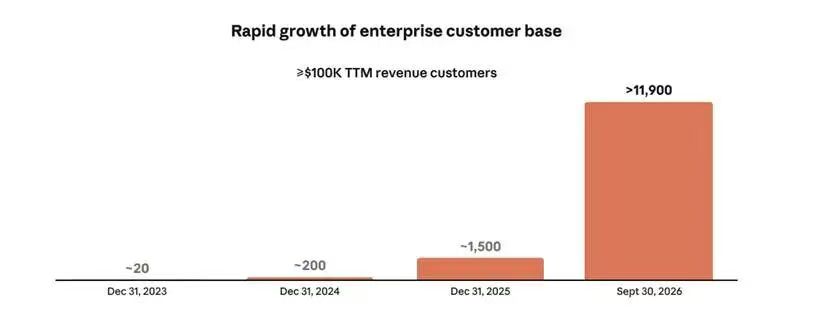
Image source: Anthropic S-1 Prospectus
The most telling indicator is the net dollar retention rate: about 900%, which means that customers who spent USD 1 a year ago now spend an average of USD 9 in the same period. However, when calculating this indicator, individual Pro and Max subscription users are excluded, on the grounds that "fixed-price subscriptions cannot reflect expansion behavior".
What is more straightforward is the treatment of free users. The computing power consumed by free access is recorded in the "sales and marketing" expenses in the prospectus — this expense reached USD 3.168 billion in the first half of 2026, including channels, marketing, personnel, and free computing power. To put it another way: free users are part of the customer acquisition cost on the account books.
Anthropic calls individual paying users "prosumers", including researchers, developers, analysts, and writers. Their strategic value is to act as "kindling": they use Claude themselves first, and then push their companies to purchase Enterprise plans. But under the premise that computing power is always insufficient, between individual subscribers with fixed monthly fees and Claude Code enterprise users whose monthly consumption is 20 times higher, it is not difficult to figure out who should be allocated resources first.
As for users in the Chinese mainland, there is only one institutional statement in the prospectus: the company has a "supported region policy" and implements IP-based geoblocking, so users from the region are not within the service scope in the first place.
USD 7 for 50.1% of voting rights
This is probably the most counter-intuitive design in the entire prospectus.
Strategic shareholders like Amazon and Google have poured huge sums of money into the company, and SBF spent USD 500 million buying Anthropic's shares back then — what they got are all Class N shares with no voting rights. So who holds the voting rights of this company?
The answer is in Article 10 of a limited liability company agreement in the appendix: seven people on the list each contribute USD 1 to the company, totaling USD 7, to subscribe for 1 Class F share. This share has no economic rights and cannot get any profit distribution, but its voting rights are fixed at 50.1% of all the company's voting rights, which cannot be diluted even after new shares are issued in the future.
The seven people are Dario Amodei, Daniela Amodei, plus Tom Brown, Jack Clark, Jared Kaplan, Sam McCandlish, and Chris Olah — the seven co-founders. The prospectus defines their role as "the guardians of our mission".
There is another layer above that: the Long Term Benefit Trust (LTBT) usually has the right to elect and remove four of the seven directors, and Dario and Daniela cannot be removed by the trust. The company is also a "controlled company" under Nasdaq rules, which can be exempted from part of the governance requirements.
In other words: you can buy Anthropic's shares, but it is very difficult to take away Anthropic's steering wheel. The capital market bears stock price fluctuations, while the founding team controls the strategic direction. This is a governance structure designed for the "AI safety mission", and it is also a premise that ordinary shareholders have to accept.
No panic even with USD 80.7 billion in losses, the real bill is the USD 8000+ billion commitment
The net loss of USD 80.748 billion in the first half of the year is a staggering figure. When you break it down, about USD 72.388 billion of it comes from the fair value changes of convertible notes, derivative liabilities and SAFE.
The mechanism is not complicated: part of the funds invested by Amazon is in the form of convertible notes, which is equivalent to an IOU that "can be exchanged for stocks at an agreed price in the future". Anthropic's valuation rose from USD 3800 billion on February 3 this year to USD 965 billion in May, and the IOU appreciated significantly accordingly. Accounting standards require that the appreciated part be recorded as the company's loss. The prospectus notes that such changes are mainly driven by the rise in valuation and do not involve cash outflow.
According to non-GAAP caliber, the adjusted net profit for the first half of the year was positive USD 2.671 billion; operating profit in the second quarter was USD 974 million, with an operating profit margin of 8%, and an adjusted operating profit margin of 19%; net cash inflow from operating activities in the first half of the year was USD 3.9 billion.
But "paper losses" are not the core risk. The real bill is the USD 8000+ billion computing power commitment and the subsequent depreciation. The prospectus itself also warns that the performance may have "significant periodical fluctuations" due to computing power expenditures.
The positive side is that efficiency is improving: the revenue brought by every USD 1 of computing power input rose from USD 0.40 in the first quarter of 2025 to USD 2.08 in the second quarter of 2026. The reasons include improved training efficiency, improved inference efficiency, scheduling across four types of chips including Amazon Trainium, Google TPU, NVIDIA GPU and AMD GPU, and price cuts of new models.
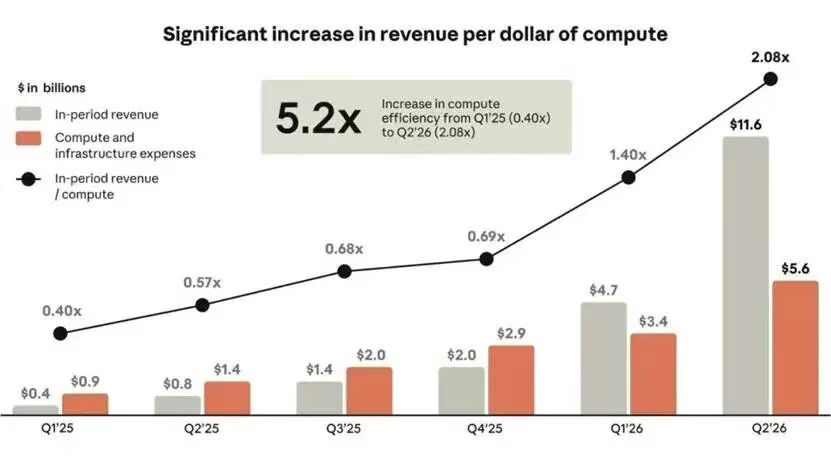
"Revenue per USD 1 of computing power" in the prospectus, Image source: Anthropic S-1 Prospectus
To put it another way: the loss figure looks scary but there is no actual cash bleeding; but what really needs to be focused on is not the USD 80.7 billion on the income statement, but the USD 8000+ billion in the contract table.
Valuation and risks are written into the same document for the first time
The risk factors section of the prospectus is more than 90 pages long, about three times the length of similar disclosures by SpaceX, which is very different from the formulaic disclosures commonly seen in enterprises.
The document warns that its technology may pose "catastrophic or existential risks" to humanity, and may "provide substantial assistance to malicious actors who intend to develop chemical, biological or other dangerous weapons". The described out-of-control scenarios include that the model may have "unexpected self-protection behaviors" in the future, such as resisting shutdown, concealing or manipulating information, and may also generate coercive outputs similar to "ransom demands".
As for whether insurance can cover the losses, the statement in the prospectus is: no single insurance company, or even the entire insurance industry combined, may have the capacity to underwrite such risks.
There are several other details worth noting: in the first nine months ending September 30, about 5%~7% of the revenue came from customers who were later found to violate the usage policy or commercial terms. The reason is that there is a time lag between the discovery, investigation and account ban, and the revenue from services already provided before the account ban is recognized normally — roughly estimated at USD 1.6 billion to USD 2.3 billion. The company strengthened its ban efforts in August and September, and warned that this may lower future revenue and growth rate.
The seven founders persuaded potential investors in the document to "not view your purchase purely from a trading perspective", admitting that the company's decisions "may run counter to investor expectations", because profit maximization needs to be weighed against "public interests".
A company preparing to go public at a trillion-dollar valuation is also publicly warning that its technology may bring existential risks. Valuation pricing and risk pricing are included in the same document for the first time.
Closing Remarks
After closing the prospectus, the true profile of Anthropic is already very clear: its revenue structure resembles enterprise software, its cost structure resembles long-term energy contracts, its governance structure resembles a foundation, and its risks are systematic, spillover and public.
It is turning AI into an infrastructure that requires long-term contracts, energy-level bills and special governance structures to support. What Wall Street buys is also the option of "AI becoming the infrastructure of the next generation of digital economy".
As for whether this option is worth USD 1.5 trillion to USD 2 trillion, the next step depends on the ARR (Run-Rate Revenue) in October, how the computing power contracts are implemented, and whether the Token call volume of enterprise customers can continue to support that steep growth curve.
The hype has faded, but the issues raised in this document are just starting to be priced.