Wang's conjecture was fully cracked by AI overnight.
A world-class problem that has plagued humanity for decades was solved by AI in just a few days.
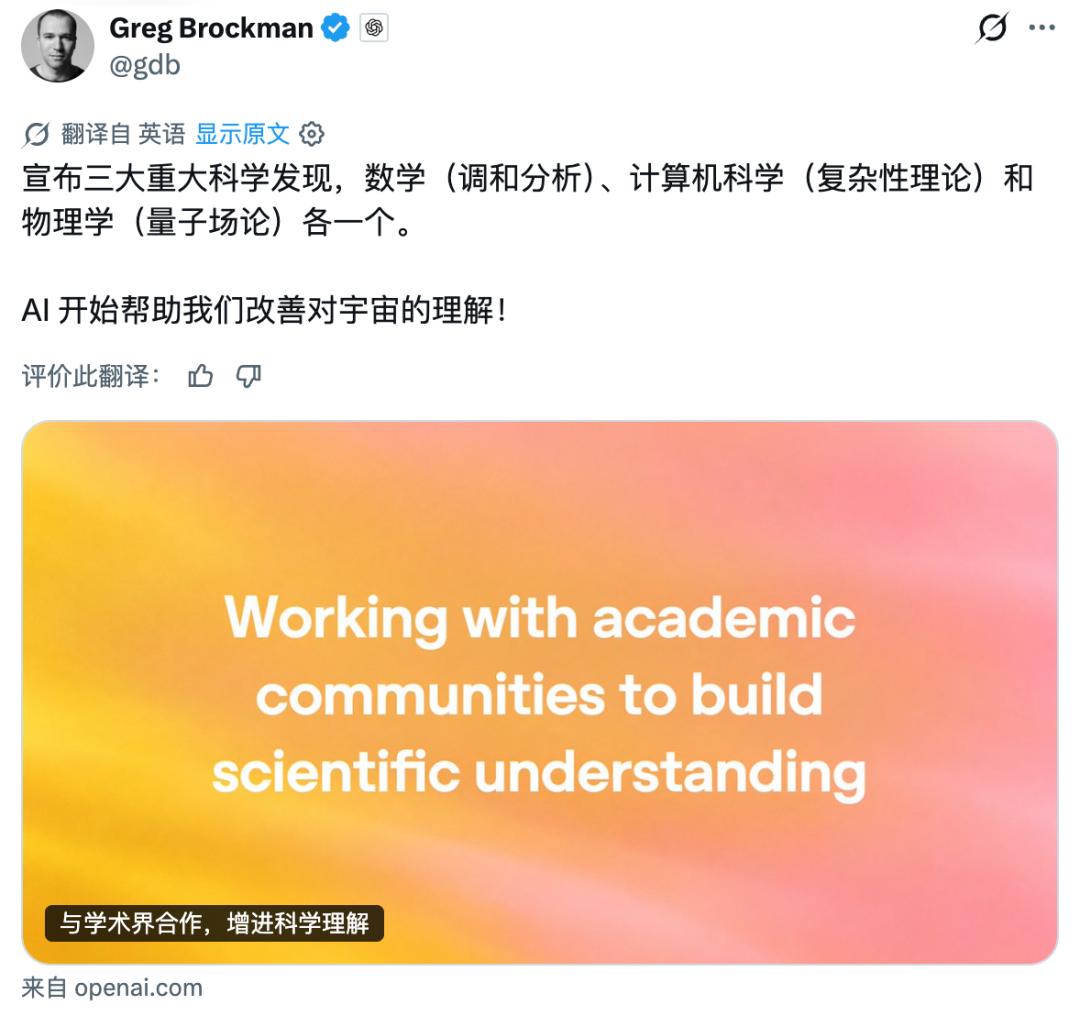
Just now, OpenAI announced that its model has delivered three breakthroughs at once: it overturned the Exponential Time Hypothesis that the computer science community has firmly believed for nearly 30 years; proved the local smoothing conjecture in all dimensions; and constructed a rigorous mathematical existence proof for quantum chromodynamics and the Yang-Mills theory.
OpenAI declared that by tracing back along the chain of mathematical deductions, this means that the Kakeya conjecture (also known as the Kakeya needle problem) has been solved in all dimensions.
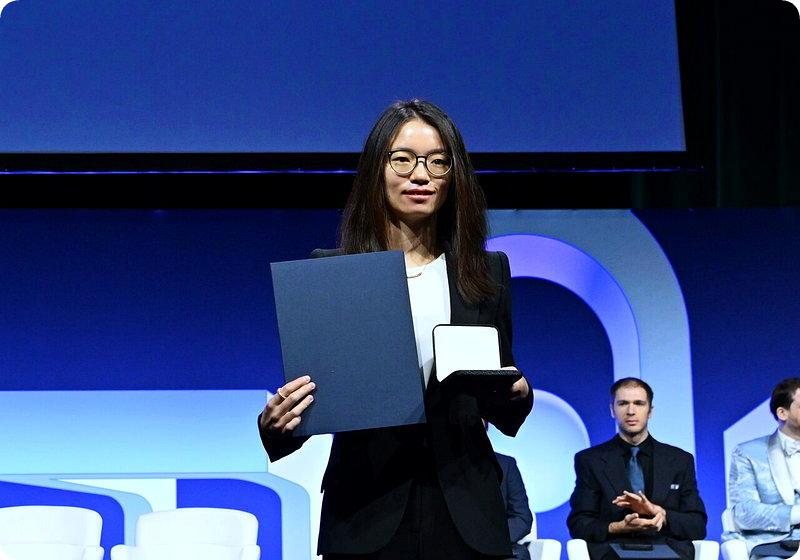
Back in early 2025, Chinese mathematician Wang Hong shocked the world by proving the 3-dimensional Kakeya conjecture. Only a year and a half later, that breakthrough humanity was once proud of has become a special case of the AI's achievements.
What is more interesting is that OpenAI invited the very scientist who proposed the ETH hypothesis back then to review the AI's disproof of his own hypothesis; it also brought in a team led by a Nobel laureate in Physics to digest the AI's proof of the Millennium Prize Problem.
Problems that scientists spent half their lives finding no answers to have had solutions generated by AI in just a few days. The next work for mathematicians will no longer be searching for proofs, but verifying the AI's proofs.
The biggest reversal in the history of mathematics is happening right now.
From Wang Hong's 3D Breakthrough to AI Challenging All Dimensions
Among the three achievements, the breakthrough in the field of mathematics is particularly notable, because it directly relates to the major result achieved by Chinese mathematician Wang Hong last year.
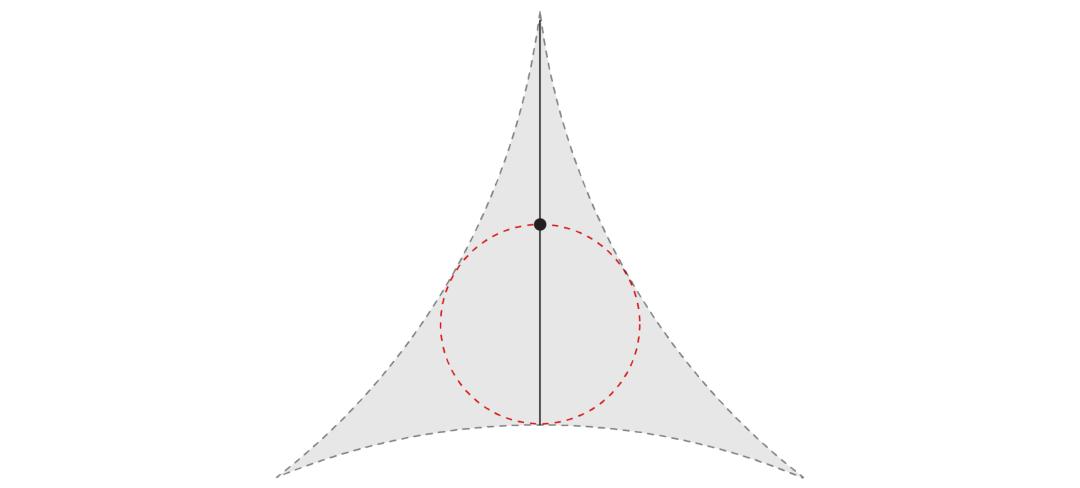
The Kakeya conjecture originated from a seemingly simple geometric problem: if a set can accommodate unit line segments in all directions, what dimension must this set have exactly? After hundreds of years of research, it has become an important topic in fields such as harmonic analysis and geometric measure theory.
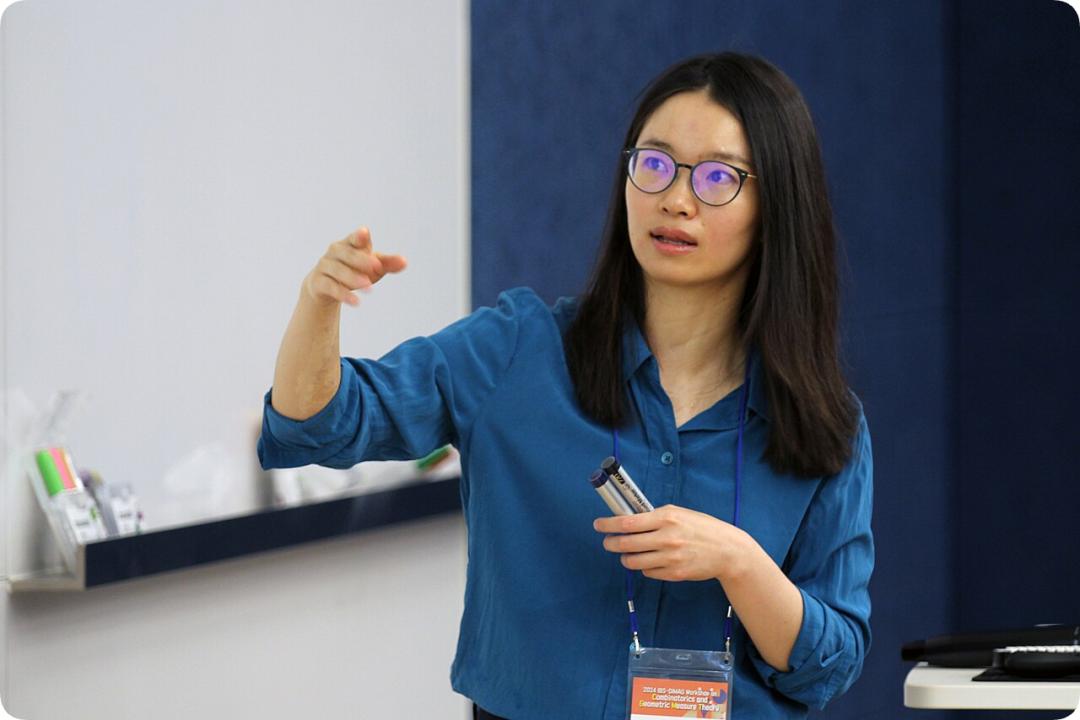
In 2025, Chinese mathematician Wang Hong collaborated with New York University mathematician Joshua Zahl to successfully prove the 3-dimensional Kakeya conjecture, which became one of the most high-profile breakthroughs in the mathematics community that year.
However, the solution to the 3-dimensional problem cannot be directly generalized to 4-dimensional, 5-dimensional, or any higher arbitrary dimensions.
The results announced by OpenAI this time precisely break through this limitation. Its AI model proved a more fundamental mathematical proposition, namely the local smoothing conjecture proposed by mathematician Christopher Sogge in 1991.
This conjecture studies the focusing phenomenon of waves during propagation. To put it simply, waves can form extremely strong focusing at certain moments, but this extreme state can only exist for a short time. If we observe the average performance over a period of time, the degree of wave focusing will be significantly lower than that at the most extreme moment.
The reason why the local smoothing conjecture is important is that it can deduce other important conclusions such as the Kakeya conjecture and the Stein restriction conjecture.
In 2019, mathematicians Larry Guth, Wang Hong and Zhang Ruixun successfully proved the local smoothing conjecture in 2-dimensional space. Now, OpenAI's model has constructed a proof of the local smoothing conjecture applicable to all dimensions by introducing a novel auxiliary partial differential equation.
According to the mathematical derivation relationship, the fact that the local smoothing conjecture holds in all dimensions means that the Kakeya conjecture and the Stein restriction conjecture are solved in all dimensions.
Wang Hong and Joshua Zahl previously conquered the 3-dimensional Kakeya conjecture, and OpenAI this time extended the relevant results to all dimensions by proving the stronger local smoothing conjecture.
OpenAI disclosed that its model generated a natural language proof on October 18, and completed the Lean formalization the next day. It should be noted that Lean formalization can only verify the syntactic compliance of reasoning steps, cannot automatically guarantee that there are no loopholes in the mathematical content of the proof, and cannot replace peer review.
At present, both proof documents have been uploaded to the public GitHub repository for verification and research by mathematicians around the world.
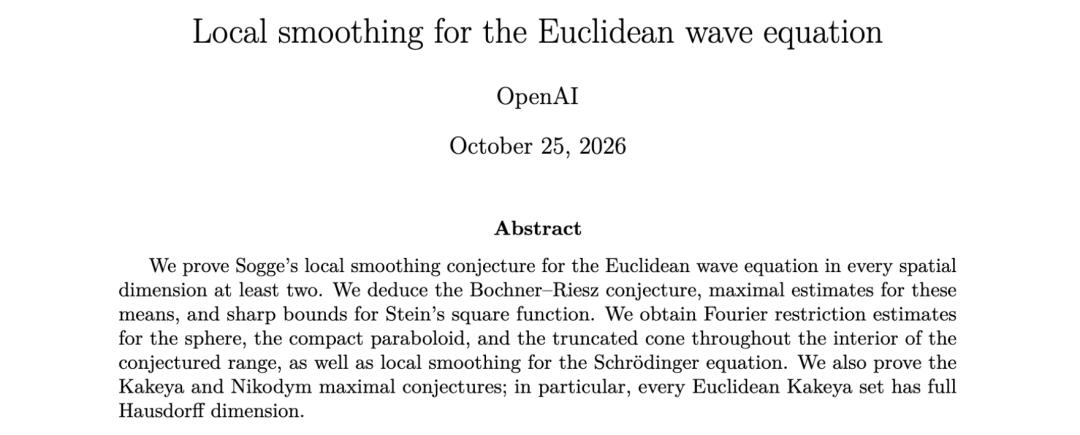
🔗 https://github.com/openai/math/blob/main/preprints/Local-smoothing-for-the-Euclidean-wave-equation-October-25-2026/paper.pdf
AI Overturned a Nearly 30-Year Foundational Assumption in Computer Science
Compared with the Kakeya conjecture, the achievements OpenAI has made in the field of computer science may have a more extensive impact on the entire algorithm research.
What was overturned by AI this time is the famous Exponential Time Hypothesis (ETH) in computational complexity theory.
This hypothesis was proposed around 1999 by researchers including Russell Impagliazzo, Ramamohan Paturi and Francis Zane, and its core question is how much computational cost a computer needs to pay when solving certain complex problems.
A typical example is the Boolean satisfiability problem (SAT).
Suppose there are a large number of conditions composed of logical variables, and the computer needs to judge whether there is a variable assignment method that makes all conditions hold at the same time. As the number of variables increases, finding the answer can become extremely difficult. ETH believes that for the general 3-SAT problem, there is no algorithm with time complexity of (2^{o(n)}), where (n) represents the number of variables.
In other words, the computation time of such problems in the worst case cannot be reduced to a sub-exponential level with respect to the number of variables.
Over the past nearly 30 years, ETH has become an important foundational assumption of computational complexity theory. Hundreds of academic papers take ETH as a premise to deduce conditional lower bounds of computational complexity for a large number of problems in fields such as graph theory, computational biology, and databases.
Now, OpenAI announced that its AI system has successfully proved that ETH is false, and has completed formal verification through Lean.
A foundational assumption that has supported hundreds of computer science papers is now expected to be overturned by AI.
This achievement means that some computational problems that have long been considered impossible to solve in sub-exponential time may have more efficient algorithms that have not been discovered before. A large number of conditional complexity conclusions built on the basis of ETH will also be re-examined.
The lineup of experts OpenAI invited for this research is also quite dramatic.
Russell Impagliazzo and Ramamohan Paturi from the University of California, San Diego, and Ryan Williams from the Massachusetts Institute of Technology will jointly lead the external research team.
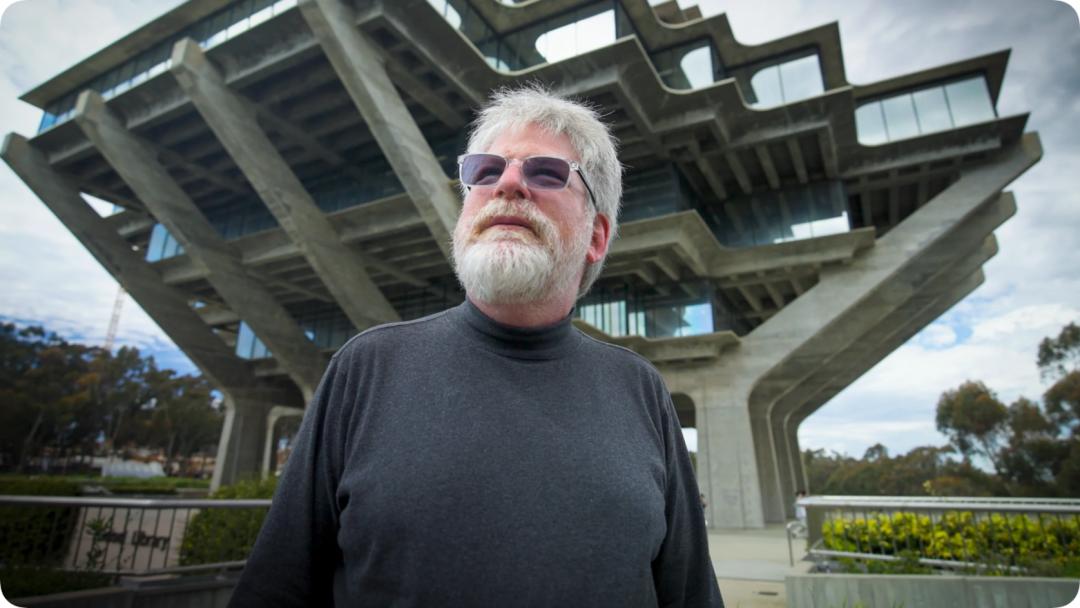
Among them, Impagliazzo and Paturi are exactly the original proposers of ETH.
OpenAI invited the scientists who proposed this hypothesis back then to personally participate in reviewing the AI's disproof of the hypothesis. OpenAI stated that the AI model generated a natural language disproof on October 16, completed Lean formalization the next day, and the two documents are now public.
The external research team also asked OpenAI to disclose all raw data and fund the holding of academic conferences to discuss the impact of this achievement on computational complexity theory, and OpenAI has accepted these requirements.
If this achievement is recognized by the academic community, humanity may need to rethink how much room for improvement there is in the computational difficulty limits that were previously identified.
Nobel Laureate in Physics Participates, AI Touches the Millennium Prize Problem
Among the three studies, the achievements in the field of theoretical physics may be the most complex and have the most fundamental scientific significance.
OpenAI announced that its AI model has constructed a rigorous mathematical existence proof for certain interacting quantum field theories containing gauge fields and fermions in 4-dimensional space.
The research involves quantum chromodynamics (QCD), a unified completion of the Standard Model of particle physics, and the existence problem of the pure Yang-Mills theory.
Modern particle physics mainly relies on the Standard Model to describe elementary particles and their interactions, involving electromagnetic force, weak interaction and strong interaction. Quantum chromodynamics specifically studies the strong interaction, explaining how quarks and gluons interact with each other.
Although the relevant theories have been verified in a large number of experiments, there are still some unresolved problems in their rigorous mathematical foundation.
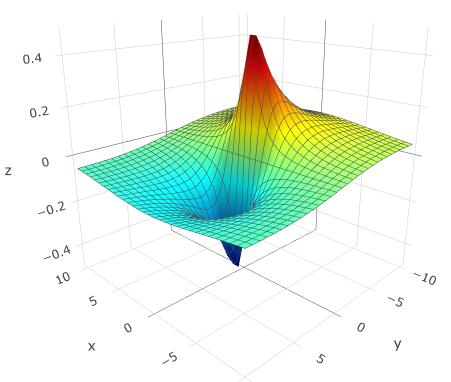
The Yang-Mills theory is the most famous example among them.
In 2000, the Clay Mathematics Institute of the United States listed the existence of the Yang-Mills theory and the mass gap problem as one of the seven Millennium Prize Problems, requiring researchers to strictly prove the existence of 4-dimensional quantum Yang-Mills theory and prove that it has a positive mass gap.
The results announced by OpenAI this time involve the existence part of it, and further advance the research to quantum chromodynamics and related unified theories.
OpenAI disclosed that the model generated a natural language proof of the existence of the Yang-Mills theory on September 9, generated a proof of quantum chromodynamics on September 18, and completed the Lean formalization of the existence proof of the Yang-Mills theory on October 16.
To further study this achievement, OpenAI invited five theoretical physicists to form a team.
The leader David Gross is the 2004 Nobel Laureate in Physics, who won the award for his participation in the discovery of the asymptotic freedom phenomenon in strong interaction, and his research laid an important foundation for quantum chromodynamics.
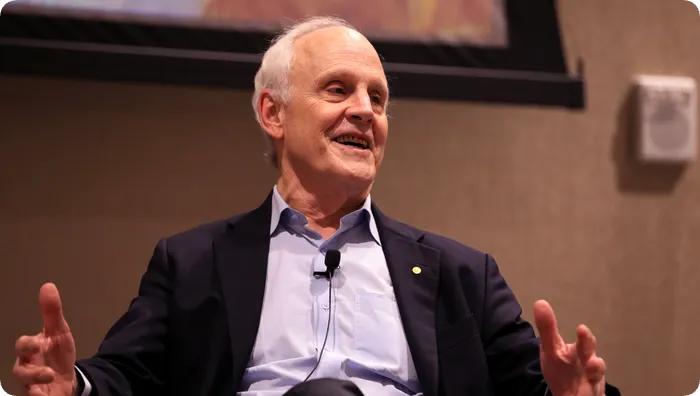
Other members include Michael Douglas, Arthur Jaffe, Igor Klebanov and Nikita Nekrasov, all of whom are important researchers in the fields of quantum field theory and mathematical physics.
Among them, Arthur Jaffe once participated in formulating the official statement of the Yang-Mills theory Millennium Prize Problem and participated in founding the Clay Mathematics Institute.
Considering that the content of the proof is very large, the expert team decided not to make the original materials generated by AI public for the time being, and the researchers will further sort out, review and write formal research results. If the research progresses smoothly, AI is expected to help physicists establish a more rigorous mathematical foundation for modern quantum field theory.
AI Starts Proving Difficult Problems in Batches, Scientists May Not Be Able to Keep Up
It is worth mentioning that on October 6 this year, OpenAI once publicly released 722 AI-generated mathematical research manuscripts at one go, involving 372 unsolved mathematical problems.
But later some proofs were found to have errors, OpenAI had to withdraw 3 manuscripts and revise 14 others.
Just 20 days later, OpenAI announced three major achievements, and at the same time changed its release strategy, treating AI-generated proofs as original research data, and inviting external scientists to participate in verification, interpretation and organization.
Mathematics results are made public directly, computer science results are reviewed by experts including the original proposers of ETH, and physics results are handed over to a team led by a Nobel laureate in Physics for research.
OpenAI also announced that it will not seek academic authorship for these discoveries, and will support scientists to carry out relevant research through the $5 million grant it previously provided to the Simons Foundation.
To a certain extent, AI scientific research is entering a rather absurd stage.
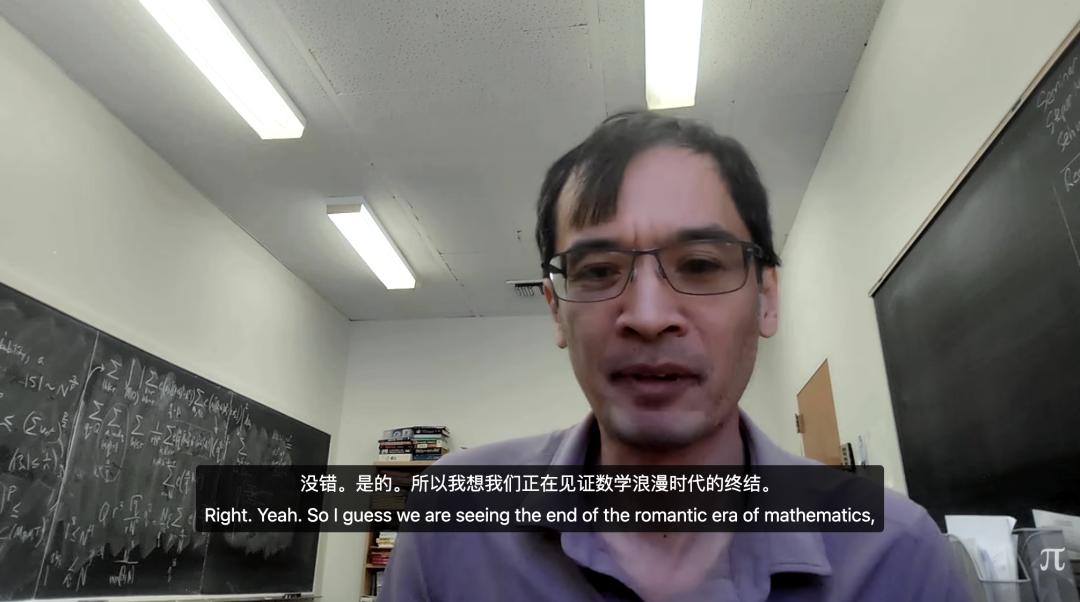
In the past, scientists might spend decades searching for a single proof. Now, AI can generate proofs in a few days, and even complete Lean formal verification, but scientists still need to spend a lot of time to truly understand what these achievements mean.
When the speed at which AI generates scientific results begins to exceed the speed at which humans can understand the results, the bottleneck of scientific research may shift from finding answers to verifying and digesting answers. Scientific problems that once plagued humanity for decades may be answered by AI more and more in the future.
AI has started to hand in its papers