Nomura: The ChatGPT moment for global robots is just around the corner.
Recently, the humanoid robot sector has continued to see positive catalysts. Unitree Robotics once raised its product prices by 20%, drawing high market attention to the robot industry.
A few days ago, Nomura released a research report on global robots, putting forward a relatively calm and more important judgment: The real "ChatGPT moment" for robots will not be announced at a launch event, but quietly confirmed by a set of operational indicators and data flywheel.
The research report compares current robotics technology to the AlexNet moment in 2012 — deep learning has proven its value, but robot brains have not yet reached the GPT-2 level; new models to be released between December and January may be closer to GPT-2, but still do not meet mass production conditions.
In other words, the robotics industry is standing on the eve of an outbreak, but the outbreak is not a single point event, but an endurance race that shifts from model competition to data flywheel, hardware consistency and operational verification.
From AlexNet to GPT-2: The Real Coordinate of Robot Brains
The core analogy of the research report is: Robots are retreading the old path of large language models, but starting at an earlier point.
LLMs have gone through three stages: massive pre-training, instruction fine-tuning, and reinforcement learning trial and error, and robots will follow the same path. Scientists at NVIDIA judge that robot training will also evolve from broad learning to fine-tuning for specific tasks, and then continue to improve through trial and error.
But current robot brains have not yet reached the GPT-2 stage:
There are already budding results in the lab, but no model is yet competent for practical work.
The 1.5 model of the AGI company can learn a task with only 3 to 12 seconds of demonstration, achieving a 59% success rate in 10 tests without additional training, which rises to 83% after only 5 minutes of supplementary training with data; Skild AI's S1 can learn to make coffee by watching human videos; Ant's Robbyant Zero-WAM achieves a 47.0% success rate in simulated environments across 7 unseen tasks, 29.5 percentage points higher than the best peer model.
These results do show signals of GPT-3-style few-shot learning, but they all come from internal enterprise tests, with short tasks or running in simulated environments. The CEO of Skild AI also stated bluntly that S1 is not ready to enter households yet.
Therefore, the research report still positions robot brains at the GPT-2 level or lower.
Where is the real breakthrough more likely to come from? Nomura judges that it will be large AI labs and Tesla, rather than pure robot brain startups.
Labs have computing power, talents and general models, while Tesla has a closed data loop, factory test environments and a fleet of robots in active use.
Google Gemini Robotics 2 was released in July 2026, with a success rate of up to 91.3% for complex multi-step tasks, and its full-body control capability is about one year ahead of Chinese competitors;
OpenAI is expected to release a model designed specifically for physical AI between December and January, and Altman expects to see "impressive demonstrations" of OpenAI robots in 2027;
Wang Xingxing also revealed that Unitree has tested GPT-6 on robots with very ideal results, and believes that GPT-7 is expected to break through the embodied AI bottleneck next year.
The catalysts are indeed dense, but model releases only push robot brains from below GPT-2 to near GPT-2, and there is still a long way to go before the real outbreak.
Three-Track Competition: VLA, World Model and Simulated Reinforcement Learning
The technical routes for robot brains are diverging into three directions: VLA, world model, and reinforcement learning in simulation.
VLA observes the scene, receives instructions and outputs actions, usually paths that lower-level controllers can follow. The airborne VLA model has about 2 to 7 billion parameters, requiring chips and storage worth about 30,000 to 40,000 yuan.
What will the world model predict to happen after the robot acts?
According to Li Feifei's framework, it includes a renderer, a simulator and a planner; World Labs' Atlas reaches 100 to 200 billion parameters, a world model that generates full videos requires 3 to 10 times more computing power, while the streamlined version running on compressed internal representations only needs 30% to 100% more computing power.
It is estimated that by 2027, world models will run on the cloud, responsible for training robots and generating data, while compact VLA and RL models will run on the robot body.
Simulated reinforcement learning trains actions through trial and error inside a physical simulator. Unitree's walking robots are the most famous example, where skills trained only in simulation have worked on real machines.
These three routes are not mutually exclusive, but are competing to become the "brain" of robots.
The research report mentions that early VLA models such as π0 and GROOT spend most of their capacity on language, so they know what an object is, but do not know how the object moves; WAM uses video generation as a physics engine, and frame-by-frame video prediction can teach the model gravity, buoyancy and light, predicting what will happen next and what the robot should do in one step, so that it can handle new scenarios without additional training.
The Dream Dojo research goes further, using a video model to replace the physics engine, allowing robots to practice in many simulated worlds at the same time.
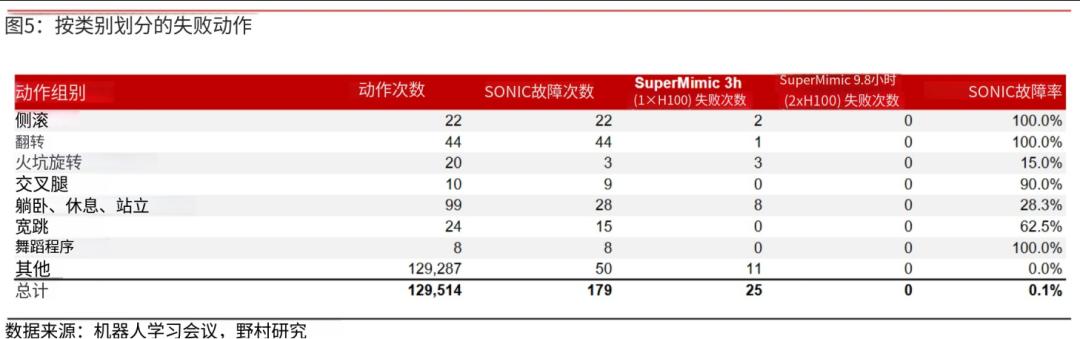
The SuperMimic paper demonstrates the transformation of training methods: running for only 3 hours on a single GPU, the model outperforms the baseline model trained on 128 GPUs for 7 days, reducing computing resources by more than 1000 times; in 129,514 action tests, the old method failed 179 times, the new model failed 25 times after 3 hours of training, and achieved zero failures after running on 2 GPUs for 9.8 hours.
This reminds us that we should train robots within the learned model rather than the original simulator, and use more motion data to train a single controller.
But the research report also emphasizes that pre-training is only half of the whole process. For continuous improvement, the model needs data generated by robots working in the field.
Data Flywheel: 1 Million Hour Critical Point and Video Scaling Law
Data is exactly the bottleneck restricting the development of robots.
Language models can learn using text from the entire Internet, but robots lack similar data sources.
Teleoperation allows humans to guide robots to collect data, which is both expensive and slow, and the data is bound to specific robot models, making it unusable once the robot changes from legged to wheeled.
The critical point given by the research report is about 1 million hours of data, roughly equivalent to the total time accumulated by a person in his lifetime; currently, the available data collected in a unified format is only about 100,000 hours, and the high-quality data of leading enterprises is only hundreds of thousands of hours, and the data collected by Tesla Optimus has just exceeded 500,000 hours.
10 million hours are required to start training, and more than 100 million hours are needed in the long run, while the industry has only accumulated several million hours so far.
More critically, a large amount of data is invalid: only about a quarter of Unitree's recorded time can be utilized, and only one hour out of every four hours of recording is valid.
The market structure of data collection also confirms the existence of this bottleneck.
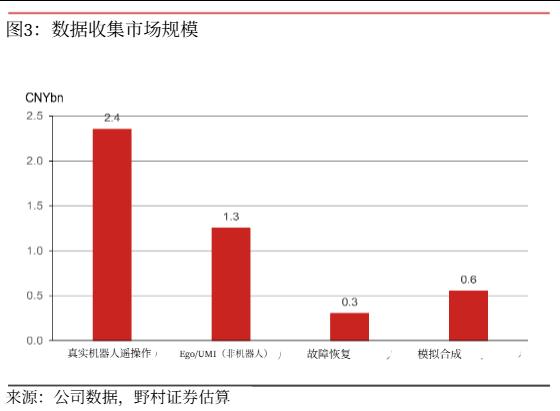
Nomura estimates that the size of China's data collection market in 2026 is about 4 billion to 5 billion yuan, of which physical robot teleoperation accounts for about 2.4 billion yuan, first-person video and UMI about 1.3 billion yuan, simulation about 600 million yuan, and fault recovery about 300 million yuan.
In terms of cost, teleoperation costs about 700 yuan per hour, UMI about 100 to 300 yuan, first-person video about 300 to 350 yuan, and simulation about 120 yuan. Teleoperation data is the most expensive and bound to specific models; first-person video and UMI have lower costs, and videos as camera footage can be reused across different generations of robots; simulation is the cheapest, but its data share in real-world perception tasks does not exceed 20%.
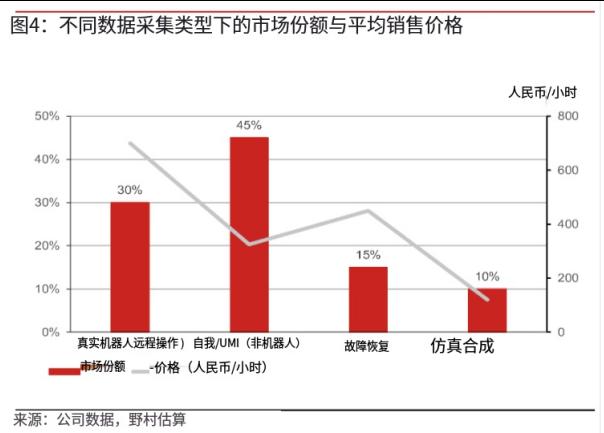
This is exactly why the industry is shifting to video: the typical data composition is already 60% first-person video, 30% UMI, and 10% real robot data.
NVIDIA EgoScale first trains with more than 21,000 hours of daily first-person video, and then fine-tunes with a small amount of teleoperation and motion capture data; for hand manipulation, more pre-training computing power can bring stable and predictable performance improvement, which is consistent with the scaling law that drives the development of LLMs.
If human videos become the main data source, whoever has the best data processing workflow and the strongest computing power will gain the greatest advantage. This further highlights the importance of large AI labs, and also limits the long-term value of teleoperation data bound to specific robot designs.
But the real ChatGPT moment comes when the positive feedback loop starts to operate: working robots generate data, data optimizes models, and better models are more widely applied.
Tesla plans to collect 1 million hours of valid data by the end of 2026 through training with about 10,000 self-owned facility robots; from Q2 to Q3 2026, Optimus's data cost dropped by about 18.1%.
In contrast, the deployment scale in China is much smaller: in 2026, the seven largest courier companies are expected to purchase less than 500 humanoid robots, and only about 1,000 units in 2027.
The research report therefore judges that the positive feedback loop will first start in a scenario where one company owns both robots and models.
OpenAI purchased about 10 million hours of data between September 2025 and August-September 2026, accounting for about 70% of the US supply; DeepMind purchased about 20%, equivalent to one third of OpenAI's purchase volume.
Independent data collectors still have a collection window of about three years, but as Chinese data cannot be exported and AI companies rely on their own collection, the number of data suppliers is expected to decrease by the end of 2027.
In other words, the threshold of the data flywheel is not "whether there is data", but "whether it can continuously obtain valid data at low cost and achieve closed-loop iteration".
Dexterous Hands and Consistent Manufacturing: The iPhone Moment on the Hardware Side
After the model path is determined, the design of humanoid robots will gradually converge into several standardized forms, which the research report calls the "iPhone moment" in the hardware field. After that, the most difficult part will be how to manufacture each device in a unified or similar way.
A humanoid robot has more than 20 joints. If there are slight differences in the behavior of different robots, the control strategy trained on one robot may only be applicable to a few other robots.
Therefore, the final winners will be enterprises that can iterate quickly and strictly control costs, such as Unitree Technology, automakers and key component suppliers.
In terms of mass production costs, the research report estimates that the cost of a 1.7-meter-high robot is between 150,000 and 200,000 yuan, and the cost of a 1.3-meter-high robot is between 30,000 and 40,000 yuan; actuators — motor and gearbox assemblies — account for 50% to 75% of component costs.
Unitree currently covers about 80% to 90% of the BOM with self-developed design, and about 50% of self-developed manufacturing, with third-party modules accounting for 10% to 15%; as production increases, it is expected to increase the outsourcing ratio to maintain low costs while ensuring quality.
Dexterous hands will be the first to benefit, because more powerful AI is solving the data shortage problem that has hindered robots from using complex grippers.
In the past, many robots used grippers simply because there was too little data available to train hands; more powerful foundation models can transfer skills learned from two-finger or three-finger grippers to five-finger hands, thus achieving greater grasping capacity and lower prices.
Nomura expects shipments of dexterous hands to increase by 80% to 120% year-on-year in 2026, with high-degree-of-freedom technologies leading this trend; 30% to 50% of factory grippers will be replaced this year.
In terms of price, the average ASP of different technical routes such as linkage, rope-driven and direct drive are all declining, but the shipment growth of high-degree-of-freedom hands is faster. The outbreak on the hardware side is not simply "replacing grippers with human hands", but a process where after AI capabilities improve, hardware value shifts from grippers to dexterous hands, actuators and key components.
Five Operational Indicators: Hard Thresholds for the Outbreak Moment
Nomura put forward five tests to judge whether robotics technology has entered the "ChatGPT moment", and currently the performance of robots in all these tests is far less than expected.
First, how long can the robot work continuously before needing human intervention: the best-performing robot currently can only run for a few hours, while factories require continuous operation for a week without human intervention.
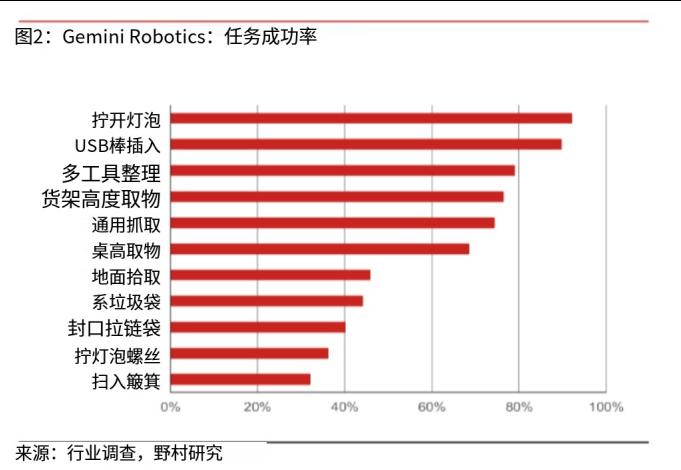
Second, fine manual operation capability: the Apollo 2 robot equipped with Sharpa Wave hand — Gemini Robotics 2 — only has a 44% probability of tightening garbage bags and a 32% probability of sweeping garbage into the dustpan.
Third, the speed at which the model adapts to new robot bodies: Google needs about 7 to 8 hours, while more advanced Chinese manufacturers take about two weeks.
Fourth, the number of demonstrations required to complete a new task: it has dropped to 1 or 2 times in the laboratory environment.
Fifth, the operation accuracy in the factory environment: the current industry test result is only about 60%, while the industry requires more than 98%. Nomura expects it to take 3 to 5 years to close this gap. The research report believes that the first and fifth items are the most important, because they determine whether customers are willing to pay for robots from the operational budget rather than the trial budget.
These five indicators constitute the hard threshold for the "real outbreak moment". Model releases, demonstration videos and few-shot learning cases can create