The RMB fund is oversubscribed, the USD fund has achieved its first close, and the "Researcher Fund" Starlink Capital takes the lead in the AI venture capital track.

"Cognition determines returns, and we only invest in the top 1% of top-tier researchers."

In China, if we talk about the area with the most concentrated scientific research strength, AI talents and entrepreneurial resources, the answer must be Zhongguancun. More precisely, it refers to the 5-kilometer radius around Tsinghua University and Peking University, which is also known as the "Cosmic Center" in the eyes of internet practitioners. A well-known investor once summed up that if you draw a square bounded by "south of Tsinghua University, east of Peking University, west of Xueyuan Road, north of Dazhongsi", the performance of invested projects located inside the square is significantly better than those outside. Nowadays, leading domestic AI enterprises in Beijing are highly clustered in this area, and well-known VC institutions serving the AI industry are also gathered here. Among the VC institutions rooted in this region, Starlink Capital has the most distinct features: since its establishment, it has focused on investment in the upstream and downstream of the AI industry, and closely integrated cutting-edge research, early-stage investment and entrepreneurial incubation by co-building an AI incubator with Tsinghua University.
Strong winds rise from tiny blades of grass. Since its establishment in 2021, Starlink Capital has positioned itself as a new-generation "AI-native" investment platform. In its first year, it acted as an angel investor to lead the investment in Zhipu AI, which is now recognized as "the first global large model listed company". After five years of exploration, Starlink Capital has continued to deploy cutting-edge artificial intelligence with a long-term perspective, with a cumulative investment scale of tens of billions of yuan, and its investment portfolio covers more than 100 high-growth enterprises. With continuous deep cultivation, a large number of portfolio enterprises have joined the unicorn camp and become leading enterprises in various sub-sectors of domestic artificial intelligence, and several companies have entered the final sprint stage for IPO.

After completing the final close of its third VC fund and the first phase of its growth fund in the first half of 2026, Starlink Capital completed the first close of its first USD fund in October. Since then, it has officially formed a dual-currency fund structure, further improving its investment layout of "covering all stages and connecting domestic and overseas markets".
Times and market conditions are evolving. The last round of internet entrepreneurship was essentially operation-driven, where enterprises built competitive advantages through product iteration, user growth and operational efficiency. The AI industry shows a more distinct research-driven trait: intelligence determines everything. Top-level intelligent capability is equivalent to top-level business efficiency; the choice of research topics and judgment on technical routes by top researchers are increasingly becoming the core points for AI enterprises to build competitive advantages in the new era. Therefore, building research-oriented enterprises around top researchers has also become the core proposition of industry and investment in the AI era.
Starlink summarizes this change as: "The AI industry is no longer a competition for ordinary talents, but a competition for geniuses." Top researchers can not only judge what problems are worth exploring, but also have the ability to lead the team to achieve breakthroughs. The starting point of a new direction may only be a paper, an experimental result, or even an idea yet to be verified. At this stage, to identify opportunities, investors need to predict the value of these explorations, and also understand why the researchers are willing to devote years of effort to them.
This is also the reason why Starlink Capital has long been deeply engaged in the researcher community. Starting from Tsinghua University, its researcher network has gradually extended to top universities, laboratories and technology companies at home and abroad. Continuous communication around the latest papers, technical routes and entrepreneurial issues allows the Starlink investment team to understand what technologies researchers are exploring, what problems they are good at solving, and what kind of partners they need. The understanding of technology and judgment on talents are gradually formed in such communication and cooperation, which also gives Starlink Capital the opportunity to identify the technical value and growth potential of startups before they receive widespread market attention.
Driving investment with research, and supporting AI enterprises at different development stages and targeting different markets through dual-currency funds, is the consistent direction that Starlink Capital keeps promoting.
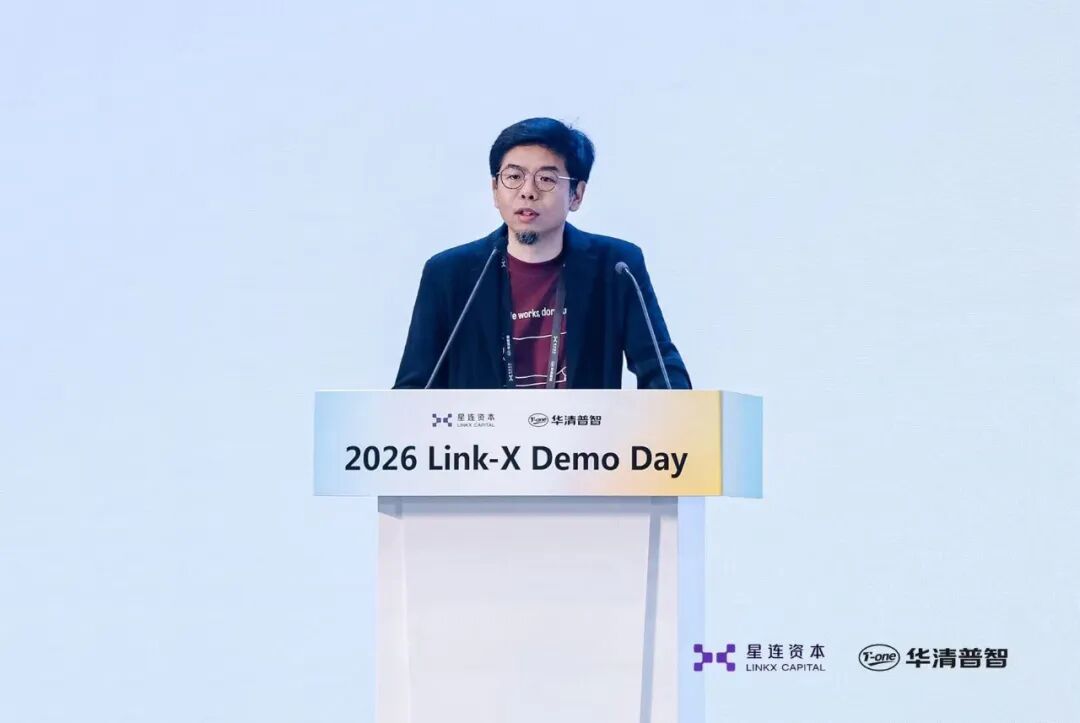
Figure / Mingchen Zhang, Founder of Starlink Capital
AI Industry Investment Strategy
Cognition determines returns, we only invest in the top 1% of top-tier researchers
"VC is essentially a business of realizing the value of cognition, and cognition needs to be iterated continuously with the development of the times." Mingchen Zhang, founder of Starlink Capital, summarizes Starlink's investment logic with this statement. In his view, the industrial ecology, technology stack and entrepreneurs in the AI era are all brand new, and investors need to "break their original cognitive inertia and move forward in a world full of acceleration".
Most Chinese funds began to systematically deploy AI after 2023. Even at present, AI investment is still the work of a research team in many investment institutions. As early as 2020, when the primary market was in a fundraising winter, Mingchen Zhang decided to establish a fund that only invests in the upstream and downstream of the AI industry. From fund establishment, team formation to project screening, AI has always been the main line of Starlink's investment layout, which makes it the first vertical fund in the market that truly takes AI as its only theme.
By tracing to the source, first-class cognition comes from the native AI research gene. In order to become the VC that understands AI best, Starlink has started a layout that can gather the top researchers in the AI industry - from founders, LPs, cooperative institutions, team members to portfolio enterprises, all of them are closely related to top universities at home and abroad such as Tsinghua University. It co-builds an incubator with Tsinghua University; more than 70% of its more than 100 invested enterprises are Tsinghua-related projects, covering nearly 50 Tsinghua professors; the expert advisory network composed of CEOs of portfolio enterprises, chief scientists and top industry researchers, as well as the construction of a unique AI-native research community, provides continuous support for technical discussions, project judgment and entrepreneurial cooperation.
In addition to the widely recognized "Tsinghua label" in the industry, Starlink Capital has given itself another definition: Researcher Fund. From Starlink's perspective, "whether in Silicon Valley or China, the fastest-growing batch of AI companies are increasingly approaching the form of research institutes. The core of the company is no longer just a mature professional manager system, but a group of researchers who are truly standing at the cutting edge of technology." Understanding the research methods, talent structure and growth path of these companies has also become an important basis for Starlink to build its own investment capabilities.
This means that research needs to be implemented in specific investment judgments: where the technical breakthrough of a direction lies, whether the current team has the ability to continuously promote it, and at what stage it is worth participating in the investment.
Facts later also verified that the researcher fund understands genius entrepreneurs better, can invest in top technologies earlier, and obtain excess returns.
In terms of project selection, Starlink follows the direction of AI technology evolution and continuously looks for investment opportunities at different levels of the industry. It contacts 2500 to 3000 projects every year, and the final investment ratio is about 1%. One type of enterprises it focuses on are companies with SOTA level in their respective technical directions: SOTA is the abbreviation of State-of-the-Art, which refers to the world's highest level in a certain field. Taking the global technological frontier as a reference is an important standard for Starlink to evaluate the technical competitiveness of enterprises.
To judge whether an enterprise can reach this standard, the final evaluation still returns to the team. "The anchor point of investment decision is people. Routes, tracks and timing are all variables, and truly top researchers can find the way forward on their own." When evaluating researchers, Starlink mainly focuses on three aspects: Research Ability, Research Taste and Research Leadership. Specifically, researchers should not only have the ability to conduct high-level research, but also know what problems are worth investing in, and be able to attract and organize a group of excellent people to explore together.
Among AI entrepreneurs around Tsinghua University, "Starlink has invested" has gradually become a technical credit mark - this statement was originally spread only in a small circle, and later cited by more and more researchers and entrepreneurs. Therefore, many projects are willing to go to Starlink Capital's office in Tsinghua Science Park for communication even when they are still in the gestation stage. Starlink is also happy to help everyone find partners and clarify directions, and for projects it is optimistic about, it often continues to follow up investment from the first round. Taking the first half of 2026 as an example, Starlink has invested in a total of 40 to 50 enterprises including new and existing projects.
Up to now, Starlink's investment portfolio has covered the entire industrial chain including chips, AI Infra, foundation models, multi-agents, embodied intelligence, AI-native applications, smart hardware, etc., and has spawned a number of SOTA companies in multiple directions including Shengshu Technology, Wall Intelligence, Infinite Core, Jiliu Technology, Qujing Technology, Super Evolution Intelligence, Qianhe Yibang, Arctic Core, Aifei Intelligent Pharma, Qiuzhi Technology and many others.
As AI investment evolves from forward-looking layout to industry consensus, Starlink Capital can still maintain its leading position in the AI industry, which is based on a consistent value judgment: both entrepreneurs and investment companies need to have judgment and insight into technology, adapt to the state of "crossing the river by feeling the stones", and then look forward to the surprises brought by the unique non-linear value change of the AI industry.
AI Industry Investment Ecosystem
Combined efforts to provide precise empowerment for scientific entrepreneurs
In this round of AI entrepreneurship, scientists and researchers often play the core role of the team. From producing a research achievement, to forming a team, polishing products and finding customers, entrepreneurs need to face a series of new problems. No one understands better than Starlink what top scientists are good at and what they need when starting a business.
Starlink summarizes the core post-investment task in the AI field as "helping scientists transform into scientific entrepreneurs". In order to solve the pain points in this role transformation, Starlink Capital has built a complete post-investment service and support mechanism for such entrepreneurs: matching commercial teams, connecting industrial resources, iterating cutting-edge industry cognition, etc.
This is a highly targeted combined post-investment strategy. The primary part of it is to help scientists "form a team" and solve their worries. For example, Starlink matches them with suitable commercial CEO and COO teams, which are responsible for underlying technology, engineering implementation and business operation modules respectively, to achieve precise complementarity and close cooperation.
At the same time, Starlink Capital has also established an advisory board for portfolio enterprises, maximizing the efficiency of the top AI scientific research talent resource pool. This advisory board, composed of 40 to 50 CEOs and chief scientists of portfolio enterprises, has multiple roles such as mutually recommending projects, verifying technologies, and connecting upstream and downstream resources, gradually forming an industrial collaboration network among portfolio enterprises.
The tracking of scientific research frontiers also runs through daily work. The investment team of Starlink Capital contacts 50 to 60 new projects every week, and the industry research team collects the latest papers and cutting-edge information every week, and organizes founder workshops for portfolio enterprises by theme. More than 100 industry sharing activities every year enable the investment team, experts and entrepreneurs to maintain high-frequency communication, and test and update judgments in discussions of specific issues.
In order to continuously discover excellent researchers and new entrepreneurial opportunities, Starlink Capital has built a researcher support platform, so that point-to-point connections gradually converge into an expanding researcher network. For young scholars aged 25 to 35, Starlink Capital has launched the Constellation Fellowship, through continuous support and regular communication, to understand what they are researching and what they hope to do in the future. With mutual recommendation and cooperation among researchers, new partners continue to join, and new entrepreneurial ideas have the opportunity to sprout from it. In this process, Starlink Capital also transforms the researchers' cutting-edge cognition of technology into capital power, connects funds and industrial resources for potential research directions, and supports research achievements to move towards entrepreneurial practice.
Starlink Capital has attached importance to such post-investment support since its establishment, and Jiliu Technology is a typical case among them. Jiliu Technology is a company engaged in independent intelligent computing cluster business. Starlink Capital has invested in it since the Series A round and continued to follow up investment. In addition to financial support, Starlink Capital also helped the company open up the early market. When its AI infrastructure business was not yet widely used by customers, the company obtained its first order of tens of millions of yuan through customers connected by Starlink Capital. For a technical team, this order not only means that the product has been recognized by customers, but also gives the team the confidence to move forward. What Starlink Capital provided at this stage is a key commercial verification.
Under such long-term and precise post-investment support, there are many typical investment projects that have quickly achieved phased results. Chaoyan Intelligence, as a representative domestic AI for Science enterprise, has a core team composed of returned scholars from MIT and project leaders from the School of Artificial Intelligence of Tsinghua University, and has now realized the automation of the creative generation link. Aifei Intelligent Pharma, an AI pharmaceutical enterprise, has improved the efficiency of small molecule virtual screening by 1 million times through the high-dimensional space model matching method, and relevant achievements have been published in the journal *Science*, and it has obtained cooperation intentions from top pharmaceutical companies. Qiuzhi Technology, founded by the former core product manager of DJI, polishes the world model in reverse starting from the robot body, and explores a collaborative path between hardware-side feedback and model training.
AI Industry Development Judgment
The rhythm is accelerating, and the form is evolving
The rapid development of the AI industry around the world is reshaping product forms, industrial patterns and entrepreneurial methods, so the investment and service methods of funds also need to be adjusted accordingly. Whether we can grasp opportunities in the changing situation depends on the current judgment of the development logic of the AI industry.
From Starlink's perspective, the VC industry is undergoing "generational replacement and differentiation". The key to differentiation lies in whether institutions can form effective judgments in a shorter time and provide corresponding resources when enterprises need them.
The rhythm of industrial development has changed, and the interval between different growth stages of enterprises is also shortening. In the past few years, the maturity cycle of the AI industry has been significantly compressed. It usually takes about ten years for traditional TMT companies to go from establishment to IPO, but in this round of AI cycle, some enterprises established in 2023 have already entered the IPO stage. The formation of industry consensus is also accelerating. Although the valuation of many projects has reached the level of the PE stage in the past, their growth potential and risks still have VC attributes, and the originally clear boundary between VC and PE is becoming blurred. This also requires AI investment institutions to adapt with a faster rhythm and strategy.
At the same time, the competitiveness of Chinese AI