The rise in express delivery fees during the Double 11 shopping festival cannot be a mere price increase without any improvement in service quality.
This year during the Double 11 shopping festival, when all consumers are looking forward to deep discounts, merchants have received a quite different notice: express delivery prices have risen.
This price hike is not an isolated case of a single express delivery company or a certain region, but a widespread industry-wide upward adjustment.
According to a report by Securities Daily on October 15, many express delivery companies including YTO Express and STO Express issued notices stating that starting from 0:00 on October 12, they will raise express parcel prices in Shandong region in consideration of enterprise costs; in addition, a large number of e-commerce customers in Yiwu, Zhejiang Province have received another price increase notice. Starting from 0:00 on October 13, express delivery enterprises will raise the delivery price of parcels, with different increase standards ranging from 0.1 yuan to 0.2 yuan per parcel.
Earlier in September, ZTO Express, YTO Express, STO Express and J&T Express had already issued price increase notices in some regions.
The media outlet "Di Kuaidi" also revealed that on October 21, franchised express delivery companies have successively issued notices on peak season network policy adjustments: for bulk parcels sent to the same destination with a settlement weight exceeding 100kg, based on the original bulk cargo fee standard, the front end will add 1 yuan per kg, and 0.8 yuan per kg will be paid to the terminal outlets.
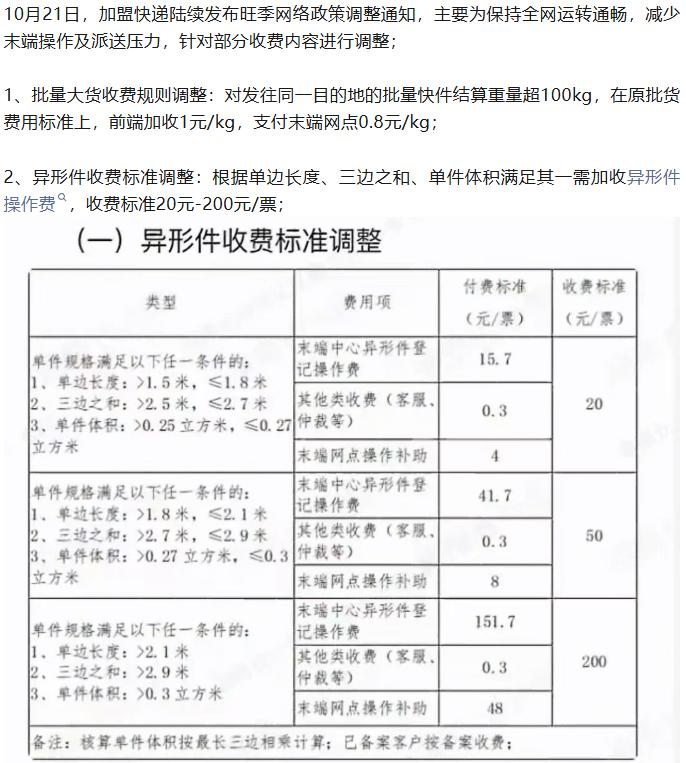
The price hike during the Double 11 period is not unique to this year, but it is different this year.
The stated reasons for this price increase may be to maintain fair competition, keep the logistics network unobstructed, or ease the pressure of terminal operation and delivery. Though the wording varies, the general direction remains the same: anti-involution.
The resonance of peak season and anti-involution are the most prominent features of this express delivery price hike, which is also a particularly obvious difference compared with previous years.
Up to now, the price increase itself is not the goal, and the healthy development of the logistics network is. However, this road is not easy to take, and there is still a long way to go.
The price increase only brings the originally hidden express delivery costs to the surface. The real test lies in whether the service quality has been improved after the price rise.
Discussions on social media that "I feel the express delivery speed has slowed down this Double 11" have coincided with this wave of price hikes that has continued since September, which is rather awkward.
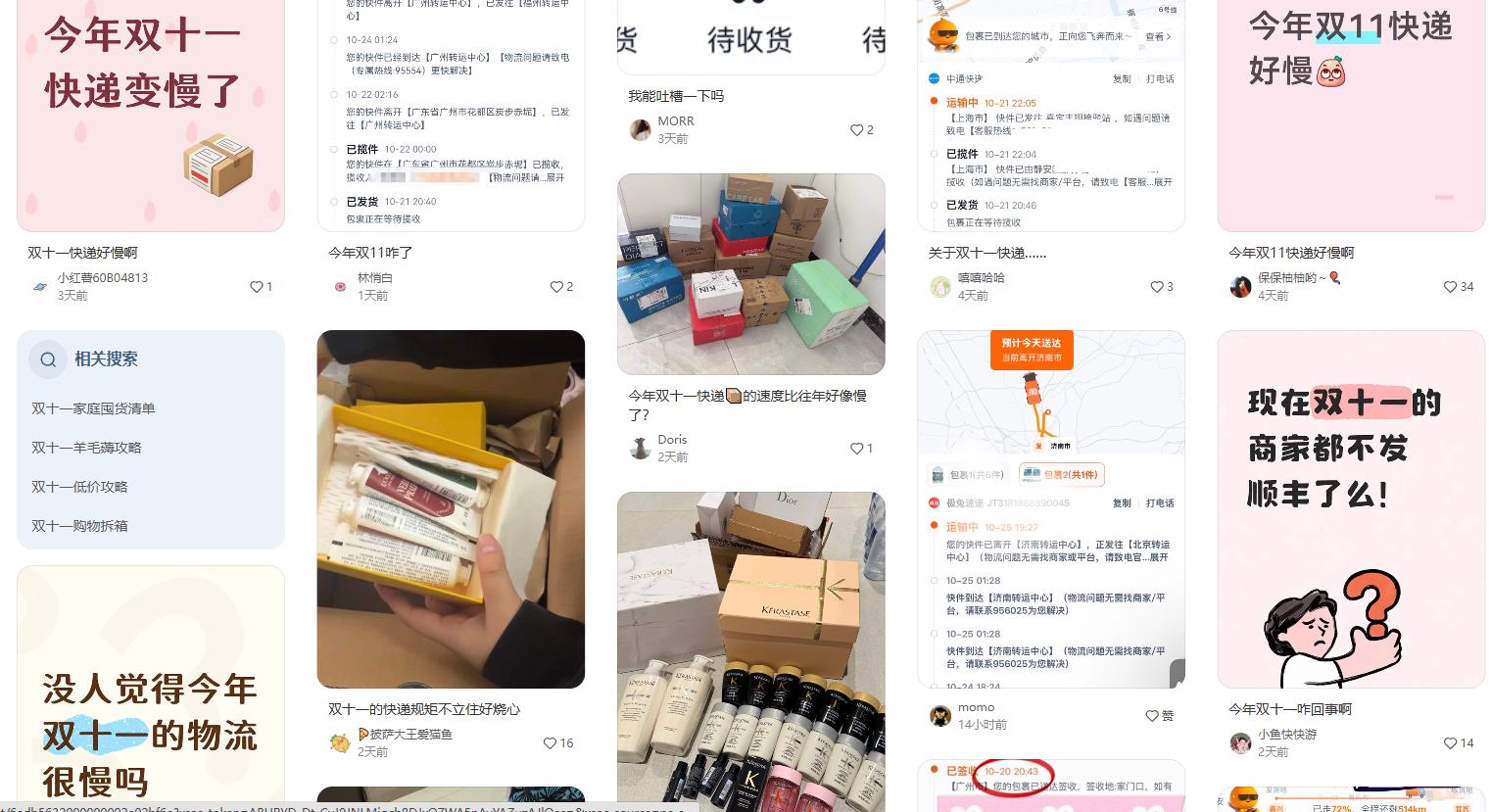
From the personal experience of the Delivery Guide during the Double 11 period, the situation is the same: no obvious improvement in delivery speed has been felt, and express delivery companies such as YTO Express and STO Express do not provide door-to-door delivery services.
Part of the reason lies in the inherent chain structure of the express delivery industry itself.
The express delivery industry is a typical multi-level chain consisting of headquarters, provincial branches, outlets and couriers. This structure determines that the impact of price hikes will not be transmitted evenly, but will be redistributed at each level.
At the beginning of this year's Double 11 shopping festival, a front-line courier working for a franchised express delivery company told Delivery Guide that he had no idea whether there would be subsidies or higher delivery fees during the Double 11 promotion period.
Although this situation cannot represent the whole industry, coupled with the long-standing complaints on social media about the reduction of delivery fees for front-line couriers, it is enough to show that the positive impact of the rising express delivery prices under the anti-involution policy has not been fully transmitted to the terminal end.
All links in the express delivery industry perform their respective duties. Only when the benefits of price increases are transmitted to every link can the workforce be more stable, the service quality be improved, and finally consumers can enjoy high-quality express delivery services.
Therefore, anti-involution, price hikes and the abandonment of vicious competition below cost are what the industry, consumers and the market need. But the conditions required to achieve this goal are far more complex than the two words "price hike": the headquarters of express delivery companies must be willing to allocate profits and supervise the distribution to every level of the network in place; express delivery companies also need to adjust their rules, reduce unreasonable assessments, so that the staff at every level of the network can breathe easily and deliver good services.
The price hike is only the beginning, and the rest is the hard part.