Listed pharmaceutical companies are setting off a wave of land transactions.
In 2026, land trading transactions among A-share listed companies in the healthcare sector have emerged in an endless stream.
A review of these transactions reveals that they are completely different from the collective practice of "hoarding land for value appreciation" by listed companies in earlier years. The underlying logic of this round of land transactions is not the rise and fall of asset prices, but the restructuring driven by industrial cycles.
Simply put, on one side, high-boom tracks are ramping up physical production capacity, while on the other side, traditional pharmaceutical companies are reducing burdens to replenish cash flow. Between buying and selling, capacity iteration and balance sheet optimization in the healthcare sector are unfolding layer by layer.
Ramping Up Production Capacity in High-Boom Tracks
As the healthcare industry has become a highly sought-after driver of local economic development, land acquisition and purchase by listed companies have come naturally.
In 2026, Kangtai Biological (300601.SZ), a company mainly engaged in vaccine business, acquired a plot of land in Nanshan, Shenzhen through public bidding, with a transaction price of 75.9 million yuan. According to the announcement, the plot will host the Baiwangxin dual-use (for regular and emergency scenarios) vaccine R&D and production base, namely the Kangtai Life Science Research Institute project.
Specifically, the project is positioned differently from ordinary commercial production workshops, adopting the "dual-use for regular and emergency scenarios" construction concept. In the regular operation phase, it will serve as a platform for vaccine R&D, pilot testing and industrialization, supporting the iteration of the company's conventional vaccine pipelines and mass production of products. In case of public health emergency needs, the base can quickly switch production capacity to undertake the production and reserve tasks of emergency vaccines.
Coincidentally, in 2026, Minova (603538.SH), whose main business covers active pharmaceutical ingredients (APIs) and pharmaceutical excipients, finalized cooperation on industrial land in Ningnan New Town, Ningbo, planning to build a "global industrial base for high-end oral solid preparations and complex injections".
Minova stated that the existing factory area has limited space and cannot accommodate the continuously growing overseas orders for complex preparations. The new base will focus on deploying production lines for high-difficulty injections and characteristic solid preparations, targeting the formulation contract development and manufacturing (CDMO) demands of overseas markets such as Europe and the United States, and increasing the upper limit of order acceptance for overseas customers.
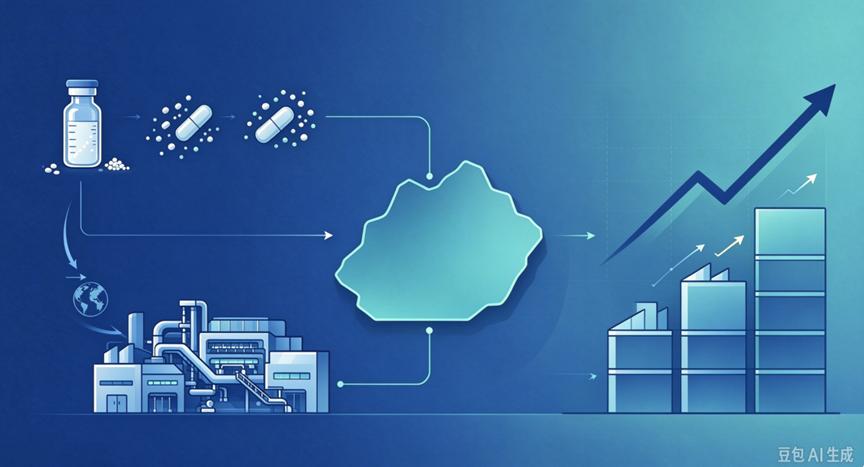
In other words, with the continuous transfer of the global generic drug industrial chain to China, the API track has become the main force in land acquisition for capacity expansion. Fundamentally, the driving force comes from the growth of overseas orders, which puts higher requirements on the scale of production capacity and quality systems for domestic upstream players.
In 2026, Shanhe Pharmaceutical Excipients (300452.SZ), whose main business is pharmaceutical excipients, successfully won the bid for Class III industrial land in Huainan Economic Development Zone at a price of 24.4087 million yuan. The core logic behind this move is that against the backdrop of accelerated overseas expansion of pharmaceutical preparations, pharmaceutical enterprise customers' demand for high-end, customized pharmaceutical excipients continues to rise, while putting forward higher requirements for the cleanliness level and continuous production capacity of excipient production workshops.
In addition, other listed companies that acquired land in 2026 include Zhongjian Health Bridge (874239.BJ), which won the bid for R&D land on Guangzhou Huangpu Bio-Island; Lianhuan Pharmaceutical (600513.SH), which built a science and innovation headquarters in Yangzhou High-tech Zone; Tide Pharmaceutical (03880.HK), which acquired industrial land and existing factory buildings in Qiantang District, Hangzhou; and Yichang Yangtze River Pharmaceutical (01553.HK), which acquired industrial land in Dongyang Economic Development Zone, Zhejiang, among others.
The direction of these transactions is mainly biased towards R&D headquarters and small-scale pilot and pilot test platforms, which are characterized by heavy R&D attributes and light large-scale manufacturing. On the whole, the goal of listed companies in acquiring land is not land value appreciation, but to undertake orders, implement industrialization projects, and build R&D transformation platforms.
Established Enterprises Divest Low-Efficiency Assets
In contrast to the land acquisition camp, many listed companies in 2026 are busy selling land, returning land, and receiving government land expropriation compensation. There are three main types of asset disposal: public listing for transfer, government land expropriation and reserve, and returning idle land to the government. Each type corresponds to different strategic demands of enterprises.
First, publicly listing and transferring land and factory buildings. In 2026, Lemei Pharmaceutical (300006.SH) announced that it plans to publicly list and sell its old factory area in Nan'an, Chongqing, with a reserve price of over 30 million yuan. According to available data, the old Nan'an factory was built long ago, and its hardware facilities can no longer meet the requirements of modern pharmaceutical production. In response, the enterprise launched a production line relocation plan.
Similarly, Taiji Group (600129.SH) has started multiple batches of low-efficiency asset clearance, and disposed of 7 idle properties and their supporting land use rights located in Chongqing and Shanghai as a package. Since 2026, the cumulative cash returned from the disposal of this batch of assets has exceeded 30 million yuan. The enterprise stated that the core purpose of this asset revitalization is to divest low-efficiency and non-core assets, recover funds, and concentrate resources on core traditional Chinese medicine products, channel construction, and R&D innovation.
Second, government land expropriation and reserve, which mainly stems from urban renewal adjustments, and belongs to the realization of stock assets through relocation and transformation. In 2026, Lukang Pharmaceutical (600789.SH) received compensation for the land expropriation project of its south factory area. The total compensation for the expropriation of the entire factory plot is about 360 million yuan, and the funds are paid in batches according to the relocation progress. In the future, the enterprise will use the funds for the construction of new production bases and the upgrading of production lines, to complete the relocation of old production capacities to modern industrial parks.
Third, returning idle land to the government. This type of move is mainly initiated by listed companies to terminate contracts voluntarily and avoid penalties for idle land. In 2026, Ogawa (002614.SZ) announced that it would return the land in Longwen District, Zhangzhou to the government, and the government will return the land payment previously paid by the enterprise in accordance with the agreement.
When it acquired the land initially, Ogawa planned to deploy health equipment industrial projects, but due to subsequent changes in the market environment, the project failed to start construction for a long time. China's land management regulations have strict constraints on idle land, so the enterprise finally chose to voluntarily terminate the land transfer contract and return the plot.
Essentially, the three models are strategic asset sorting for listed companies, with highly consistent underlying motivations, that is, asset disposal can not only quickly replenish cash flow, but also concentrate resources to focus on their main business.
Restructuring of Asset Structure
The buying and selling of land reflects that the healthcare industry is undergoing a restructuring of its asset structure.
In terms of industry, industry differentiation is intensifying. High-boom tracks such as CDMO and high-end excipients continue to expand production capacity to seize the next round of production capacity high ground, while traditional generic drug and established traditional Chinese medicine enterprises accelerate the phase-out of backward production capacity to get rid of the heavy burden of fixed assets. The balance sheets of the two types of enterprises are moving in different directions: one is increasing heavy asset investment, and the other is reducing assets to replenish cash flow.
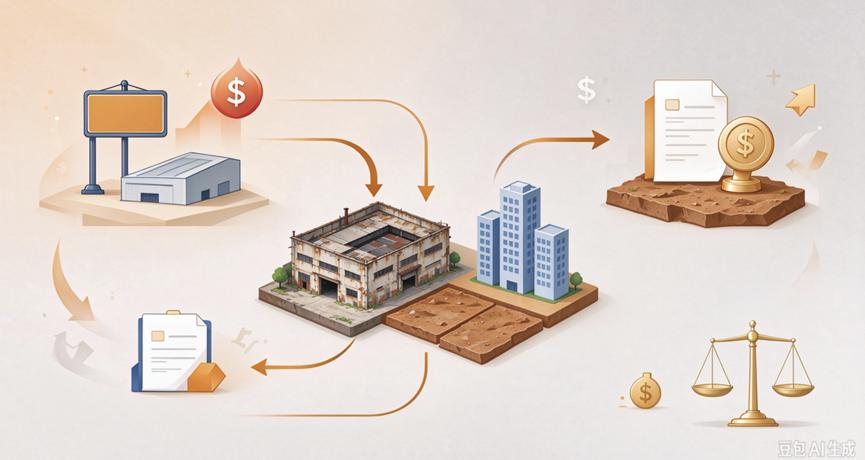
In terms of capital, the market is re-examining the heavy assets of pharmaceutical listed companies. Land value appreciation no longer constitutes a plus for valuation. Instead, the pipeline quality, order structure and capacity utilization rate behind the land and factory buildings have become the key to testing the quality of land-acquiring enterprises.
In the final analysis, asset restructuring is only a means, not a source of long-term value. Short-term land transactions can optimize cash flow and adjust the balance sheet, but the core competitiveness of pharmaceutical enterprises ultimately lies in the R&D pipelines and product competitiveness of drugs, vaccines and medical devices. This differentiated asset adjustment may continue, and the market will continue to test it.
(This article is for reference only and does not constitute investment advice. The market is risky, so investment needs to be cautious.)
This article is from the WeChat Official Account "Investor Network - Thinking Finance", author: Cai Jun, published by 36Kr with authorization.