A Decade of China's Shopping Malls: Why a Good Mall Is Not Necessarily a Good Investment?
Over the past decade, the rental income from shopping malls of several leading commercial real estate enterprises in China has multiplied several times. If only referring to the operating reports, this is almost an undisputed success. However, if we turn to another performance sheet from the capital market, the story presents a completely different outcome: some keep raising dividends, some cut dividends significantly, and a number of enterprises have finally delisted from the stock market.
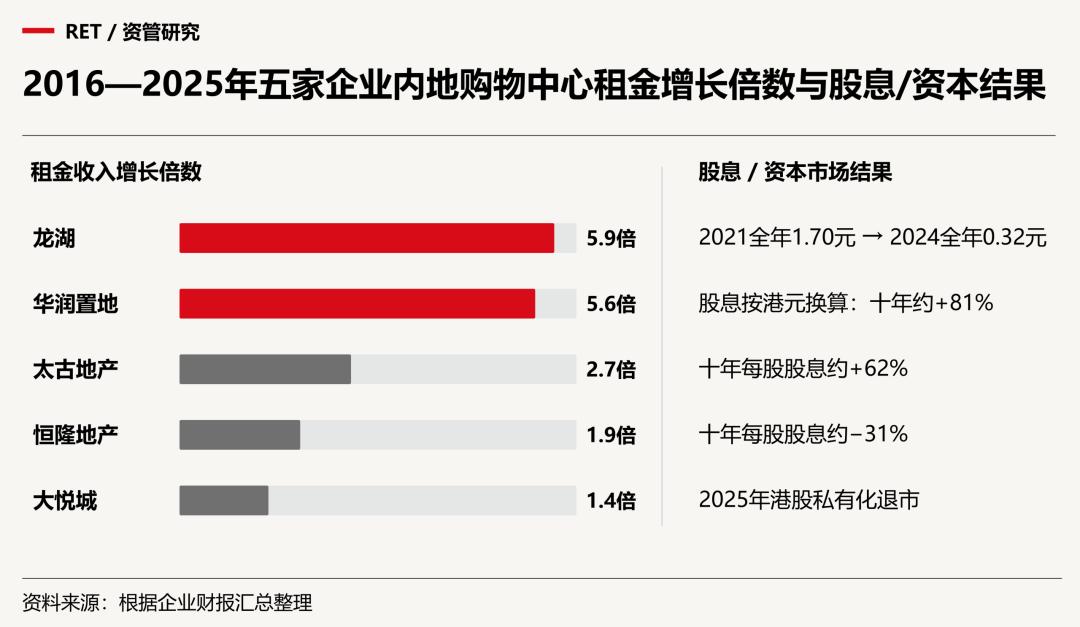
According to the statistical research on the financial reports of five enterprises including Hang Lung Properties, Swire Properties, China Resources Land, Longfor Group and Joy City conducted by RET, from 2016 to 2025, the total rental income of the five enterprises' shopping malls in Chinese mainland rose from about 12 billion yuan to about 46 billion yuan. Among them, the rental income of Longfor's shopping malls increased by about 5.9 times, that of China Resources Land increased by about 5.6 times, that of Swire Properties increased by about 2.7 times based on the estimated base period and consolidated statement caliber, and the rental income of Hang Lung's mainland shopping malls nearly doubled.
Nevertheless, during the same period, Swire Properties' dividend per share grew from HK$0.71 to HK$1.15, and China Resources Land's cumulative dividend per share converted into Hong Kong dollars increased by about 81%; while Hang Lung Properties' dividend per share dropped from HK$0.75 to HK$0.52, Longfor's dividend payout shrank obviously after hitting a peak in 2021, and Joy City Properties completed its privatization in 2025.
The five enterprises have different business compositions and capital structures, and the change in dividends cannot directly represent the return on investment of commercial assets. But when the two sets of data are combined, an unavoidable question still arises: why did the operating growth in similar directions fail to bring about capital results in the same direction?
RET Commercial Real Estate Research Center
Over the past decade, the shopping mall industry has devoted a lot of energy to studying how to attract consumers, boost sales and increase rental income, but relatively ignored the other half of the problem: how much capital does it actually take to create such growth, and how much operating income can truly be left to investors?
A shopping mall can enjoy heavy foot traffic, gather a large number of brands and keep its rental income growing, but if the price for acquiring the asset is too high, continuous additional investment is required to maintain operation, or the financing cost erodes most of the earnings, the seemingly excellent operating performance may not necessarily create ideal investment returns.
The deeper contradiction lies in that commercial operation pursues better operation of a shopping mall, while commercial investment pursues sustained returns at reasonable cost and risk. The two are interdependent but not naturally consistent.
In the era of rapid market expansion, this difference is easily covered up by growth. Newly added projects bring more rental income, asset appreciation can make up for part of investment mistakes, and convenient financing can support the next round of expansion. However, when consumption growth slows down and asset prices are readjusted, the problems hidden behind the operating performance sheets in the past will gradually emerge.
Therefore, looking back on the different experiences of the five enterprises over the past decade, what is worth studying is not which company is better at operating shopping malls, but a more universal question: whether a commercial real estate enterprise is creating operating growth or creating investment value?
With rental income multiplied several times, has capital efficiency also improved?
Around 2016, China's shopping mall industry was still in the stage of rapid expansion. About 465 new shopping malls opened across the country in 2016, the number reached about 531 in 2018, and there were still about 529 new openings in 2019. Urban expansion and consumption upgrading created a large number of new demands, and also provided growth opportunities for different business models.
Hang Lung adheres to the luxury-focused commercial positioning, Swire focuses on high-quality urban complexes, China Resources has formed a multi-level product system of MixC and MixC Mini, Longfor accelerates its national layout relying on its Paradise Walk brand, and Joy City builds market recognition through youth-oriented positioning and content operation. Their development paths are different, and all have shared the dividends of market growth, but there are obvious differences in the capital logic behind the rental income growth.
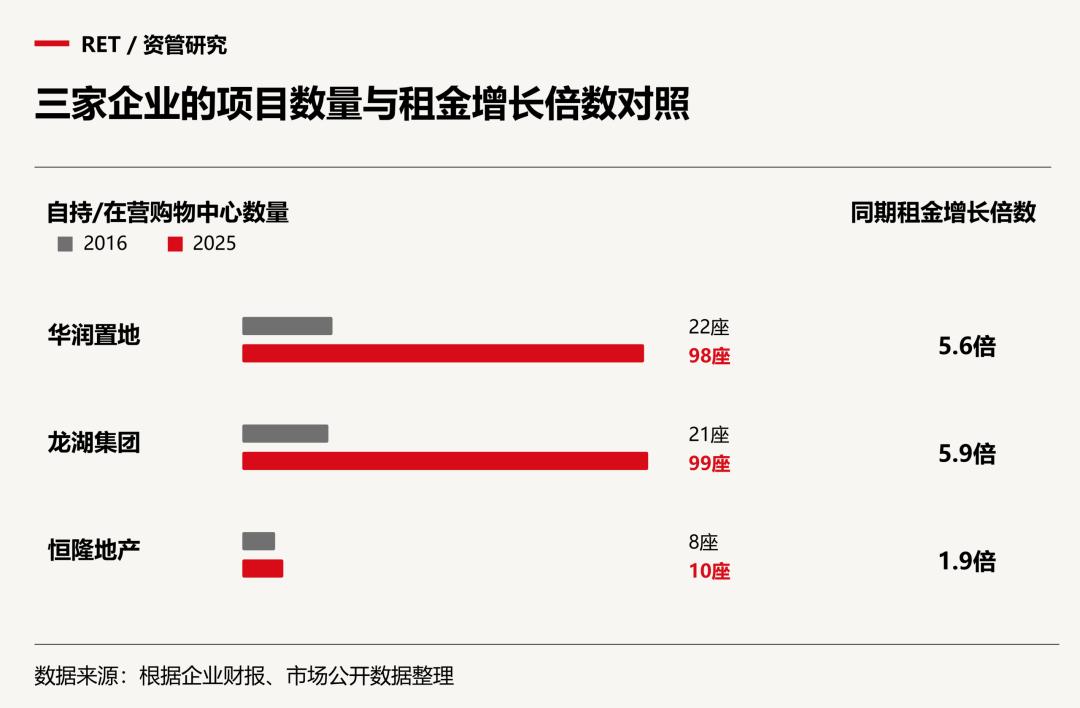
From 2016 to 2025, the number of self-owned shopping malls of China Resources Land increased from 20 to 98, and the number of operating shopping malls of Longfor increased from 21 to 99; during the same period, the number of Hang Lung's mainland shopping malls only increased from 8 to 10. The former two achieved growth largely by expanding the scale of commercial assets, while Hang Lung relied more on the long-term operation of a small number of high-value projects.
RET Commercial Real Estate Research Center
The most noteworthy point of this set of data is not who has faster rental income growth, but how much new capital needs to be paid for the rental income growth.
Assuming that two enterprises both increase their annual rental income by 1 billion yuan, one needs to invest 15 billion yuan to build new projects, while the other only invests 8 billion yuan by acquiring and renovating existing assets. Even if the final operating income is the same, their investment efficiency may be completely different. Of course, further comparison of operating costs, subsequent capital expenditures and asset risks is needed to judge which investment creates higher value.
In the past, the industry used to measure growth potential by the number of shopping malls, management area and rental scale, but these indicators cannot directly reflect the capital use efficiency. The increase in the number of projects may mean that the enterprise has acquired more high-quality assets, or it may mean that it takes up more capital and undertakes more operating risks.
In the incremental market, as long as new projects can continuously attract consumers, scale expansion has the opportunity to create growth. But after entering the stock market, expansion no longer naturally means value appreciation. If an enterprise keeps accepting lower return on investment just to maintain rental income growth, the growth may even start to erode value.
What commercial real estate deserves to pursue is not the maximization of rental income, but the maximization of long-term returns created by per unit of capital investment. This means that stopping an expansion with insufficient returns can better reflect excellent asset management capabilities than completing a sizable investment in some cases.
Why the competitive advantage of the last round may become the burden of the next round?
In the growth period, whether a business model is successful often depends on whether it can seize market opportunities. But after the cycle changes, the same business model may show completely different risk characteristics. Three changes in the past decade are particularly worth paying attention to: the return of luxury consumption in 2020-2021, the change in real estate financing environment around 2022, and the expansion of capital exit channels for commercial properties after 2023.
The first change took place in 2020-2021. Restrictions on outbound consumption promoted the return of luxury consumption to the mainland, and the size of China's mainland personal luxury goods market reached about 471 billion yuan in 2021. Luxury-focused commercial operators such as Hang Lung and Swire obtained special growth opportunities, and a small number of core assets generated quite substantial earnings. However, when high-end consumption adjusted in 2024, the same asset portfolio also faced a relatively concentrated demand shock. In contrast, China Resources' commercial products covering different consumption levels provided a certain buffer, and its shopping mall rental income still increased by about 8.4% in 2024. This does not prove that multi-product lines are necessarily better than the luxury-focused strategy, but reveals an important rule: the asset portfolio not only determines what kind of growth the enterprise can obtain, but also determines what kind of risks it has to bear.
The second change comes from the financing environment. In the past, profits from residential development and external financing could support the construction and cultivation of shopping malls. But when the real estate development cycle reverses, commercial assets may be affected by the group's debt and capital allocation even if they maintain stable operation. Longfor is a very representative case: its shopping mall rental income increased by about 5.9 times in ten years, but the growth of commercial operation did not make the group completely get rid of the impact of the real estate development cycle. Commercial properties continue to generate cash flow, but the group still has to face the pressure of debt repayment and financing structure adjustment.
The third change took place in the capital market. In 2023, consumption infrastructure was included in the pilot of publicly offered REITs, and the first batch of products were listed in 2024. Mature commercial properties began to have new equity capital recovery channels, and the independent pricing and capital recycling of commercial assets have a more realistic realization path.
These three changes constantly remind investors that there is no permanent advantage in commercial real estate that is independent of cycle conditions. Highly concentrating on high-quality assets, rapidly expanding scale, and relying on group financing to cultivate projects may all be effective in a specific period, but may also expose limitations after the environment changes.
For asset investors, the important judgment is not only how much money they can make when the market is booming, but also how much they will lose when the market deteriorates, and whether the enterprise still has the ability to adjust its strategies. This involves an easily ignored asset management capability: capital option.
When the market is in a downturn, some enterprises can only sell high-quality assets to repay debts, while other enterprises can take advantage of price adjustments to find new investment opportunities. What determines this difference is often not the mall's investment promotion capability, but the capital discipline and financial buffer formed over the past years. The capital structure not only determines whether an enterprise can withstand risks, but also determines whether it can use risks to create opportunities.
Shopping malls are getting better at doing business, why don't property owners necessarily earn more?
Over the past decade, the operation level of leading shopping malls in China has improved significantly. Brand investment promotion, member management, space renewal and digital operation are constantly maturing, and the occupancy rate of the five enterprises' shopping malls in the latest disclosure period is generally in the range of 94% to 98.8%.
However, high occupancy rate and high sales do not mean that property owners can obtain higher earnings synchronously. A noteworthy indicator is the rent-to-sales ratio, that is, the proportion of rental income in the tenant's sales. According to their respective research calibers, the rent-to-sales ratio of China Resources Land dropped from about 13.0% to 11.5%, that of Longfor dropped from about 17.5% to 13.7%, and that of Joy City dropped from about 11.1% to 6.4%.
The situation of Joy City is particularly worth studying. From 2021 to 2024, according to the sorted-out business caliber of Hong Kong-listed enterprises, the sales of its shopping malls rose from 24.92 billion yuan to 38.4 billion yuan, with a cumulative growth of about 54%; during the same period, the rental income increased from about 2.766 billion yuan to 3.023 billion yuan, with a cumulative growth of about 9.3%.
Although project securitization, consolidated statement adjustment and statistical scope changes during the period will affect the comparison results, the difference between sales growth and rental income growth still raises a problem worthy of attention for asset investors: how much of the commercial prosperity created by consumers can be transformed into the long-term earnings of asset holders?
Shopping malls do not directly own all the expenditures of consumers. The money paid by consumers first becomes the sales revenue of brands, and then is partially converted into property rental income through mechanisms such as lease contracts and point deduction arrangements. The property also needs to bear the costs of management, maintenance, marketing and continuous renovation, and finally forms the net operating income. Therefore, commercial operation is not only a process of creating consumption value, but also a process of determining how these values are distributed among brands, property owners and other participants.
There is an easily ignored contradiction here: a shopping mall may be very good at attracting consumers, but it does not necessarily have the same strong ability to obtain earnings. The growth of brand sales does not necessarily mean that the property owner can obtain the same proportion of rental income growth; even if the rental income grows, it does not mean that the cash obtained by investors increases synchronously after deducting all operating and capital expenditures.
Of course, the decline of rent-to-sales ratio does not naturally mean the deterioration of operation. Moderately reducing the rent extraction level may improve the profitability of tenants, enhance brand attractiveness, and create space for long-term operation. On the contrary, excessively pursuing current rental income may lead to brand loss and future income decline. Therefore, it is not that the higher the rent, the better, but whether the property owner can obtain sustainable net cash flow while maintaining the profitability of tenants and commercial competitiveness.
This actually requires a re-understanding of the value of commercial operation. In the past, the industry was more used to judging whether a project is successful by foot traffic, sales, occupancy rate and rental income; but for asset investors, they must also examine the operating expenses, capital expenditures and continuous investment required to create such growth.
What commercial operation needs to prove is not only how much consumption it can create, but also how much operating results can be transformed into long-term asset earnings. This is not to reduce the importance of operation, but to establish a stricter value evaluation standard for operation capabilities.
Why a good shopping mall is not necessarily a good investment?
A shopping mall with excellent operation does not mean that investing in it can definitely obtain ideal returns. This is the most important and easily ignored difference between commercial operation and asset investment.
Assuming that a shopping mall generates 100 million yuan of net operating income every year, and the market capitalization rate is 5%, according to the simplified direct capitalization method, its asset value is about 2 billion yuan. In the second year, the operation of the shopping mall continues to improve, and the net operating income increases by 10% to 110 million yuan. However, if the capitalization rate required by the market rises to 6%, the asset valuation will drop to about 1.83 billion yuan instead. That is to say, the net operating income of the shopping mall increased by 10%, but the asset valuation may drop by about 8%. This is not an operation failure, but the capital market has changed the pricing of future earnings.
Asset value not only depends on how much cash flow it can generate, but also depends on what price investors are willing to pay to buy these cash flows. Interest rate, risk premium, growth expectation and asset liquidity may all change the final valuation. This leads to an important principle of commercial real estate investment: good assets are not necessarily good investments, because the return on investment not only depends on the asset quality, but also depends on the purchase price.
The capital arrangements of the five enterprises exactly reflect this difference. Swire reallocates capital within the group by selling some non-core assets; Hang Lung begins to explore the long-term leasing model to reduce the demand for some new property rights investment; China Resources explores equity capital recovery with the help of tools such as publicly offered REITs; Longfor gives more play to the financing capacity of commercial assets through operating property loans. All these methods can support the development of enterprises, but their economic essence is different.
Selling or securitizing part of the asset equity has the opportunity to recover the long-term occupied capital, and reallocate the funds to other investment opportunities. Mortgage financing mainly obtains funds by increasing debts. Although it retains the property right of assets and future operating earnings, it still needs to bear the interest and debt repayment responsibility. There is no absolute advantage or disadvantage among different methods, and the key lies in whether the capital cost, risk and future investment opportunities match.
Joy City provides another observation perspective. In 2025, Joy City Properties completed privatization at a valuation corresponding to about 0.27 times of the fair value-measured net assets, while the assessed value of Chengdu Joy City, the underlying asset of the consumption infrastructure REITs, is about 3.24 billion yuan. Although the valuation of a single asset cannot be directly compared with the equity value of a listed company, the fact that the two adopt different pricing mechanisms is worthy of further research.
The value of a shopping mall mainly depends on the earnings it can create in the future and its risks. But the equity value of a listed company is also affected by factors such as group debt, other businesses, management expenses, capital allocation and corporate governance. Therefore, owning high-quality commercial assets does not mean that the enterprise can fully make the value of these assets reflected in shareholder returns.
In 2026, the development of commercial real estate REITs has given new significance to