$65 billion in ARR, $80 billion in net losses, the most powerful AI company has lifted its veil of mystery
Anthropic may not be the largest IPO in history, but it is definitely one of the most anticipated IPOs. On the evening of October 26 Beijing Time, people waiting for Anthropic to release its public S-1 prospectus directly crashed the official website of the U.S. Securities and Exchange Commission (SEC).
This company was founded only five years ago. In 2021, seven former OpenAI members left to start their own businesses; five years later, Anthropic overtook its former employer in both valuation and revenue. In May this year, it surpassed OpenAI with a post-money valuation of 9.65 trillion US dollars, becoming the world's most valuable AI startup. At the end of July, its ARR reached 650 billion US dollars, while OpenAI's was about 400 billion US dollars in the same period.
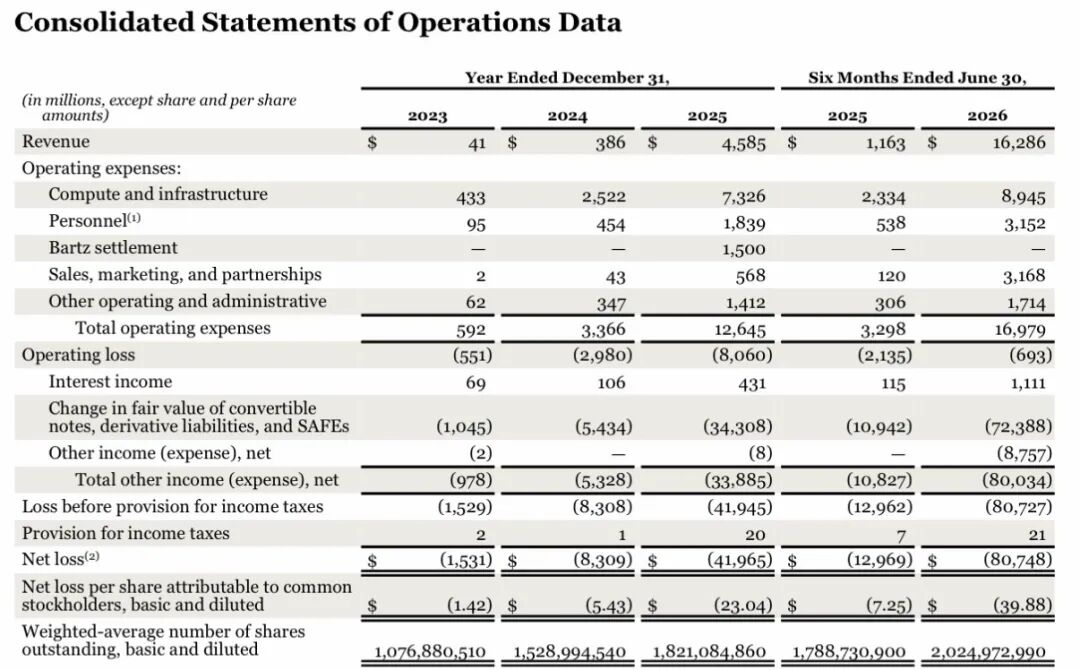
The prospectus shows that Anthropic's revenue in the first half of 2026 increased by about 13 times year-on-year to 162.86 billion US dollars, of which revenue billed by API usage accounted for 80% and subscription revenue accounted for 20%. During the same period, the book net loss exceeded 800 billion US dollars, but this was mainly affected by changes in the fair value of financing instruments. After adjustment, the company has achieved profitability with an operating profit margin of 10% and a gross profit margin of 85%.
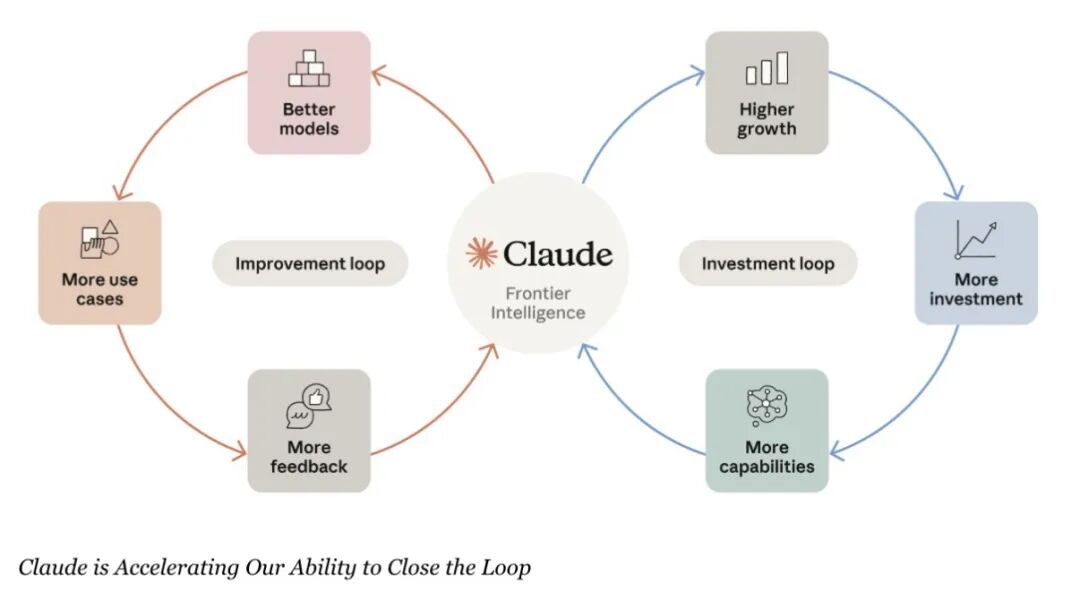
Shortly before the prospectus was made public, according to Reuters, due to the slowdown in the company's sequential revenue growth, some investors who attended Anthropic's Investor Day discussed lowering their IPO valuation expectation from the previous 2 trillion US dollars to around 1.5 trillion US dollars. This figure is only the expectation under discussion among investors, and the final issuance valuation has not yet been determined. If issued at a valuation of 1.5 trillion US dollars, it will be lower than the 1.77 trillion US dollar valuation of SpaceX's IPO in June this year.
Investors' concerns are not groundless. Even Anthropic, the front-runner, is not yet sufficient to prove that large models are a good business.
High computing power costs, leading advantages that may shrink at any time, and unproven long-term returns may all change the profit curve of this business. The answers given by the prospectus are far more complex than a report card of adjusted profitability.
01. The most profitable large model company with an operating profit margin of only 10%
Many brokerage analysts who have long focused on US stock technology companies told "DingJiao One" that they are cautious about Anthropic's financial data. This adjusted profitable prospectus not only failed to strengthen market confidence, but also exposed problems in the business model of cutting-edge model companies.
The primary problem is reflected in the revenue structure and growth mode.
The prospectus shows that from 2023 to 2025, Anthropic's revenue increased from 41 million US dollars to 4.585 billion US dollars, with a two-year compound growth rate of about 957%. The revenue in 2024 and 2025 was about 9.4 times and 11.9 times that of the previous year respectively, which is equivalent to the revenue scale roughly doubling 10 times on average every year.
In the first half of 2026, Anthropic's revenue scale further increased to 162.86 billion US dollars, a year-on-year increase of about 1300% compared with 1.163 billion US dollars in the first half of 2025. At least from the data up to the end of Q2 2026 in the prospectus, the revenue slowdown that investors care about has not yet occurred.
The change in ARR (Annualized Recurring Revenue) behind the revenue can better reflect the terrifying growth rate of Anthropic. At the beginning of 2025, Anthropic's ARR was only 1 billion US dollars, and by the end of the year it was almost 9 billion US dollars. In April this year, Anthropic officially disclosed that the company's ARR exceeded 300 billion US dollars, surpassing the 250 billion US dollars that OpenAI had disclosed to the public two months earlier.
Enterprise customers are the main factor driving the company's growth.
The prospectus shows that as of September 30, 2026, Anthropic's customer group includes more than 11,900 customers who contributed 100,000 US dollars or more in revenue in the past 12 months (TTM); more than 1,900 customers who contributed 1 million US dollars or more in revenue; and about 250 customers who contributed 10 million US dollars or more in revenue.
In terms of revenue types, Anthropic's revenue is mainly divided into two categories: billing by API usage and subscription. Usage-based revenue increased from 288 million US dollars in 2024 to 38 billion US dollars in 2025, with the proportion rising from 75% to 83%, and further reached 131 billion US dollars in the first half of 2026, with the proportion slightly falling back to 80%. During the same period, the proportion of subscription revenue was 25%, 17% and 20% respectively. Usage-based payment occupies the main position, and the revenue is closely related to the frequency and scale of customers' continuous calls to the model.
The prospectus also discloses a detail that is easy to ignore. Model versions released within the six months ending September 30, 2026 contributed more than 80% of the revenue within the three months ending that date.
A US dollar fund investor told "DingJiao One" that this is relatively common in the large model field, and revenue growth is largely driven by new models. Companies need to constantly update versions and maintain leading positions to sustain revenue growth. Once there is no update for a long time, or the new model lags slightly, revenue may be greatly impacted.
Another hidden danger in the prospectus is reflected in the profit margin.
From 2023 to 2025, Anthropic's net losses were 1.531 billion US dollars, 8.309 billion US dollars and 419.65 billion US dollars respectively. The net loss in the first half of 2026 expanded to 807.48 billion US dollars, about 6.2 times that of 129.69 billion US dollars in the same period of the previous year.
This huge loss needs to be analyzed separately. In the first half of 2026, the loss from changes in fair value of convertible notes, derivative liabilities and SAFE reached 723.88 billion US dollars. The rise in the company's valuation will push up the fair value of relevant liabilities, resulting in non-cash losses. The principle is similar to the preferred stock fair value loss common in Hong Kong stock IPO companies, but the tool structure and accounting treatment are different. The relevant revaluation will not stop until the tools are converted, repaid or settled, which is not a loss generated at the operating level.

The operating level has achieved break-even. In the first half of 2026, Anthropic's GAAP operating loss was 693 million US dollars, the adjusted operating profit was 1.618 billion US dollars, the adjusted operating profit margin was 10%, and the adjusted net profit was 2.671 billion US dollars.
This is basically consistent with the data previously reported by foreign media. In August this year, foreign media reported that Anthropic achieved positive adjusted operating profit for the first time in the second quarter. At the Investor Day in October, the company disclosed that its revenue in the third quarter was 168 billion US dollars, a sequential increase of about 45%, achieving adjusted profitability and positive cash flow for the second consecutive quarter.
It can be seen that Anthropic's profit margin is not generous, and profitability mainly depends on the rapid expansion of revenue scale, as well as computing power efficiency and cost control. Scale growth is bet on frequent model updates and continuous leadership. Once the improvement of model capabilities slows down, revenue, profit and subsequent R&D investment may have a chain reaction.
Of course, large model companies do not only have the business model of selling APIs. Embedding advertisements is a high-profit business model, which OpenAI is doing. But Anthropic promised in the prospectus that Claude will never embed advertisements, and explained that although advertising may bring considerable revenue, the company hopes that Claude's only incentive is to provide helpful answers, avoiding the pressure of pursuing user engagement brought by revenue targets.
This choice maintains the product positioning, which also means that Anthropic still needs to rely on model calls and subscription revenue to prove its profitability at this stage.
02. Carrying a computing power bill of more than 800 billion US dollars, locking in the next ten years
At this stage, AI large models are still not an easy business to do, and Anthropic is well aware of this. Therefore, the special feature of this prospectus is that a large amount of space is used at the beginning to talk about AI safety and the company's unique equity setup to avoid the risk of AI getting out of control, trying to explain how to maintain long-term goals beyond commercial returns.
Since Anthropic was registered as a Public Benefit Corporation (PBC) at the time of its establishment, it is legally required to take into account the interests of shareholders, groups affected by the company's actions, and the public interest goal of responsibly developing and maintaining advanced AI. This arrangement incorporates safety goals into the company's articles of association, but it cannot automatically eliminate commercial pressure, nor can it guarantee that the company will always give priority to safety.
In terms of governance structure, the Long-Term Benefit Trust (LTBT), through Class T common stock, usually has the right to elect and remove the majority of Class T directors occupying the authorized seats of the board of directors, and Class T does not enjoy economic rights. The Founder LLC established by the seven co-founders will obtain one share of Class F common stock before listing, corresponding to 50.1% of the voting rights of general voting matters of shareholders, and also does not enjoy economic rights.
Both the public interest goal and founder control are written into the post-listing structure, and public shareholders need to accept this special distribution of power. This structure answers who the company hopes to guard its long-term mission, but whether the mission can be implemented depends on whether the company has enough money to continue investing. Model R&D, talent retention and computing power procurement all require long-term funds.
The financing scale and specific investment amounts of this listing have not been disclosed. The general uses listed in the prospectus include working capital, operating expenses and capital expenditures. Capital expenditures cover computing power and infrastructure investment, and funds will also be used to recruit and retain high-skilled talents. The company may also acquire or invest in related businesses, products, services and technologies, but there are no major acquisition or investment agreements and commitments at present.
It can be seen from the financing destination that the two core expenditures of AI large model companies are still talents and computing power.

Source / pexels
In terms of talents, as of September 30, 2026, Anthropic has about 5,300 employees, and the revenue corresponding to each employee in the past 12 months exceeds 6.6 million US dollars, which is significantly higher than the average level of the largest listed companies in the United States.
In terms of computing power, the prospectus discloses multiple long-term agreements. The five-year equipment lease rent related to Broadcom is about 1612 billion US dollars, excluding interest; the rental expenditure for obtaining NVIDIA GPU computing power from SpaceX AI is up to 1205 billion US dollars; the service commitment paid to Nscale is up to about 446 billion US dollars.
In addition to the above contracts, Anthropic also promised to pay Amazon at least 1.1 trillion US dollars from 2026 to 2036, pay Google about 1.145 trillion US dollars from 2026 to 2033, and have an additional estimated TPU computing power expenditure of 1250 billion to 1.5 trillion US dollars. The long-term arrangements related to Microsoft and Lambda also reached 449 billion US dollars and about 413 billion US dollars respectively. Different agreements are inconsistent in terms of minimum payment, maximum expenditure, delivery conditions and cancellation clauses. The total computing power-related bills disclosed in the prospectus are about 8.5 trillion US dollars.
These contracts have changed the company's cost elasticity. The prospectus states that most computing power is purchased 12 to 18 months in advance, and the expenses are recognized after the computing power is available, so recent expenditures are relatively fixed. Too low demand forecast may lead to missed revenue and R&D progress, while too high forecast may lead to idleness, and the hardware and facilities locked today may lose cost advantage in a few years.
The relationship between Anthropic and cloud vendors has therefore become more complicated. Amazon, Google and Microsoft are not only shareholders and computing power suppliers, but also may be supporters of customers, distribution channels and competitors at the same time. They provide capital and infrastructure for Anthropic, and Anthropic locks in future expenditures with long-term procurement commitments. Listing can supplement funds, but it cannot make this business break away from this investment network composed of talents, chips, cloud vendors and long-term contracts.
03. A reference point has been obtained for pricing large models
Anthropic's prospectus is not only a performance display of a cutting-edge model company, but also provides a new valuation anchor for the current large model industry.
Looking back at the changes in Anthropic's valuation, several nodes in 2026 are particularly critical.
In February, Anthropic completed a G-round financing of 30 billion US dollars, with a post-money valuation of 3.8 trillion US dollars. The company disclosed at that time that its ARR was about 140 billion US dollars, and Claude Code contributed 25 billion US dollars; in April, on the private secondary market platform Forge Global, Anthropic's implied valuation once hit 1 trillion US dollars, while OpenAI's was about 880 billion US dollars in the same period. In the same month, Anthropic disclosed that its ARR exceeded 300 billion US dollars.

Source / Unsplash
Shortly after one month, Anthropic completed a H-round financing of 650 billion US dollars, with a post-money valuation of 9.65 trillion US dollars, which is the latest publicly disclosed valuation of the company before listing. According to Bloomberg, Anthropic disclosed to investors that its ARR had increased to 650 billion US dollars by the end of July.
Since the final IPO market value is still uncertain, taking the