36Kr Exclusive丨The full-body tactile solution provider that has received investments from HSG, GL Ventures and Zhiyuan has secured a new round of financing at the hundred-million-yuan level, whose core team members are from the Hong Kong University of Science and Technology.
Author | Qiao Yujie
Editor | Yuan Silai
This article is approximately 2500 words, with a recommended reading time of 5 minutes
36Kr learned that MoSense, a full-body multimodal integrated tactile solution provider, recently completed a 100-million-yuan Angel+ round of financing, led by CDH Investments and Oasis Capital, with follow-on investment from ExDynamics, Loongson Ventures, CAS Star, WestSummit Capital, Pudong Venture Capital and a leading domestic embodied intelligence manufacturer. Houlang Capital served as the long-term exclusive financial advisor. Previously, the company had obtained Angel round financing with participation from HSG, GL Ventures, and Agibot, etc.
MoSense was founded in May 2026, incubated by the championship team of the Hong Kong University of Science and Technology robotics competition. Dr. Yan Zhaoxu, co-founder and CEO, graduated from the Department of Microelectronics of the Hong Kong University of Science and Technology, and has long been engaged in research on high-frequency systems, electromagnetic algorithms and embodied multimodal sensing. Dr. Zhou Hang, co-founder and CTO, graduated from the robotics major of the Hong Kong University of Science and Technology, and used to be a senior algorithm researcher at a vehicle-grade autonomous driving enterprise, with long-term research experience in end-to-end autonomous driving models, world models and embodied intelligence algorithms.
MoSense focuses on full-body multimodal tactile solutions for humanoid robots. Different from manufacturers that mainly provide electronic skin hardware, MoSense's differentiated advantage lies in its ability to provide a complete technical chain from tactile hardware, perception algorithms to tactile world motion models, forming a full-stack solution covering hardware, algorithms and models.
Specifically, the company is currently deploying around three core products: full-body electronic skin hardware MoSkin, multimodal integrated tactile algorithm MoTact, and multimodal integrated tactile world motion model MoWorld.
In terms of hardware, MoSense starts from the underlying mechanical structure and adopts a tunable artificial lattice structure with negative Poisson's ratio characteristics. With the help of this structure, the structure can disperse external loads through directional rotation and deformation of the lattice when subjected to force, protect the internal sensing unit when bearing large impact, and maintain extremely high perception sensitivity under the action of tiny force, solving the problem that traditional tactile sensors cannot balance high sensitivity and wide range, and improving the system's anti-magnetic interference and anti-overload fatigue capabilities.
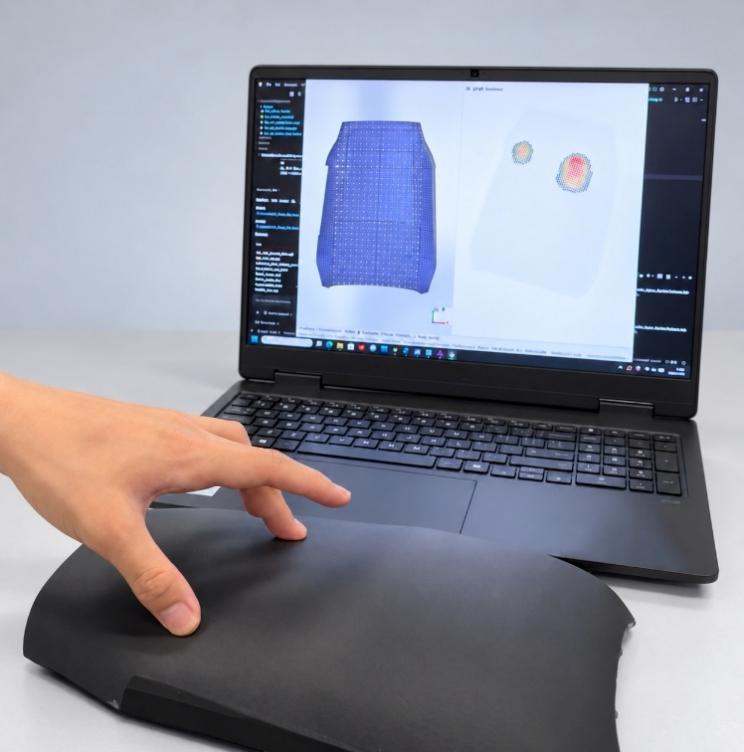
MoSkin Multimodal Tactile Integrated Shell
In terms of manufacturing processes, traditional tactile sensors usually need to attach the sensing film to the surface of the robot, and then complete the integration through wiring and other methods. This method not only has many processes and high manufacturing costs, but also poses challenges to the fitting ability of complex curved surfaces, limiting the large-scale deployment of tactile sensors to the whole body of the robot.
The magneto-photocuring 3D printing molding process adopted by MoSense can directly process materials with specific lattice structures into integrated tactile structural parts, and form electromagnetic lattices by introducing magnetic units into the materials. The algorithm end adopts a super-resolution scheme to endow it with powerful multimodal perception capabilities, while taking into account low mass production costs. This technology can adapt to different materials such as silica gel, foam materials and TPU, which helps to realize the molding of complex curved surfaces. The company also has a fully automatic large-area multimodal calibration algorithm for curved surfaces to help downstream customers achieve plug-and-play.
At the same time, Yan Zhaoxu introduced to 36Kr that based on the original "programmable mechanical properties" technology, the same set of underlying technology can adjust the mechanical properties of materials and micro-lattice structures according to the needs of different parts of the robot. For example, the fingertips require higher sensitivity and can be designed to be softer; the soles of the feet need to withstand large impacts, and their structural support capacity can be strengthened; the torso can achieve a balance between large-area perception and structural strength, and all complex solutions can efficiently and automatically generate reasonable topological structures.
In terms of algorithms, MoTact is equivalent to the "tactile cerebellum", which is mainly responsible for solving the multi-axis magnetic field signals collected by the hardware into perception information such as force, displacement, slip, and material, and optimizing the algorithm for the application requirements of different parts. The company's proposed technical capabilities include sparse super-resolution, complex topology integration, anti-drift and anti-magnetic interference, and KHz-level high-speed array sampling, etc. The goal is to enable the robot to identify the contact state and external force in a more timely manner, and provide feedback for high-frequency actions such as grasping, operation and contact control.
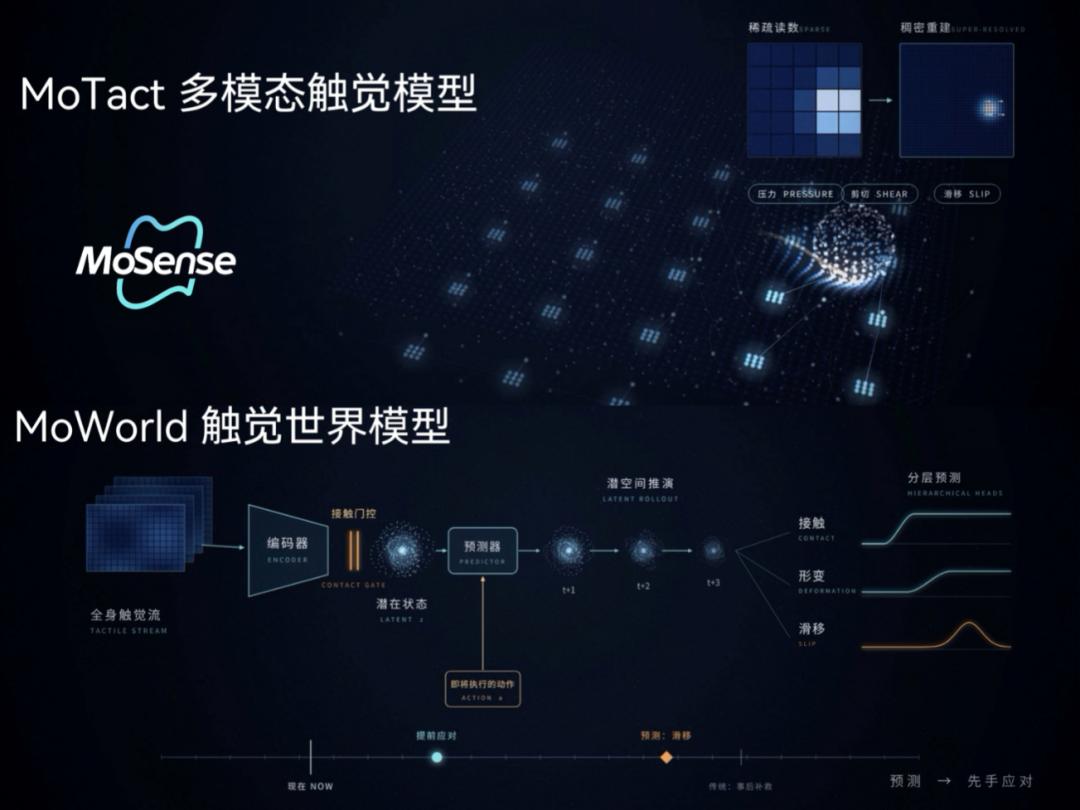
MoTact and MoWorld Model Algorithms of MoSense
In terms of models, MoSense is simultaneously advancing the MoWorld, a tactile-based multimodal integrated tactile world motion model. Compared with relying only on information such as vision to judge the environment, tactile sense can provide information such as contact force, object deformation and local interaction state. The company hopes to use high-frequency, multi-dimensional tactile feedback to continuously correct the judgment and control of the robot during action execution, and add tactile information to the model as a physical prior to improve the robot's interaction ability in the real environment and narrow the gap between simulation training and real execution.
According to the introduction, at present, MoSense's full-body tactile system is advancing cooperation with a number of leading robot ontology manufacturers and expanding application implementation. On the model side, the company has cooperated with leading robot ODM/OEM companies to promote the integrated deployment of the overall tactile system and model, providing a complete tactile "cerebrum-cerebellum" solution for robots. In addition to humanoid robot related businesses, intelligent overall solutions for multiple industries are also accelerating commercial implementation.
The following is the Q&A with the founder:
36Kr: What pain points in the tactile sensor field does magneto-photocuring 3D printing specifically solve?
Yan Zhaoxu: Most traditional electronic skins are in the form of films or fabrics and need to be attached to the surface of the robot structural parts. However, the shoulders, waists and other positions of humanoid robots often have complex curved surfaces, and traditional solutions have certain difficulties in fitting and integration, which are easily limited by structural design and assembly processes.
Our current idea is to directly integrate the tactile perception capability into the structural parts. In the past, it might require the robot shell supplier and the electronic skin supplier to complete this task together. Now we hope to directly provide tactile structural parts with both structural and perception capabilities. The advantage of this method is that the structural parts can adapt to the curved shape of the robot at the molding stage, reducing the problems caused by subsequent fitting. At present, we are adapting different materials such as silica gel, rubber, foam materials, and some complex curved surface structures.
Therefore, our positioning is not just electronic skin, but tactile structural parts. By combining structural design and sensing capabilities, we hope to make it easier to integrate the tactile system into different parts of the robot and create conditions for subsequent large-scale production.
36Kr: What problem in the tactile field does "programmable mechanical properties" specifically solve?
Yan Zhaoxu: In fact, this is a manifestation of our rapid engineering capability. Different robot manufacturers have different requirements for shell materials, structural hardness and tactile sensitivity. If every time we receive a customer's demand, we have to redesign the structure and re-simulate, the development cycle will be relatively long.
Therefore, in the early design and simulation stage, we make the structural parameters adjustable. If customers need stronger impact resistance, we can adjust the structure to make it more robust; if the robot arm needs to perceive when it touches slightly, we can design the corresponding area to be softer and more sensitive.
We are also analyzing the relationship between structural deformation and distributed complex magnetic field signals through simulation models, so as to complete design and parameter adjustment faster. In this way, when facing different customers and different robot structures, we do not have to develop from scratch every time, and can quickly adapt on the basis of the existing technical system.
36Kr: At the algorithm level, how does the company optimize for the tactile requirements of different parts of the robot?
Yan Zhaoxu: The perception requirements of different parts of the robot vary greatly, so the algorithm also needs targeted design.
For example, fingers and palms are involved in tasks such as grasping and fine manipulation, which have relatively high requirements for sensitivity, sampling rate and resolution. We will increase the layout density of sensors in these areas and optimize the algorithm for high-frequency contact actions. Hands and feet also involve relatively complex force conditions, so it is necessary to further strengthen the multi-axis force perception capability.
But for large-area areas such as the torso, the requirements may be different. These positions pay more attention to low power consumption and wide coverage, and do not necessarily need continuous high-frequency sampling. For such scenarios, we can design corresponding low-power algorithms, for example, adopt a low-power monitoring mode in the normal state, and increase the sampling frequency after detecting events such as collisions.
Therefore, we do not use the same set of parameters to cover the whole body of the robot, but differentially configure the sensor layout, sampling rate, resolution and algorithm according to the contact characteristics, force conditions and task requirements of different parts. This can not only meet the fine perception requirements of key parts, but also help to control the power consumption and cost of the whole system.