Xiaomi has acted as a property developer, with an average price of approximately 13,900 yuan per square meter.
On October 25, in Wuhan Optics Valley, "Guanggu Dream Home", the first employee residential project of Xiaomi, officially opened for sale. A technology company renowned for mobile phones, automobiles and smart homes has stepped into the spotlight at the property sales office.
The project is about 700 meters away from Xiaomi Wuhan Science and Technology Park, located south of Gaoxin 4th Road and east of Baoxi Road, with a total floor area of about 57,000 square meters. It consists of 4 buildings with 297 housing units in total.
According to the pre-sale information from Wuhan Municipal Bureau of Housing and Urban Renewal, the project obtained 4 pre-sale permits at one go on October 16 this year, with a record average price of about 13,900 yuan per square meter. The scheduled completion date is March 2028, and the scheduled delivery date is May 2028.
The developer of the project, M-Space Wuhan Information Technology Co., Ltd., is an affiliated company of Xiaomi Group, and the implementation of the project is supervised by Wuhan Optics Valley Central City Construction and Service Center designated by the East Lake High-tech Development Zone Management Committee.
This is Xiaomi's first project that has gone through the full process of a real estate developer. All links including land acquisition, permit application, pricing and opening for sale are no different from those of market-oriented real estate enterprises. The only difference is that the sales target is limited to internal staff, and the properties are only sold to full-time employees who have signed labor contracts and paid social security for companies under Xiaomi Group.
In the current real estate context, it is a matter worthy of serious consideration that technology companies enter the residential construction sector. The real estate industry is undergoing in-depth adjustment, with commercial housing sales under pressure, while leading technology enterprises are starting to extend their reach to housing construction and sales.
It is worth noting that the story of technology companies building self-owned staff housing is evolving from individual cases into an industry-wide phenomenon. To understand this phenomenon, we need to start with Xiaomi's own role transformation.
From Property Owner to Internal Seller
Looking back at Xiaomi's moves in the housing sector, in August 2021, Xiaomi established a wholly-owned subsidiary "Mi Apartment" (later renamed "Mi Star"), laying a groundwork for its identity as a property owner.
At the end of June 2025, according to Xiaomi's official administrative WeChat account, it had launched youth apartments in Beijing and Nanjing, with an average rent of 1999 yuan per month. Subsequently, Lei Jun clarified that these apartments are built for young engineers, with priority given to new graduates.
Separately, the Beijing project is located at Dingfu Road, Changping District, with a total of 2658 units, the main unit type is 29 square meters, the lease term covers from July 2025 to June 2028, and the full-cycle operation and management services are provided by Vanke Puyue.
The Nanjing project is relatively smaller in scale, with a total of 566 units, the main unit type is 55 square meters, less than 100 meters away from Xiaomi Nanjing Science and Technology Park, and the cheapest unit has a monthly rent of 1599 yuan.
In July of the same year, the two youth apartment projects in Beijing and Nanjing were put into use one after another. In terms of market response, all 566 housing units of the Nanjing project were fully booked within 3 days after the reservation opened.
The Beijing project releases housing units in batches. Although there is no rush to buy, the project has also attracted a large number of new graduates to make reservations due to its advantages of relatively low rent, complete supporting facilities and high scarcity.
By July this year, Xiaomi officially launched the Wuhan Youth Apartment, involving a total of 990 housing units, the main unit type is 26 square meters, the monthly rent is about 1099 yuan, including central heating and network fees, and Puyue continues to be entrusted for operation.
In-depth analysis of this move shows that the logic of the rental model is simple: the enterprise holds the property, and employees pay rent far below the market level to obtain a stable transitional residence.
However, this model solves the personal housing problem of employees, but fails to well address the mobility problem of enterprise employees.
From another perspective, Wuhan is of extraordinary significance to Xiaomi.
Xiaomi settled in Optics Valley in 2017. At present, Wuhan has become Xiaomi's largest R&D and intelligent manufacturing base outside its Beijing headquarters, with about 8,000 employees in Wuhan, R&D personnel accounting for more than 60%, and a 10,000-person R&D center under construction.
The planning of the 10,000-person R&D center means that what Xiaomi needs is not passing visitors, but the core backbone who can settle down. This is probably the commercial starting point of the Guanggu Dream Home project.
The total floor area of the project is about 57,000 square meters, with a floor area ratio of 2.0. The unit types cover three-bedroom, two-living room and two-bathroom apartments of about 110 square meters and 122 to 125 square meters, as well as four-bedroom, two-living room and two-bathroom apartments of 143 square meters.
The project is designed according to the fourth-generation residential standard, with sky gardens and covered walkways. The community is equipped with a gym, yoga room, healing space, billiards room and meeting lounge, and the supporting community commercial facilities are targeted for investment attraction according to the needs of employees.
In terms of location, the project is about 700 meters away from Xiaomi Wuhan Science and Technology Park, which is accessible on foot for commuting. It takes 5 minutes to walk to the Optics Valley Skyrail Gaoxin 4th Road Station, with supporting facilities such as Baozixi Park and Wuhan Children's Hospital Optics Valley Campus in the surrounding area.
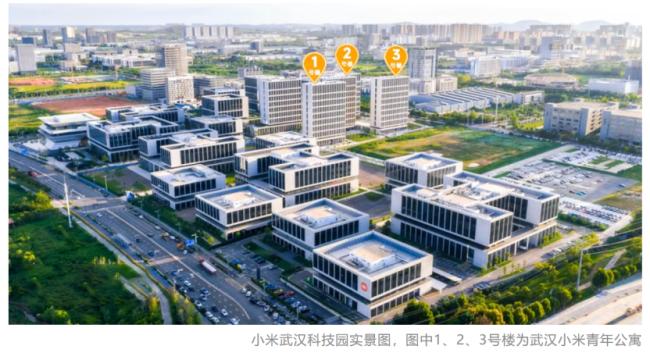
The picture is from the official WeChat account of "Wuhan Optics Valley"
In terms of price, the record average price of Guanggu Dream Home is 13,900 yuan per square meter, which is at a medium-low level among the new residential projects for sale in the surrounding area. According to data, the latest average price of second-hand housing in the Financial Port area where the project is located is about 12,000 yuan per square meter.
According to observations, the price with a starting threshold total price of 1.5 million yuan has obvious internal welfare attributes, which is not out of reach for R&D personnel in Wuhan.
From a rent-collecting property owner to a licensed seller, Xiaomi has completed an identity transformation. Behind this is the change of the enterprise's logic of retaining talents, and this transformation is complementary to the resurgence of Chinese enterprises building self-owned staff housing.
The Resurgence of Self-built Staff Housing
The history of Chinese enterprises building self-owned staff housing can be traced back to the era of the work unit system. In the second half of the last century, state-owned enterprises and large factories generally built staff dormitories and family courtyards, covering a complete living system from housing to schools and hospitals.
Under the conditions at that time, housing was allocated by the work unit, and employees lived in it with extremely low rent, and the houses hardly entered the circulation market.
After the housing reform in 1998, the welfare housing distribution exited the stage, and monetized housing purchase became the mainstream. The unit-funded housing construction was strictly restricted by policies around 2006, and the channel for enterprises to directly build houses was basically closed. In the following more than ten years, enterprises solved the housing problem of employees mainly through subsidies, loans and group purchases.
The turning point came in the middle and late 2010s. Since 2015, as the most typical sample, Huawei has successively acquired multiple plots of talent housing land in Songshan Lake, Dongguan. The decorated lakeside garden was sold at 8500 yuan per square meter, while the average price of surrounding properties was about 25,000 yuan at that time.
This type of housing has strict circulation constraints: it is leased for the first 5 years, and employees can purchase it after the lease expires. They can transfer the property 5 years after obtaining the property right, which actually takes about 10 years to enter the market for circulation.
Gree Electric took another path. In 2018, Dong Mingzhu publicly promised to give one apartment to each of its 80,000 employees. In 2021, the first batch of 3700 apartments were delivered, which were preferentially allocated to outstanding employees, and the internal housing application system was launched synchronously.
In addition to self-building and selling apartments to employees, more enterprises tend to rent apartments to their employees.
For example, JD invested huge sums of money to build the Youth City in Beijing, which is planned to have nearly 4,000 self-owned staff rental apartments; Tencent's apartments in Shenzhen Penguin Island are also rental properties for employees and ecological partners; the youth apartments launched by Xiaomi in many places previously are also defined as "for rent only" welfare housing.
This phenomenon is mainly affected by two aspects: policy attributes and asset layout. On the one hand, most of the land used by enterprises to build staff apartments has strict rental attributes. If it is converted into property rights for sale, it may touch the regulatory bottom line.
On the other hand, these rental apartments are long-term assets that remain in the hands of enterprises. Even if they are no longer used as employee benefits in the future, the cost can be gradually recovered through market-oriented leasing or REITs and other methods.
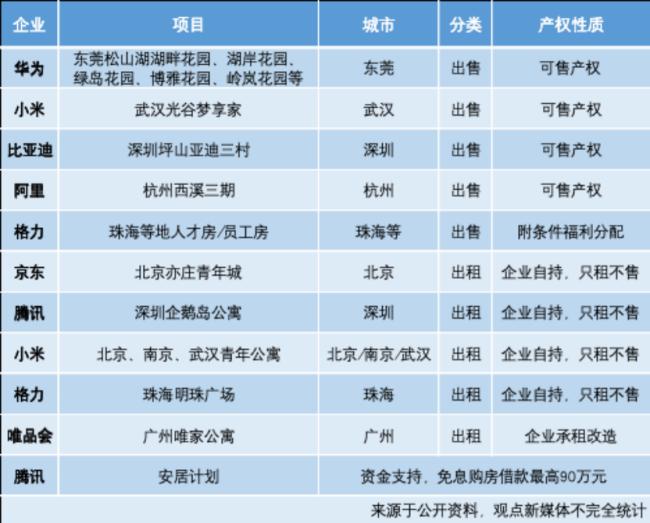
In contrast, selling houses to employees at a preferential price lower than the market price will reduce the profits that enterprises can obtain or the heavy assets they hold, but why are enterprises still willing to do so?
For many years, the ratio of housing prices to income has remained high, and housing costs have become part of the labor cost of enterprises. As Ren Zhengfei pointed out in his early years, high housing prices raise the cost of employees, which will eventually erode the competitiveness of enterprises.
The in-depth function of self-built housing is to lock the service years through property rights or long-term use rights, and reduce the loss rate of core talents. The clauses restricting the circulation and transfer of houses deeply bind the professional life cycle of employees with the enterprise, which is a more feasible and cost-effective talent retention investment than raising salaries.
It cannot be ignored that the government plays a driving role in this process. Dongguan, Zhuhai, Wuhan and other places support enterprises to build talent housing through targeted land transfer, low-cost land supply and other methods, which is essentially an extension of urban investment promotion competition, and both sides get what they need.
Back to the case of Xiaomi, Wuhan Optics Valley needs the 10,000-person R&D center to settle down, Xiaomi needs R&D personnel to stay for a long time, and employees need affordable housing. The interests of the three parties converge in "Guanggu Dream Home", which is a microcosm of the current relationship between enterprises and cities.
This article is from the WeChat official account "Viewpoint", written by Viewpoint New Media, and authorized for release by 36Kr.