Just now, GPT-6.1 Terra has been released at a rock-bottom price, and the working model for the Agent era has arrived.
OpenAI has once again raised the bar for the cost-performance of large models.
Just now, OpenAI officially released its new-generation model GPT-6.1 Terra, which focuses on faster response speed, stronger visual understanding and computer operation capabilities, and lower usage costs.
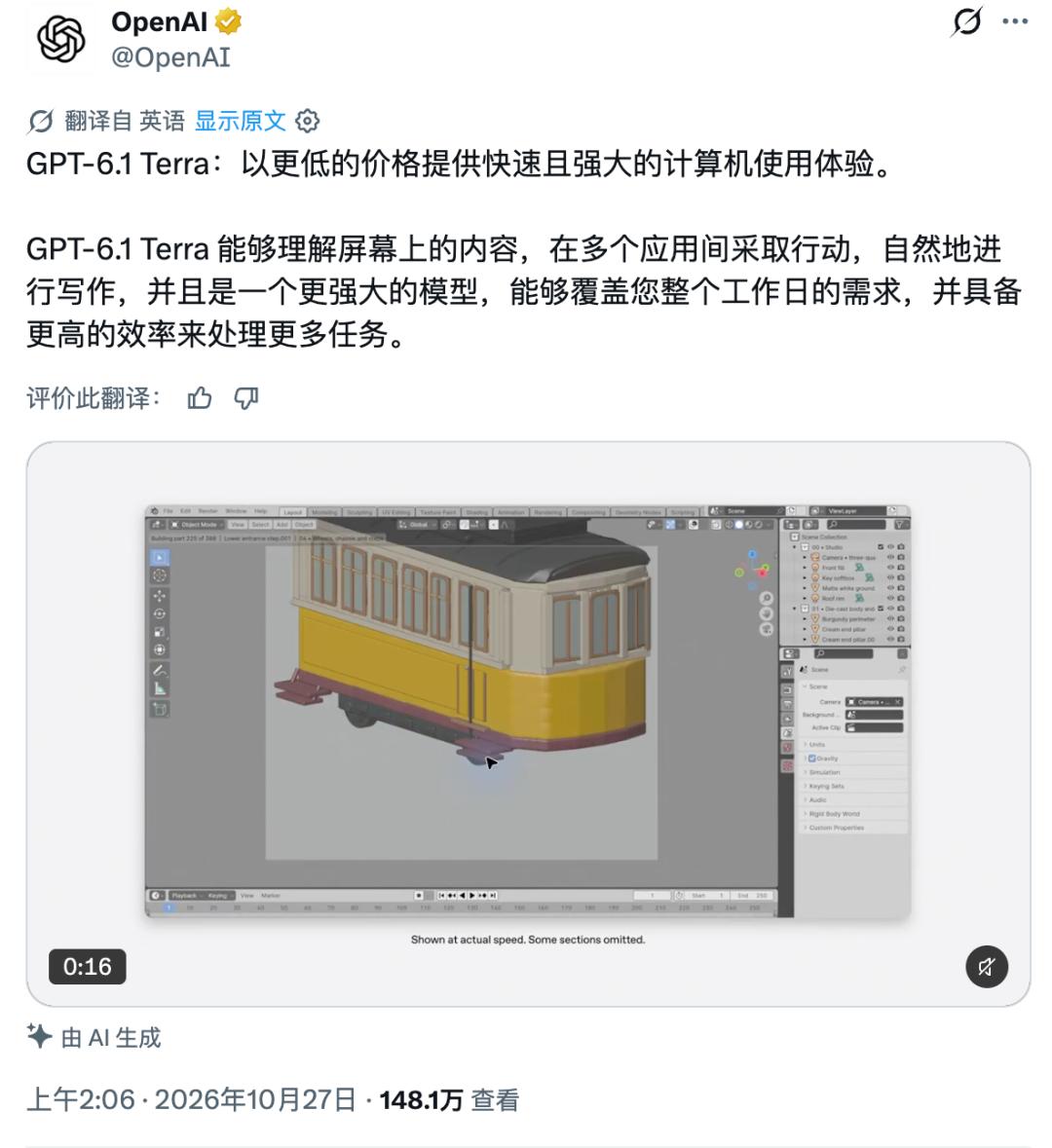
Figure | Blog 🔗 https://openai.com/index/introducing-gpt-6-1-terra/
Compared with the previous generation GPT-5.6 Terra, the standard API price of the new model is directly reduced by 50%, but it has been significantly improved in complex task execution, factual accuracy and programming capabilities. Especially in some professional task tests, GPT-6.1 Terra can already approach the performance of the flagship model GPT-6 Astra, while its Token price is only one-tenth of the latter.
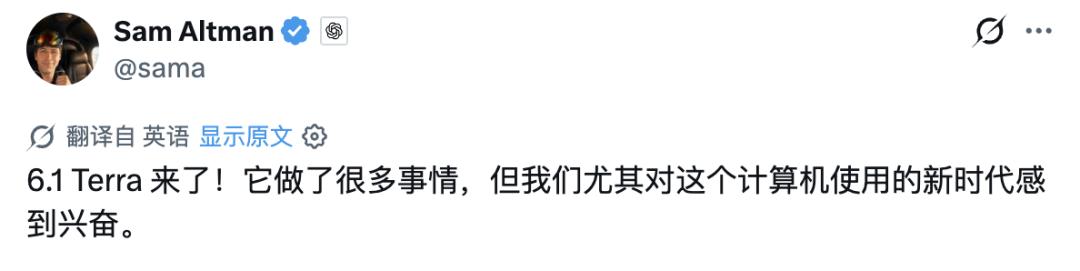
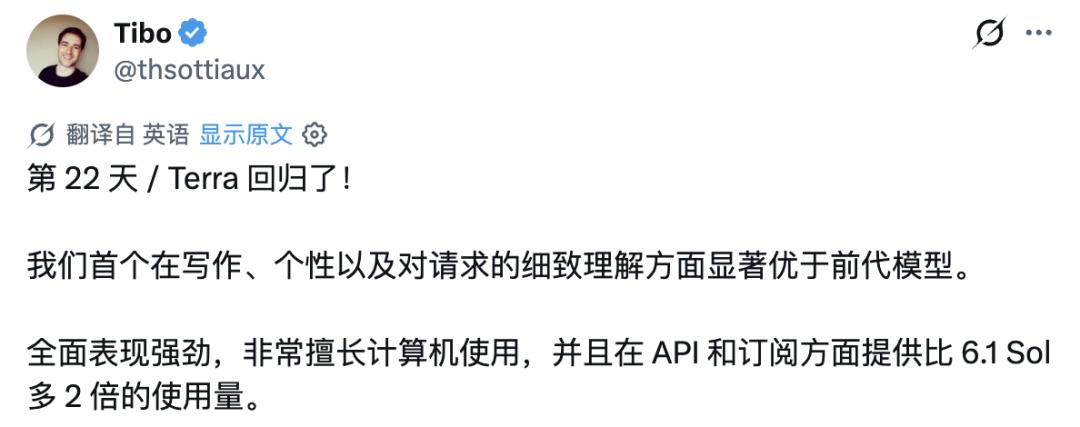
OpenAI positions it as an efficient model oriented to high-frequency work scenarios, hoping to allow more enterprises and developers to apply AI Agent to daily work at a lower cost.
Performance is close to Sol, task execution speed is 3 times faster
The most noteworthy change of GPT-6.1 Terra is the further integration of visual understanding and computer operation capabilities.
In the past, AI could understand pictures and analyze documents, but to make it actually operate computers and complete complex tasks across applications, higher model capabilities and reasoning costs were still required.
Now, GPT-6.1 Terra can already handle a series of professional tasks from reading technical drawings, filling in forms, to editing videos and operating desktop software.
For example, users can ask it to create 3D models based on architectural design drawings, or check animated films frame by frame to produce shot records with time codes for the restoration team. Enterprises can also use it to read received invoices and automatically enter relevant information into financial software.
In the Agents' Last Exam test that measures the ability of AI Agent to complete professional work, the performance of GPT-6.1 Terra is quite outstanding.
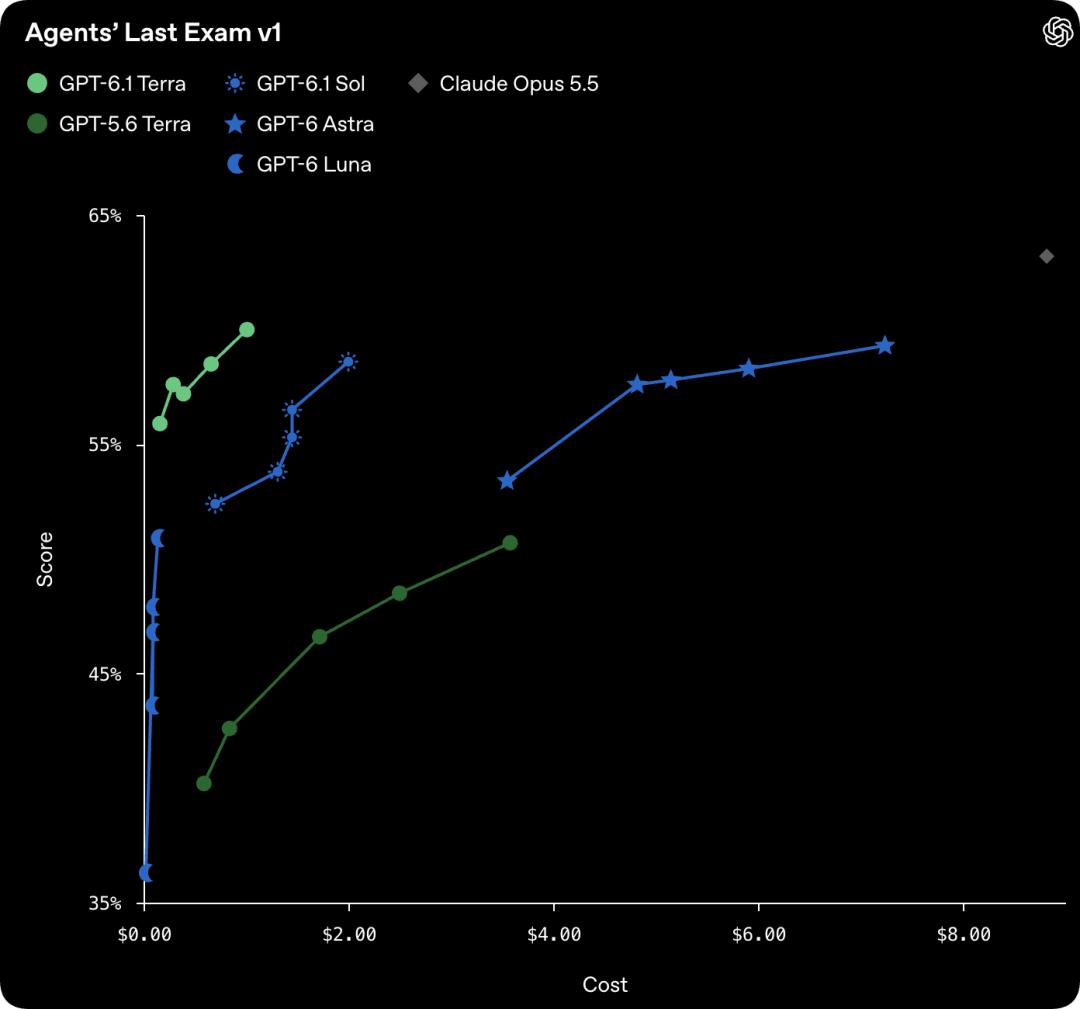
Under medium reasoning intensity, the score of the new model is 15 percentage points higher than that of GPT-5.6 Terra, but the cost of a single task is reduced to about one-third.
More notably, in the same test, GPT-6.1 Terra has reached the level of GPT-6 Astra, and the unit price of Token for standard API is only one-tenth of the latter.
Compared with Anthropic's Claude Opus 5.5, under the maximum reasoning intensity, the Token usage efficiency of GPT-6.1 Terra is more than 3 times that of it, the unit price of Token is only a quarter of it, and the final cost of completing similar tasks is about 9 times lower.
In terms of speed, GPT-6.1 Terra also completes tasks 3 times faster than GPT-6 Astra and GPT-6.1 Sol.
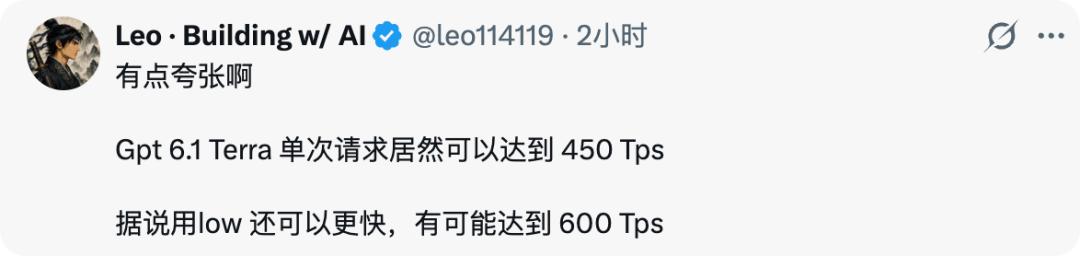
The test results shared by some developers show that the generation speed of a single request of GPT-6.1 Terra can reach 450 Tokens per second, and it is even expected to reach 600 Tokens per second under low reasoning intensity, but the latter has not been verified yet.
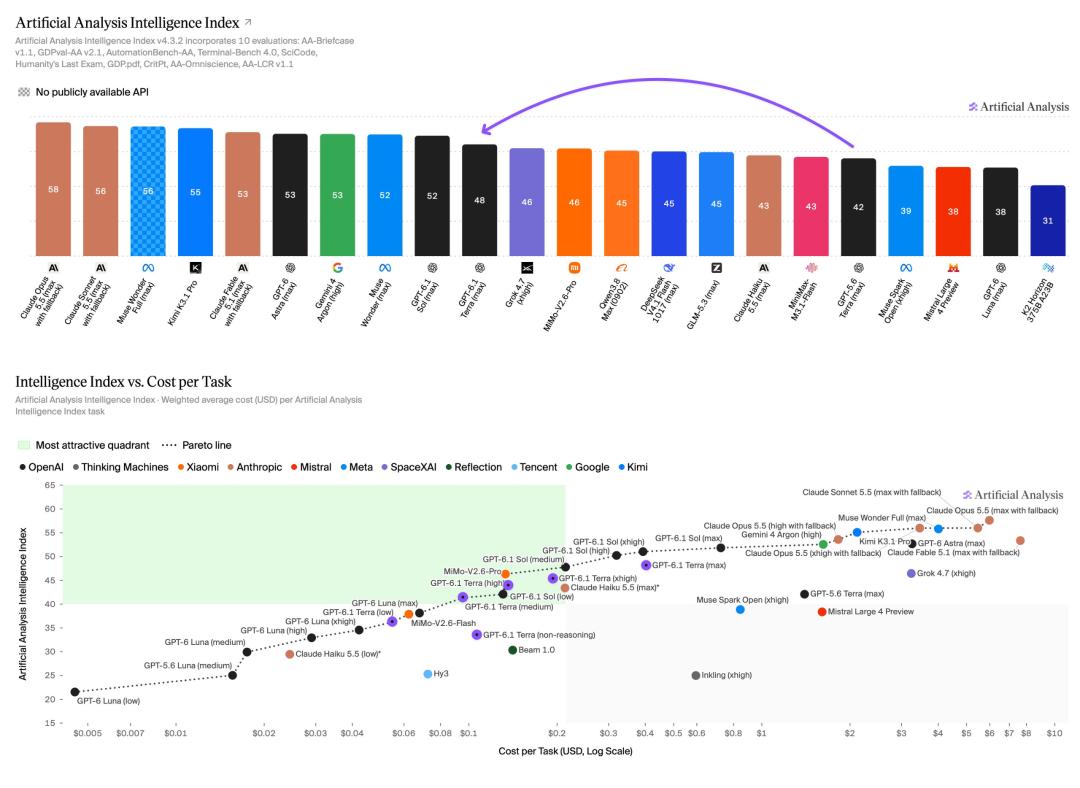
The intelligence index list of the third-party evaluation agency Artificial Analysis also gives an interesting reference. GPT-6.1 Terra (Max) scored 48 points, surpassing all Chinese open-weight models except Kimi K3.1 Pro (55 points).
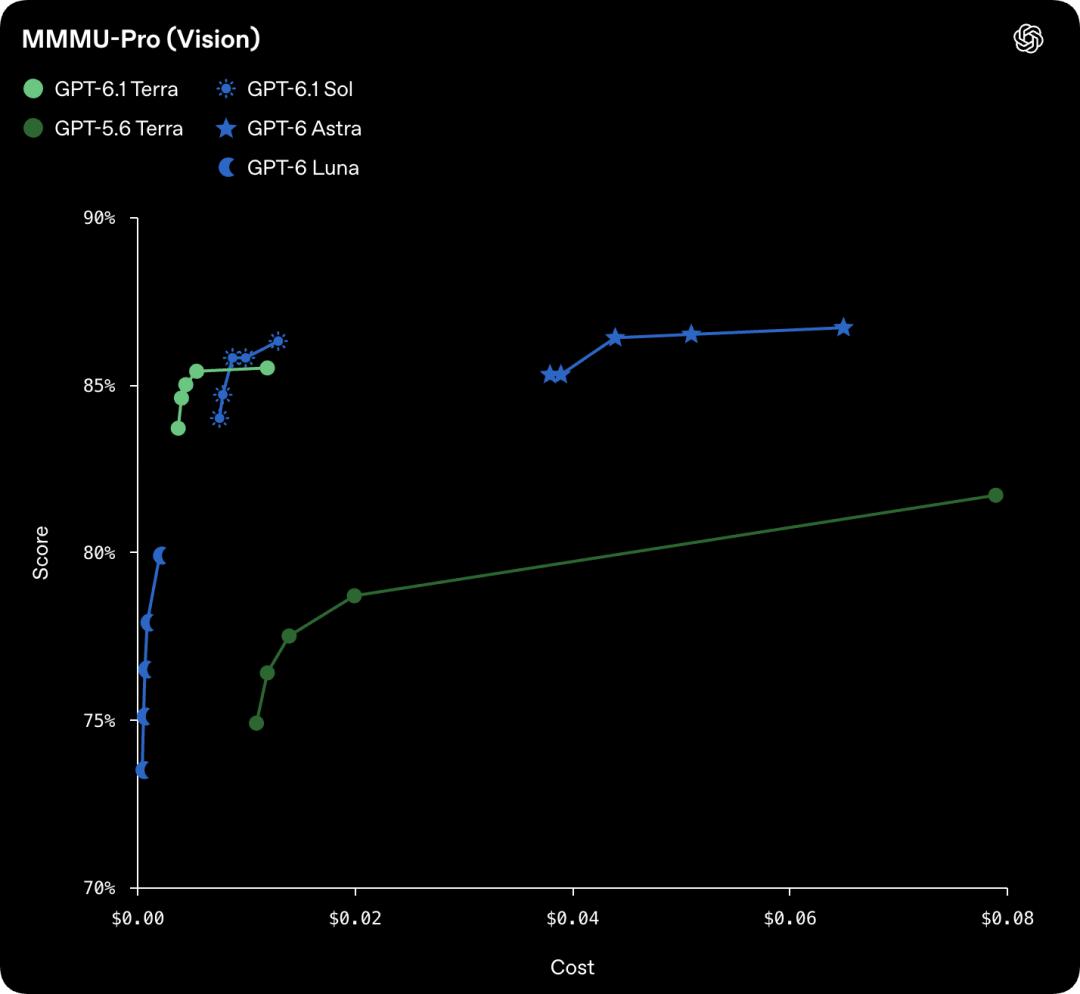
In addition, in the MMMU-Pro test that examines visual reasoning capabilities, GPT-6.1 Terra outperforms the previous generation model under all reasoning intensities, and achieves results close to GPT-6 Astra and GPT-6.1 Sol at a significantly lower cost.
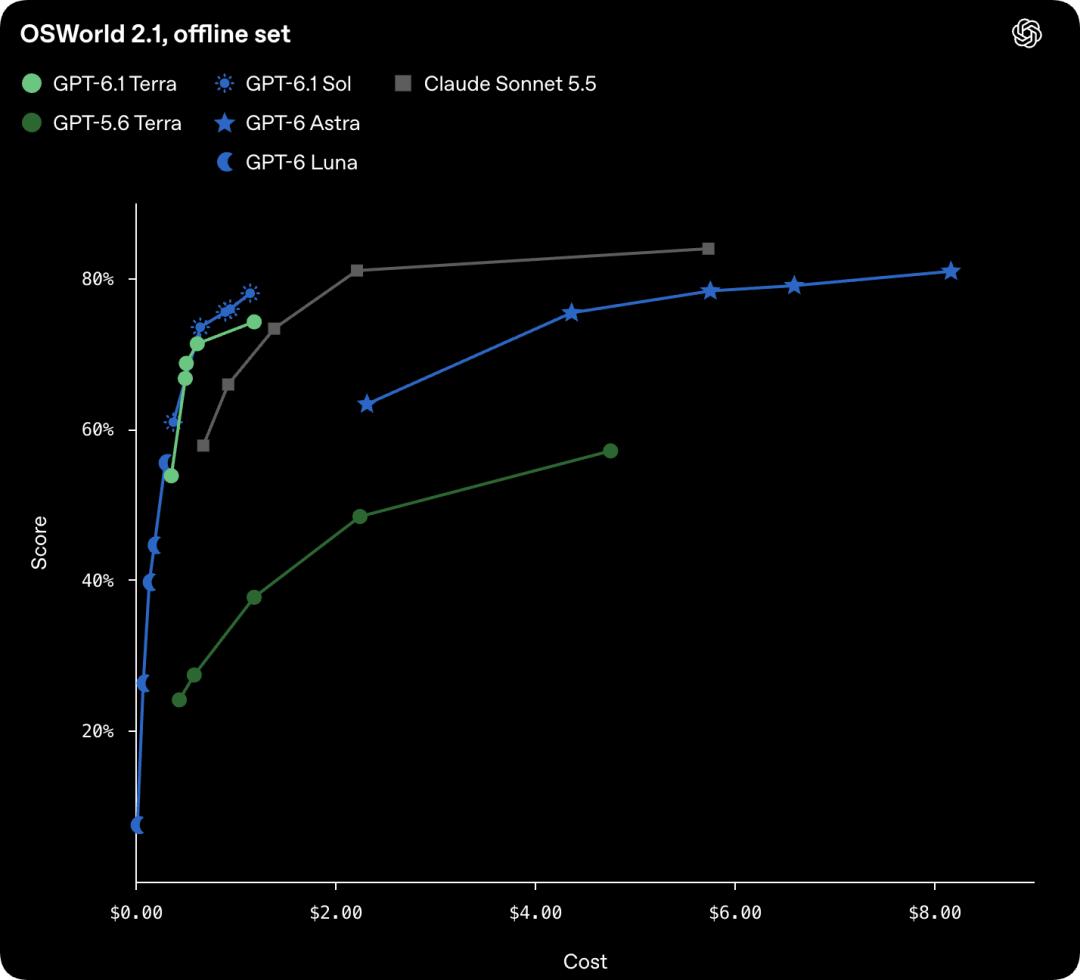
In OSWorld 2.1, which specially tests the ability of AI to operate desktop applications, the new model only uses medium reasoning intensity to exceed the score of GPT-5.6 Terra under the maximum reasoning intensity, while significantly reducing the cost of a single task.
The actual experience also confirms part of the improvement. DesignArena asked the two generations of Terra to reproduce the Belém Tower in Lisbon at sunset. The 6.1 version generated more fine-grained light and shadow of buildings and water surfaces. Although the time consumption is nearly 4 times that of the previous generation and the Token consumption increased by 48%, the single cost dropped from 0.077 USD to 0.047 USD.

While atomic.chat used the same prompt to let the two models develop games with 8 Agents respectively, Terra only took 6 minutes and spent 1.06 USD to complete the task, while Claude Sonnet 5.5 spent about an hour and 18.10 USD, but delivered a significantly better game work.
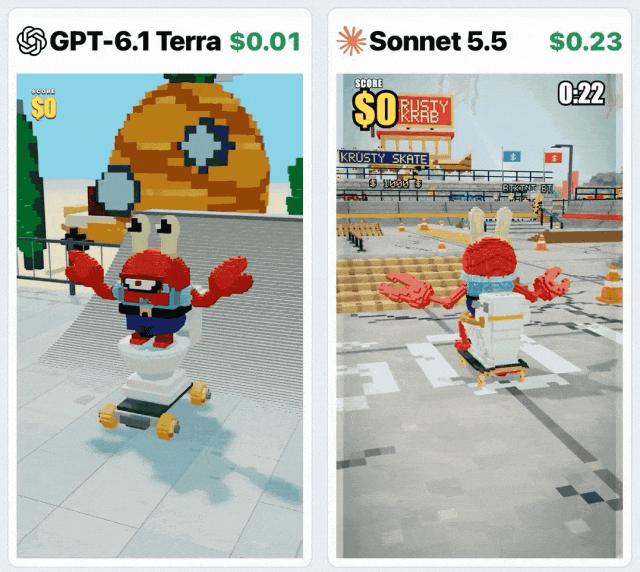
In addition, according to existing tests, GPT-6.1 Terra is still inferior to Claude Opus 5.5 in the final delivery quality of high-difficulty tasks, but considering its lower price and faster execution speed, it still has considerable living space. After all, a large number of tasks in reality only require AI to get things done, and it is not worth calling out the most expensive flagship model every time.
Hallucination rate drops significantly, programming results double
In addition to visual understanding and computer operation, the progress of GPT-6.1 Terra in factual accuracy and programming is also equally obvious.
OpenAI stated that it has been focusing on solving the problem of model hallucinations and factual errors this year.
In its internally designed high-difficulty factual accuracy test, the error rate of GPT-5.6 Terra under low reasoning intensity is as high as 53.6%, while GPT-6.1 Terra has reduced it to 16.7%, a drop of 36.9 percentage points.
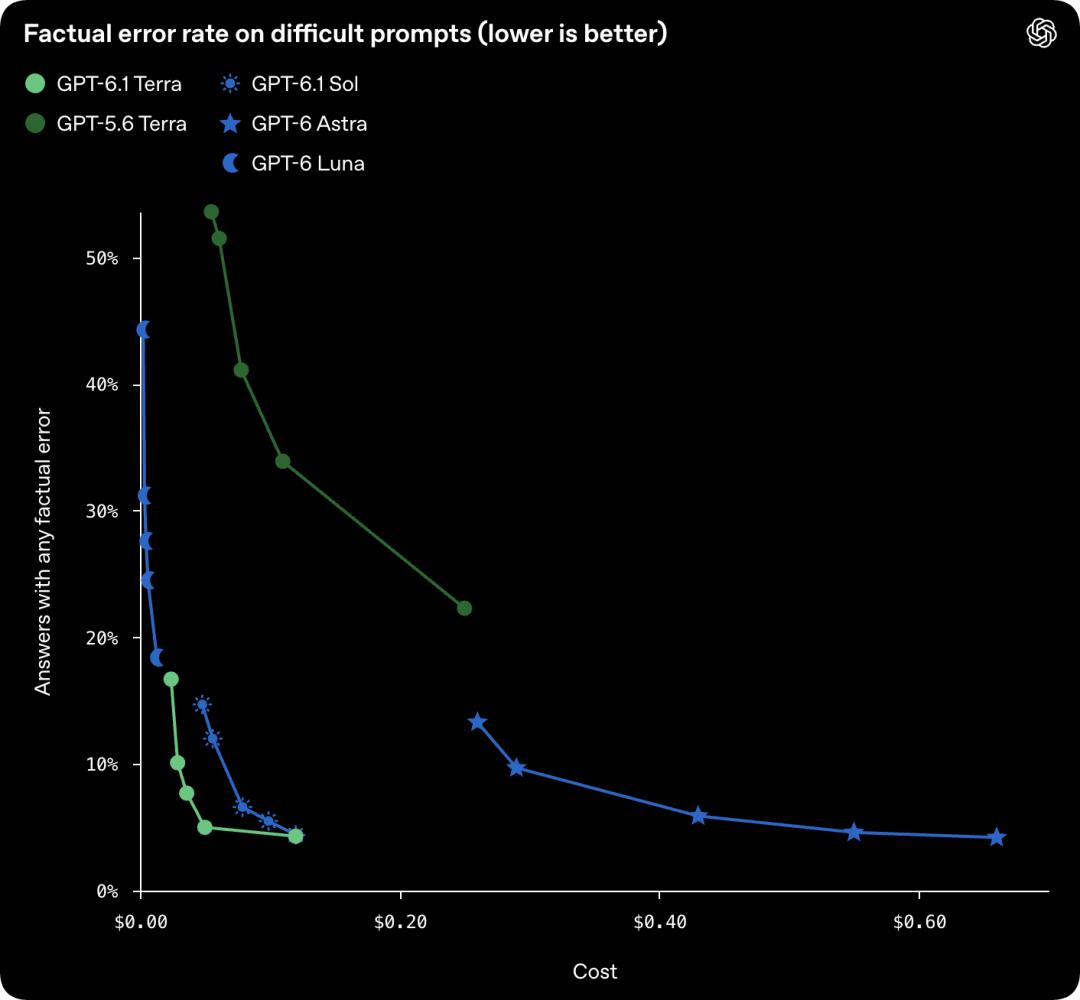
When the reasoning intensity is increased to the highest level, the error rate of the new model further drops to 4.3%, which is close to the level of GPT-6 Astra and GPT-6.1 Sol.
For AI Agents that need to process contracts, technical documents and enterprise internal data, the drop in factual error rate is particularly important. After all, the ability of the model to complete tasks is only the foundation. Whether it can maintain accuracy continuously during the execution process directly determines whether users can safely entrust more work to AI.
In terms of programming capabilities, GPT-6.1 Terra has also ushered in a substantial improvement.
In Terminal-Bench 4.0, which tests the command-line programming ability of AI Agent, GPT-6.1 Terra achieved a task resolution rate of 50.3% under the maximum reasoning intensity, while the public score of the previous generation GPT-5.6 Terra was only 21.5%.
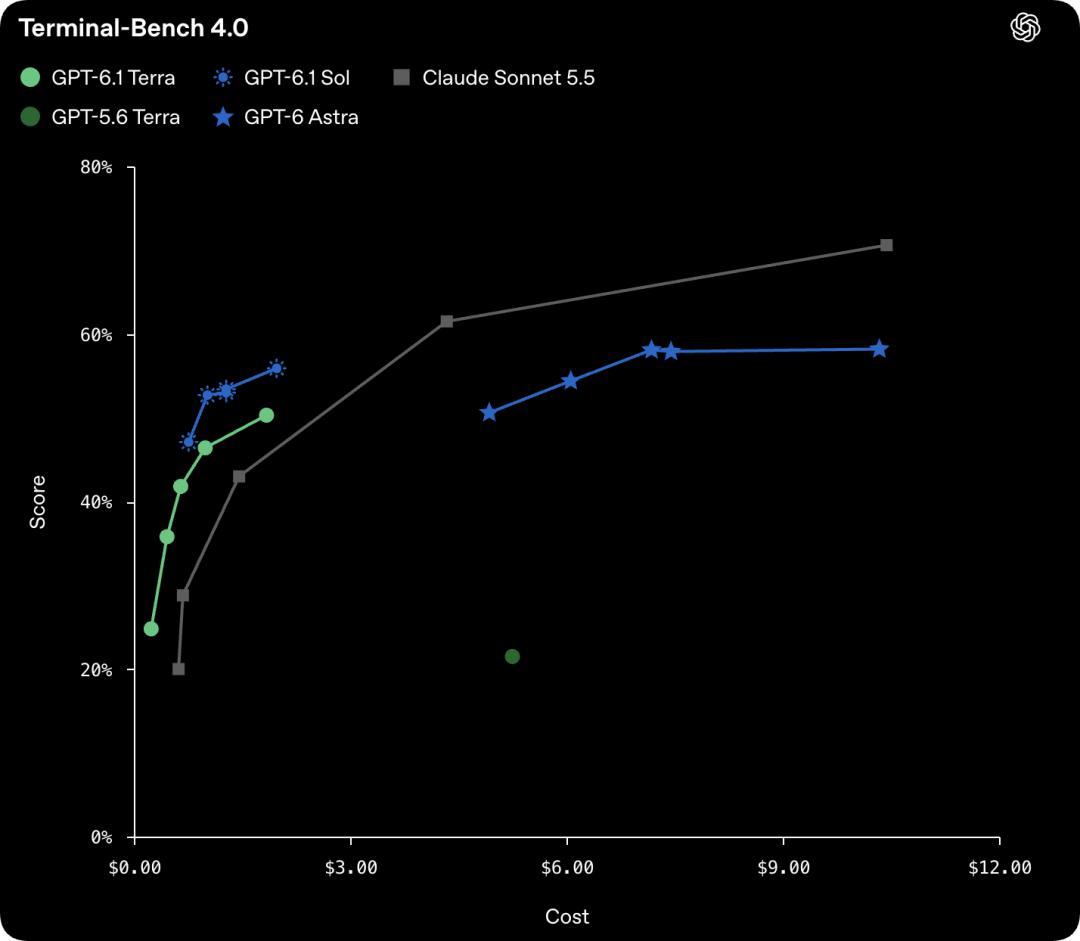
In other words, the programming test score of the new model has more than doubled that of the previous generation.
In the scientific research programming test Terminal-Bench-Science 0.1, GPT-6.1 Terra even surpassed the higher-positioned GPT-6.1 Sol.
This test includes scientific research tasks such as using code to analyze cell division in time-lapse videos. OpenAI stated that the score of GPT-6.1 Terra is less than 5 percentage points away from Claude Opus 5.5, but the estimated cost is less than one-fifth of the latter.
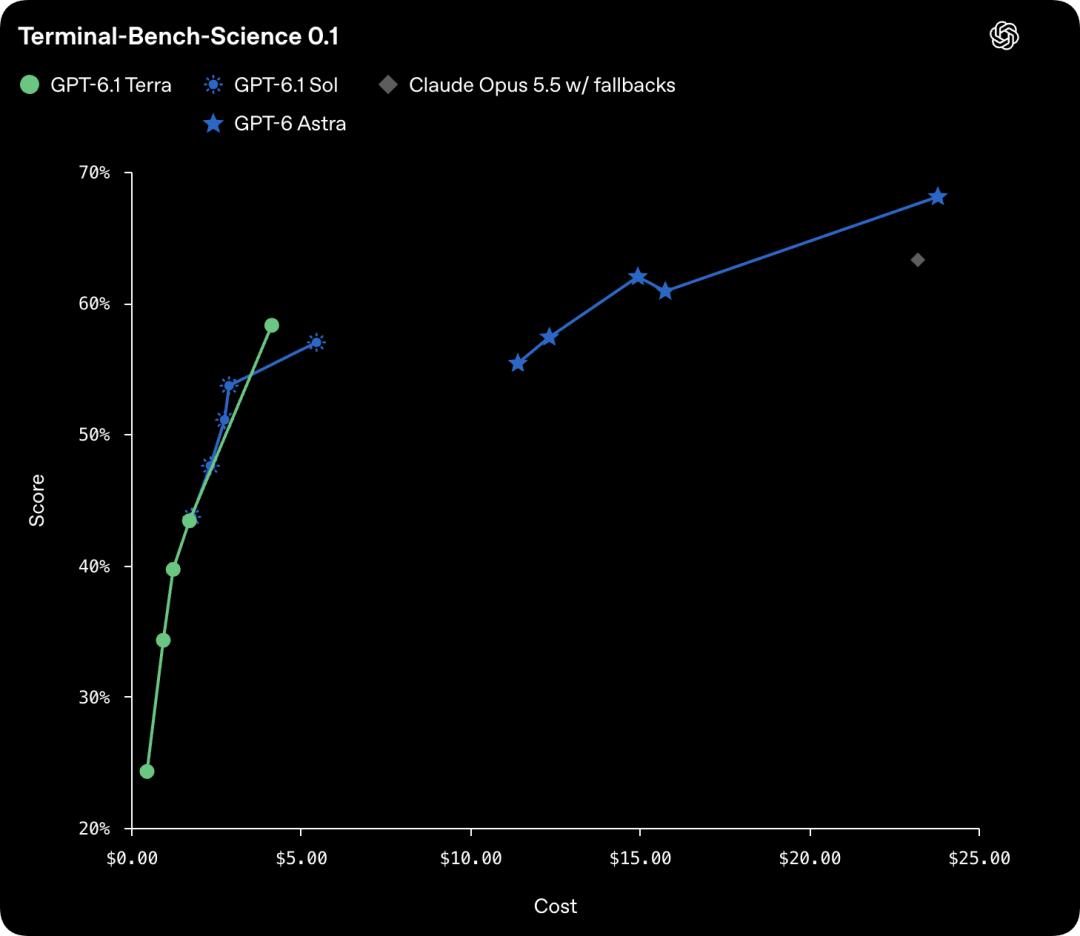
Of course, OpenAI also made it clear that for the most complex software engineering and in-depth research tasks, GPT-6.1 Sol and GPT-6 Astra are still more suitable choices.
API price cut in half, officially integrated into ChatGPT Work and Codex
Compared with performance improvement, the price adjustment of GPT-6.1 Terra may be more attractive to developers.
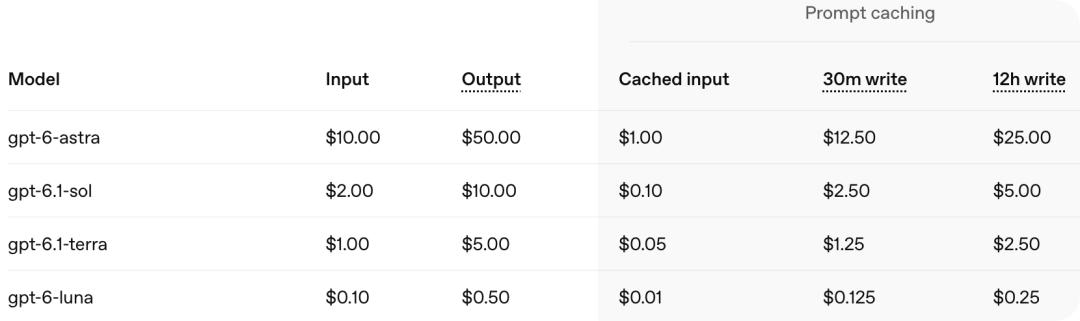
According to the information released by OpenAI, the standard API pricing of the new model is as follows.
The input price is 1 USD per million Tokens
The cached input price is 0.05 USD per million Tokens
The output price is 5 USD per million Tokens
Compared with GPT-5.6 Terra and GPT-6.1 Sol, the standard API price of GPT-6.1 Terra is reduced by 50%. Compared with the flagship model GPT-6 Astra, the price of its input and output Tokens is only one-tenth of the latter.
At the product level, GPT-6.1 Terra is already open to ChatGPT Plus, Pro, Enterprise and Edu users, and can be used in ChatGPT Work and Codex.
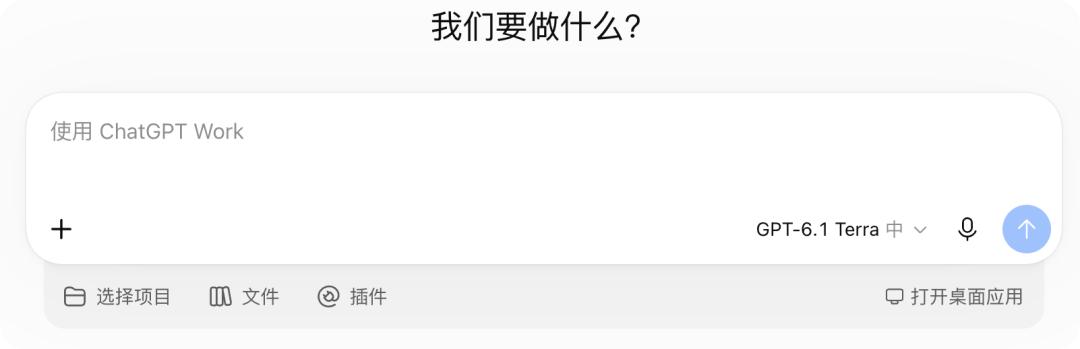
OpenAI stated that under the same usage quota, users can complete more tasks through GPT-6.1 Terra than GPT-5.6 Terra, and the improvement of quota usage efficiency is even more obvious compared with GPT-6.1 Sol and GPT-6 Astra.
Developers can also call the model through the OpenAI API, and the model name is gpt-6.1-terra.
In terms of security, OpenAI stated that GPT-6.1 Terra has reached the Critical risk level of cybersecurity capabilities in its Preparedness Framework, so it follows the relevant security protection measures of models such as GPT-6 Astra.
At the same time, the new model inherits the alignment improvements of the GPT-6 series, and has improved compared with the previous generation in terms of complying with the scope of user authorization, proactively stating its own capability limits, and resisting malicious prompt injection.