A century of exploration in 3D movie viewing has been presented with a brand new solution by a pair of smart glasses.
In 1922, a silent film titled *The Power of Love* was screened in Los Angeles, USA. The audience present was asked to wear red-green anaglyph glasses, marking the first time in human history that the audience experienced stereoscopic imagery during the screening of a commercial feature film. At that time, the audience could even see different endings of the film through lenses of different colors.
Unfortunately, this film was later lost, but the question it left behind never disappeared: when imagery is no longer limited to a flat plane, can people obtain a viewing experience that is closer to the real world?
In the hundred years that followed, 3D films experienced multiple rises and falls. In the 1950s, stereoscopic films once set off a boom; in 2009, *Avatar* brought 3D back to the public view again. James Cameron, a well-known Hollywood director, spent years working on this film, driving the development of 3D camera systems, motion capture and digital production technologies. To make the planet Pandora truly have depth, the film industry not only had to rethink how to shoot, but also transform the projection system, so that the audience could get a stereoscopic experience in a specific cinema.
Technology has advanced again and again, but 3D has never fully become part of daily life. It requires specific content, equipment and viewing environment. For ordinary audiences, 3D often means a special consumption behavior, rather than an experience that can be obtained anytime and anywhere by simply opening a film.
Now, new changes are emerging along this exploration path.
The recently released smart glasses XREAL 1 Pro+ attempts to integrate spatial display capabilities into a pair of portable glasses. Instead of remaking ordinary films into native 3D works, it relies on the X1 spatial computing chip and 3D spatial function to convert ordinary 2D content into 3D images with spatial depth in real time on the glasses end, with a maximum conversion frame rate of 60fps. Users do not need to specifically look for 3D sources, nor do they need to install additional apps. Films, TV series, sports events and games that were originally played on mobile phones, computers or game devices can all gain stronger 3D spatial depth.
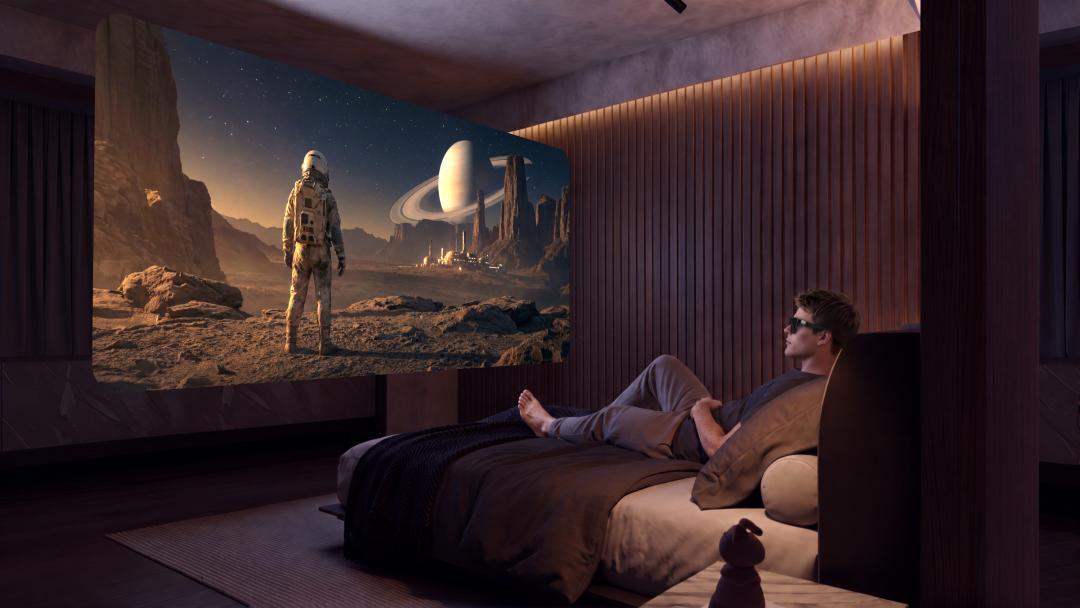
Viewing scene schematic
Of course, this certainly does not mean that the 3D film industry no longer needs professional production. Its real value lies in promoting a transformation: spatial display is beginning to try to get rid of its dependence on specific content and specific places. When 3D is no longer just a special experience provided by cinemas, but a screen that individuals can carry with them, the significance of spatial display goes beyond display technology itself.
A pair of glasses brings ordinary content into 3D space
The beauty of 3D content is that it is closer to human's three-dimensional perception of the real world, delivering a more immersive and intuitive experience.
For this reason, the more technology pursues immersion, the more it tends to rely on a complete set of dedicated infrastructure.
Early stereoscopic films required special shooting and projection methods. After entering the era of digital films, the maturity of 3D technology has not eliminated this dependence. During the shooting of *Avatar*, Cameron collaborated with cinematographer Vince Pace to develop and continuously improve the Fusion 3D camera system, which simulates the visual relationship of human eyes through two sets of lenses, and adjusts the inter-lens distance and convergence parameters according to the shooting scene. At the same time, the digital production process of films also needs to adapt to the requirements of stereoscopic imagery.
In the forests of the planet Pandora, floating mountains, flying creatures and layers of plants form a world with depth. For film creators, 3D is an exploration to reorganize the spatial relationship between the audience and the imagery.
This is a technical upgrade at the level of the film industry. Cameras, post-production, digital projection systems and cinema equipment together form the foundation of the 3D experience. The stereoscopic world that the audience finally sees is backed by a complex production and delivery system.
This model can create amazing visual effects, but it also naturally limits the daily use of 3D experiences. Audiences need to find suitable content sources, go to cinemas that support 3D projection, wear dedicated glasses, and complete the experience in a specific viewing environment.
As a result, people often ignore why 3D content cannot be experienced after leaving the cinema, and acquiesce that this immersive form of content consumption is difficult to become a high-frequency daily consumption for the public.
But XREAL 1 Pro+ is trying to find a breakthrough from this acquiescence.
The key here is not just to add depth to flat images, but to put the computing power of the X1 spatial computing chip on the terminal directly used by users. The real-time 2D-to-3D conversion process is completed directly on the glasses end, without the need to install a dedicated conversion app, nor to rely on dedicated 3D content sources or cloud processing. This means that users do not have to enter a content world specially prepared for 3D first. Content that can originally be viewed on mobile phones, computers and game devices can directly become the input for spatial display.
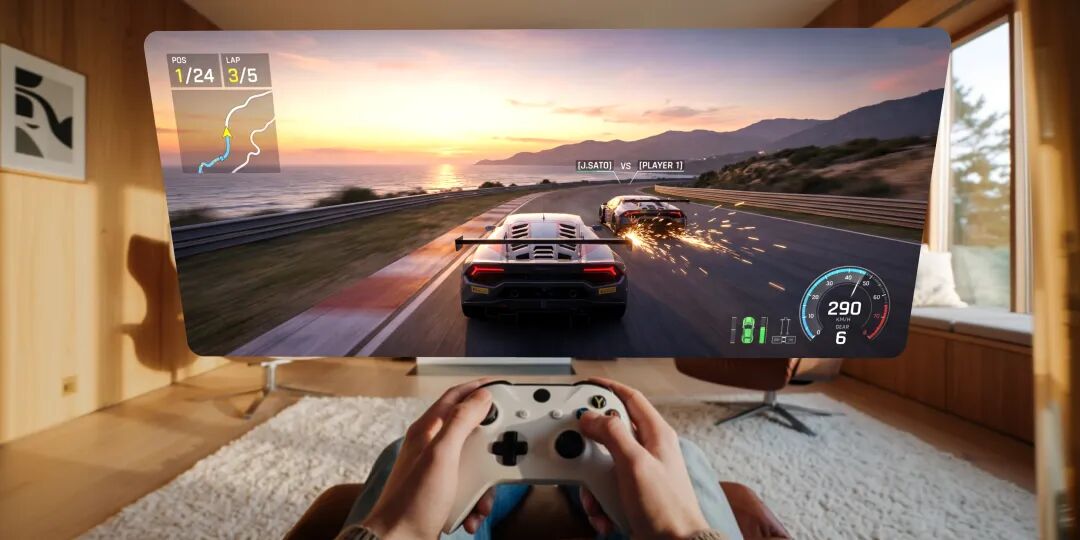
Game scene schematic
Compared with the previous generation of products, XREAL 1 Pro+ increases the rendering frame rate of 2D-to-3D conversion from 30fps to 60fps, making the stereoscopic presentation of dynamic images smoother and more coherent. When connected to a compatible handheld console or game device, users can also obtain a gaming experience different from that of traditional 2D screens through the depth of 3D space.
For users, there is no need to change the content source, but the way content is presented has changed.
Now, XREAL 1 Pro+ tries to put part of the spatial processing on the terminal, so that existing content can also get a new presentation method.
When users do not need to change their original content consumption habits to experience 3D, spatial display has the opportunity to evolve from an experience that requires special arrangements to an optional item in daily entertainment. This is the beginning of 3D consumption entering the mass consumer market.
XREAL 1 Pro+ is not an exaggeration of individual parameters, but integrates spatial display, spatial audio-visual, ultra-clear large screen, environment adaptation and practical use. These all-round capabilities are finally put into the same pair of glasses.
It is a flagship spatial screen with complete comprehensive experience, excellent performance, and closest to actual daily usability. To a certain extent, this is a very stable and mature technology delivery logic.
A new solution for spatial screens
In the past, 3D content consumption essentially brought the audience into a completely 3D virtual world: when you enter the cinema, you enter this world, but when you leave the cinema, you return to another world.
The exploration of XREAL 1 Pro+ has jumped out of this black-and-white setting.
This is also the exam question for spatial screens: if spatial screens want to truly enter the mass market, they can never only rely on the technological breakthrough of "being able to see stereoscopic images" to gain a foothold. As a complete product, it must allow users to "watch comfortably, listen properly, wear easily, store conveniently, and use naturally" in real life scenarios.
In this regard, XREAL 1 Pro+ adopts an optical see-through design, so that users can still perceive the real environment while viewing spatial images. The X1 chip provides native Follow Mode and 3DoF Hover Mode, which means the screen can be fixed at a spatial position in front of your eyes. Paired with the optional XREAL Eye, it can also expand 6DoF spatial anchoring and natural gesture interaction, allowing users to further move from viewing the spatial screen to interacting with spatial content.
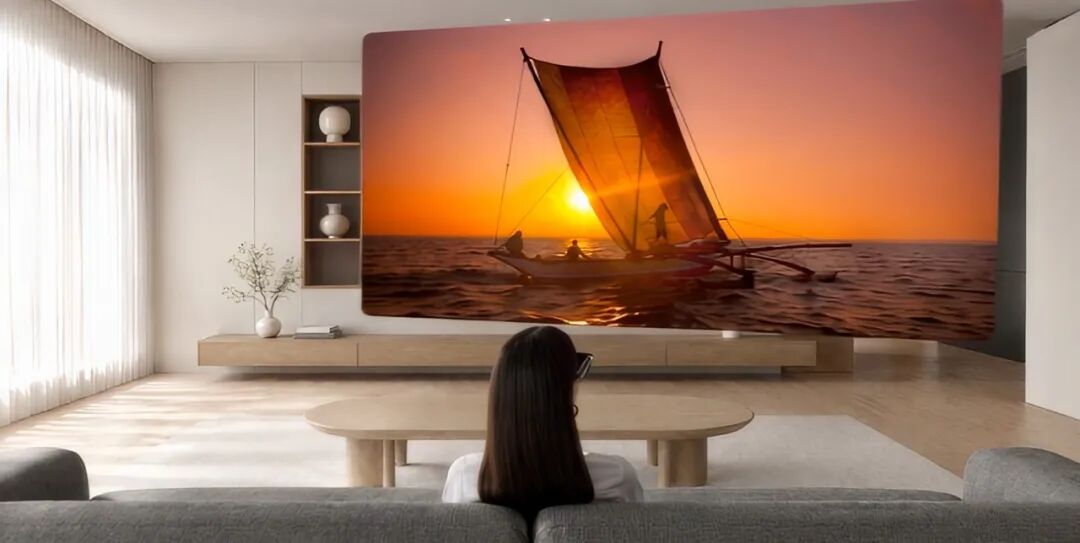
XREAL 1 Pro+ Follow Mode
The multiple viewing modes of the spatial screen free your hands and provide the diversity of free movement. This is the outstanding convenience brought by the optical see-through design in real life. This convenience is not limited to movie watching. When playing games, the handle operation will be more convenient; when working in spatial mode, you can free your hands to use an external keyboard or mouse to type and process documents.
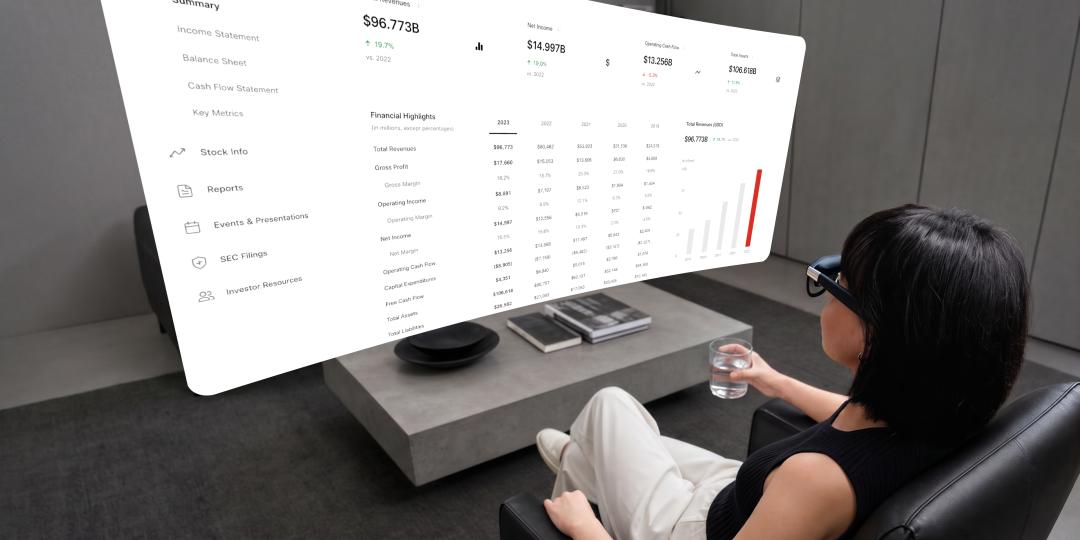
Office scene schematic
A very interesting use case: after users put on the glasses, it is just like being in a private cinema, and they can fully enjoy the experience of holding a popcorn bucket while binge-watching shows and movies. Without having to hold the device all the time, they can also enjoy a freer and more immersive personal viewing experience.
If you regard it as a set of high-end private cinema, XREAL 1 Pro+ is easier to understand at the configuration level, such as X Prism optical engine, 57° field of view, 39 PPD, 0.55-inch Sony Micro-OLED, and monocular FHD (1920x1080 pixels).
Based on the original flagship product series, XREAL 1 Pro+ has also made further upgrades. On the basis of retaining the original display advantages, XREAL 1 Pro+ increases the peak in-eye brightness to 1200 nits, and adds new AI HDR and display modes such as Reading, Movie, and Standard, to further enrich the image performance in different scenarios.
In addition, users can also wear the glasses to use the small screen mode. According to the setting information, the content projected on the glasses can be placed on the upper left or upper right of the glasses, ensuring that while seeing the content, users can also naturally observe the real spatial scene.
This forms a completely different usage idea from traditional closed head-mounted displays. Users do not need to fully enter a virtual environment isolated from reality, and digital content can coexist with the real space.
This change will also redefine the boundary of personal entertainment devices. On mobile phones, the screen size and viewing distance are limited by the physical structure; on traditional TVs, the position of the screen is basically fixed, and viewing is often centered on the living room; in cinemas, audiences need to enter a dedicated place. Spatial glasses separate the screen from the physical device, allowing users to call the same virtual display space in different environments.
What the spatial cinema is really targeting is another long-existing but insufficiently met demand: people hope to get a larger viewing picture in their personal space, but do not want to be fixed in a certain position by a physical display device. The improvement of 3D visual experience also unlocks the restrictions on the content side.
This also explains why the competition of AR glasses cannot only focus on individual display parameters, nor only rely on the breakthrough of a certain technology. For spatial screens to become daily devices, in addition to display capabilities, they must also handle image stability, sound, environment adaptation, wearing comfort and operation convenience. If any link becomes an obvious short board, it may make users return to mobile phones or TVs.
For XREAL, whether spatial display can become a new screen ultimately depends on whether it is natural enough that users no longer need to specifically realize that they are using a complex technology.
From one screen, to a new AI era
For a new technology or a new product, the hardest stage is never the laboratory and research, but making ordinary people willing to use it repeatedly.
In the early stage of AR and XR, the industry was still pursuing whether technologies such as display, tracking and spatial computing can be implemented in the form of glasses. Entering the next stage, the industry needs to solve the problem of whether ordinary users are willing to use it: whether content can be obtained easily, whether the connection is direct enough, whether the image is clear, whether the sound is complete, whether the wearing is comfortable, and whether there is professional basis for long-time viewing.
All these details need to be realized step by step. More importantly, there was no industry standard before. As the leading enterprise, XREAL has been working hard on all kinds of details in the past, pursuing the professionalism of product details with a very high engineering spirit.
According to the disclosure, XREAL 1 Pro+ has obtained the TÜV Rheinland five-star eye comfort certification (Eye Comfort★★★★★), which provides a reliable basis for the visual comfort of long-time viewing through independent third-party professional testing.
The significance of this is that through continuous polishing at the technical level, the consumer experience of ordinary users is gradually optimized, and the continuous accumulation of details makes spatial content consumption more long-lasting. The professional testing by a neutral third-party institution makes these technical details perceptible.
Glasses are regarded as the future AI entry point, not just because they are closer to the eyes, but because they may become a medium for users to connect the virtual and the real. Therefore, before entering the AI era, what really needs to be cultivated is that users are willing to wear the device for a long time, and allow the device to naturally connect sight, sound, space and real environment.
Looking back at the past, what XREAL 1 Pro+ is exploring is to reduce the cost for users to access spatial content through a more complete experience: users' existing content can be used directly, commonly used devices can be connected directly, spatial computing is completed on the glasses end, and the image, sound and wearing form a complete viewing experience, making every effort to reduce the cost for users to understand and use them.
This exploration is also divided into several stages: first, use spatial display to build a stable, clear and portable personal screen; then use XREAL Eye, 6DoF and gesture interaction to establish a relationship between digital content and real space; after the capabilities of display, sound, four-microphone array and spatial perception are mature, it will establish a hardware foundation for future AI to understand the environment, present information and participate in interaction.
A hundred years ago, *The Power of Love* tried to free imagery from flat planes. Since then, 3D films have repeatedly sought a balance between technological breakthroughs and mass consumption. *Avatar* proved what kind of spatial wonders professional production and projection systems can create; now, spatial glasses are exploring another possibility, making space no longer just a special effect of the film industry, but a personal screen that ordinary people can call at any time.
In the past, when people talked about 3D, the first question they would ask was: is there any 3D content worth watching? Now, a new question is emerging: if ordinary content can also enter the space, do we need to re-understand the screen itself?
When a screen no longer has to be a physical screen, the boundary of personal entertainment devices, and even the way people interact with AI, all have the possibility of being redefined. On this road that is still under exploration, XREAL has been trying to provide solutions and answers.