Cha Yan Yue Se exits its pub business, while Gu Ming starts selling fresh draft beer: Is draft beer the new answer for the tea drink industry?
In September, new tea drink brand Cha Yan Yue Se announced the closure of more than a dozen of its pub stores. Meanwhile, Gu Ming quietly launched freshly tapped beer at one of its outlets in Hangzhou.
These two leading popular tea drink brands have both set their sights on the alcohol business, but have made different choices.
Cha Yan Yue Se decided to end an attempt that has lasted for several years, while Gu Ming added beer products to one of its stores first to observe consumer feedback.
The two events together form a noteworthy phenomenon: tea drink brands are trying to bring their original products and stores into new consumption scenarios, and different attempts come with different operation modes.
Cha Yan Yue Se Closes More Than A Dozen of Its Pub Stores
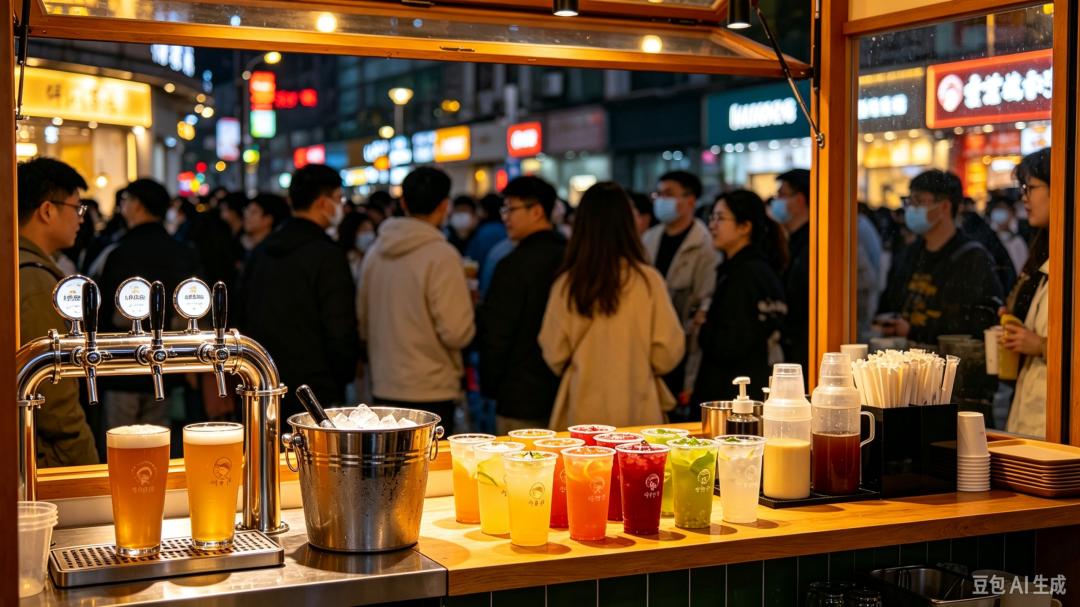
Cha Yan Yue Se's "Day & Night Poetry, Wine & Tea Art Pub" was launched in 2024, focusing on the consumption experience that combines tea and alcohol, with stores mainly located in Changsha.
Different from adding several alcohol drinks to a milk tea store, this business adopts the form of independent stores. Consumers coming here can drink alcohol, drink tea, stay in the store, and experience a space and service different from that of ordinary tea drink stores.
In September 2026, Cha Yan Yue Se announced the closure of all stores under this brand, planning to complete the store closure successively before October 31.
The company stated in the relevant notice that after several years of exploration, the business model of the project has not yet been verified. There is a mismatch in consumer demand: consumers who want to drink alcohol feel that the place is not like a bar enough, while consumers who do not drink alcohol have to face a considerable proportion of alcohol menus. After attempts such as adjusting the menu and adding non-alcoholic drinks, the business still failed to generate sustained and healthy revenue.
This means that Cha Yan Yue Se will no longer continue to operate this independent pub business. Extending from tea drinks to pubs seems to only add alcohol categories, but in practice, it has to face a completely different set of operating conditions.
An independent pub requires separate space, staff and daily operation, and also needs consumers to form a relatively stable habit of visiting the store. The fact that consumers like Cha Yan Yue Se's milk tea does not mean that they will make a special trip to its pub just to drink alcohol.
This attempt by Cha Yan Yue Se involves not only whether the products can be sold, but also whether consumers are willing to enter this space, and whether this consumer demand can support the sustainable operation of the stores.
At present, Cha Yan Yue Se has not disclosed the complete revenue, profit and single-store operation data of this business. Therefore, the outside world cannot accurately judge how much influence various factors have exerted on the store closure decision.
What can be confirmed is that after several years of exploration, the company finally decided to cease this business.
Gu Ming Sells Freshly Tapped Beer At One of Its Stores In Hangzhou
During the period when Cha Yan Yue Se closed its pub stores, Gu Ming put two types of freshly tapped beer on the shelves at its store in Hangzhou Hubin Intime in77.
According to media reports in September 2026, the two products are classic draft beer and triple grapefruit lager, both served in 500ml cups. At that time, the promotional prices of the two products were 12 yuan and 15 yuan respectively.
This store is equipped with a beer machine, and displays product information and drinking reminders in its mini-program. According to reports at the time, this store was the single-store pilot for Gu Ming to carry out this attempt.
Instead of opening a separate store for these two beers, Gu Ming put them into its existing tea drink stores, which makes its attempt different from that of Cha Yan Yue Se.
Cha Yan Yue Se previously established an independent pub business, requiring consumers to enter a new space and experience a set of services different from those of tea drink stores. Gu Ming, on the other hand, added alcohol products to its existing stores to first observe whether consumers are willing to buy.
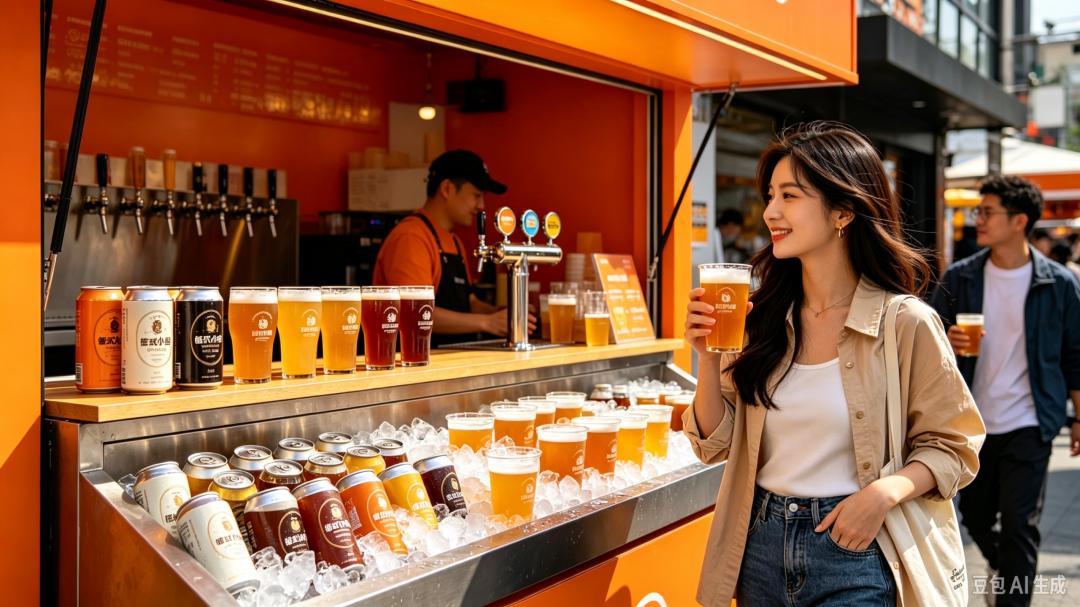
For Gu Ming, existing stores can provide venues, staff and ordering systems, as well as existing customer flow. These resources provide a ready-made sales environment for new products.
But this does not mean that beer will not add any operating costs. Equipment, alcohol supply, storage management and compliance with alcohol sales regulations are all issues that need to be considered.
More importantly, the pilot result of one store cannot directly represent the entire brand. At present, Gu Ming has not disclosed the specific sales volume, number of purchasers, repurchase rate and profit data of this pilot. It remains to be seen whether consumers will continue to buy, whether beer will bring new consumption, and whether this business is suitable for promotion to other stores.
Two Brands, Two Different Attempts
Looking at these two events together, we can see two different business exploration methods.
Cha Yan Yue Se chose to establish an independent pub brand, trying to provide a consumption experience that combines tea and alcohol. After several years of exploration, the company believed that the original business model had not been verified, and decided to close all stores.
Gu Ming added freshly tapped beer to its existing tea drink stores, and for now only carried out the pilot at one store.
The former involves the operation of an independent business format, while the latter is currently only a store product test. The two are at different stages and need to verify different issues, so we cannot judge which practice is better only based on the store closure and new product launch.
But they raise a specific operational question: when tea drink brands try new businesses, do they need to establish an independent operating system, or can they first use their original stores to test consumer demand?
This depends on the new business itself.
If what consumers need is an independent space, special services and a different consumption experience, then simply adding a few products may not be able to meet the demand.
If consumers' demand for new products can be met in existing stores, then conducting pilots in a small number of stores first will have the opportunity to reduce upfront investment and accumulate actual sales experience before scaling up.
However, this is only the difference between the two operation modes, and does not mean that one is necessarily more effective. In the end, it still depends on the actual sales and cost data.
Why Is Beer The Product Being Sold
Apart from the facts themselves, perhaps the New Consumption Think Tank is more worthy of asking: Why is it beer specifically? The first reason, which is also the most easily overlooked detail, is that the milk tea business is actually becoming more and more difficult.
In the first half of this year, the number of tea drink stores across the country decreased by 43,200 on a net basis in one year, with a store closure rate of 16.2%. Gu Ming is not having an easy time either: GMV is still rising, up 40% year-on-year in the first half of the year, but the store opening speed has slowed down significantly, with a net increase of 797 stores in half a year, compared with 1,265 stores in the same period last year.
What is more troublesome than store closure is another thing: new products are increasingly unable to drive revenue. In the past year, the entire industry has hardly launched any real hit products, and the effects of co-branding and new product launches are getting worse, bringing mostly one-time novelty-seeking consumption. If brands want to maintain revenue, they have to keep spending money to acquire new customers, and the cost of acquiring new customers is getting higher and higher.
At this time, looking at beer, it has two things that milk tea does not have. First, the peak hours of the two hardly overlap — the peak of milk tea is in the afternoon, while the peak of beer is at night. From 6 p.m. to closing time of a milk tea store, the staff are present, the rent is paid, and the lights are on, but basically no revenue is generated. If one more product can be sold at the counter to fill these hours, it is equivalent to generating an extra income without opening a new store. Second, repurchase rate. It's no big deal if you don't drink milk tea for a month, but for people who are used to having a drink at night, it's very uncomfortable not to drink for a week. Stickiness is exactly what milk tea lacks the most now.
Therefore, Cha Yan Yue Se and Gu Ming are actually making the same strategic choice, but their solutions are completely different. Cha Yan Yue Se's approach is to directly buy a ticket for a new scenario and open an independent pub; Gu Ming's approach is to first put a new product in the existing counter. The goals are the same: to make extra sales in the time period where the rent is already a fixed cost.
Then there is the second reason, which is also the more critical one — this path has actually been half verified, but the verifier is neither Cha Yan Yue Se nor Gu Ming.
In October 2025, Mixue Bingcheng spent 297 million yuan to acquire 53% equity of fresh draft beer brand Fulujia. At that time, Fulujia had about 1,200 stores. By the end of May this year, this number had risen to more than 3,000, covering more than 300 cities, and just one German wheat beer sold 100 million jin a year. In other words, seven months after Mixue's shareholding, this brand opened 1,800 new stores. This can no longer be described as a "pilot", it is a verified expansion model.
What Fulujia has verified is not just that "fresh draft beer can be sold", but a set of gameplay. Its core is to make beer completely look like milk tea: the main products are tea beer and fruit beer with alcohol content of only 2.3% to 6%, accounting for more than 60%, which tastes more like "fruit tea with alcohol flavor";
The price is 6 to 10 yuan, which is exactly within Mixue's price range; the store starts from 15 square meters, with almost no dine-in service, focusing on takeaway, and the operation process is simplified to "whoever can turn on the tap can pour beer". Everything is prepared for large-scale standardized replication.
Therefore, the answer to Cha Yan Yue Se's failure is actually very clear. Consumers are not unwilling to buy alcohol in the tea drink system, but they are unwilling to pay bar prices for the word "pub". If alcohol is restored to an ordinary, low-alcohol drink, the business can be realized.
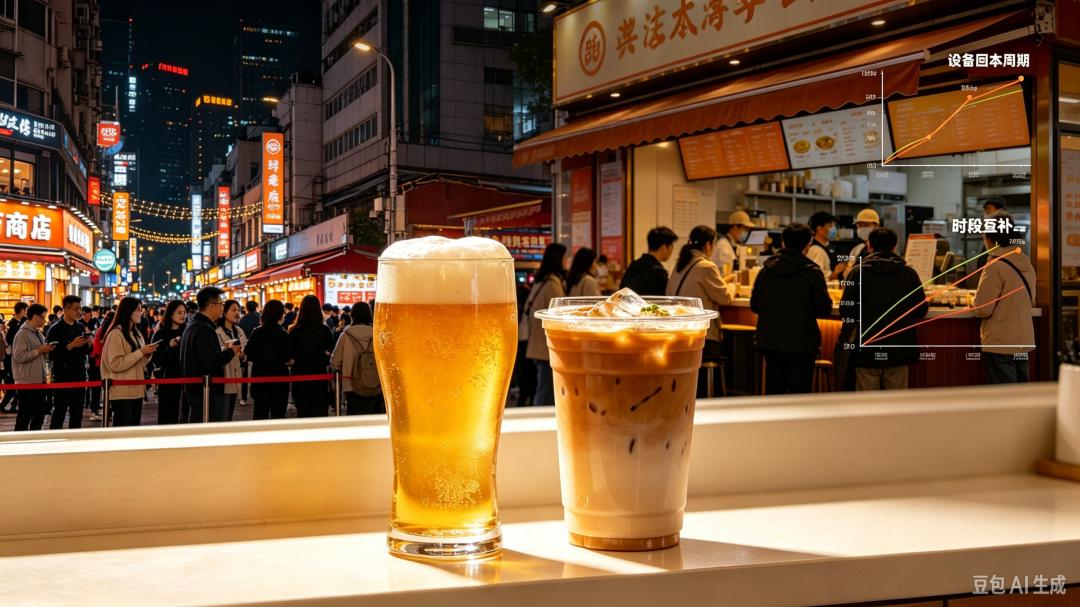
The data of Day & Night Poetry, Wine & Tea in the later period also confirmed this point: non-alcoholic drinks sold better than alcohol after being launched, indicating that when people came to this store, what they wanted was originally a good-tasting drink, not a slightly drunk space.
Fulujia also provides a ready-made expansion script. The first step is to test in existing stores to see if beer can reuse the existing customer group, equipment and staff. The second step, if the single-store model works, instead of spreading beer to all milk tea stores, spin off an independent brand to connect the supply chain and franchise system — milk tea stores are responsible for verifying demand, and the independent brand is responsible for expansion. When Mixue incubated Lucky Coffee and acquired Fulujia, it followed this path.
Gu Ming's store in Hangzhou is currently taking the first step. The cost is relatively low: one beer machine, two pilot stores. If it works, it will follow Fulujia's script; if it doesn't work, the loss will only be limited to this beer machine. This is much cheaper than Cha Yan Yue Se spending two and a half years and more than a dozen stores to get an answer.
However, apart from these two reasons, there is still a question that no one can answer. Milk tea plus coffee, milk tea plus alcohol, the menu is getting longer and longer. But the mental capacity of a store is limited, and equipment, raw materials, licenses, business hours, every additional category adds an extra burden. When "tea, coffee and alcohol" are all added, what is the next category that can make use of off-peak hours? Breakfast? Light food? The increment brought by each new category is getting smaller, while the complexity of the store keeps increasing linearly.
Season is the second inherent flaw. The peak seasons of tea drinks and freshly tapped fresh draft beer almost completely overlap, both from March to October, and they both enter the off-season in winter. Fulujia's operating data clearly states that winter is the traditional off-season, and it can only be eased by seasonal limited products such as winter-brewed beer. That is to say, beer can fill the gap of milk tea within a day, but cannot fill the gap of milk tea within a year. What can really survive the off-season are hot drinks and coffee.
Therefore, a more calm statement about this story may be: the significance of beer to milk tea brands is not the second growth curve, but to realize the value of existing assets one more time. It can improve the single-store model, but cannot change the general trend of net reduction of stores in the tea drink industry. Cha Yan Yue Se's mistake was to treat this one-time realization as a new growth curve and bet heavily on it; what Gu Ming did right was to use the lightest way to measure how much this realization is worth.
In the end, the value still depends on three core elements: among the people who buy beer, how many are the ones who would have come to buy milk tea originally; after the novelty-seeking craze passes, how many people come back within a week; how long it takes for a beer machine to pay for itself. Before these three figures are fully verified, all judgments are still too early.
This article is from the WeChat Official Account "New Consumption Internal Reference" (ID: cychuangye), written by Long Zhimao, and published with authorization from 36Kr.